The Dash for Trash
We’ve seen a number of claims recently that the huge surge in the share prices of formerly “trash” companies is a sign that markets are getting carried away. In reality, this is very normal behavior coming out of an extreme market movement like the February-March selloff. Across the 26 Russell 3,000 companies that had CDS spreads greater than 1000 bps (the traditional indication of “distressed” credit territory) at the equity market lows on March 23rd, the average spread was over 57%. As shown below, in 2009, there were three times as many distressed companies, but they traded at a lower average spread (26%).


Average performance afterwards, though, looks almost identical in the two cases. As shown below, in the 60 trading days that started the last bull market in 2009, these distressed companies rallied 209.8% on average. In the current situation, the average gains have been 208.2%.
Given the fact that equity is a call on the value of assets (retaining whatever is left after liabilities), large shifts like major bear market lows by definition should lead to huge gains for the most distressed companies. In other words, the theory (first put forward by Robert C. Merton in 1974, link) is perfectly consistent with what we see in practice both now and historically. The most stressed companies by definition should rally the most, by virtue of their distress in the first place; this “dash for trash” phenomenon is a function of the capital structure of distressed firms, not any sort of sentimental excess in the behavior of investors. This analysis was included in last night’s Closer report — Bespoke’s post-market macro note that goes out to clients at 6 PM ET each weekday. If you’d like to receive Bespoke’s Closer free for the next two weeks, sign up for a 14-day trial to Bespoke Institutional by clicking here.

Diminishing Improvements For Claims
Last week, initial jobless claims beat estimates for the first time in six weeks. That better than expected trend didn’t continue this week, though, as seasonally adjusted claims came in at 1.508 compared to forecasts of 1.290. With claims 218K above expectations, that was the largest miss relative to forecasts since the week ending May 8th (481K above estimates). Even though claims were higher than expected this week, they still declined…again. Claims were lower week over week for an eleventh consecutive week; the longest such streak on record. Granted, this week’s decline was the smallest of the eleven weeks at just 58K. On an absolute basis, that was actually the smallest change (either positive or negative) since the first week of March (6K decline) when claims were printing in the sub-millions. Overall, a massive number of Americans continue to apply for unemployment insurance, and while there have been fewer doing so, the rate of those improvements has also slowed
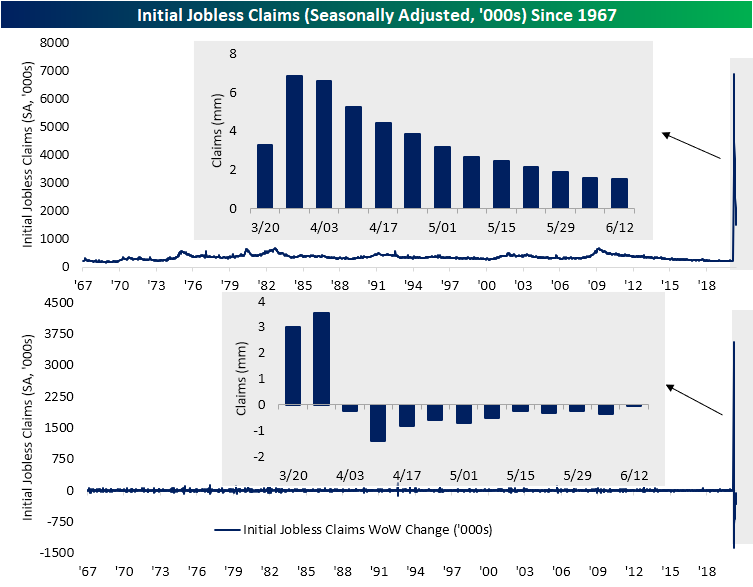
On a non-seasonally adjusted basis, claims also fell and by a larger degree than the seasonally adjusted number. Non-seasonally adjusted claims totaled 1.433 million this week; down 128K from last week. Unlike the seasonally adjusted data, that was not the smallest change of the past several weeks, but this reading has also generally seen lesser improvements recently.

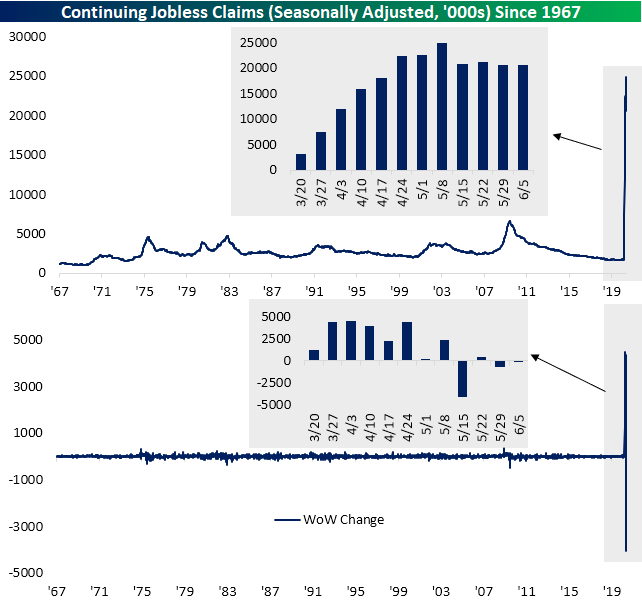
It is a similar story for continuing jobless claims which fell by just 62K to 20.544 million this week; the smallest absolute WoW change since March 6th. With people returning to work as the economy slowly reopens and additional initial claims still in the millions, the in and out-flows have seemed to more or less balance out as continuing claims have been fairly flat over the past month, especially relative to much larger moves in March, April, and the first half of May. Since May 17th, continuing claims have hovered between roughly 20.5 million and 21.25 million with this week’s reading at the lower end of that small range. Click here to view Bespoke’s premium membership options for our best research available.
Bespoke’s Morning Lineup – 6/18/20 – “These Go to Eleven”
See what’s driving market performance around the world in today’s Morning Lineup. Bespoke’s Morning Lineup is the best way to start your trading day. Read it now by starting a two-week free trial to Bespoke Premium. CLICK HERE to learn more and start your free trial.
It’s been a rather volatile overnight session in equity futures. Late last night, futures bottomed out with a decline of well over 1% but then recovered steadily in the early morning hours right up until 5 AM eastern time. Since then, much of the gains have been reversed, and the S&P 500 is poised to open firmly in negative territory.
The overnight volatility we have seen comes as rising COVID case counts around the world and around the country start to weigh on investor sentiment. After the sharp rally, investors are looking to reassess where things stand in terms of government stimulus, economic growth, earnings, and global health trends. Not an easy job by any means!
Be sure to check out today’s Morning Lineup for a rundown of the latest stock-specific news of note, a look at infrastructure stocks, global and national trends related to the COVID-19 outbreak, and much more.

Anytime a streak reaches eleven, we always feel compelled to invoke the famous quote from the movie Spinal Tap. With this week’s drop, initial jobless claims have now dropped for a record 11 straight weeks. While the decline versus last week is encouraging, we also have to note that this week’s drop in claims was the smallest weekly decline in claims of the entire streak. Hopefully, this isn’t a sign of waning momentum in the job market.

The Very Slow Recovery In Economic Activity Is Continuing
As economies around the country slowly recover from COVID-19 and reopenings proceed, economic activity is slowly recovering. For the hardest-hit sectors, though, the recovery is only inching forward. Security checkpoint volumes at US airports are still down 80% YoY, and the trend of improvement is only set to return travel activity to 50% of 2019 levels in September.
For restaurants, OpenTable data shows covers down by two-thirds from last year, though some of that is because many restaurants remain closed. Among reopened establishments, the number of seated customers are still down almost 40% YoY. About half of restaurants remain closed per the OpenTable data. We discussed this chart and other retail enthusiasm indicators in last night’s Closer report, which is available to Bespoke Institutional members. Click here to start a two-week free trial.

Daily Sector Snapshot — 6/17/20
Chart of the Day: Smart Money Indicator
Global Valuations Stretching
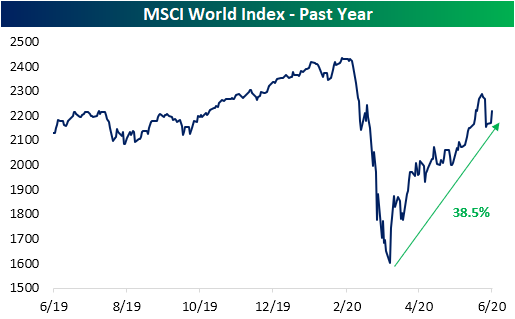
Generally speaking, stock markets around the globe have recovered a solid portion of their losses from earlier in the year. The MSCI World index is now just 8.86% below its February 12th all-time closing high after rallying 38.5% off of its March 23rd low.
With equities running higher around the globe, valuations have risen as well. The median price to earnings ratio of the 23 countries in our Global Macro Dashboard is now 19.89. That is actually down from some of the higher readings of the past couple of weeks when the P/E ratio was north of 20. As shown in the chart below, only about 10% of days over the past decade have seen the median P/E ratio at 20 or more. Most of those days came in January and February of this year and in parts of 2015 and 2016.

As shown in the table below, the median stock market’s P/E ratio is now in the 88th percentile of the past decade’s range. As for the 23 Global Macro Dashboard countries comprising that median reading, several including the US, Germany, Japan, and Norway are in the 90th percentile or better of the past decade’s range. Of all 23 countries, Norway has the highest overall P/E ratio of 41.22. Many of the other countries with the highest valuations like Brazil, Spain, and Japan all are also in the upper end of the past few years’ range. Meanwhile, China actually has one of the lowest valuations when compared to other countries, albeit that is at the highest level of the past couple of years. Other countries like South Africa, Mexico, and Canada are similarly at the lower end of the range of current country P/E ratios while also being at the upper end of their own range of the past few years. Click here to view Bespoke’s premium membership options for our best research available.

Job Losses Around the Globe
Every Wednesday we release our Global Macro Dashboard which covers major macroeconomic and stock market indicators across 23 of the world’s largest economies. One of the stats tracked is each country’s unemployment rate. Labor market data has been a major focus in the US as jobless claims have printed in the millions for multiple months now and the U-3 unemployment rate sits at 13.3%, off its April high of 14.7% but still at some of the highest levels since the Great Depression. High unemployment is not just a US phenomenon though. While it isn’t as extreme as the US, the world average across the 23 countries in our Global Macro Dashboard has soared and currently sits at 7.6%; the highest level in a decade.
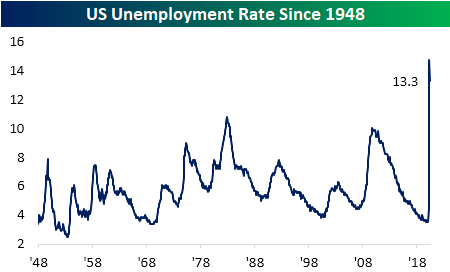

In the charts below, we show eight countries that are experiencing some of the most dramatic upswings in unemployment. Our neighbor to the North, Canada, has a similar unemployment rate to the US both in terms of the rate itself and the sharp upswing over the past few months. Of the other countries in our Global Macro Dashboard, Brazil, South Africa, and Spain are the only other countries with double-digit unemployment rates at the moment. Like Canada and the US, the unemployment rates of Hong Kong, Malaysia, and South Korea have also all spiked to the highest levels of the past decade. Sweden, Australia, Germany, and Switzerland also all have seen large moves higher. Of these, only Germany has seen any respite as the US has in the most recent readings. Click here to view Bespoke’s premium membership options for our best research available.

Bespoke’s S&P 500 Sector Weightings Report
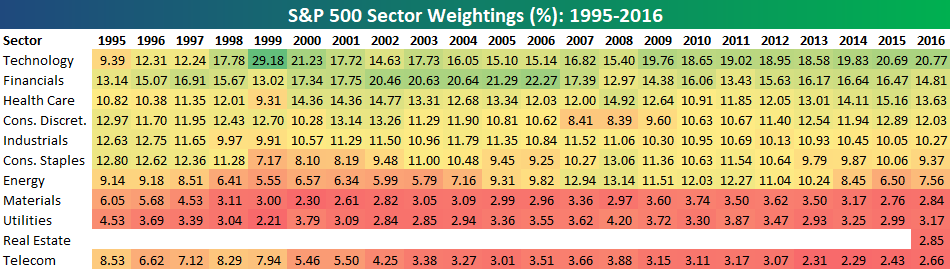
S&P 500 sector weightings are important to monitor. Over the years when weightings have gotten extremely lopsided for one or two sectors, it hasn’t ended well. Below is a table showing S&P 500 sector weightings from the mid-1990s through 2016. In the early 1990s before the Dot Com bubble, the US economy was much more evenly weighted between manufacturing sectors and service sectors. Sector weightings were bunched together between 6% and 14% across the board. In 1990, Tech was tied for the smallest sector of the market at 6.3%, while Industrials was the largest at 14.7%. The spread between the largest and smallest sectors back then was just over 8 percentage points.
The Dot Com bubble completely blew up the balanced economy, and looking back you can clearly see how lopsided things had become. Once the Tech bubble burst, it was the Financial sector that began its charge towards dominance. The Financial sector’s sole purpose is to service the economy, so in our view you never want to see the Financial sector make up the largest portion of the economy. That was the case from 2002 to 2007, though, and we all know how that ended.
Unfortunately we’ve begun to see sector weightings get extremely out of whack once again.
If you would like to see the most up-to-date numbers for S&P 500 sector weightings, simply start a two-week free trial to our Bespoke Premium or Bespoke Institutional services. Click back to this post to see the numbers once you’re signed up!
Battle of the Social Media Misfits
While both companies were touted by some as the next Facebook (FB) at the time of their IPOs, Twitter (TWTR) and Snap (SNAP) have clearly not lived up to their hype. Years after their respective IPOs, both companies trade well below levels they traded at immediately after they started trading. While neither company has been able to hold a candle to FB, for the last several years TWTR has mostly been considered the least bad of the two companies given its utility for a source of breaking news.
So far in 2020, both stocks have held up relatively well, but the tide has turned in SNAP’s favor. Looking at TWTR first, after a sharp drop during the COVID Crash, the stock has regained the bulk of its losses trading in a steady uptrend channel off the lows. While the stock has been unable to retake its February highs, it is up in the high single-digit percentage range on a YTD basis.

Turning to SNAP, if you look quickly, the chart looks very similar to TWTR. Looking a little closer, though, the stock has seen a steeper ascent off the March lows, and as a result, it has also managed to make new YTD highs in the last couple of weeks. SNAP first overtook its high from January on June 2nd, and while it pulled back with the overall market last week, it has rebounded to new highs in the last two days. Following this move, SNAP is 9% above its January high and up more than 32% YTD.

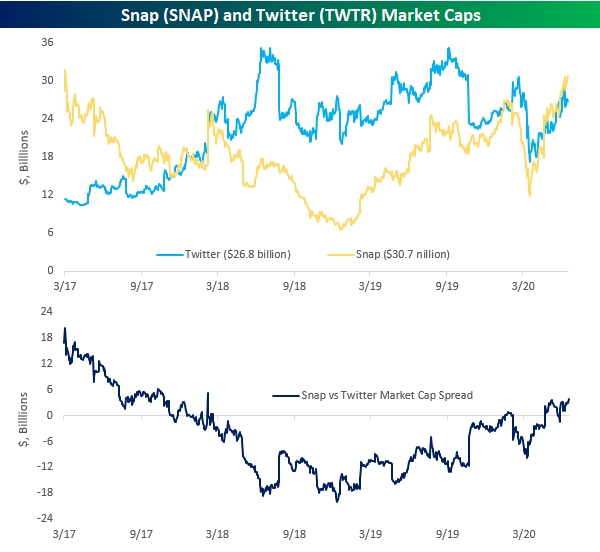
With SNAP’s recent outperformance, it also recently overtook TWTR in terms of market cap, and the gap has been widening ever since. In fact, with a current spread of $3.8 billion between the two stocks, the gap hasn’t been wider (in SNAP’s favor) since February 2018. Only time will tell whether or not this trend will continue, but analysts are currently expecting a lot stronger growth from SNAP than they are for TWTR. For this year and the next two, SNAP’s revenues are expected to rise by 23%, 38%, and 30%, respectively. Conversely, expected sales growth for TWTR in the same three years is expected to be much weaker at -5%, +22%, and +14%, respectively. For anyone with kids or teenagers, that kind of forecast makes sense as the first app they want when they get a phone is Snap, while the phrase, “Can I get a Twitter account?” is about as common as “Can I go to bed early tonight?” Click here to view Bespoke’s premium membership options for our best research available.