Salesforce Big Buys
The past couple of weeks had seen some rumblings that one of the newest additions to the Dow, Salesforce.com (CRM), was in talks to buy Slack (WORK). On Tuesday, the deal was officially announced to the public with the transaction valued at approximately just over $25 billion. The deal is set to be CRM’s largest acquisition to date, surpassing last year’s $14 billion acquisition of Tableau Software. While that would nearly double the previous record-sized acquisition for the company, there have been several other acquisitions valued at more than $1 billion at the time of the announcement.

The announcement concerning Slack is CRM’s seventh acquisition with a value of at least $1 billion, and it is the second such deal of 2020 after software company Vlocity was taken on back in February. Additionally, while the announced deal with Slack is the largest in terms of dollars, as a percentage of CRM’s market cap it is actually roughly in line with the Tableau acquisition and will be slightly larger than the deal with Exact Target in 2013.
As for these past deals, a negative reaction in the stock price of CRM has very much been the norm one week after the deal was announced. As CRM has fallen over 9% in today’s session, it is already on pace to see the worst stock price reaction since the announcement of a deal with MuleSoft in 2018. While positive returns have come down to a coinflip one to three months later, in the times the stock has rallied, the gains have been double digits. Additionally, six months out has consistently seen Salesforce higher with an average gain of over 20%. Click here to view Bespoke’s premium membership options for our best research available.

Market Caps and YTD Performance Drivers in November
In yesterday’s B.I.G. Tip report, we showed a decile analysis of performance in the month of November based upon a range of metrics. One of the most notable themes was performance based on market cap. Whereas for most of this year the stocks with the largest market caps have outperformed, the opposite was true in November. If the small-cap Russell 2000’s return to new all-time highs wasn’t indication enough, the decile of Russell 1000 stocks with the smallest market caps rose an average of 28.5% in November. That is head and shoulders better than the next decile (the 9th) in which the average stock rose 17.09%. As you move up the ladder in terms of market cap, performance worsened with the largest stocks seeing some of the worst performance on the month. The first decile saw an average gain of 12.39%. That group includes stocks with market caps above $100 billion including the trillion-dollar club: Apple (AAPL), Microsoft (MSFT), Amazon (AMZN), and Google (GOOG).

Again, some of the stocks with the largest market caps have also been the ones that have risen the most this year. Given this, the stocks that were up the most on a year-to-date basis through the end of October were also the ones that underperformed the most in November and vice versa. As shown below, the decile of stocks that have been the top performers from the start of the year through October averaged a gain of 12% in November. The second decile averaged an even smaller 9.35% rally. On the other end of the spectrum, November saw heavy rotation into the stocks that had been most beaten up this year. The decile of the worst performers averaged a substantial 38.08% rally in November. Deciles 8 and 9 similarly saw big rallies of 16.05% and 21.45%, respectively. These deciles included a lot of reopening stocks like airlines, energy, travel, regional banks, and brick and mortar heavy retail. Click here to view Bespoke’s premium membership options for our best research available.

Hard to Beat Steel
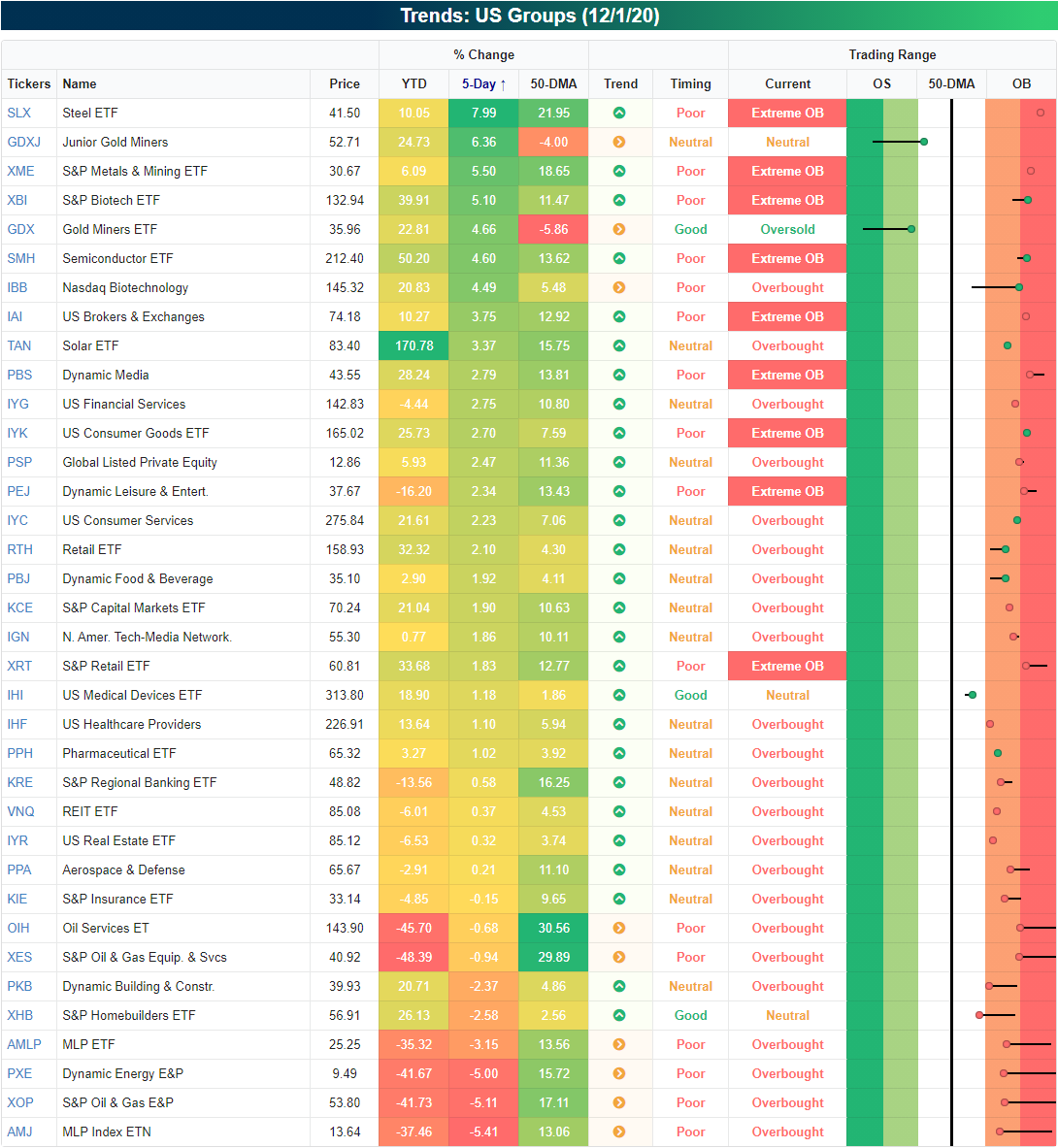
In Monday’s Chart of the Day and Closer, we noted the recent outperformance of industrial metals relative to other commodities, namely precious metals like gold. Given the strength of industrial metals, in the equities space, stocks related to the steel industry have been surging in recent days. Over the five days through yesterday’s close, the Steel ETF (SLX) which tracks these types of stocks has been the top-performing ETF of the US groups screen in our Trend Analyzer with a nearly 8% rally as shown below. That massive rally has left SLX as the most overbought ETF of this screen. Other metal related groups like the Junior Gold Miners (GDXJ) and S&P Metals and Mining ETF (XME) have also been top performers.
While there are plenty of reasons for steel’s rally including bets on a recovery in global growth, seasonality also appears to play a role. As shown in the snapshot of our Seasonality Tool below, for the current week of the year over the past 10 years, SLX has been the top-performing ETF with a median rally of 2.26%.

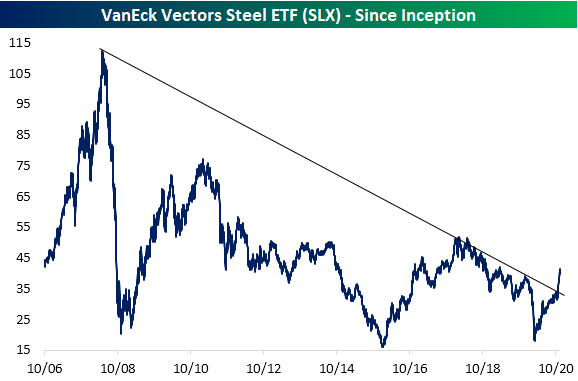
With SLX’s massive rally over the past several months which has accelerated in part thanks to seasonal tailwinds more recently, the ETF’s long-term downtrend that has been in place since not long after its inception has now been broken. As shown below, SLX is now around its highest levels since April of last year. While that is a positive from a long-term perspective, on a shorter-term basis SLX is running very hot. As shown in the second chart below, the ETF currently trades over 2.5 standard deviations above its 50-DMA. That is a historically elevated overbought reading as it is in the 98th percentile of the historical range. Click here to view Bespoke’s premium membership options for our best research available.

Bespoke’s Morning Lineup – 12/2/20 – Wednesday Hangover
See what’s driving market performance around the world in today’s Morning Lineup. Bespoke’s Morning Lineup is the best way to start your trading day. Read it now by starting a two-week free trial to Bespoke Premium. CLICK HERE to learn more and start your free trial.
“Well, I don’t have any greater insight than anybody else.” – Jensen Huang
Hangover on a Wednesday? Well, there is football today, so anything is possible! After a great start to the month yesterday, futures are indicated lower this morning as concerns over a stalemate on any agreement related to a stimulus/spending bill weigh on sentiment. ADP Private Payrolls for November was just released and came in weaker than expected. While economists were forecasting an increase of 440K jobs, the actual reading came in more than 100K weaker at 307K. That’s a pretty big miss, but there has been little reaction in the futures market on the premise that ADP has been consistently weaker than expected over the last few months.
Be sure to check out today’s Morning Lineup for updates on the latest market news and events, Eurozone auto sales, an update on the latest national and international COVID trends, and much more.

Equities have continued to do well lately, but semis have been an area of notable strength. While the S&P 500 has rallied nearly 1% in the last three trading days, the Philadelphia Semiconductor Index (SOX) has rallied over 1% on each of the last three trading days for a total gain of over 4%. Semis are considered one of the more cyclical sectors of the market, so their recent strength is a good sign.

Chart of the Day – December: The Worst of Times for Retailers
Daily Sector Snapshot — 12/1/20
B.I.G. Tips – November 2020 Decile Analysis
November 2020 Asset Class Performance
The S&P 500 had its best November since 1928 with a gain of 10.75%. Below is a snapshot of our asset class performance matrix showing total returns across US-listed ETFs. Of the major US index ETFs, SPY was actually up the least in November with a gain of 10.88%. The S&P Smallcap 600 (IJR) and the Russell 2,000 (IWM) were up nearly twice that with gains of more than 18%.
Of the major sectors, Energy (XLE) was up by far the most in November but you’ll notice that it’s still down 35% year-to-date. The Financial sector (XLF) was up the second most in November with a gain of 16.85%, but like Energy, it too is still in the red on the year. Utilities (XLU) had the worst month with a gain of just 0.74%.
Outside of the US, four countries gained more than 20% — Brazil (EWZ), France (EWQ), Italy (EWI), and Spain (EWP). All four of these countries still finished November in the red for the year. India (PIN) and China (ASHR) were up the least of the countries listed with gains of 8% and 6.95%, respectively.
Looking at commodity ETFs, oil (USO) had a banner month with a gain of 22.65% while natural gas (UNG), gold (GLD), and silver (SLV) were all solidly in the red. For the year, though, USO remains down 69.8%. Finally, the various fixed income ETFs in our matrix were all up slightly on the month. The long-term Treasury ETF — TLT — remains up nearly 20% on the year, which easily beats the S&P 500 by more than five percentage points. Click here to see Bespoke’s premium membership options and start a free trial for instant access to our research and interactive tools.

Headcounts Hurting
Today’s ISM report pointed to broad improvements in the manufacturing sector in November, albeit there were some slowdowns in areas like New Orders, Production, and worst of all Employment. The index for Employment saw the sharpest decline falling 4.8 points from an expansionary reading of 53.2 in October to a contractionary 48.4 in November. That decline was in the bottom 5% of all month over month changes. Taking a more granular look, 18.9% of companies reported a lower number of workers (compared to 17.7% last month) whereas 14.8% reported a higher number (23.1% in October). 66.4% reported no change in the number of employees, up from 59.3% last month.
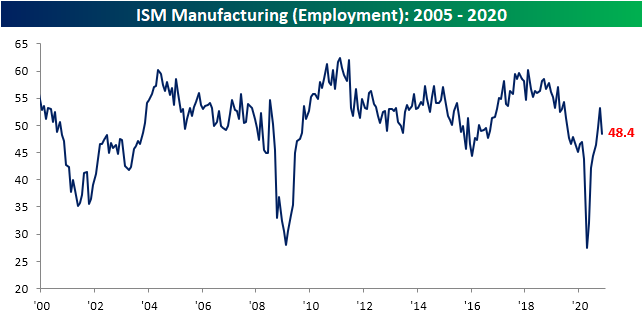
That reading at face value may be a bit of a worrying sign as it points to more companies reporting lower rather than higher headcounts. That also goes counter to other parts of the ISM report which pointed to further growth in demand and production. Some explanation can be found at least anecdotally through the comments section though. As shown below, rather than firms mentioning that they are laying off workers, the verbiage more often points to troubles in hiring. For example, there are mentions of “labor shortages” as “finding new people is an issue”. Put differently, there is anecdotal evidence that the manufacturing labor market is facing a supply instead of a demand issue. As a result of these shortages, firms report that there have been production constraints while demand has been strong. Click here to view Bespoke’s premium membership options for our best research available.

Manufacturer Recovery Continues
This morning, the Institute for Supply Management (ISM) released a less positive outlook for the US manufacturing sector. The headline number for ISM’s Manufacturing index fell from 59.3 last month down to 57.5. A drop was expected, but the actual results were worse than the drop to 58.0 that had been forecasted. That reading indicates that the manufacturing sector continued to grow in November but at a slower rate than October.

Similar to the various Federal Reserve bank surveys from around the country, breadth in the November report was more negative than in recent months. Of the ten indices excluding the headline number, only three were higher in November: Backlog Orders, Supplier Deliveries, and Export Orders. Additionally, two indices—Customer Inventories and Employment—showed contractionary readings.

One theme of the report was that orders remain very healthy. New Orders fell from 67.9 to 65.1, but that is a sixth consecutive month of expansionary readings. Although the index was lower this month, meaning new order growth decelerated, it remains in the top decile of historical readings. As new orders have continued to grow, so too have backlogs. The index for Backlog Orders has continued to press higher, rising to 56.9 from 55.7. That is in the 88th percentile of all months and is now at the highest level since August of 2018. Demand continues to improve with new orders coming in at a historically strong pace, even though it is slower than last month, and order backlogs have once again risen as a result.

As new order growth decelerated, so too did production. The index fell from 63.0 in October to 60.8 last month. That is still consistent with growth (readings above 50) in production but at the slowest rate since June. One factor that potentially had an impact on the slowdown in production is issues with suppliers. The index for Supplier Deliveries rose for the fourth month in a row in November and reached the highest level since May. Higher readings in the Supplier Deliveries index indicates longer lead times and vice versa. In other words, products from suppliers have been taking longer to reach manufacturers, in turn, impacting productivity.

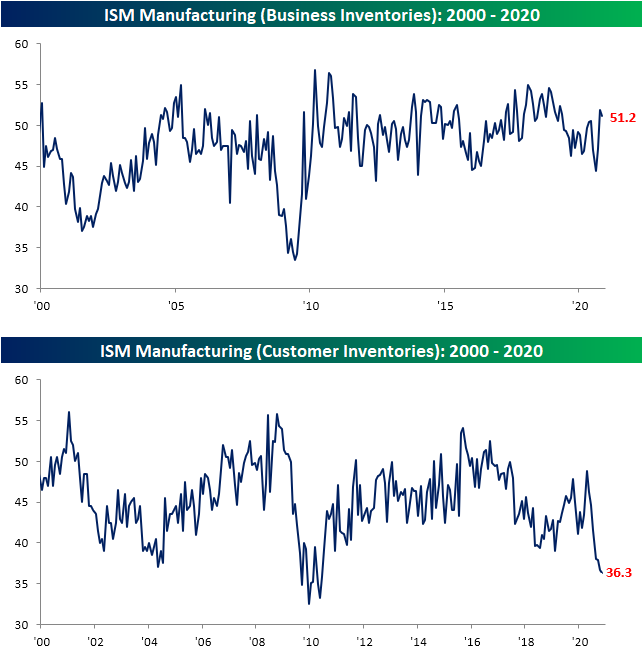
Although suppliers appear to have some constraints and production has slowed slightly, business inventories rose for the second month in a row even as more and more firms report that customer inventories are too low. The index for Customer Inventories now sits in the bottom 2% of historical readings after dropping another 0.4 points in November. At 36.3, the index is at the lowest level since June of 2010. That low reading can be considered positive for future production. Click here to view Bespoke’s premium membership options for our best research available.