Bespoke Market Calendar — January 2021
Please click the image below to view our January 2021 market calendar. This calendar includes the S&P 500’s average percentage change and average intraday chart pattern for each trading day during the upcoming month. It also includes market holidays and options expiration dates plus the dates of key economic indicator releases. Start a two-week free trial to one of Bespoke’s three research levels.

They’re Selling Winners Early In 2020
So far price action today is showing a pretty heavy New Years hangover for investors with markets dropping steadily across the first half of the first trading day of 2021. What’s interesting is how much this looks like profit-taking in the wake of a spectacular second half last year. Obviously, there was a big bounce off the lows back in March, but even stripping out that initial bounce by looking just at the second half of the year, there’s a clear pattern in today’s trading for big winners leading the way lower. In the chart below, we show the average intraday performance of stocks in the Russell 3000, grouped by their performance last year. This broad index includes both large and small-cap stocks. As shown, by far the biggest losers today are the stocks that were the biggest gainers in the second half of last year. Conversely, stocks that were at the bottom in terms of performance in the second half of last year are nearly unchanged so far today. Investors accumulated a lot of gains in the second half of 2020, and based on today’s performance, it appears as though they were waiting for the calendar to turn before locking in some of those gains. Like what you see? Click here for a free trial to any of Bespoke’s premium membership options, including our nightly Closer note that regularly features decile analysis of this kind.
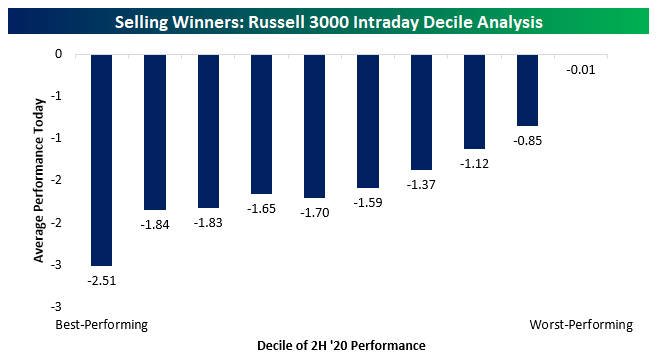
Chart of the Day: January Intra-Month Returns
Bespoke’s Morning Lineup – 1/4/21 – Picking Up Right Where 2020 Left Off
See what’s driving market performance around the world in today’s Morning Lineup. Bespoke’s Morning Lineup is the best way to start your trading day. Read it now by starting a two-week free trial to Bespoke Premium. CLICK HERE to learn more and start your free trial.
“An end is only a beginning in disguise.” – Craig D. Lounsbrough
It’s still early, but based on early indications in the market, 2021 is picking up right where 2020 left off. Futures are indicated higher, COVID numbers remain right at or near their highest levels of the pandemic, and President Trump is still dominating the headlines. Besides the year on the calendar, one of the few differences between now and 2020 is that bitcoin is trading down sharply from its highs over the weekend. Despite the 8% decline, though, it is still trading higher than where it closed out 2020.
Be sure to check out today’s Morning Lineup for updates on the latest market news and events, a recap of the latest PMI Manufacturing reports for the month of December, an update on the latest national and international COVID trends, and much more.
Heading into the first trading day of the year, the majority of sectors remain at overbought levels with just four that aren’t overbought (Utilities, Real Estate, Industrials, and Energy). Of those four sectors, two (Utilities and Industrials) now actually have “Good’ timing scores while every other sector enters 2021 at neutral levels.

Bespoke Brunch Reads: 1/3/21
Welcome to Bespoke Brunch Reads — a linkfest of the favorite things we read over the past week. The links are mostly market related, but there are some other interesting subjects covered as well. We hope you enjoy the food for thought as a supplement to the research we provide you during the week.
While you’re here, join Bespoke Premium with a 30-day free trial!
Security
GoDaddy Employees Were Told They Were Getting a Holiday Bonus. It Was Actually a Phishing Test. by Lorraine Longhi (The Copper Courier)
Lured with promises of a year-end bonus, employees of GoDaddy responded to an email from an internal domain only to find out they had failed a phishing test. [Link]
Insecure wheels: Police turn to car data to destroy suspects’ alibis by Olivia Solon (NBC)
With little precedent over privacy related to various data systems used in modern vehicles, privacy advocates and prosecutors are gearing up for a major conflict over whether the data cars carry can incriminate suspects. [Link]
Education
How Covid-19 Makes Teaching Reading Harder by Leslie Brody (WSJ)
Reading allowed is a challenge when teaching remotely, and that doesn’t include the challenges of faulty technology. Millions of children are at risk of falling far behind. [Link; paywall]
When the Great Equalizer Shuts Down: Schools, Peers, and Parents in Pandemic Times by Francesco Agostinelli, Matthias Doepke, Giuseppe Sorrenti & Fabrizio Zilibotti (NBER)
Educational inequality is already a huge challenge in the United States, and the pandemic is increasing the already wide gulf between students with resources and those without. [Link]
Hedge Funds
Human-Run Hedge Funds Trounce Quants in Covid Year by Hema Parmar, Katherine Burton, and Nishant Kumar (Bloomberg)
The dramatic volatility and rapid moves across the investment universe have made nimble human-driven funds better-performers than algorithmic traders in the hedge fund industry this year. [Link; soft paywall, auto-playing video]
Wrong-Way Bet on Covid Is Changing Oil-Trading Industry Forever by Alfred Cang (Bloomberg)
One of the biggest names in crude oil trading blew up in spectacular fashion, with billions in debt and nothing to show for it thanks to the collapse in demand for petroleum that led to a collapse in crude markets. [Link; soft paywall]
Books
Washington’s Secret to the Perfect Zoom Bookshelf? Buy It Wholesale. by Ashley Fetters (Politico)
The secret to a good Zoom bookshelf isn’t a wide library of books that you’ve read, but bulk orders intended only to meet the aesthetic needs of an office with a webcam. [Link]
Surprise Ending for Publishers: In 2020, Business Was Good by Elizabeth A. Harris (NYT)
Whether intrepid book buyers spent the pandemic reading or just telling themselves they were going to read, either way there has been an impressive wave of book buying this year. [Link; soft paywall]
Material Stories
How a ship-eating clam helped bring about the Industrial Revolution by David Fickling (Thread Reader)
An amazing rundown of how a desire to protect wood hulls lead to higher demand for copper, which led to more mines, and eventually led to the invention of the steam engine. [Link]
China’s Empire of Concrete by Mike Bird (WSJ)
Chinese municipalities long process of land privatization via sales of collectively owned property to the private sector have created a behemoth market that drives an impressive percentage of economic activity around the world. [Link; paywall]
Outflows
Cathie Wood’s Flagship Fund Posts Largest Outflow On Record by Claire Ballentine (Financial Advisor)
The most impressive asset-gathering story this year finished on a bit of a sour note, with tens of millions of assets flowing out of the ARK Innovation ETF (ARKK) at the end of the year. [Link]
Vaccination
Temperature Snag Delayed 144,000 Moderna Shots Bound for Texas by John Tozzi (Bloomberg)
Over 400 shipments of Moderna’s COVID vaccine sent to Texas had evidence that they had strayed above maximum storage temperature this week. [Link; soft paywall]
Social Media
The North Carolina Kid Who Cracked YouTube’s Secret Code by Lucas Shaw and Mark Bergen (Bloomberg)
A Greenville teenager dropped out of college to figure out exactly the best way to go viral. A bit over four years later, he is the king of YouTube. [Link; soft paywall]
Read Bespoke’s most actionable market research by joining Bespoke Premium today! Get started here.
Have a great weekend!
Bespoke Wealth Management
Bespoke Investment Group offers wealth management services for investors who are looking for a portfolio manager to handle either all or a portion of their assets. Bespoke offers management services for the following taxable and retirement account types:
- Individual
- Joint Tenants
- Trusts and Estates
- Traditional IRA
- Rollover IRA
- SEP IRA
- Simple IRA
- Individual Pension and 401k
Bespoke’s portfolio management team uses rigorous in-house research to construct portfolio strategies for investors based on their financial goals and needs. Bespoke offers multiple strategies, including aggressive growth, conservative growth, conservative income, and asset allocation models. We also run a “Triple Plays” strategy that holds names with strong earnings momentum.
Bespoke’s accounts are housed at Charles Schwab, which acts as custodian. Charles Schwab offers in-depth broker/dealer services with full transparency at all times. Bespoke has an account minimum of $200,000, and our management fee is 0.80% per year.
If you would like to learn more about Bespoke’s wealth management services and inquire about opening an account, please feel free to send us an email or give us a call at 914-315-1248.
You can access our most recent Form ADV Part 2 and Form CRS for additional information.
It’s Over
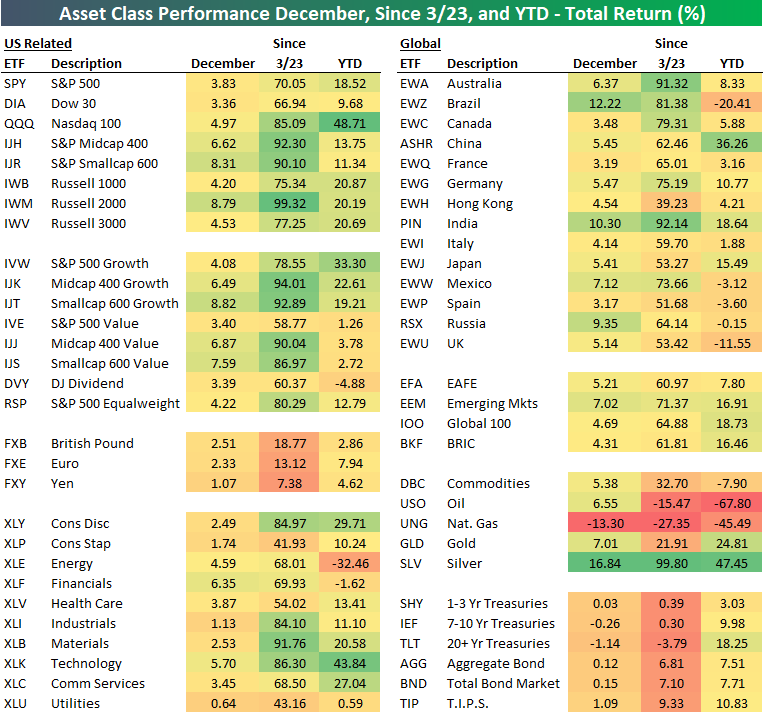
The 2020 market year is officially behind us, and for most of the ETFs in our Asset Class Performance Matrix is was a great year. The top-performing ETF in our matrix was the Nasdaq 100 (QQQ), which advanced 48.7% on a total return basis. Fittingly, in second place silver (SLV) posted a gain of 47.5%. Other big winners this year were large-cap growth (IVW), Consumer Discretionary, (XLY), Technology (XLK), Communication Services (XLC), and China (ASHR). All of these ETFs posted annual returns of more than 25%. On the downside, there were some big losers, though. Oil (USO) lost two-thirds of its value, while Natural Gas (UNG) dropped 45%. The only other ETFs that experienced declines of more than 20% were Brazil (EWZ) and Energy (XLE).
The middle column of our matrix shows each ETF’s total return since the 3/23 closing S&P 500 low. There were some truly mind-boggling returns as SLV, India (PIN), Australia (EWA), the Materials sector (XLB), Mid Cap Value (IJJ), Small Cap Growth (IJT), Mid Cap Growth (IJK), the Russell 2000 (IWM), the Small Cap S&P 600 (IJR), and the Mid Cap S&P 400 (IJH) all advanced 90% or more. Over that same span, the only ETFs that were down were long-term US Treasuries (TLT), UNG, and USO.
What was a very strong year for financial assets in 2020 was capped off with a strong December. In the US, every major index ETF was up at least 3%, every sector was positive, and every international ETF finished in the green. In fact, of the nearly 60 ETFs in the matrix, only three were down in December (IEF, TLT, and of course UNG).
Bespoke’s Weekly Sector Snapshot — 12/31/20
The Bespoke 50 Top Growth Stocks — 12/31/20
Every Thursday, Bespoke publishes its “Bespoke 50” list of top growth stocks in the Russell 3,000. Our “Bespoke 50” portfolio is made up of the 50 stocks that fit a proprietary growth screen that we created a number of years ago. Since inception in early 2012, the “Bespoke 50” is up 413.1% excluding dividends, commissions, or fees. Over the same period, the S&P 500 is up in price by 170.4%. Always remember, though, that past performance is no guarantee of future returns. To view our “Bespoke 50” list of top growth stocks, please start a two-week free trial to either Bespoke Premium or Bespoke Institutional.

Fifty to Zero in 283 Days
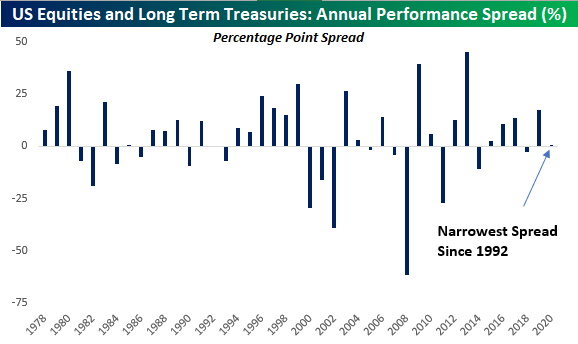
In a year with some pretty crazy charts, the one below is right up there with some of the best. After all the markets have been through this year, bot the S&P 500 and Long-Term Treasuries have seen nearly identical returns on a total return basis. That’s right, with just a few hours left in the trading year, the S&P 500’s total return in 2020 has been a gain of 17.6%, while Long Term US Treasuries, as measured by the B of A Merrill Lynch Long-Term Treasury Index has rallied 17.3%. What makes this nearly identical performance all the more incredible is that on March 23rd, the performance gap between the two was more than 50 percentage points.

The fact that stocks and bonds have essentially seen identical returns this year isn’t typical. The chart below shows the annual performance spread between the S&P 500 and long-term US Treasuries going back to 1978. During that time, the S&P 500 has historically outperformed long-term US Treasuries by an average of 3.9 percentage points per year, but the average gap in performance between the two has been over 15 percentage points. In the 43 years since 1978, there have only been seven other years where the performance spread between the two asset classes was less than five percentage points and just two years (1985 and 1992) where the performance spread was less than a percentage point.