
Wage Expectations Surge in Dallas
The receding of COVID case counts and higher oil prices had a beneficial impact on manufacturers in the eleventh district in February. The Dallas Fed’s Manufacturing Outlook Survey was forecast to see Business Activity rise only slightly from 2 in January to 2.8 after three straight months of declines. Instead, the index surged 12 points to 14 which is the biggest one-month gain since June 2020 and the highest reading since October.

As we have seen with other regional Fed manufacturing surveys this month, breadth across components has been somewhat mixed in spite of the move in the headline index. While there are a handful of categories in the upper end of their historical ranges, others like Company Outlook and Inventories have been more middling. Additionally, six categories decelerated month over month.

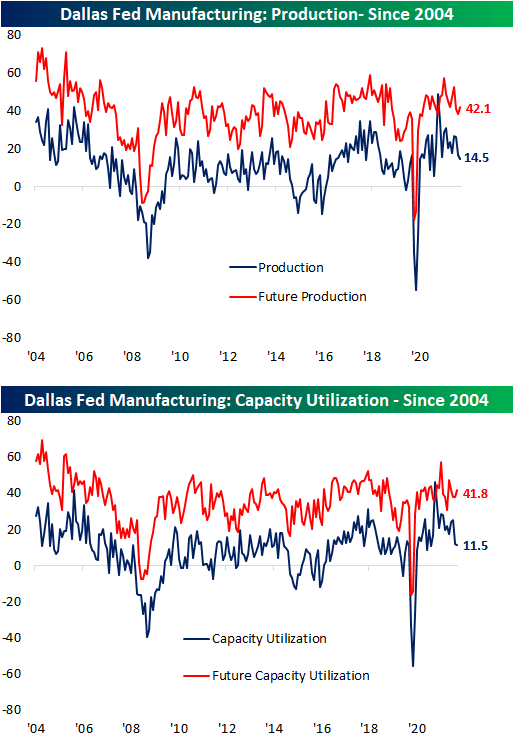
One area that experienced a decline was in regards to output. Production and Capacity Utilization both fell in February. For the former, that was the third decline in a row leaving it at the lowest level since January of last year. Capacity Utilization is also at the lowest level in a year and a month, but this month’s decline was far smaller than the prior month’s 9.4 point drop.
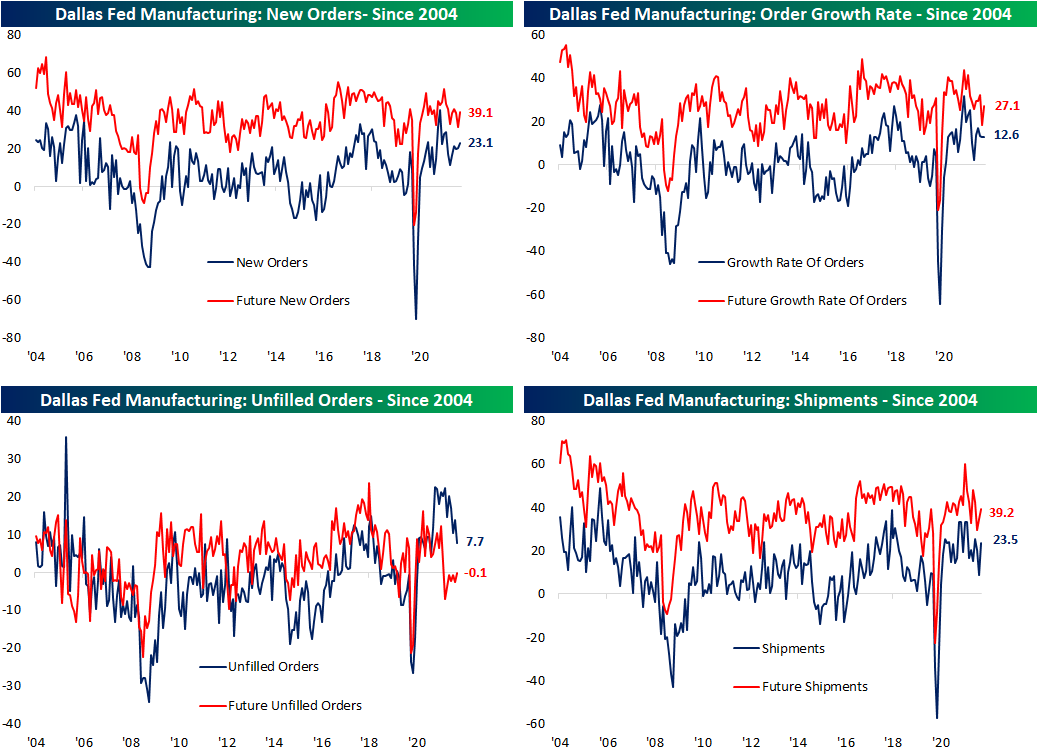
While production has pulled back, Order Growth Rate held firm as New Orders hit the highest level since July. Meanwhile, order backlogs continue to fall from historic levels with this month marking the lowest reading since last January as shipments recovered some of the declines from the past few months.
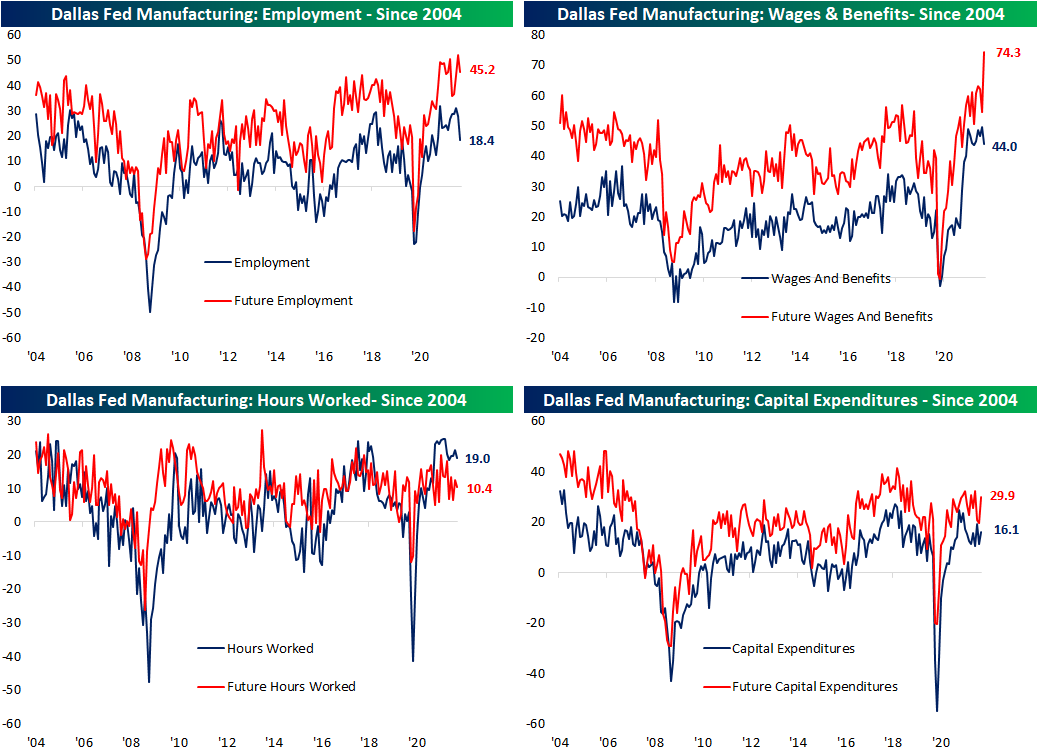
Employment was perhaps the most interesting area of the report. While the region’s firms continue to report net hiring, the Employment index plummeted 9.3 points for the largest single-month decline since March 2020. That deceleration in new employees happened alongside a deceleration in Hours Worked and Wages & Benefits as well. While current conditions for the Wages and Benefits index was lower, expectations have been blown out of the water. That index not only set a new record high, but it did so on the largest one-month gain to date. In other words, hiring slowed slightly in February, but there are widespread plans to increase wages in the future. While it is hard to pinpoint the exact reason for that increase, one potential explanation can be firms trying to raise wages to entice new workers. Click here to view Bespoke’s premium membership options.
Bespoke’s Morning Lineup – 2/28/22 – Down But Not Out
See what’s driving market performance around the world in today’s Morning Lineup. Bespoke’s Morning Lineup is the best way to start your trading day. Read it now by starting a two-week trial to Bespoke Premium. CLICK HERE to learn more and start your trial.
“The two most powerful warriors are patience and time.” – Leo Tolstoy
Some periods of time or more eventful than others, and this past weekend was one of the more news-jammed weekends we have seen in years as nearly the entire world has unified against Russia’s actions in Ukraine. Futures are lower this morning in reaction to the continued hostilities, but there are a ton of moving parts to contend with. Make sure to read this morning’s full recap of all the events in today’s Morning Lineup.
Read today’s Morning Lineup for a recap of all the major market news and events from around the world, including the latest US and international COVID trends.
Despite the weak picture in the futures market, equity prices still remain well above their lows from last week, and within the commodity space, we’ve seen a similar picture play out. For both gold and WTI crude oil, last night saw early moves higher at the open, but neither commodity was able to rally enough to take out the intraday highs from last week. Besides the fact that they weren’t able to take out those highs, both commodities have also given up much of their early gains. Gold is now 3.4% off last week’s high of 1,976.5 per ounce while WTI is down 4.72% from its high of 100.54 per barrel. Those highs from last week will be key levels to watch. Nobody knows how things are will play out from here, but last week’s highs in gold and crude oil are important milestones to watch. As long as they are able to remain in place, the better sign it is that the worse of this crisis could be behind us.


Start a two-week trial to Bespoke Premium to read today’s full Morning Lineup.
Bespoke Brunch Reads: 2/27/22
Welcome to Bespoke Brunch Reads — a linkfest of the favorite things we read over the past week. The links are mostly market related, but there are some other interesting subjects covered as well. We hope you enjoy the food for thought as a supplement to the research we provide you during the week.
While you’re here, join Bespoke Premium with a 30-day free trial!
Inflation
After Long Covid, U.S. Businesses Get Ready for Long Inflation by Shawn Donnan and Emma Kinery (Bloomberg)
Amidst extremely stressed supply chains, high commodity prices, and extremely tight labor markets, US businesses are getting more comfortable and used to the idea of raising prices to solve profitability challenges. [Link; soft paywall, auto-playing video]
Why This Economic Boom Can’t Lift America’s Spirits by Josh Mitchell (WSJ)
While the unemployment rate has plunged, consumer spending is booming, and wage gains are rapid, Americans are feeling much less optimistic about the economy compared to recent periods of weaker growth. [Link; soft paywall]
Crime
Miami Street Gangs See No Hope In Dope. They’ve Switched To Identity Fraud Fueled By Russian Hackers by Thomas Brewster (Forbes)
With stiff penalties and lots of competition (not to mention physical danger) in drugs, semi-organized criminals are turning to white collar crimes as lower hanging fruit. [Link; soft paywall]
Three men plead guilty to planning U.S. power grid attack, driven by white supremacy by Kanishka Singh and Sarah N. Lynch (Reuters)
A small terrorist conspiracy to violently attack the American power grid has led to guilty pleas from conspirators per plea agreements recorded this week. [Link; soft paywall]
China
Beijing Olympic Ratings Were the Worst of Any Winter Games by Tiffany Hsu (NYT)
It wasn’t just your imagination: this Olympics wasn’t good. China’s winter games drew only a little better than half of the viewership the prior games in Korea reported. [Link; soft paywall]
China Is About to Regulate AI—and the World Is Watching by Jennifer Conrad and Will Knight (Wired)
New rules introduced by Chinese regulators will change how algorithms that dictate pricing, determine search results, and power a galaxy of different consumer tech are managed, a first in the world. [Link; soft paywall]
Renewables
U.S. offshore wind auction bids top $1.5 billion, with more to come by Nichola Groom (Yahoo!/Reuters)
The largest-ever sale of offshore wind development rights in the US got major interest from 14 different companies despite efforts by homeowners to restrict development based on protection of views from summer homes. [Link]
Million-Dollar Home Listings Dry Up for Wealthy Suburban Buyers by Prashant Gopal (Bloomberg)
Large footprint suburban homes have evaporated off the market as dual-income Millennials seek breathing space with big budgets. The result is a massive price boom for the McMansion. [Link; soft paywall, auto-playing video]
Markets
Heavily Hedged Traders Have Been Awaiting a Stock-Market Storm by Vildana Hajric and Katie Greifeld (Yahoo!/Bloomberg)
Short interest has risen and put options have flown into the hands of speculators nervous about a market decline, making the drop in equities this week less painful than it might otherwise have been. [Link; auto-playing video]
Ukraine Swaps Signal 90% Chance of Default as Russia Attacks by Laura Benitez (Bloomberg)
Financial markets are pricing high odds of a default for Ukraine, but the aggressor is also being punished thanks to sanctions and fears over political disruption. [Link; soft paywall]
Read Bespoke’s most actionable market research by joining Bespoke Premium today! Get started here.
Have a great weekend!
The Bespoke Metaverse Index
Bespoke’s Metaverse Index tracks 40 companies with exposure to the continued rollout of the metaverse. We outlined seven components of the metaverse and selected the companies that have either spoken about their metaverse plans or have the capabilities to fulfill metaverse needs within these categories.

Bespoke’s Metaverse Index is available at the Bespoke Premium level and higher. You can sign up for Bespoke Premium now and receive a 14-day trial to read our Metaverse report. To sign up, choose either the monthly or annual checkout link below:
B.I.G. Tips – Death by Amazon – 2/25/22
In this note we update performance of our “Death By Amazon” and “Amazon Survivors” indices. The rebound from the COVID shock led to massive outperformance of retail-related stocks like those in our “Death By Amazon” index which made up its entire performance lag versus the broad market since 2012. Since November, that outperformance has trailed off dramatically as “meme” stocks that happen to be in the portfolio trail off and the broad market declines. Since inception, total returns for the DBA are roughly in-line with the overall market.
As for “Amazon Survivors,” since 2016 there’s been significant outperformance that is entirely driven by their performance in the recovery from the COVID drop. Over the past five and a half years, this group of stocks have substantially outperformed the market as a whole. More recently, though, the index has lagged, underperforming the broad market in a manner similar to the “Death By Amazon” index.
Our “Death By Amazon” index was created many years ago to provide investors with a list of retailers we view as vulnerable to competition from e-commerce. In 2016, we also created our “Amazon Survivors” index which is made up of companies that look more capable of dealing with the threat from online shopping. To see how the two indices have been performing lately and view the full list of stocks that make up the indices, please read our newest report on the subject available to Bespoke Premium and Bespoke Institutional members.
To unlock our “Death By Amazon” and “Amazon Survivors” indices, login or start a two-week free trial to either Bespoke Premium or Bespoke Institutional.
Bespoke’s Morning Lineup – 2/25/22 – Where it Stops, Nobody Knows
See what’s driving market performance around the world in today’s Morning Lineup. Bespoke’s Morning Lineup is the best way to start your trading day. Read it now by starting a two-week trial to Bespoke Premium. CLICK HERE to learn more and start your trial.
“Don’t blindly follow someone, follow market and try to hear what it is telling you.” – Jaymin Shah
After trading lower most of the night, futures have seen a significant turnaround leading up to the opening bell. Although not nearly as dramatic as Thursday’s intraday reversal, major US indices are currently looking at steady gains. Whether that holds into the closing bell ahead of the weekend remains to be seen. The catalyst behind this morning’s strength has been calls for diplomacy from China in settling the Ukraine conflict and apparent signals from Russia that they too are ready to have diplomatic talks. At the same time, though, the Russian military says it has seized control of a key airport outside of Kyiv.
Economic news this morning was generally positive Durable Goods, Personal Income, and Personal Spending all surpassing expectations while inflation data was mostly inline with expectations.
Read today’s Morning Lineup for a recap of all the major market news and events from around the world, including the latest US and international COVID trends.
Yesterday, we noted that the Nasdaq 100 ETF’s (QQQ) positive reversal was just the third time in its history that the ETF gapped down more than 3% at the open and finished the day more than 3% higher. The other two days were in April 2000 and May 2001. Neither of those two prior days were followed by positive returns for US stocks. Widening out the criteria a little more, yesterday was only the 14th time that QQQ gapped down 2% at the open and finished the day higher. Once again, the vast majority of prior instances occurred during the dot-com bust, but they weren’t exclusively confined to that period, and there have also been a handful of prior occurrences since the end of the financial crisis that occurred late in market selll-offs as well. In other words, the jury is still out, and given the catalyst behind yesterday’s downside gap (a major geopolitical conflict) it’s probably not a good idea not to read too much into one day’s action.

Start a two-week trial to Bespoke Premium to read today’s full Morning Lineup.
Richmond Fed Keeps Rising
The Kansas City Fed’s February reading on manufacturing activity was expected to grow at an accelerated rate with forecasts calling for the headline number to rise from 24 to 25. Instead, the actual reading came in even higher at 29. That is the strongest reading on the region’s manufacturing economy since last May. Similar to the Richmond Fed report on Tuesday, expectations saw a similarly impressive reading rising to 38 which is tied with last April for the highest reading on record.

Relative to other regional Fed reports released this month, the Kansas City Fed’s survey has generally seen stronger results. As shown below, nearly every category across current conditions and future expectations sit in the top decile of their respective historical ranges and breadth was generally positive. The only indices that declined month over month were not outright negatives with declines in things like prices, order backlogs, and delivery times.
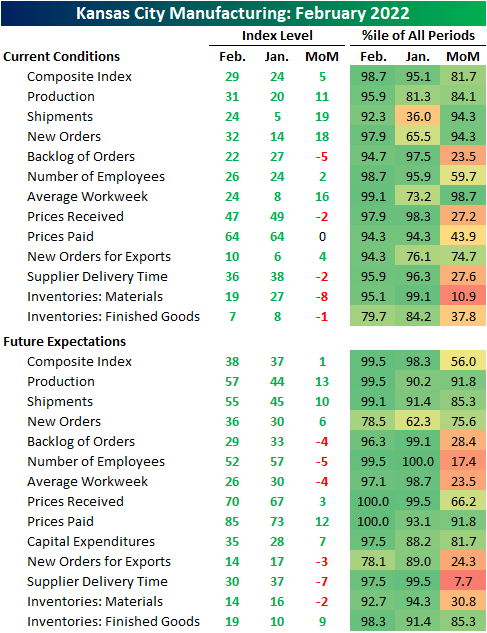
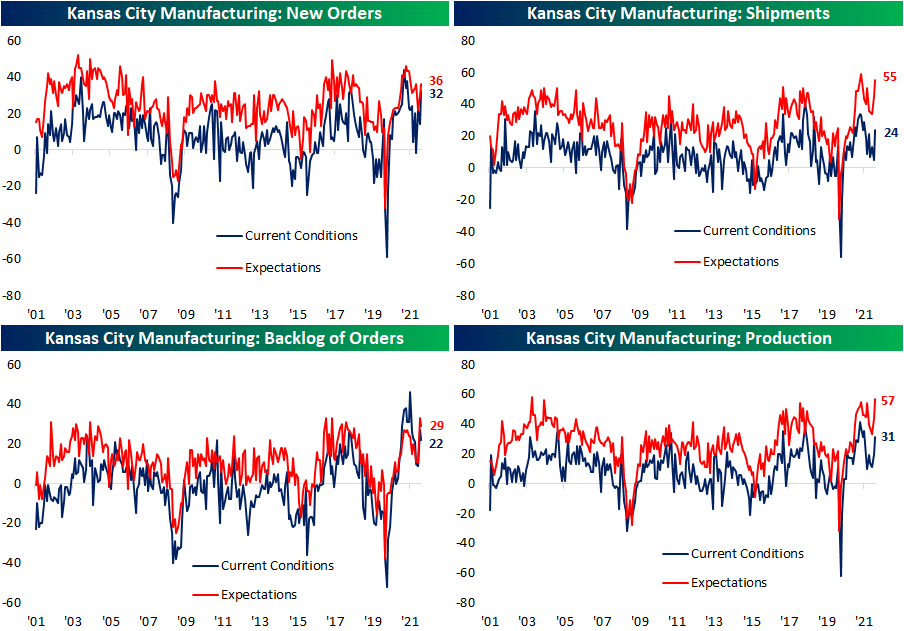
Of the indices that were higher, the biggest gains came from New Orders, Shipments, and Production. Each of these categories rose double digits month over month. While those increases bring these readings into the top decile of their historical ranges, they have not fully recovered the peaks from earlier in the pandemic. Expectations indices are in a similar situation with significant increases (except for order backlogs) this month. Production has seen the most notable increase of these as this month’s reading on expectations hit the second-highest level on record behind the October 2003 reading.
The report showed supply chains remain stressed but improved as delivery times fell another 2 points marking the third decline in a row.

The report’s readings on prices showed a wide divergence between current conditions and expectations. Both indices had generally been on the decline from extremely high levels in the past year, but over the past two reports, expectations have surged with both prices paid and received hitting new record highs. Meanwhile, current conditions have only flattened out after reversing lower in the second half of 2021. Click here to view Bespoke’s premium membership options.

Neutral Sentiment Plunges as Bears Move Back Above 50%
As the S&P 500 enters correction territory, sentiment has further degraded. Once again this week, less than a quarter of respondents to the weekly AAII sentiment survey reported as bullish. Although it was an improvement from 19.2% last week, the current reading of 23.4% remains in the 6th percentile of readings going back to the start of the survey in 1987. We would also note that while there are a range of potential factors that have likely played a role in the recent drop in sentiment ranging from price action to forecasted paths of interest rates to geopolitical tensions, this week’s survey likely did not fully capture changes to sentiment from the news surrounding the situation in Ukraine. More specifically, the collection period would not have captured today’s news of escalation.
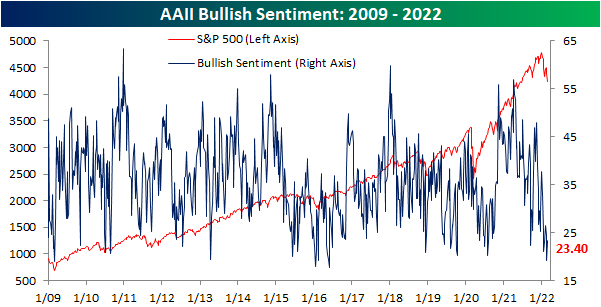
Bearish sentiment crossed above 50% as recently as the last week of January, and after falling all the way back down to 35.5% earlier this month, it is now back above 50%. In fact, bearish sentiment surpassed the January high of 52.9% by 0.8 percentage points this week to reach the highest level since April 2013. Back then it was only slightly higher at 54.48%. The two-week increase since the low on February 10th now ranks in the top 3% of all two-week changes on record. As for other sentiment surveys, the bearish results are being echoed with the Investors Intelligence survey seeing the highest bearish reading since April 2020.

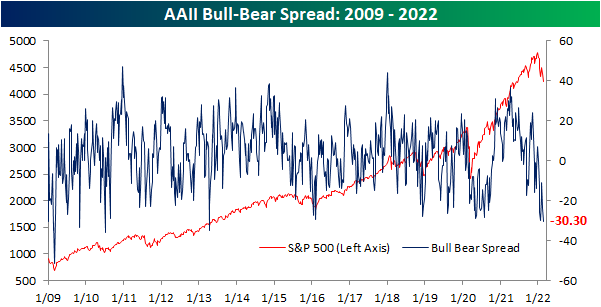
With the huge pickup in bearish sentiment, the bull-bear spread has fallen below -30. Similar to bearish sentiment, that is the most pessimistic reading on sentiment since April 2013.
With both bullish and bearish sentiment rising, each reading’s gains have borrowed heavily from neutral sentiment. Neutral sentiment has gone from a multi-year high of more than 40% only two weeks ago down to the lowest level since last April this week. The bulk of that decline occurred since last week’s survey as neutral sentiment plummeted 14.7 percentage points week over week. There has not been as large of a decline in neutral sentiment since February 2003.

Given how severe of a decline neutral sentiment experienced this week, in the table below we look back at all other times that this reading has experienced a double-digit percentage point decline for the first time in at least six months. Of the baker’s dozen of prior occurrences, the current instance ranks as the second-largest decline in neutral sentiment behind the August 1994 instance when it fell 15 percentage points. There were also three other times—March 2005, July 2010, and April 2013—when, similar to now, bearish sentiment was above 50%. Overall across these past occurrences, the S&P 500 has tended to outperform in the short term but longer-run performance (3 months to one year out) has been smaller than the norm for all periods. In the three periods most similar to the present period, though, where nearish sentiment was also above 50%, forward returns three, six, and twelve months later were higher each time Click here to view Bespoke’s premium membership options.

Continuing Claims At Lowest Level Since 1970
Initial jobless claims came in 3K lower than expected this week falling from 248K to 232K. While it does not take away from the fact that the current level of claims is at the low end of the historical range, this week’s number remains 44K above the multi-decade lows set in late 2021.

On a non-seasonally adjusted basis, claims remain within the range of readings from the few years leading up to the pandemic. This week saw a drop from 239.7K to 214.9K; the lowest level since March 2020. Claims continue to generally follow the usual seasonal pattern and the next few weeks of the year have historically tended to mark a short-term seasonal low. In other words, some minor seasonal headwinds are on the horizon.

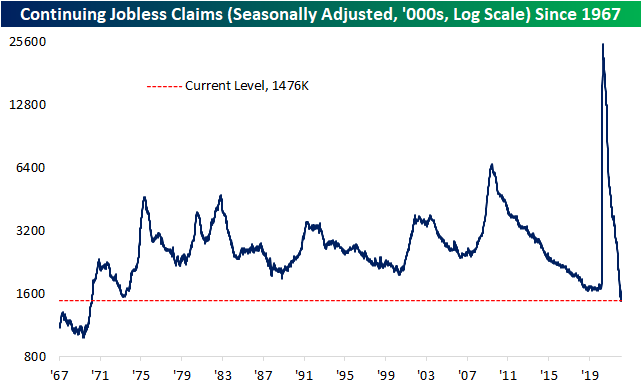
Continuing claims experienced a significant drop this week falling by 112K to 1.476 million. Not only did that exceed expectations by over 100K, but that also marked the largest decline of 2022 to bring claims to the lowest level since March 1970. Click here to view Bespoke’s premium membership options.
Oil Tops $100 Per Barrel
For the first time since September of 2014, the price of brent crude oil has topped $100. This occurred on the back of Russia’s invasion of Ukraine, which unleashed a slew of sanctions against Russia from the US & EU, sparking flash backs to the Cold War. Diplomatic relations between Russia and the West are deteriorating, and NATO Secretary General Jens Stoltenberg commented, “Peace in our continent has been shattered. We now have war in Europe, on a scale and of a type we thought belong to history.”
Russia is the world’s second largest producer of natural gas (behind the US) and the third largest producer of oil, as per the US Energy Information Administration. Additionally, Russia has the second largest spread between oil produced and oil used (behind just Saudi Arabia), giving the country a key roll in supplying oil to the rest of the world.
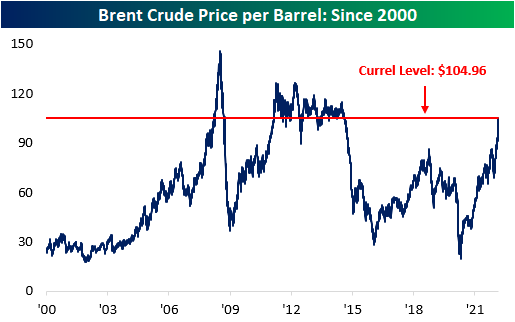
The last time that oil topped $100 per barrel for the first time in three months was in January of 2011. In just two months, the price of oil shot 17.6% higher, resulting in a y/y price increase of 41.4%. This occurred on the back of political turmoil in the Middle East, particularly in Egypt, Lebanon, Yemen and Bahrain. These conflicts caused speculation of continued unrest in the entire region, thus pulling into question the ability for the Middle East to adequately supply the world with oil. This occurred while demand for fossil fuels remained robust, hence the soaring price of oil. Oil did not definitively break back below $100 per barrel level until September of 2014, when OPEC increased output, oil production in the US began to boom and the Middle East’s geopolitical situation eased. The combination of these three factors sent the price of oil tumbling, falling by 51.8% in less than five months.
In 2008, the sky-rocketing in the price of oil was largely demand driven. In late February, oil topped $100 after considerable demand increases crossed with a stagnant supply. Oil moved continuously higher over the preceding 12 months, gaining 63.0% when all was said and done. However, the global financial crisis, also known as the great recession, caused a severe reduction in economic activity and demand, sending the price of oil tumbling by 58.2% in just one year following the initial topping of $100 per barrel.
Below is a set of graphs that shows the performance of the S&P 500 during these periods. As you can see, a rise in the price of oil does not necessarily imply a market pullback. In fact, a high price of oil insinuates that economic activity is strong and demand is robust.


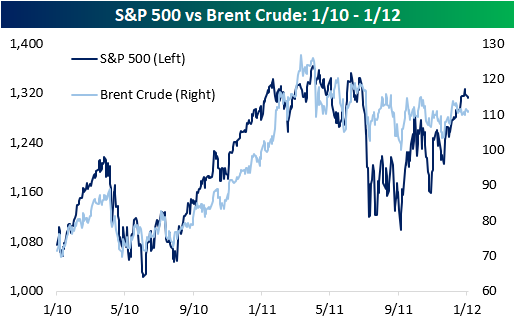
Whereas the correlation coefficient between brent crude and the S&P 500 is just 0.07 since the turn of the century, the correlation in the year before and after oil tops $100 for the first time was 0.40 between February of 2007 and 2009 and 0.84 between January of 2010 and 2012. These coefficients signify a moderate and strong positive relationship, respectively. When oil eventually definitively moved below $100 per barrel later in 2008, the S&P 500 crashed alongside oil prices, but the opposite was seen in 2011. Needless to say, the market is influenced by a multitude of factors, and oil is simply a single input.
Although we don’t have much data to go on, the forward performance of the market has been closely tied to the performance of brent crude after oil has topped $100 since 2000. In 2008, crude crashed just as quickly as it had risen, and the market followed suit. On the other hand, the price of crude remained elevated following the topping of $100 in 2011, and the market performed positively, but the forward year performance was lesser than the average since the turn of the century (3.1% vs 6.8%). In both occurrences, the price of brent crude climbed higher over the course of the next three months. In 2008, the price of brent crude rose by 29.8% in the next three months and 13.6% over the following six months. However, one year later, the price had crashed by 59.4%. In 2011, brent crude appreciated by 24.6% in the following three months, 15.6% in six months and 8.7% in a year. However, insinuating that the crash in 2008 had anything to do with oil would be a mistake. In fact, the inverse is likely true. Long story short, investors should not sell this dip due to the hike in oil prices alone, but there is much more to consider in the current macro environment. Click here to view Bespoke’s premium membership options.

