
Bespoke’s Morning Lineup – 6/23/22 – The Flying Powell
See what’s driving market performance around the world in today’s Morning Lineup. Bespoke’s Morning Lineup is the best way to start your trading day. Read it now by starting a two-week trial to Bespoke Premium. CLICK HERE to learn more and start your trial.
“Being on the tightrope is living; everything else is waiting.” Karl Wallenda

Below is a snippet of content from today’s Morning Lineup for Bespoke Premium members. Start a two-week trial to Bespoke Premium now to access the full report.
Nine years ago today, people all over the world watched with bated breath as acrobat Nik Wallenda became the first person to walk across the Grand Canyon on a tightrope. Technically, it wasn’t actually the Grand Canyon, but a gorge right near the Grand Canyon National Park. However, the 1,800-foot highwire trek across the gorge that took place 1,500 feet above the ground (without a net) was impressive. Wallenda’s Grand Canyon crossing came barely a year after an even more widely watched event where he became the first person to walk a tightrope over Niagara Falls. Talk about an ability to strike a balance!
Nik Wallenda is just one of a long line of ‘Flying Wallendas’ that have for decades been known for their death-defying stunts that mostly involve high-wire acts without a net. Living on the edge is simply in their blood.
Up until recently, Fed Chair Powell has been attempting his own ‘Wallenda act’ looking to strike a delicate balance between raising interest rates to fight inflation and avoiding throwing the economy into recession on the other. Just like Nik Wallenda’s walks over the Niagara Falls and The Grand Canyon, many out there say that it simply can’t be done. Powell, on the other hand, remained optimistic up until recently, arguing in mid-May that removing accommodation and raising rates could be achieved with a ‘softish’ landing in the US economy that may be a ‘little bumpy’ but ‘still a good landing’.
In the month since those May comments, though, Powell has sounded less confident, increasingly leaning on the recession side of the wire in order to prevent a fall further onto the side of inflation. Just yesterday, in Senate testimony, the Fed Chair noted that “We’re not trying to provoke, and don’t think that we will need to provoke, a recession, but we do think it’s absolutely essential that we restore price stability, really for the benefit of the labor market, as much as anything else.” Wallenda ultimately proved all his doubters wrong. Is Powell’s balance anywhere near as good?
Futures have been bouncing around this morning, but have mostly been in positive territory after yesterday’s rebound from a sharply lower open. Jobless Claims were just released and came in very slightly higher than expectations at 229K compared to forecasts for 226K. Continuing Claims, on the other hand, came in 5K lower than the consensus forecast of 1.32 million. Looking ahead to the rest of the day, Powell will testify in front of the House at 10 AM, and the EIA will release Natural Gas stockpiles at 10:30. The release of crude oil inventories, which were already delayed by a day due to the Juneteenth holiday, has been postponed indefinitely due to system issues.
In today’s Morning Lineup, there’s a lot covered as we discuss overnight moves in Asian and European markets, central bank moves, and overnight economic data from Asia and Europe.
Treasury yields are down this morning with the 10-year yield below 3.1% after topping out at just under 3.5% a little over a week ago. In the five trading days that ended yesterday (6/22), the 31 basis point decline in the 10-year yield was the largest since the COVID crash, although it followed what was the largest five-day increase in over five years.

Start a two-week trial to Bespoke Premium to read today’s full Morning Lineup.
Bespoke’s Morning Lineup – 6/22/22 – Giving it Back
See what’s driving market performance around the world in today’s Morning Lineup. Bespoke’s Morning Lineup is the best way to start your trading day. Read it now by starting a two-week trial to Bespoke Premium. CLICK HERE to learn more and start your trial.
“There are no easy fixes nor any short-term answers to the global supply and demand imbalances aggravated by Russia’s invasion of Ukraine.” – Mike Wirth, CEO of Chevron
Below is a snippet of content from today’s Morning Lineup for Bespoke Premium members. Start a two-week trial to Bespoke Premium now to access the full report.
It was fun while it lasted. In the latest example of the two steps backward, one step forward market, most of yesterday’s rally, which wasn’t enough to erase the declines of the prior two trading days, is poised to get erased at the open. Besides the fact that it’s a weekday and the market is open, there isn’t much in the way of a catalyst for this morning’s weakness. Oil prices are sharply lower with WTI down nearly 5%. Unlike most other days this year where equities and US Treasuries have moved in tandem with each other, Treasuries are actually rallying this morning.
There’s no economic data on the calendar to speak of today, but it will be a busy day of Fedspeak with Powell testifying in front of the Senate while Barkin, Evans, and Harker will also be speaking throughout the trading day.
In today’s Morning Lineup, there’s a lot covered as we discuss overnight moves in Asian and European markets, central bank moves, activity in the metals markets, and overnight economic data from Asia and Europe.
The quote above came from a letter to President Biden from Chevron (CVX) CEO Mike Wirth ahead of a scheduled meeting on Thursday between Energy Secretary Jennifer Granholm and US oil executives. The letter argues that the Biden “Administration has largely sought to criticize, and at times vilify our industry.” Wirth goes on to note that “bringing prices down and increasing supply will require a change in approach” and that the industry needs “clarity and consistency on policy matters”. Closing out, Wirth encourages President Biden that in addition to Secretary Granholm, he also “send your senior advisors to this meeting, so they too can engage in a robust conversation.”
Whatever side of the debate you are on with regards to energy policy, the current state of tension between the Federal government and the US oil industry can’t continue. While expectations are low, Thursday’s meeting will hopefully be more than a photo-op for both sides and instead help to bring some clarity to the strategy moving forward.
This morning, the Biden Administration has proposed a three-month holiday from the 18-cent per gallon federal gas tax holiday. While it sounds nice, the majority of economists and industry insiders have said it will do little to ease pressure at the pump and may actually worsen the situation by increasing demand. One study from Wharton found that a ten-month holiday would save consumers between $16 and $47 in total. The current proposal is for just three months which would imply total savings that’s barely enough to cover a McDonald’s value meal!
Despite the weakness in equity futures this morning and confusion surrounding US energy policy, oil prices are sharply lower. At a level of $104 per barrel, WTI has now pulled back 15% from its recent closing high on June 8th and has also broken the uptrend that has been in place since late 2021. Outside of the oil industry, just about everybody is rooting for this chart to keep moving lower. None more than Fed Chair Powell.

Start a two-week trial to Bespoke Premium to read today’s full Morning Lineup.
And Then It Was Energy’s Turn
The Energy sector has bounced along with the overall market today, but last week it was that sector’s turn to get taken to the woodshed. Throughout the year, Energy was the only sector that worked, and less than two weeks ago it traded at 52-week highs. From the high on June 8th through Friday’s close, though, the S&P 500 Energy sector fell over 20%. The only other times since at least 1990 that the Energy sector fell more than 20% in an eight trading day span were in October 2008 and March 2020. While the sector’s 50-day moving average didn’t hold in last week’s plunge, the sector was able to hold support at its late April lows.

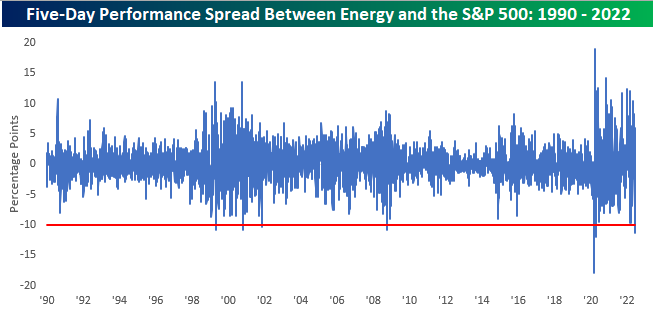
In addition to falling over 20% in an eight-day span, the Energy sector’s 17.2% decline last week (5-days) was also one that was surpassed by only a handful of other periods (October 2008, August 2011, and March 2020) since 1990. While declines of last week’s magnitude have been very uncommon, Energy is a volatile sector, and as illustrated in the chart below, there have been a number of periods in the last thirty years when the sector fell 10% or more (red line) in a five-day span.

Of the periods mentioned above where the Energy sector dropped as much as it did in the five days ending last Friday, they were also periods of overall market weakness. To help adjust for broader market moves, the chart below shows the rolling five-day performance spread between the S&P 500 Energy sector and the S&P 500 going back to 1990. Last week marked just the sixth period in the last 30+ years that the Energy sector underperformed the S&P 500 by more than ten percentage points in a five-trading day span. The other periods were April 1999, October 2000, November 2001, October 2008, and March and April 2020. On a side note, one aspect of the chart below that really stands out is how untethered the Energy sector has become relative to the S&P 500. Since 2020, the range of out/underperformance for the sector relative to the S&P 500 has widened out to an unprecedented range.
Separately, given the fact that Energy’s decline occurred as oil prices were only down a bit over 10% from their 52-week high (-11.4%), we were curious to see how far WTI was from 52-week highs following prior five-day periods where the Energy sector experienced massive underperformance. Of the six prior periods, there was only one where crude oil was down less relative to its 52-week high than it was as of last Friday (April 1999). Additionally, the only other time it was down by a similar amount was in October 2000. In the remaining four periods, crude oil prices had already declined significantly relative to their 52-week highs with declines of at least 48% and up to 70%. Click here to learn more about Bespoke’s premium stock market research service.
Bespoke’s Morning Lineup – 6/21/22
See what’s driving market performance around the world in today’s Morning Lineup. Bespoke’s Morning Lineup is the best way to start your trading day. Read it now by starting a two-week trial to Bespoke Premium. CLICK HERE to learn more and start your trial.
“A ship is safe in harbor, but that’s not what ships are for.“ – William Shedd
Below is a snippet of content from today’s Morning Lineup for Bespoke Premium members. Start a two-week trial to Bespoke Premium now to access the full report.
It took a day longer than normal, but at least equity markets are kicking off the week on a positive note. Obviously, where we end up today is an entirely different story. It doesn’t take much to erase a market rally these days, but at least there won’t be much in the way of economic data to derail things. The only two reports on the calendar are the Chicago Fed National Activity Index which was barely positive at +0.01 and was the lowest level since last September and Existing Home Sales which will be released at 10 AM Eastern. On the speaker front, Fed Presidents Mester and Barkin will be speaking this afternoon.
In today’s Morning Lineup, there’s a lot covered as we discuss overnight moves in Asian and European markets, the wild weekend in crypto, political trends in Latin America, and economic reports out of Asia and Europe.
Based on where the tracking ETF (SPY) is currently trading in the pre-market, the S&P 500 is poised to gap up 1.7% to kick off the new trading week. As shown in the chart below, if these gains hold through the opening bell it would be the largest upside gap to kick off a new trading week since “Pfizer Monday” on 11/9/20. While this week’s upside gap is the strongest since November 2020, it follows last week’s downside gap of 2.6% which was the largest downside gap to kick off a week in two years.

Start a two-week trial to Bespoke Premium to read today’s full Morning Lineup.
Bespoke Brunch Reads: 6/19/22
Welcome to Bespoke Brunch Reads — a linkfest of the favorite things we read over the past week. The links are mostly market related, but there are some other interesting subjects covered as well. We hope you enjoy the food for thought as a supplement to the research we provide you during the week.
While you’re here, join Bespoke Premium with a 30-day free trial!
Recession Watch
Housing Market Update: Share of Homes with Price Drops Reaches New High as Mortgage Rates Top 2008 Levels by Tim Ellis (Redfin)
Demand is cratering across the housing market per Redfin data measuring everything from buyer traffic to price cuts to pending sales indicating that surging mortgage rates have buried the housing market. [Link]
It’s hip to be bear: Business leaders join chorus of economic doomsayers by Jason Kirby (The Globe And Mail)
Prognosticators, pundits, strategists, fund managers, and all manner of other market participants are leaning heavily into a negative outlook for stock markets reeling amidst massive global monetary policy tightening and soaring interest rates. [Link; soft paywall]
Hedge Funds
JPMorgan Packed Its Wealthy Clients Into Tiger Global Fund for Private Bets by Sridhar Natarajan, Hema Parmar and Miles Weiss (The Wealth Advisor/Bloomberg)
The most recent fund offered by collapsing hedge fund complex Tiger Global was stuffed full of investments from JPMorgan customers; total investments in Tiger and another similar fund a few months earlier neared $5bn just before the funds cratered. [Link]
Hedge Fund Selling Was Never More Furious Than in Last Two Days by Lu Wang and Melissa Karsh (Yahoo!/Bloomberg)
Goldman Sachs prime brokerage clients in the equity hedge fund space liquidated more equity exposure over two days in the past week than at any point since 2008. The good news, we suppose, is that this kind of liquidation event is often the sort of even that tags market lows rather than the other way around. [Link]
Prices
Why Gas Prices Are So High by Ella Koeze and Clifford Krauss (NYT)
High crude prices and insufficient new production are the most important driver of the surge in prices at the pump that consumers are suffering through this summer. [Link; soft paywall]
Cruise-Line Pricing Is Lost at Sea by Laura Forman (WSJ)
Eye-watering hotel prices are making seaborne trips a lot more attractive, with room rates roughly 10% below what’s on offer from mid-scale hotels. The industry’s rebound might be dependent on consumers biting at the bargain. [Link; paywall]
Plague & Pestilence
Ancient DNA solves mystery over origin of medieval Black Death by Willy Dunham (Reuters)
The discovery of bubonic plague victims who died in 1338 or 1339 are the earliest ever documented from the Black Death pandemic, all but confirming the plague originated in Central Asia and spread to Europe and the rest of Asia via trade routes. [Link]
New Tools Can Make Our Covid Immunity Even Stronger by Deepta Bhattacharya (NYT)
A recap of the new technologies which have boosted COVID immunity, and a proposal for maximizing population immunity long-term, including deploying vaccines through the mouth or nose instead of via a shot. [Link; paywall]
Single beaver caused mass internet, cell service outages in Northern B.C. by Kaitlyn Bailey (CTV)
One pesky beaver got a little bit too interested in the wrong aspen tree and ended up cutting a large swathe of British Columbia off from the internet in the process. [Link]
Crypto
What were all those 6,200 Coinbasers doing anyway? by Alexandra Scaggs (FTAV)
An investigation into the downright perplexing personnel decisions of one of the world’s largest crypto exchanges. [Link; registration required]
Crypto Hedge Fund Three Arrows Capital Considers Asset Sales, Bailout by Serena Ng (WSJ)
One of the largest pools of crypto investment capital has seen positions blown up a scramble for liquidity amidst brutal market conditions across the blockchain. [Link; paywall]
Marriage
Marry Your Like: Assortative Mating and Income Inequality by Jeremy Greenwood, Nezih Guner, Georgi Kocharkov, and Cezar Santos (NBER)
An estimate that assortative mating (that is, marriages that pair people with similar incomes and socioeconomic backgrounds) was responsible for much of the increase in US income inequality over the past half century. [Link; 26 page PDF]
Read Bespoke’s most actionable market research by joining Bespoke Premium today! Get started here.
Have a great weekend!
Bespoke’s Morning Lineup – 6/17/22 – Trying To Go Out On A Positive Note
See what’s driving market performance around the world in today’s Morning Lineup. Bespoke’s Morning Lineup is the best way to start your trading day. Read it now by starting a two-week trial to Bespoke Premium. CLICK HERE to learn more and start your trial.
“We can offer sunshine that glows bright in the afterthought, and scatters the darkness of the tenement for the price of a nickel or a dime.” — L.A. Thompson
Below is a snippet of content from today’s Morning Lineup for Bespoke Premium members. Start a two-week trial to Bespoke Premium now to access the full report.
138 years ago yesterday, the first roller coaster in the United States opened at Coney Island. Called the Switchback Railway, it was invented by LaMarcus Thompson, and in the years since the roller coaster has become a staple of American leisure activities. The one area where we like to avoid them as much as possible is in the financial markets. Unfortunately, investors haven’t been able to dodge them this year. Making matters worse, the last several days have been more like the ride Free Fall than anything else. After all, in order to have a roller coaster, there have to be ups and downs.
Futures are higher heading into the last trading session of the week, and whether they hold into the close is probably a bet many investors wouldn’t take at this point given the tendency to give up gains intraday. We’ll also get some important reports on Industrial Production (9:15), Capacity Utilization (9:15), and Leading Indicators (10:00).
In today’s Morning Lineup, there’s a lot covered as we discuss the latest moves from the BoJ, and overnight economic and market data in Asia and Europe.
We’ve been calling it the one step forward and two steps backward market for some time now, and yesterday and today provides another illustration of that pattern. After rallying over 1% following yesterday’s Fed meeting, the S&P 500 is indicated to open down about 2.0% this morning, more than erasing all of Wednesday’s gains. Keep in mind too, that even after Wednesday’s rally, the trailing five-day performance of the S&P 500 was a decline of just under 8%.
For the second week in a row, the S&P 500 is closing out trading with a decline in nine of the last ten weeks. In the post-WWII period, there have only been three other periods where this has occurred. Besides the fact that all three were lousy market environments, another theme they all have in common is that they all occurred in the middle of recessions. In 1970, the economy was six months from bottoming out, while in March 1982, the economy was more than a half year into a recession and eight months from its trough. Lastly, the period ending in early April 2001 was just one month into a recession that had another seven months left to go.

Start a two-week trial to Bespoke Premium to read today’s full Morning Lineup.
The Bespoke 50 Growth Stocks — 6/16/22
The “Bespoke 50” is a basket of noteworthy growth stocks in the Russell 3,000. To make the list, a stock must have strong earnings growth prospects along with an attractive price chart based on Bespoke’s analysis. The Bespoke 50 is updated weekly on Thursday unless otherwise noted. There were no changes to the list this week.
The Bespoke 50 is available with a Bespoke Premium subscription or a Bespoke Institutional subscription. You can learn more about our subscription offerings at our Membership Options page, or simply start a two-week trial at our sign-up page.

The Bespoke 50 performance chart shown does not represent actual investment results. The Bespoke 50 is updated weekly on Thursday. Performance is based on equally weighting each of the 50 stocks (2% each) and is calculated using each stock’s opening price as of Friday morning each week. Entry prices and exit prices used for stocks that are added or removed from the Bespoke 50 are based on Friday’s opening price. Any potential commissions, brokerage fees, or dividends are not included in the Bespoke 50 performance calculation, but the performance shown is net of a hypothetical annual advisory fee of 0.85%. Performance tracking for the Bespoke 50 and the Russell 3,000 total return index begins on March 5th, 2012 when the Bespoke 50 was first published. Past performance is not a guarantee of future results. The Bespoke 50 is meant to be an idea generator for investors and not a recommendation to buy or sell any specific securities. It is not personalized advice because it in no way takes into account an investor’s individual needs. As always, investors should conduct their own research when buying or selling individual securities. Click here to read our full disclosure on hypothetical performance tracking. Bespoke representatives or wealth management clients may have positions in securities discussed or mentioned in its published content.
More Promise For Supply Chains
Piggybacking off of another contractionary reading in the Empire Fed survey yesterday, the neighboring Philly Fed’s Manufacturing survey also saw its headline reading print a negative number for June. The index for General Business Conditions has fallen sharply over the past three months, now having shed 30.7 points in that time. This month was the smallest month-over-month drop of those months, though, with the index falling from a barely expansionary reading of 2.6 in May to -3.3. Despite the small drop, that is still the first negative reading since May 2020. As for expectations, this month also saw the index fall into contractionary territory, a first since December 2008.
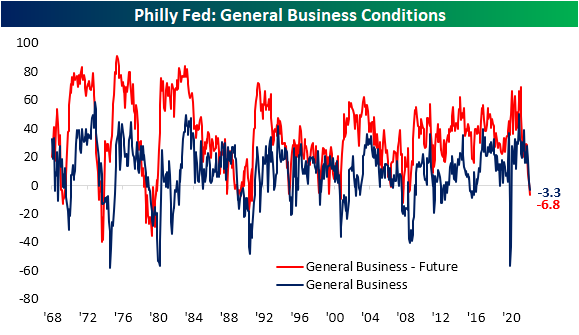
Whereas the Empire Fed report had some silver linings with pretty mixed breadth, this report saw large and broad declines across nearly all categories. Multiple month-over-month moves ranked in the bottom few percentiles of all monthly changes on record in data going all the way back to 1968. There were also three indices (excluding the headline number) that fell from expansion into contraction.

Following up on a retail sales report yesterday that showed the US consumer has cooled off, regional Fed reports are also showing decelerating demand; perhaps even more dramatically so. The Philly Fed’s New Orders index not only fell into contraction and the weakest levels since the spring of 2020, but the 34.5 point decline month over month ranks in the bottom 1% of all monthly moves on record. In fact, that move was large enough to bring the index from the top quartile of its historical range all the way down to the bottom decile. Shipments and Unfilled Orders did not see drops down to quite as extreme levels, but each one went from the 96th percentile to 35th percentile in just one month. Again, their month-over-month declines were some of the largest on record.
Expectations are in even worse shape with similarly large declines. New Orders expectations not only saw the first negative reading since 2008, but at -7.4 it is at the lowest level since 1995. Unfilled Orders expectations have been negative for some time now meaning firms have been expecting to unwind massive backlogs built up during the pandemic due in part to supply chain disruptions. But considering the inflow of New Orders is and is expected to continue declining, Unfilled Orders expectations are at the lowest level since the start of 1974.

As we noted yesterday with the Empire Fed Manufacturing report, the decline in unfilled orders is both bad and good. With regard to the former, it is bad because it appears to in part be due to cooling off of demand. But on the bright side, it also appears to be thanks to massive improvements in supply chains. Not only did the current conditions index for Delivery Times fall sharply in June, but expectations have completely collapsed bringing it to a record low.

Another welcome sign of the report was cooling inflation as fewer respondents reported higher Prices Paid and Prices Received. Both of these readings have plateaued in recent months alongside expectations.

Employment metrics were mixed this month with the Number of Employees rebounding slightly after a big drop the prior month. Expectations, on the other hand, saw a massive 18.7 point decline. Not only was that one of the biggest declines on record but it follows two other sizeable declines in April and May. That indicates the region’s firms are expecting that hiring will moderate significantly in the coming months. Meanwhile, the Average Workweek has been pulling back with current conditions still at a historically healthy level. Click here to learn more about Bespoke’s premium stock market research service.

Sentiment Staying Low
More hawkish monetary policy and the S&P 500 hitting the bear market threshold have given sentiment plenty of reason to turn lower, and that’s exactly what has happened. After reaching a short-term high of 32% only two weeks ago, the percentage of respondents to the AAII survey considering themselves bullish has fallen back below 20% this week. That may not be as extreme of reading as those in the mid-teens from back in April, but, it is still a historically low reading and in the bottom 2% of all weeks going back to the start of the survey in 1987.
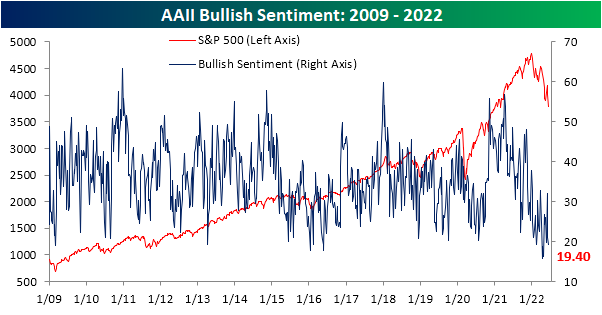
While bullish sentiment has declined, this week’s 1.6 percentage point decline was actually much smaller than the 11 percentage point drop last week. An even bigger decline occurred for those reporting neutral sentiment. That reading fell 9.9 percentage points from a recent high of 32.1%. Now at 22.2%, the percentage of neutral respondents is back down to the lowest level since the start of May.
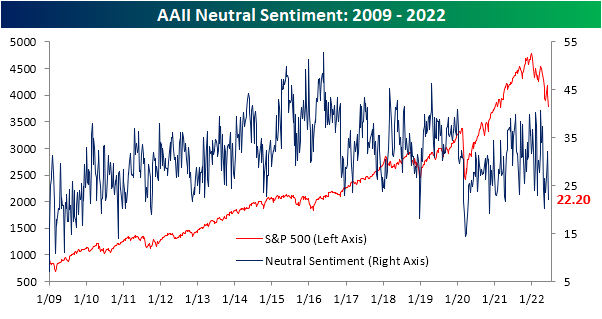
With both bullish and neutral sentiment falling, the bearish camp picked up the difference. Heading into this week, bearish sentiment was already elevated at 46.9%. The 11.4 percentage point bump this week means that well over half of respondents are now bearish with the current reading just 1.1 percentage points shy of the 59.4% high from the end of April. That ranks as the eleventh highest reading of all weeks on record.

That also means the percentage of bears outweighs bulls by an astounding 38.9 percentage points and is the lowest reading since the last week of April.

Not only do bears outweigh bulls by a large margin, but it has also been a historically long length of time that this has been the case. Smoothing out the reading by taking a four-week moving average of the bull-bear spread, the average has been below -10 (in other words on average over a four-week span bearish sentiment has been at least 10 percentage points higher than bullish sentiment) for 21 straight weeks. That surpassed another long 18-week streak in 2020 and is now only five weeks short of the record stretch of 26 weeks in the early 1990s.

Not only has the AAII survey showed souring sentiment, but so too have the weekly NAAIM Exposure Index and the Investors Intelligence surveys. This week, the NAAIM index showed investment managers only have 32.2% long equity exposure. Meanwhile, the Investors Intelligence survey saw the most negative bull-bear spread in a month. Normalizing each of these three sentiment indicators, the average reading is now 1.28 standard deviations from the historical norm. That is not as bad as last month, but it remains a historically pessimistic reading on sentiment. Click here to learn more about Bespoke’s premium stock market research service.

Jobless Claims Moderate
Jobless claims have been trending higher off of multi-decade lows, indicating a moderating labor market. This week, initial claims would have gone unchanged week over week at 229K if it were not for a modest upward revision to 232K to last week’s number. In other words, claims were little changed this week as they continue to gradually head higher. At these levels, claims remain at the high end of the range from the few years prior to the pandemic.

On a non-seasonally adjusted basis, claims have begun to experience the typical upward swing for this point of the year and that is likely to continue over the next month and change. NSA claims topped 200K this week for the first time since the last week of April which is right in line with the readings from the comparable weeks of the year of 2018 and 2019.

Continuing claims are lagged an additional week to initial claims but this reading has also been making its way off the lows. Granted, the move off the lows for continuing claims has been much more modest than initial claims (only 6K for continuing claims versus 66K for initial). Seasonally adjusted continuing claims rose for the second week in a row this week to 1.312 million which is only the highest level in a month. Click here to learn more about Bespoke’s premium stock market research service.
