
Bespoke Brunch Reads: 2/2/20
Welcome to Bespoke Brunch Reads — a linkfest of the favorite things we read over the past week. The links are mostly market related, but there are some other interesting subjects covered as well. We hope you enjoy the food for thought as a supplement to the research we provide you during the week.
While you’re here, join Bespoke Premium for 3 months for just $95 with our 2020 Annual Outlook special offer.
Social Statistics
The U.S. Housing Crisis Is Making Its Way to the Heartland by Jordan Yadoo and Noah Buhayar (Bloomberg Quint)
As home prices outpace the growth of economic activity in big swathes of the country and refugees of the coasts seek affordability, smaller and mid-sized cities are seeing affordability fade from the grasp of the middle class. [Link]
Life expectancy in the US rises for the first time in four years (New York Post/Associated Press)
After four years of declines that were driven by rising suicides and overdoses, declining death rates from cancer and lower rates of mortality related to drugs in 2018 helped push up overall life-expectancy for the first time in four years. [Link]
Bike Fatalities Are On The Rise by Phillip Reese (Kaiser Health News)
As more cyclists take to the roads and more drivers are distracted by their phones, the number of cyclists killed in accidents has trended steadily higher relative to the population both in California and across the rest of the country. [Link]
Screens
Collectors Are Spending Thousands on Video Games They Will Never Play by Jason M. Bailey (NYT)
Similar to other forms of artistic expression, video games are a collector’s dream even if they’ve never actually blown a cartridge off and slammed it into a console. [Link; soft paywall]
Modern Family: Average Parent Spends Just 5 Hours Face-To-Face With Their Kids Per Week! by Ben Renner (Study Finds)
A survey of UK households recently found that on average parents spend less than five hours per week in conversation with their kids, with a variety of strategies being pursued to reconnect including opting-in to kids’ activities including video games. [Link]
Big Tech
Facebook’s Relationship With Democrats Hits a Low Point by Deepa Seetharaman, Joshua Jamerson and Emily Glazer (WSJ)
In an effort to avoid the ire of the President, Mark Zuckerberg may have steered too far from Scylla and too close to Charybdis, as lawmakers see recent internal policy decisions as tipping the scales towards Republicans. [Link; paywall]
Sports
Race Is On to Cash In on Sports Betting by Katherine Sayre and Benjamin Mullin (WSJ)
A major gambling operator took a 36% stake in Barstool Sports, a blog best known for its irreverent and often misogynistic coverage of sports, in an effort to drive traffic to its gambling operations. [Link; paywall]
Cosmology
The Biggest Celestial Event of the Year Could Happen Tomorrow by Marina Koren (The Atlantic)
Given cosmic timelines, we’re never assured a view of the most spectacular events in the night sky, but the Betelgeuse supernova stands a real chance of taking place during our lifetimes. [Link]
Church Changes
German Bishops Rethink Catholic Teachings Amid Talk of ‘Schism’ by Francis X. Rocca (WSJ)
As European church officials push for a more modern church tradition, conservative American bishops are considering a revolt that could see a fresh schism in the church of St. Peter. [Link; paywall]
Scams
The Telephone Is A Lifeline For Prison Families. And Calls Are Outrageously Expensive by Bonita Tenneriello and Elizabeth Matos (WBUR)
With extreme price points for basic services, Massachusetts is considering laws that would prevent prisons from gouging the families of incarcerated persons. [Link]
Everything Old Is New Again: The Continuing Saga Of Bioscam Nanoviricides (Buyers Strike)
A stock that has long been known as a biotech fraud has come surging back in the wake of 2019-nCov’s surge across China. [Link]
Read Bespoke’s most actionable market research by joining Bespoke Premium today! Get started here.
Have a great weekend!
What a Difference Two Weeks Makes!
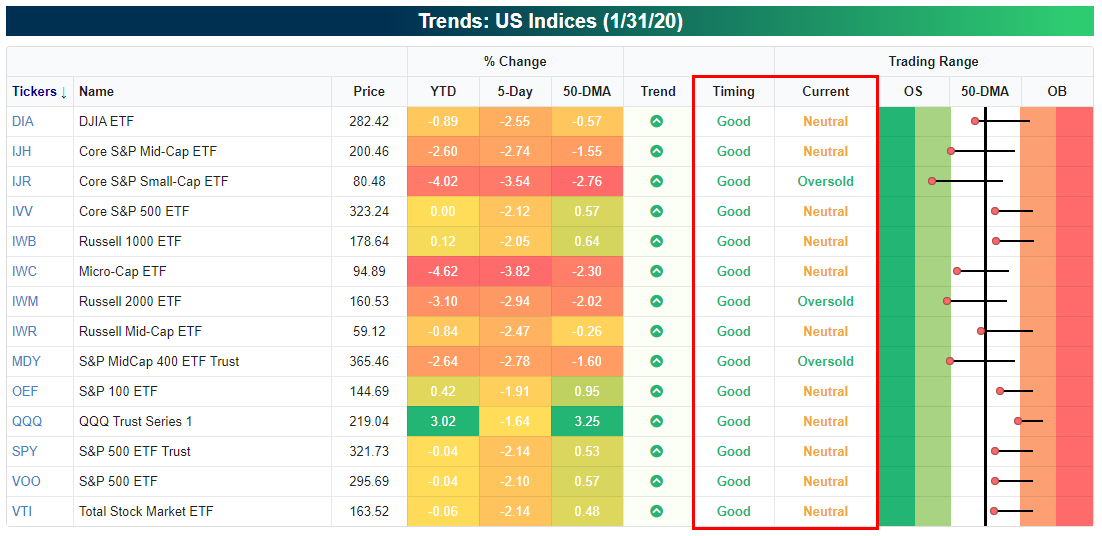
The tone of the market sure did change over the last two weeks! The image below is from our Trend Analyzer screen of US indices as of the close two weeks ago on 1/17. Heading into that weekend, the major US averages were all at ‘Overbought’ or ‘Extreme Overbought’ levels, and while their Trend ratings were all positive, the Timing scores for nearly all of them was ‘Poor’.

Fast-forwarding to the present, it’s a completely different picture for the major US indices. Today, not a single one of the major US index ETFs headed into this weekend overbought at overbought levels, and a few of them are even oversold. Here’s the silver lining, though; since all of their Trend ratings are still positive, their timing scores all rank as ‘Good’. While not what we would classify as a ‘Perfect’ set up right now, for investors who have been waiting for a pullback, the window is starting to open. Start a two-week free trial to Bespoke Institutional for full access to our Trend Analyzer tool, so you can track the key trends of major indices and individual stocks.
The Bespoke Report — 1/31/19
This week’s Bespoke Report newsletter is now available for members.
Along with in-depth analysis of the 2019-nCov outbreak and its potential impact on global financial markets, this week we take a deep dive into recent earnings results from a dozen or so of the largest US companies (see pages 29-31). We also provide our thoughts on potential 2020 election outcomes and whether the market is not yet pricing in the real possibility of socialist Senator Bernie Sanders winning the nomination.
In this week’s Bespoke Report, we provide our take on everything going on in the market this week, including the action in international markets, global economics, and cross-asset price action. To read the report and access everything else Bespoke’s research platform has to offer, start a two-week free trial to one of our three membership levels. You won’t be disappointed!

The Closer: End of Week Charts — 1/31/20
Looking for deeper insight on global markets and economics? In tonight’s Closer sent to Bespoke clients, we recap weekly price action in major asset classes, update economic surprise index data for major economies, chart the weekly Commitment of Traders report from the CFTC, and provide our normal nightly update on ETF performance, volume and price movers, and the Bespoke Market Timing Model. We also take a look at the trend in various developed market FX markets.

The Closer is one of our most popular reports, and you can sign up for a free trial below to see it!
See tonight’s Closer by starting a two-week free trial to Bespoke Institutional now!
Bespoke Market Calendar — February 2020
Please click the image below to view our February 2020 market calendar. This calendar includes the S&P 500’s average percentage change and average intraday chart pattern for each trading day during the upcoming month. It also includes market holidays and options expiration dates plus the dates of key economic indicator releases. Start a two-week free trial to one of Bespoke’s three research levels.

Short Circuit
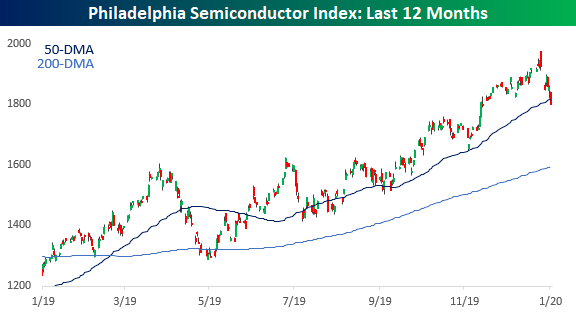
It was just a week ago that the Philadelphia Semiconductor Index (SOX) gapped sharply higher to record highs on the back of strong earnings from Intel (INTC). So much for that rally. By the end of the day last Friday, the SOX was actually down over 1%, and outside of a rally this past Tuesday, it has traded down every day since. From record highs on Friday morning, the SOX is closing out this week down more than 8% from last Friday’s highs and below its 50-day moving average (DMA) for the first time since October. For the last several months, the 50-DMA has acted as support for the SOX, so we’ll be watching closely to see how the index holds up in the days ahead. We’ve repeatedly discussed the importance of the semis as a barometer of the health of the broader market, so it will be important for the group to find its footing soon.
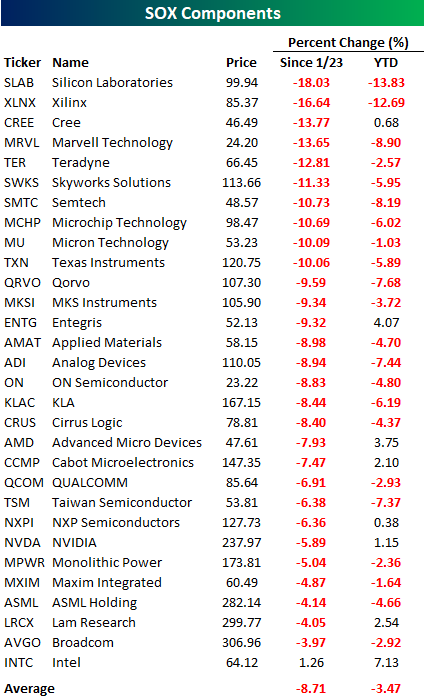
In terms of the SOX’s individual components, the weakness has been broad-based. Since its closing high on 1/23, every member of the SOX besides INTC is down, and INTC is barely up! The average performance of the index’s components since 1/23 has been a decline of nearly 9%, and a third of the components are down by double-digit percentages. Semis had been a leadership group for the market as recently as last week, but after the declines over the last five trading days, the average 2020 performance of stocks in the index is a decline of 3.5% and only eight components are up. Even for the semis, this has been a quick reversal. Start a two-week free trial to Bespoke Institutional for full access to our research and market views.
B.I.G. Tips – February 2020 Seasonality
B.I.G. Tips – CAT Sales Head South
Bespoke’s Morning Lineup – 1/31/20 – One Down, Eleven to Go
See what’s driving market performance around the world in today’s Morning Lineup. Bespoke’s Morning Lineup is the best way to start your trading day. Read it now by starting a two-week free trial to Bespoke Premium. CLICK HERE to learn more and start your free trial.

The Closer – Tech & Utility Market, Energy A/D, Amazon Earnings, GDP, Housing – 1/30/20
Log-in here if you’re a member with access to the Closer.
Looking for deeper insight on markets? In tonight’s Closer sent to Bespoke Institutional clients, we begin with a look across sectors showing the persistent outperformance of the Technology and Utilities sectors as well as the Energy sector’s A/D line which has become very stretched. Then we recap tonight’s earnings reports with particular focus on Amazon’s (AMZN) blowout quarter. Next, we review today’s GDP release and quarterly homeownership and vacancy data.
See today’s post-market Closer and everything else Bespoke publishes by starting a 14-day free trial to Bespoke Institutional today!