
S&P 500 Stocks Outpacing Analyst Price Targets
This morning’s jobs report shocked the financial world — most notably the economists whose job it is to provide estimates. The consensus estimate among economists for May nonfarm payrolls was projecting a loss of more than 7 million jobs. The actual number that was reported did not just show a smaller than expected job loss, but it actually showed a gain in jobs of more than 2.5 million.
We’re seeing a similar situation play out in the equity analyst community. With the S&P 500 now up 40%+ since its low less than three months ago, the average stock in the index is now trading above its consensus analyst price target that looks 12 months out. Analysts have simply not been able to catch up to the rapid rise we’ve seen for equity prices.
It’s extremely rare to see share prices move above consensus analyst price targets. We don’t have the historical daily data on this, but anecdotally we can’t remember a time when the spread has been this wide. As shown below, at the end of 2019 when the S&P finished a massive rally, equity prices were 5.5% below the consensus price target. That was seen as a very tight spread prior to what we’re seeing now. At the lows in March, the average share price had dropped all the way to $92.50 compared to an average consensus price target of $143.20. That projected a gain of 54.9% at the time!
Since March 23rd, the average share price has risen from $92.50 up to $138.40, while the average analyst price target has fallen from $143.20 to $136. Current price targets no longer project a gain for the average S&P 500 stock, but rather a 1.7% drop. Click here to view Bespoke’s premium membership options for our best research available.

Bespoke’s Morning Lineup – 6/5/20 – Bonds Banished
See what’s driving market performance around the world in today’s Morning Lineup. Bespoke’s Morning Lineup is the best way to start your trading day. Read it now by starting a two-week free trial to Bespoke Premium. CLICK HERE to learn more and start your free trial.
Here comes the big jobs report! Looking at where futures are trading, though, investors don’t seem all that concerned as the S&P 500 is indicated higher by about 0.8%. The re-opening stocks are once again flying today, led by the airlines. Based on where it is trading this morning, the Airlines ETF (JETS) is up 40% on the week. On the WEEK!
Be sure to check out today’s Morning Lineup for a rundown of the latest stock-specific news of note, European markets, economic data out of Germany, global and national trends related to the COVID-19 outbreak, and much more.

The chart below is from the second page of our Morning Lineup and shows the relative strength of the S&P 500 versus long-term US treasuries. When the line is rising, it indicates that equities are outperforming bonds and vice versa when it’s declining. From the S&P 500 peak in February to the lows in March, equities were crushed and long-term treasuries surged as yields dropped to record lows. Since then, we’ve seen a steady uptick in the relative strength of equities relative to bonds, but that pace has really accelerated this week to the point where equities are almost back to outperforming bonds on a trailing one-year basis.
As of this morning, SPY is up over 3% on the week while the long-term treasury ETF (TLT) is down over 5%. While we saw wider 5-day performance gaps as recently as March, for a period where volatility has been relatively restrained, this is a wide gap.

Bespoke’s Weekly Sector Snapshot — 6/4/20
Bearish and Neutral Sentiment Normalized
While the Nasdaq is within tangible reach of its all time highs and the S&P 500 is closing in on going positive YTD, bullish sentiment has continued to pick up. AAII’s weekly survey of investor sentiment showed 34.55% of respondents reported as bullish this week which is up from 33.07% last week. While a smaller increase than the past couple of weeks (1.48 percentage points compared to 4.07 percentage points last week and 5.69 percentage points the week before), this was the third consecutive week with bullish sentiment moving higher. At the current reading, bullish sentiment is at its highest level since the mid-April.

Meanwhile, bearish sentiment has continued to fall from its elevated levels. Bearish sentiment fell back below 40% to 38.87% this week. That is the first time that bearish sentiment has been below 40% in 12 weeks. In the history of the AAII survey, there were only two other streaks above 40% that ran that long if not longer: one ending in December of 1990 at 19 weeks and another ending in March of 2008 at 14 weeks. S&P 500 performance following both of those past occurrences differed greatly with the index higher by 17% six months later in 1990, but down over 10% in 2008.
Additionally, this was the first time that bearish sentiment has been within one standard deviation of its historical average of 30.48% in 12 weeks. There have only been three other similar stretches that have gone on at least 12 weeks. Two of those were during the previously mentioned periods in 1990 and 2008 lasting for 18 and 14 weeks, respectively. Additionally, there was a 14-week long stretch that ended in August of 2006. In terms of performance of the S&P 500 following that period, it more closely resembled 1990 than 2008 with the index higher by 12.18% six months after the streak came to a close.

With bearish sentiment continuing to move to more historically normal levels and bullish sentiment clawing higher, the bull-bear spread still favors bears at -4.32, but by the narrowest margin since the first week of March when it stood at -0.9.

Meanwhile, neutral sentiment also continues to move back to more normal levels. Historically, neutral sentiment has averaged a reading of 31.5% but is now at 26.58%. That is the highest level for neutral sentiment and the closest to its historical average since the final week of February. Click here to view Bespoke’s premium membership options for our best research available.

The Bespoke 50 Top Growth Stocks — 6/4/20
Every Thursday, Bespoke publishes its “Bespoke 50” list of top growth stocks in the Russell 3,000. Our “Bespoke 50” portfolio is made up of the 50 stocks that fit a proprietary growth screen that we created a number of years ago. Since inception in early 2012, the “Bespoke 50” has beaten the S&P 500 by 112.9 percentage points. Through today, the “Bespoke 50” is up 239.1% since inception versus the S&P 500’s gain of 126.1%. Always remember, though, that past performance is no guarantee of future returns. To view our “Bespoke 50” list of top growth stocks, please start a two-week free trial to either Bespoke Premium or Bespoke Institutional.

Nasdaq’s Historical Run
At its highs earlier this morning, the Nasdaq Composite was within 2% of its record high from earlier in the year. Besides the steep V-shape of the Nasdaq’s pattern over the last four months, the other aspect of the chart that stands out is just how steep the 50-day moving average is trending lately.

To illustrate just how steep the Nasdaq’s 50-DMA has become, the chart below shows the daily percentage change of the 50-day going back to 1971. Currently, the Nasdaq 50-DMA is rising at an average of over 0.5% per day. That’s an incredible slope and a level that has been exceeded only a handful of times in the Nasdaq’s 50-year history. Start a two-week free trial to Bespoke Institutional to access all of our research and interactive tools.

Chart of the Day: What’s Driving The Rally
Continuing Claims Higher Again
Weekly jobless claims left a sour taste in investors mouths this morning. Despite coming in lower (by 249K) for a ninth consecutive week—the longest streak of week over week declines on record—seasonally adjusted initial jobless claims once again came in well into the millions at 1.877 million. Additionally, last week’s number was revised up 3K to 2.126 million. This week’s print was also once again above expectations of 1.8 million. Ironically enough, despite a record streak of weekly declines, jobless claims have been weaker than expected for six consecutive weeks. That’s the longest streak of weaker than expected prints since November of 2013.
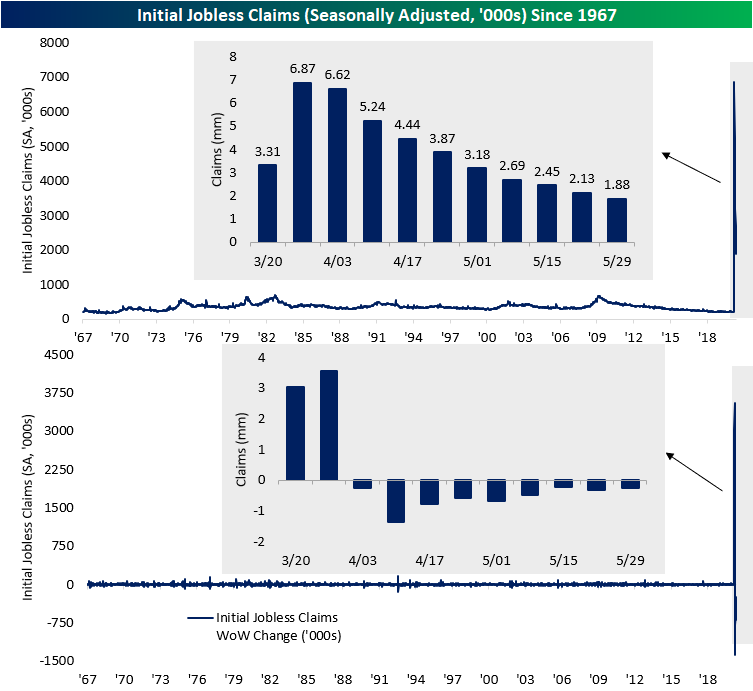
On a non seasonally adjusted basis, claims fell 314.6K and are a bit lower at 1.6 million. This week marked an eighth straight week with WoW declines which is tied with streaks from 1972, 1975, 1980, 1991, and 2002 for the longest such streak ever. This week’s extra 1.6 million claims brings the total NSA claims filed since March 20th (first weekly print above 1 million) to 42.6 million.

Another sticking point of this week’s jobless claims release was the continuing claims number which resumed WoW increases after a massive decline last week. This week, continuing claims were up to 21.49 from 20.84 last week.

Last week, we noted reason for skepticism as continuing claims recorded its largest one week decline ever thanks to massive outliers like Florida and California which saw claims drop by an unexplained 76.35% and 40.46%, respectively. This week (week of May 23rd), a large share of the overall move can once again be largely accredited to California where claims rose 28.69% WoW. Florida also saw a sizeable uptick of 14.54% from last week. Oregon, Pennsylvania, and Texas were the other states that largely accounted for this week’s increase in continuing claims. Start a two-week free trial to Bespoke Institutional to access our interactive economic indicators monitor and much more.

B.I.G. Tips – Breakouts to New 52-Week Highs
Bespoke’s Morning Lineup – 6/4/20 – More Stimulus
See what’s driving market performance around the world in today’s Morning Lineup. Bespoke’s Morning Lineup is the best way to start your trading day. Read it now by starting a two-week free trial to Bespoke Premium. CLICK HERE to learn more and start your free trial.
Markets had gotten a boost this morning following the ECB’s decision to nearly double the size of its Pandemic Emergency Purchase Program from 750 billion euros up to 1.350 trillion euros. While former US Senator Everett Dirksen is famously quoted as saying “A billion here, a billion there, pretty soon, you’re talking real money.” These days, trillions are the new billions as global central banks continue to flood financial markets with liquidity.
Although central bank liquidity has acted as a support, economic data released this morning was mixed. Initial Jobless Claims dropped week/week again but came in higher than expected. Continuing Claims, however, weren’t as strong. Not only were they higher than expected, but they also increased on a week/week basis. In reaction to the data, some of the post ECB gains were erased.
Be sure to check out today’s Morning Lineup for a rundown of the latest stock-specific news of note, European markets, economic data out of Sweden, global and national trends related to the COVID-19 outbreak, and much more.
This rally continues to amaze just about everyone, and yesterday we saw some encouraging signs regarding its durability. The latest example is the continued outperformance of the Philadelphia Semiconductor Index (SOX) which rallied 2% for the second day in a row. At yesterday’s closing level, the SOX has only closed higher six other times in its history!