
A Little Gun-Shy
As unrest has erupted around the country this year, Federal background checks for firearms have been rising to record levels. Just three months ago, in June, there were a record 3.931 million background checks. In July that total declined by nearly 300K to 3.639 million. Figures for the month of August were released earlier today and showed an additional decline of 524K to 3.115 million. While August’s decline was the largest m/m decline in background checks going back to 1998, the total number of background checks was still the 6th highest monthly total on record, and all but one (December 2015) of the five months that saw larger numbers of background checks were all this year (March, May, June, and July).

Despite what was one of the largest monthly declines on record, the y/y change in background checks was still more than 30% which while down from the 79% y/y rate in July is still a blistering pace. Start a two-week free trial to Bespoke Institutional to access all of our research and interactive tools.
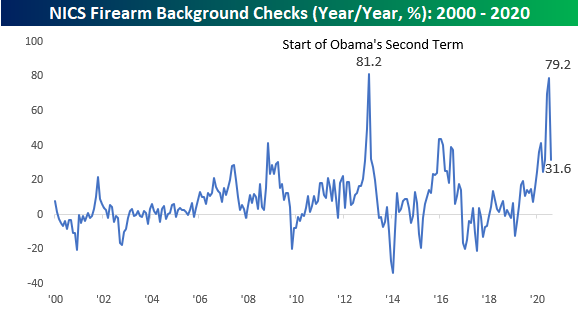
Chart of the Day: Who’s Next?
Not Much Pickup in New Highs
Every day in our Daily Sector Snapshot, we provide a look at the net percentage of S&P 500 stocks that are making new 52-week highs (percentage of new 52 week highs minus the percentage of new 52 week lows). Even though the S&P 500 has continued to hit new highs recently, the same cannot be said for much of the individual stocks that the index is comprised of. Historically for the S&P 500 when it has reached all-time highs, the average reading on the net percentage of new highs has stood at 12.35%. Today, it is around 5 percentage points lower at 7.33% and is off the post bear market low peak of 10.1% from July 23rd. The same can also be said for each of the eleven sectors. At the moment there is only one sector, Materials, that is currently at its highest level since the bear market low. Every other sector is currently off-peak with no stocks reaching new highs in Energy, Real Estates, and Utilities. Meanwhile, Consumer Staples has seen its share of stocks at new highs fall the most dramatically recently with the reading as of yesterday’s close the lowest since August 13th. Financials also continue to show positive readings but those remain far more muted than what was observed prior to the pandemic. On the other hand, unsurprisingly the sector with the highest net percentage of new highs currently is Technology at 16.9%, but that too is off the peak of nearly 20% from just about a week ago. Granted, for Tech that reading has generally been trending higher recently as it also has for Health Care, Industrials, Communication Services, and Consumer Discretionary. Start a two-week free trial to Bespoke Institutional to access our interactive economic indicators monitor and much more.

Bespoke’s Morning Lineup – 9/2/20 – Strong September Starts
See what’s driving market performance around the world in today’s Morning Lineup. Bespoke’s Morning Lineup is the best way to start your trading day. Read it now by starting a two-week free trial to Bespoke Premium. CLICK HERE to learn more and start your free trial.
“I’m totally used to deflation. Deflation is finished.” – Richard Fisher
Does somebody want to tell the market that the calendar says September? After the strongest first-day of September for the S&P 500 since 2010, global equities are in rally mode again today with Europe up nearly 2% and S&P 500 futures trading higher by over half of a percent.
ADP Employment for August just came out, and the headline reading missed expectations by a mile (428K vs 1,000K). While that’s a big miss, we would note that last month’s report was an even bigger miss relative to expectations (1,67K vs 1,200K), and even after that big miss, the NFP report two days later exceeded expectations by nearly 300K (1,763K vs 1,480K).
Be sure to check out today’s Morning Lineup for a rundown of the latest stock-specific news of note, market performance in the US and Europe, trends related to the COVID-19 outbreak, and much more.

With a rally of 0.75% yesterday, the S&P 500 kicked off the month with its best start to a September since 2010. Gains of this magnitude are not particularly common for the start of September. Since 1928, yesterday was just the 23rd time that the S&P 500 kicked off September with a gain of more than 0.50%. The table below highlights each of those occurrences along with the performance of the S&P 500 for the remainder of the month. In the 22 prior occurrences, the S&P 500 saw a median gain of 1.27% for the remainder of the month with positive returns 59% of the time. That may not sound like all that big of an advance, but for all months of September, the median performance from the close on the first trading day of the month has been a decline of 0.10% with gains slightly less than half of the time.

Daily Sector Snapshot — 9/1/20
Bespoke Stock Scores — 9/1/20
Zoom Video (ZM) Now The Best Performing Nasdaq 100 Stock YTD
Zoom Video Communications (ZM) is the talk of the town today after reporting a triple play after the close last night. ZM reported EPS and guidance more than double estimates and revenues one third higher than forecasts. In response to the blowout quarter, the stock has surged over 38% in today’s trading. That is the best single day for the stock since it IPO’ed back in April of last year.

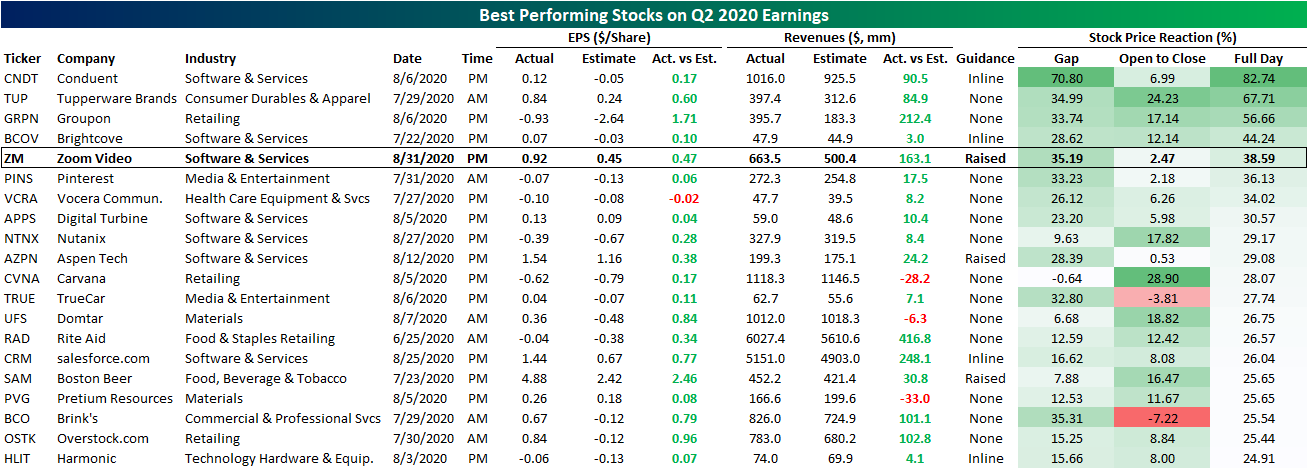
Using data from our Earnings Explorer, in the table below we show the 25 stocks that have seen the biggest positive price reactions to second-quarter results this year. As shown, ZM’s massive surge of buying today leaves it as the fifth best performing stock behind Brightcove (BCOV), Groupon (GRPN), Tupperware (TUP), and Conduent (CNDT). CNDT saw the biggest one-day gain on earnings of these when it rose over 82% on August 7th. One notable difference between ZM and the other top 5 best performers is intraday performance. Whereas ZM has only risen around 2.5% intraday, TUP, GRPN, and BCOV all rose double digits from open to close, and while it did not rise double digits, even CNDT saw much stronger performance intraday. Of the top 25 best reactions to earnings, in addition to ZM, there were only two other triple plays (EPS and sales beat plus raised guidance): Aspen Tech (AZPN) and Boston Beer (SAM).
Not only does ZM find itself on a “best of” list in terms of reactions to earnings, but with the massive boost from today’s performance, ZM has now overtaken Tesla (TSLA) as the best performing Nasdaq 100 stock in 2020. In the table below we show the top-performing quarter of the index YTD through today. As shown, the COVID economy staple tops the chart with an over 540% gain compared to the runner up — Tesla (TSLA). In terms of market cap, ZM is now the 28th largest stock in the index having added roughly $72.9 billion year to date. For comparison’s sake, that is roughly $0.5 billion less than the current value of Goldman Sachs (GS). Given these massive moves, the stock is very much trading at a premium (which we discussed in more depth in today’s Morning Lineup) and is very elevated versus its moving averages. ZM is currently 65% above its 50-DMA and 174.64% above its 200-DMA. The only comparable overbought stock in the index at the moment is TSLA. Click here to view Bespoke’s premium membership options for our best research available.

Chart of the Day: 95 Cents on the Dollar
New Orders Blowout
The Institute for Supply Management’s August reading on the manufacturing sector showed a third straight month of accelerating expansionary activity. The headline index rose to 56 compared to expectations of 54.8 and 54.2 in July. That is now the highest level of the index since November of 2018 when it read 58.8.

Breadth across each of the individual components of the report continues to be solid with just about every index higher month over month. The only two indices to fall were both for inventories. The index for Employment along with these indices for Business Inventories and Customer Inventories are also the only ones that remain in contraction as has been the case for the past few months. Employment has been on the rise over the past few months, so it’s not all bad though. Additionally, the declines in inventories may not necessarily be a bad thing as it coincides with strong demand and rising production, meaning strong demand is likely drawing on inventories rather than supply issues.

Demand is extraordinarily strong. Consistent with solid readings for New Orders across regional Federal Reserve manufacturing surveys, the ISM’s reading on New Orders has consistently risen over the past few months and is now around the top 5% of all historical readings going back to 1948. The 6.1 point increase to 67.6 leaves the index at its highest level since the final months of 2003/January of 2004. Prior to that, you have to go all the way back to 1983 to find a time that New Orders were this strong. That is an enormous turnaround compared to where things stood as recently as April when the index was at its low of 27.1; in fact, it is the most the index has risen in four months on record (second chart below). The 40.5 point rise in New Orders in that time surpasses a 39.5 point increase that went from June to October of 1980.


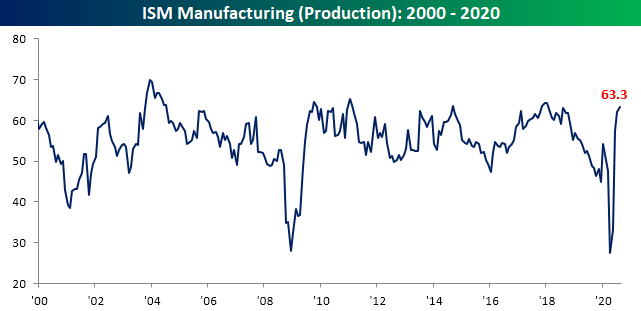
Given the historically strong demand, manufacturers continue to ramp up production. That index rose to 63.3 from 62.1 last month. That is the strongest reading since January of 2018.
Additionally, US manufacturers also appear to be ramping up general trade activity as both indices for Imports and Exports have risen. Export Orders index are at the same levels as January of this year after rising 2.9 points this month while Imports are even stronger at their highest level since June of 2018. Assuming those imports are mostly inputs, that could be a positive sign for future production.

Even though production continues to rise, it still appears that demand is outpacing supply as Backlog Orders also expanded for a second straight month. Backlog orders rose 2.8 points to 54.6. That 2.8 point month over month increase is in the top decile of all monthly changes and leaves the index at the highest level since November of 2018.

Further evidence of demand outpacing output can be seen through inventories. As mentioned earlier, the only areas of the survey that remain in contraction concern inventories. Both Business Inventories and Customer Inventories remain deep in contraction at 44.4 and 38.1, respectively. For Business Inventories, that is the lowest since January of 2014.
For Customer Inventories, that was the largest decline in a single month since December of last year and that is now the lowest level in over a decade with the last time it was this low being June of 2010. With inventories dwindling and demand historically elevated, these should act as tailwinds for future improvements to employment and production (as well as prices)
Click here to view Bespoke’s premium membership options for our best research available.

This is a Recession?
According to the National Bureau of Economic Research (NBER), the US economy peaked in February of 2020 with the economy beginning its downturn in March. With August just finishing, until the NBER says otherwise, we are now six months into the current recession. This morning’s ISM Manufacturing report for the month of August, however, would beg to differ.
Not only did the August report surpass expectations, but it also came in above 50 (expansion territory) for the third straight month. What stood out even more than the headline reading, though, was the commentary section of the report (shown below). Do these sound like the types of responses you would expect to see in a recession? Outside of one comment in the Transportation Equipment sector and another in the Machinery sector, all of the other responses were not only positive but in many cases, they were downright bullish. Interested in staying on top of the latest trends related to the market and economy? Start a two-week free trial to Bespoke Premium by clicking here.
