
Gun Background Checks Down Again
While background checks for the purchase of firearms may not be the most obvious example of an economic indicator, we find that they are worth watching as a gauge of sentiment. For example, if you see a sudden sharp increase in the number of background checks, it could be a signal of increased uncertainty on the part of Americans. After all, when things are going smoothly in the economy and society, people probably don’t feel the need to go out and buy a gun. A perfect case in point is last year during the early days of the pandemic in the Spring. In January 2020, right before COVID, there were 2.7 million background checks for the purchase of firearms. By March, even with most of the economy locked down, background checks surged 37% to 3.7 million. After that initial COVID surge, background checks dropped off a bit but then rebounded throughout the summer as protests flared up across the country. Then, after President Biden was elected and Democrats gained control of the House and the Senate, there was one last surge to a peak of 4.69 million in March 2021.

From that peak in March 2021, background checks have plunged over the last six months to a pre-COVID level of 2.63 million. Not only that, but with six straight months of declines, there has only been one other period in the last 20 years where background checks declined for as many consecutive months. That was back in June 2013 just after President Obama was re-elected. Since Democrats are traditionally more anti-gun than Republicans, any time they do well in elections, it creates a short-term surge in people looking to buy firearms in order to get ahead of any potential anti-gun legislation.

While a drop in firearm purchases suggests an easing level of uncertainty on the part of Americans, it’s obviously not good for the manufacturers of firearms. As shown in the charts below, both stocks are well off their recent highs and are currently testing support levels. Smith and Wesson (SWBI) has actually nearly been cut in half from its highs in the Summer, and while Sturm Ruger (RGR) has held up much better, it is still down 20% from its high. Read Bespoke’s most actionable market research by joining Bespoke Premium today! Get started here.


Bespoke’s Morning Lineup – 10/4/21 – Hostage to Interest Rates
See what’s driving market performance around the world in today’s Morning Lineup. Bespoke’s Morning Lineup is the best way to start your trading day. Read it now by starting a two-week trial to Bespoke Premium. CLICK HERE to learn more and start your trial.
“If a window of opportunity appears, don’t pull down the shade.” – Tom Peters
Equities are looking lower to start to the week, but the magnitude of the losses has narrowed over the last hour or so. There’s very little in the way of economic or earnings-related news to deal with today. For the week, the major economic news will be Tuesday’s ISM Services report and Friday’s Non-Farm Payrolls. That will give investors plenty of time to focus on negotiations in Washington over reconciliation and the debt ceiling.
Read today’s Morning Lineup for a recap of all the major market news and events from around the world, including the latest US and international COVID trends.
With equity futures lower, one thing you can count on is that interest rates are moving higher to start the week. As shown in the chart below, the performance of the equity market has recently been closely tied to the direction of the 10-year US Treasury yield on an inverted basis. For much of the last six months, SPY has moved step for step with the yield on the 10-year. The only period of divergence was back in August when yields first started to move higher (shown in the chart below as a falling red line). Initially, the S&P 500 kept moving higher, but by early September, the tug of interest rates began to pull the equity market lower.

Start a two-week trial to Bespoke Premium and read today’s full Morning Lineup.
Bespoke Brunch Reads: 10/3/21
Welcome to Bespoke Brunch Reads — a linkfest of the favorite things we read over the past week. The links are mostly market related, but there are some other interesting subjects covered as well. We hope you enjoy the food for thought as a supplement to the research we provide you during the week.
While you’re here, join Bespoke Premium with a 30-day free trial!
Conflicts of Interest
131 Federal Judges Broke the Law by Hearing Cases Where They Had a Financial Interest by James V. Grimaldi, Coulter Jones and Joe Palazzolo (WSJ)
More than 685 lawsuits heard between 2010 and 2018 involved judges that had an explicit financial conflict due to ownership of stocks impacted by the suits. [Link; paywall]
Kaplan Steps Down as Dallas Fed Chief, Hours After Rosengren by Catarina Saraiva and Craig Torres (Bloomberg)
After revelations that two different regional Fed Presidents traded individual stocks during 2020 and called their objectivity into question, both have stepped down within hours of each other. [Link; soft paywall]
Investing Business
Fidelity Brings Fractional Share Trading to Advisors by Diana Briton (Wealth Management)
RIA custody clients of Fidelity will get the ability to trade fractional shares for their clients across both single stocks and ETFs. Custody clients will get the benefit slightly later. [Link]
Franklin to Buy Custom Indexing Firm O’Shaughnessy to Help Personalize Portfolios by Justin Baer (WSJ)
Asset management giant Franklin Resources is betting on custom indexing, buying a modest asset manager whose core strength is a technology platform that allows investors to create and get exposure to custom indices. [Link; paywall]
University Endowments Mint Billions in Golden Era of Venture Capital by Juliet Chung and Eliot Brown (WSJ)
Numerous colleges saw their endowments gain more than 50% in the year ended June as favorable base effects and huge returns from venture investing sent the value supporting private colleges to their best years on record. [Link; paywall]
Downfall
Graveyard of the bikes: Aerial photos of China’s failed share-cycle scheme show mountains of damaged bikes (Straits Times)
The explosive growth of bike sharing programs in China didn’t lead to the sort of permanent demand that had been expected and the result is massive “graveyards” for scrapped bikes which are discarded when riders don’t turn up. [Link]
The Ancient People Who Burned Their Culture to the Ground by Blair Mastbaum (Atlas Obscura)
A pre-Roman society in Spain that was one of the most developed and powerful in the region is being unveiled by a site in Extremadura that suggests a self-destructive end. [Link]
TV
Why Is Every Young Person in America Watching ‘The Sopranos’? by Willy Staley (NYT)
A wandering investigation of why so many younger Americans – many far on the political left – are jumping into The Sopranos. The show is less about the Mafia, and more about American decline, or so many new enthusiasts argue. [Link; soft paywall]
How Peyton and Eli Manning Are Changing Television by Jason Gay (WSJ)
Three weeks in to the NFL season, ESPN’s experimental Manning-only version of their Monday Night Football broadcast has achieved rave reviews for its Twitch-like approach to covering sports. [Link; paywall]
Inflation & Shortage
An Obscure Chinese Mining Law Is Hobbling Global Energy Security by Alfred Cang (Bloomberg)
Back in March, Chinese coal miners faced stepped-up requirements for miner safety, which has made it harder to expand production of the critical energy resource. Tighter climate enforcement has also played a role, but this key factor has flown further under the radar. [Link; soft paywall]
Dollar Tree to Sell More Items Above $1 as Costs Rise by Sarah Nassauer (WSJ)
Famous for selling nothing at more than a single dollar bill, Dollar Tree has decided to shift strategy amidst supply chain costs and high demand. Previously the chain had experimented with higher-dollar items, but this latest choice is a more widespread one. [Link; paywall]
The Return of Empty Shelves and Panic Buying by Andrea Felsted (Bloomberg)
Supply chain snarls have left some grocery shelves empty in a vibe reminiscent of pandemic panic buying back in March and April of 2020. COVID restrictions around the world are also playing a role. [Link; soft paywall]
COVID
Merck to seek emergency US approval of oral COVID treatment by Will Feuer (NYPost)
Clinical trials for a 5 day course of pills designed to fight COVID severity went so well that the trial was discontinued in order to give all participants the drug. It appears to prevent hospitalization entirely. [Link]
Newsom orders COVID vaccines for eligible students, the first K-12 school mandate in nation by Howard Blume, Rong-Gon Lin II, and Taryn Luna (LAT)
All eligible school children in the country’s largest state will be required to receive COVID vaccinations per a mandate from Governor Gavin Newsome on Friday. [Link]
Real Estate
Squamish Nation moves Vancouver forward with transformative Senakw project by Kenneth Chan (Daily Hive)
Frustrated by anti-development elements in Vancouver, the Squamish Nation is using its special legal status to opt out of approval by the city government, giving the stiff-arm to anti-housing advocates and introducing 50+ story residential towers to Kitsilano. [Link]
Fedcoin
Analysis: U.S. Fed navigates policy minefield with impending digital dollar report by Jonnelle Marte and Michelle Price (Reuters)
The Fed is due to release a report exploring adoption of a digital dollar not reliant on bank liabilities like deposits. Some helpful background explains how the central bank is likely to come down on the issue in this read. [Link]
Emissions
Electric Cars Have Hit an Inflection Point by Robinson Meyer (The Atlantic)
After years of slowly building momentum, EV adoption and production have reached a point of critical mass. Climate subsidies and charging network rollouts well help smooth the process, but even without more state support the shift towards zero emission driving is here to stay. [Link]
Hole in the ozone layer widens as recovery remains in the distance by Camilla Hodgson, Claire Buchan and Steven Bernard (FT)
While the end of CFC use means that the ozone layer will repair itself over time, this year has still seen a record large gap in UV protection over Antarctica. [Link; soft paywall]
Irrational Investors
Individuals Embrace Options Trading, Turbocharging Stock Markets by Gundan Banerji (WSJ)
Retail investors continue to sway markets, with options the latest space to get large flows of retail trading that was scarce or inconsistent only a few years ago. [Link; paywall]
MIT Study Finds Older Men Are More Likely to Panic Sell Stocks (Bloomberg/The Wealth Advisor)
Three critical factors made investors more likely to dump stocks during selloffs: being male, being over the age of 45, being married, or having a self-described “excellent” level of investment experience. [Link]
Texas
JPMorgan’s Texas Muni Work Becomes Latest Culture War Fallout by Amanda Albright and Danielle Moran (Bloomberg)
Texas laws designed to punish private companies for taking stances on certain political questions will shut JP Morgan out of the $58bn Texas muni underwriting market. [Link; soft paywall]
Read Bespoke’s most actionable market research by joining Bespoke Premium today! Get started here.
Have a great weekend!
The Bespoke Report Newsletter — 10/1/21
This week’s Bespoke Report newsletter is now available for members.
September 2021 ended with a thud this week with the S&P 500 falling 1.2% on the last trading day of the month. The turn of the calendar to October marked a turning point for the market as well, as the S&P rose 1.15% on the first day of the month to close out the trading week. This week’s Bespoke Report looks closely at the recent action in leading groups and sectors like the semiconductors and the transports. We also check in on the economy as the Delta wave recedes. There are a ton of insights on both markets and the economy in this week’s newsletter, and you can read it now with a two-week trial to our subscription service — Bespoke Premium. Click here to learn more about Bespoke Premium and start a two-week trial if you’re interested.


Mega Caps Underperforming as Energy Explodes
In November of last year, we took a look at the performance spread between the equal and market cap weighted versions of the S&P 500. The chart below provides an update through the end of September where positive readings indicate outperformance of the equal-weight S&P 500 and negative readings indicate outperformance of the market cap weighted index. In March 2020, as the market was plunging from the February peak and bottoming towards the end of the month, mega-caps such as Apple (APPL), Microsoft (MSFT), Alphabet (GOOGL), Amazon (AMZN), and Facebook (FB) significantly outperformed the broader market, resulting in a 5.68 percentage point spread between the return of the equally weighted and market cap weighted S&P 500. Whereas the equal-weighted index declined 18.19% in March 2020, the market cap weighted index dropped ‘just’ 12.51%. In a reversal of these trends, the equal-weighted index outperformed between the months of September 2020 and March 2021, rallying 30.84% while its market cap weighted counterpart gained 18.14%. Over these months, there was a maximum monthly spread of 3.37 percentage points in favor of the equal-weighted index, which occurred last December. In recent months, mega-caps briefly took back the reins before the trend reversed in September when the equal-weighted index outperformed by 0.82 percentage points.

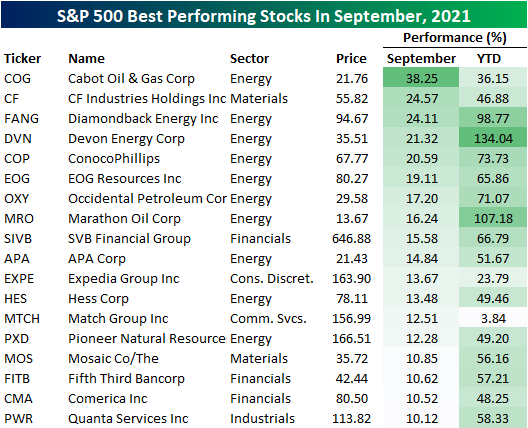
With the month of September behind us, the table below lists the 18 stocks in the S&P 500 that finished the month up over 10%, and less than a quarter of the stocks in the index (22%) finished the month higher. Overall, the average performance of stocks in the index was a decline of 3.7 percentage points. While short-term performance has been weak, on a YTD basis, 81.42% of S&P 500 stocks are up on the year, and the overall average gain is 18.90%. Of the stocks that have rallied 10%+ in September, more than half are from the Energy sector and another three come from the Financials sector. Click here to view Bespoke’s premium membership options.
Q3 Asset Class Performance
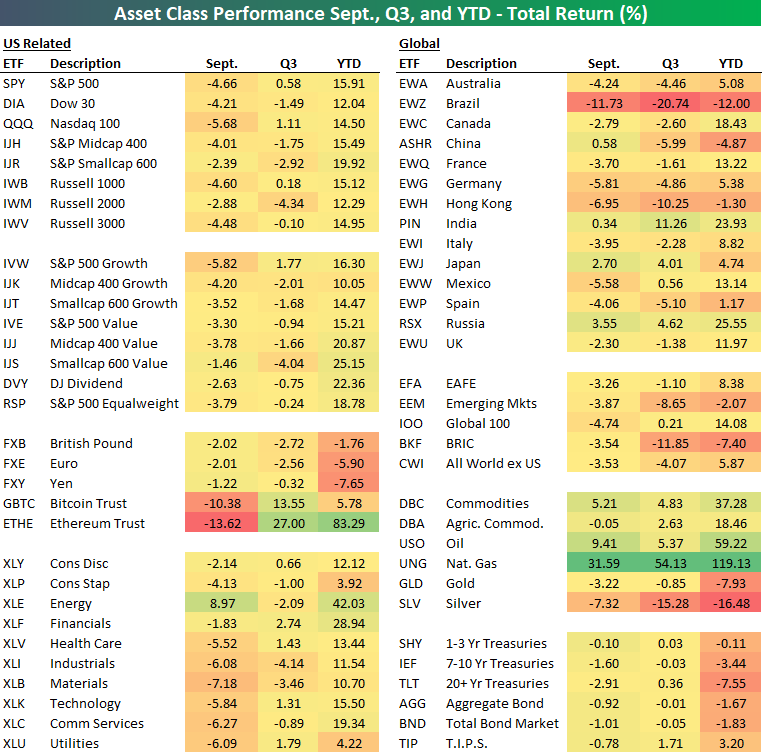
Q3 and the month of September are now in the books, and it was not a great period for US equities. As shown in our asset class performance matrix below, the sole portion of the US equity market that was higher in September was Energy stocks. Every other sector, theme, and major index was lower on the month. As for global equities, performance was more mixed with declines ranging from 11.73% for Brazil (EWZ) to a 3.55% gain for Russia, though, most country ETFs were lower on the month.
Commodities had a good month particularly in the energy space with crude oil (USO) gaining 9.41% and Natural Gas (UNG) rising an astounding 31.59%. That lifted the total gain in Q3 to 54.13% while it has returned almost 120% year to date; the best performer for both time periods. Precious metals, namely silver (SLV), on the other hand, was hit particularly hard. As for cryptos, Ethereum (ETHE) was another top performer YTD and in Q3, but September pared those gains. ETHE fell 13.62% in September while Bitcoin (GBTC) also fell by double-digit percentages. Click here to view Bespoke’s premium membership options.
Daily Sector Snapshot — 10/1/21
Bespoke Matrix of Economic Indicators – 10/1/21
Our Matrix of Economic Indicators provides a concise summary analysis of the US economy’s momentum. We combine trends across the dozens and dozens of economic indicators in various categories like manufacturing, employment, housing, the consumer, and inflation to provide a directional overview of the economy.
To access our newest Matrix of Economic Indicators, start a two-week free trial to either Bespoke Premium or Bespoke Institutional now!
B.I.G. Tips – October Intra-Month Seasonality
Bespoke’s Morning Lineup – 10/1/21 – Merck Friday
See what’s driving market performance around the world in today’s Morning Lineup. Bespoke’s Morning Lineup is the best way to start your trading day. Read it now by starting a two-week trial to Bespoke Premium. CLICK HERE to learn more and start your trial.
“As an investor, my job is to figure out what will happen rather than what should happen.” – David Einhorn
It wasn’t looking like a positive start to October earlier this morning as futures were significantly lower, but beginning at 6 AM we started to see a turnaround following positive trial results from Merck (MRK) regarding its oral anti-viral COVID treatment. The thought of being able to simply pop a pill to significantly reduce the chances of an adverse reaction to COVID would be a big step in returning back to normal.
Given the volatility and sell-offs we’ve seen during the regular trading session this week, there’s still a real possibility that these early gains don’t hold, but at least this morning we’ve seen futures strengthening from low levels throughout the morning rather than the opposite of weakness from higher levels.
Read today’s Morning Lineup for a recap of all the major market news and events from around the world, including the latest US and international COVID trends.
As far as closing acts go for a quarter, Q3’s exit was one to forget. Over the last week of the month, the S&P 500 dropped 3.18% for its worst final week of September since 2003 when it dropped by a similar amount. In the S&P’s history, there have been thirteen prior years where the index dropped more than 2.5% in the final week of September, and we have highlighted each of those years below.
Looking ahead to today and the first week of October, weak finishes to September have historically been followed by a weak first day of October. In the thirteen prior years shown, the S&P 500 dropped by an average of 0.19% (median: -0.60%) on the first trading day of October with positive returns just under a third of the time. Based on the turnaround we have seen in futures this morning, we may be on pace to buck that trend today.
While the first trading day of the month has been weak, the first week of October has been positive with an average gain of 0.30% (median: 0.93%) and positive returns just over two-thirds of the time. Relative to the long-term average, returns on the first trading day of October have been below average while performance in the first week of October has been pretty much right in line with the historical average of all first weeks of October.

Start a two-week trial to Bespoke Premium and read today’s full Morning Lineup.