Bespoke’s Morning Lineup – 10/30/20 – Got That Over With
See what’s driving market performance around the world in today’s Morning Lineup. Bespoke’s Morning Lineup is the best way to start your trading day. Read it now by starting a two-week free trial to Bespoke Premium. CLICK HERE to learn more and start your free trial.
“My model for business is The Beatles. They were four guys who kept each other kind of negative tendencies in check. They balanced each other and the total was greater than the sum of the parts. That’s how I see business: great things in business are never done by one person, they’re done by a team of people.” – Steve Jobs
Investors had been looking warily forward to last night’s earnings reports for several days now as several of the largest companies in the world reported their Q3 results. While the reaction to the reports hasn’t been positive, it could have been worse. Futures are indicating a decline of almost 1% at the open, but that is actually more than 1% off the lows.
On the data front, both Personal Income (0.9% vs 0.4% est) and Spending (1.4% vs 1.0% est) topped expectations, while the Employment Cost Index came in right in line with forecasts (+0.5%).
Given it’s month-end, there could be some volatility today, but don’t expect much in the way of news to clear the haze regarding any of the short-term issues facing investors.
Be sure to check out today’s Morning Lineup for a rundown of the latest stock-specific news of note, market performance in the US and Europe, key earnings data from the US and Europe, economic data, trends related to the COVID-19 outbreak, and much more.

With futures currently indicating a decline of over half of one percent today, the S&P 500 is on pace for a decline of 5% this week. For the year so far, this would rank as the worst week since March and the fourth-worst week of the year. Between rising COVID cases around the country, next week’s election, and lackluster reactions to solid earnings reports, there are more than a few concerns on the minds of investors heading into the last two months of the year.

Record Triple Plays and the Reverse
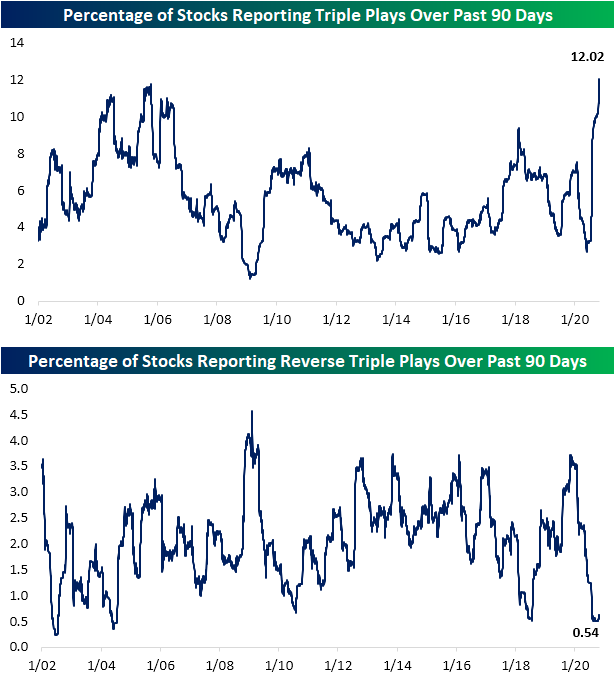
We have frequently been making note of the extraordinary beat rates for earnings this earnings season. As such, companies are reporting triple plays at an astounding rate. An earnings triple play is when a company beats estimates on both the top and bottom lines while simultaneously raising guidance. These can be taken as a sign of a solid fundamental picture for a stock. We keep track of the 100 most recent triple play, and over a third of that list reported within the last 24 hours! We are currently in one of the busiest 24 hour periods of earnings season with 238 companies having reported last night after the close and this morning. Of those, 38 reported triple plays. On a slightly longer time horizon, in the charts below we show the percentage of stocks reporting triple plays over the past 90 days on a rolling basis. In the past 3 months, 12.18% of earnings reports have been a triple play. In the history of our Earnings Explorer database, there has never been a period with such a massive share of stocks reporting these types of results.
We also thought it would be worth taking a look at the inverse of this. In the second chart below we show the percentage of stocks reporting a reverse triple play: miss on both the top and bottom line while lowering guidance. While there has been a small uptick in this reading over the last few days, it is still at a historically low 0.54% of stocks reporting. That is just 10 stocks over the past three months! When it comes to the recent uptick, this month there were only two reverse triple plays and both reported in the past day: Fastly (FSLY) which reported last night and FTI Consulting (FCN) releasing results this morning. In today’s session, both stocks are getting hammered with FSLY down over 6% and FCN down more than twice that. When the number of companies reporting triple plays is at record highs, you don’t want to be one of the companies reporting a reverse triple play. Click here to view Bespoke’s premium membership options for our best research available.
Bulls and Bears Split
The American Association of Individual Investors released this week’s reading on investor sentiment and things were little changed despite the S&P 500 having fallen roughly 4.75% in the past week. Last week, bullish sentiment rose above 35% for the first time since April 9th reaching 35.75%. This week, optimism held above 35%, but it was slightly lower than last week dropping to 35.29%

Conversely, bearish sentiment rose 2.26 percentage points this week. That is the first time bearish sentiment has moved higher (and the first time bullish sentiment has moved lower) since the last week of September. Whereas last week marked the end of a record-long streak of negative readings of the bull-bear spread (meaning bearish sentiment outweighed bullish sentiment), this week bearish sentiment is dead even with bullish sentiment at 35.29%.
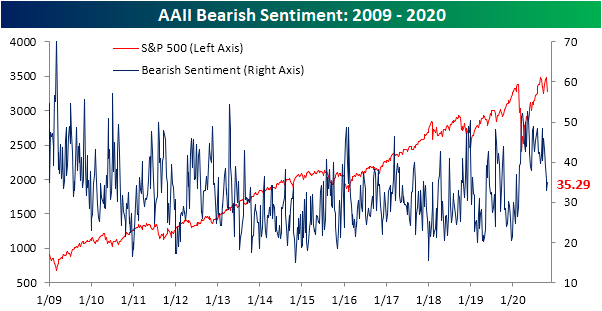
In the history of the AAII survey dating back to mid-1987, there have only been 47 weeks in which bullish sentiment matched bearish sentiment with the most recent example being late January of last year. On average across those instances, the two readings on sentiment have been 33.5%. In the table below, we show all 11 occurrences that have happened without another occurrence in the prior year. As shown, the last such occurrence was in September of 2018, a few months before the previously mentioned January 2019 instance. Back then, bullish and bearish sentiment stood at 32.04%. As for the performance of the S&P 500, even readings in bullish and bearish sentiment have usually been followed by gains although the magnitude of the advance is pretty much right in line with the historical averages for all periods. Click here to view Bespoke’s premium membership options for our best research available.


Claims Keep Up Their Momentum
Jobless claims have kept up their momentum as they fell for a second straight week. With the caveat of differences in seasonal adjustment methodologies beginning in September making comparisons not exactly like for like, this week’s print of 751K is a new low for the pandemic. That is down 40K from last week’s upwardly revised reading of 791K. It was also significantly better than expectations which were calling for claims to only fall to 778K.
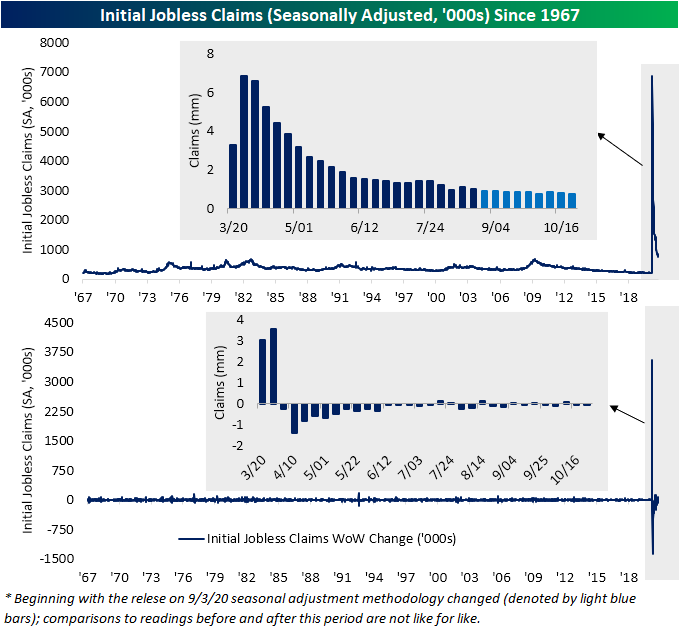
Lagged one additional week to initial claims, continuing claims also reached its lowest levels since March this week. Seasonally adjusted claims fell to 7.756 million. That is 709K lower than last week. Since the first week of September, continuing jobless claims have fallen every week but one (9/12) when claims were unchanged. Although claims did improve this week, forecasts had penciled in for a slightly larger improvement, calling for claims to fall to 7.7 million.

On a non-seasonally adjusted basis, claims were actually not at a new low for the pandemic, but they did come very close. Unadjusted claims did fall from 760.6K last week down to 732.2K, but that is 1K above the prior post-COVID low from the first week of October.

Even though unadjusted initial claims are not necessarily at a new low, recent improvements have appeared to be going against seasonal tendencies. As shown in the charts below, both initial and continuing claims have historically risen from now through the end of the year. Instead, this year has seen claims continue to grind lower. In fact, unadjusted continuing claims did reach a new low in the most recent reading.
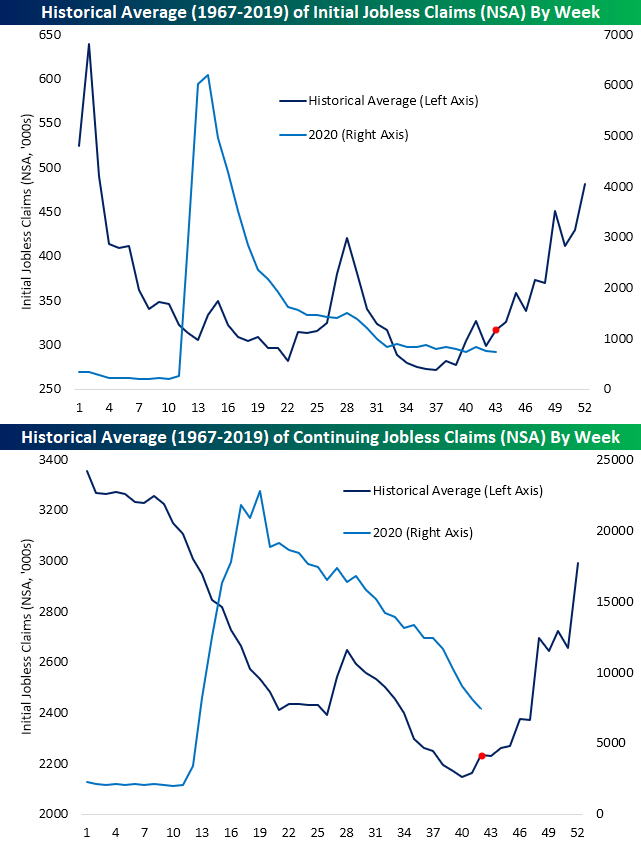
While the inclusion of all programs in addition to regular state claims creates yet another week’s lag, by this measure claims also fell to a new post-COVID low. For the week of October 9th, total continuing claims were 22.7 million, a decline of 0.4 million from the previous week. Total claims have now declined for four consecutive weeks, the longest streak of back to back declines of the pandemic. Regular state claims drove this decline while Pandemic Unemployment Assistance (PUA) and Pandemic Emergency Unemployment Compensation (PEUC) have actually risen. For PUA claims, the most recent week’s increase actually still leaves the count for the program at the low end of its range. Meanwhile, PEUC claims, which extend regular unemployment benefits up to 13 weeks after expiration are at new highs for the pandemic. Given this, they now take up their largest share of total continuing claims yet (16.2%). Extended benefits, on the other hand, were lower in the most recent week but remain at the high end of their range. In other words, net overall claims have continued to improve, but the declines in some measures (namely regular state and PUA claims) have not necessarily meant all those people are exiting the unemployment insurance system, but rather a growing number of people are filing for available extensions. Click here to view Bespoke’s premium membership options for our best research available.

Chart of the Day: FAANG Keeping Stocks Green
GDP Up Big But Still Deep in the Hole
Following the record decline in Q2, economists were expecting Q3 to be a record in the opposite direction. And that’s exactly what we got. While economists were expecting growth of 32.0% on a seasonally adjusted annualized rate (SAAR), the actual reading came in even stronger at 33.1%. With economic growth of 33.1% following a quarter where activity shrank 31.4%, a person’s first reaction may be to think it’s a wash, but you know math, so you know that’s not how it works.
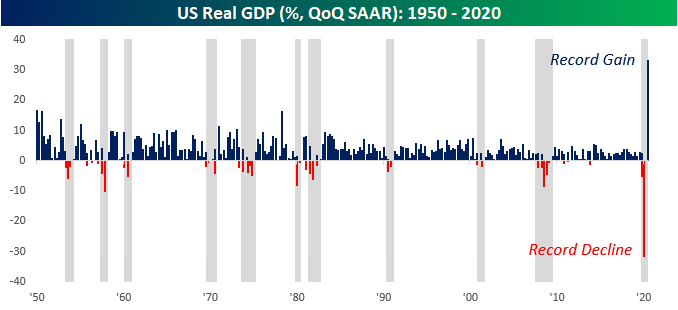
The chart below shows US GDP in dollar terms going back to 2000. After Q2’s decline, economic activity in the US was more than 10% below its prior peak, and even after Q3’s rebound, we’re still down 3.5% from Q4 2019.

3.5% may not sound like much of a hole, but it’s still a large number. The chart below shows how far GDP was off its record high each quarter since 1950. Because the US economy is normally growing, GDP is typically at record highs, and even when activity contracts, the magnitude of the decline is usually measured in the low single-digit percentage range. Prior to the COVID shutdowns, in fact, there was never a time in the last 70 years where GDP was more than 4% off a prior peak. At the end of Q2, the hole was more than twice that at 10.2%. Because of that, even after a record quarter of growth, GDP is still further below its peak than it has been in all but two other periods (1958 & 2009) in the seventy years leading up to the start of 2020. Like what you see? Click here for instant access to our actionable research and interactive tools.

Bespoke’s Morning Lineup – 10/29/20 – GDP Beats and Post Pandemic Low in Claims
See what’s driving market performance around the world in today’s Morning Lineup. Bespoke’s Morning Lineup is the best way to start your trading day. Read it now by starting a two-week free trial to Bespoke Premium. CLICK HERE to learn more and start your free trial.
“It’s not what happens to you, but how you react to it that matters.” – Epictetus
We got some big economic numbers this morning as Q3 GDP rose at an annualized rate of 33.1% versus forecasts for growth of 32.0. This is obviously a record number, but when a 33.1% gain follows a 31.4% drop, you’re still almost 10% in the hole. Jobless claims also dropped this week as both initial and continuing claims dropped to post-pandemic lows. So far, the initial market reaction has been positive. Futures were higher overnight, reversed all of those gains and more heading into the report, but have now moved back into positive territory after the releases.
Be sure to check out today’s Morning Lineup for a rundown of the latest stock-specific news of note, market performance in the US and Europe, key earnings data from the US and Europe, economic data, trends related to the COVID-19 outbreak, and much more.
Even for a big down day like yesterday, there was a pretty decent amount of technical damage within the market as the percentage of stocks trading above their 50-day moving average (DMA) dropped from 46.1% down to 27.4%. Heading into this week, more than two-thirds of stocks in the S&P 500 were above their 50-DMA, today it’s less than a third, and based on where the futures are now, it may be less than a quarter by the closing bell.
The last time there was a lower percentage of stocks above their 50-DMA was just back at the September lows when it bottomed out at 25.5%, and before that, you have to go back to the Spring to find lower readings. All in all, readings like the current one represent oversold conditions but aren’t especially rare.

All or Nothing Days Back on the Rise
The S&P 500’s A/D line for the day (number of advancing stocks minus number of declining stocks) currently stands at about -460, which would be the weakest one-day reading since June. Today’s A/D reading also is notable in that it represents the tenth ‘all or nothing’ day for the S&P 500 since the index’s last peak on 9/2. We consider ‘all or nothing’ days to be those days where the S&P 500’s daily A/D reading is either above +400 or below -400. To put the frequency of ‘all or nothing’ days into perspective, while there have been ten in the last forty trading days, in the forty trading days before that there weren’t any.
The chart below shows the percentage of ‘all or nothing’ days on a 50-day rolling basis. The current pace of 20% is still well off the extraordinary level of 44% we saw back in late April/early May, but it is still relatively high.

Including today, there have now been 41 ‘all or nothing’ days so far in 2020. If the current pace for the entire year keeps up that will put us on pace for fifty days this year. If the current pace keeps up and we do reach 50 ‘all or nothing’ days this year, it will be the third-highest annual total behind 2011 (70) and 2008 (52), but even if there isn’t another ‘all or nothing’ day this year, 2020 would still rank fifth behind the years from 2008 through 2011. Like what you see? Click here for instant access to our research and interactive tools.

Earnings and Economics Diverge
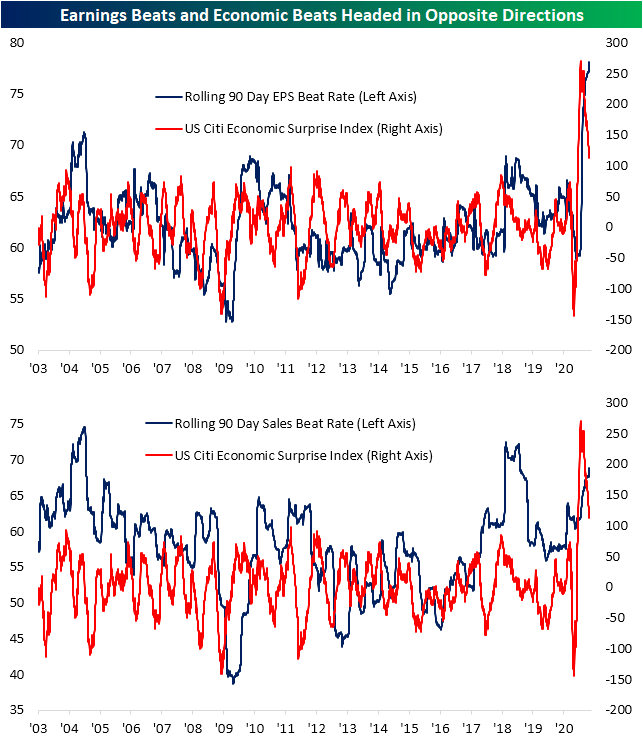
This earnings season, we have frequently mentioned how beat rates have continued to rise relentlessly. From our Earnings Explorer database, our 3-month rolling EPS beat rate currently stands at a record high of 78.19%. That is nearly 20 percentage points higher than the historical average of 59.37%. The sales beat rate is not at a record, but it too is elevated at 69.09% versus the historical average of 56.45%. That means that of the companies that have reported earnings over the past three months, a massive proportion are exceeding consensus sales and EPS estimates.
While earnings beat rates have continued to grind higher, economic data is another story. The Citi Economic Surprise Index basically tracks macroeconomic data and how it comes in relative to forecasts. Higher readings indicate the data is trending stronger than expected and vice versa for negative readings. With the unprecedented shock to macroeconomic data in 2020, this index for the United States plummeted, but that was followed by a sharp rebound to record highs. Although the index for the US remains higher than anything prior to the pandemic, it has been heading lower since the summer. In other words, economic data is still coming in better than expected but is not massively exceeding expectations to the degree it was back in the spring and early summer.
The two charts below compare EPS and revenue beat rates to the Citi Economic Surprise Index. Comparing the two series to the Citi Economic Surprise Index shows that while EPS beat rate has been somewhat connected (correlation: +0.325)) there is very little in the way of correlation between the Surprise Index and the revenue beat rate (+0.084). Given that EPS figures are typically easier to massage than revenues, that was a bit of a surprise. What is notable about the recent decline in the Citi Economic Surprise Index is that in prior periods where it became elevated and then pulled back as it did in (2003, 2009, and 2018), the EPS beat rate typically didn’t peak and start to trend lower for another few months. Click here to view Bespoke’s premium membership options for our best research available.
More Pain for European Stocks
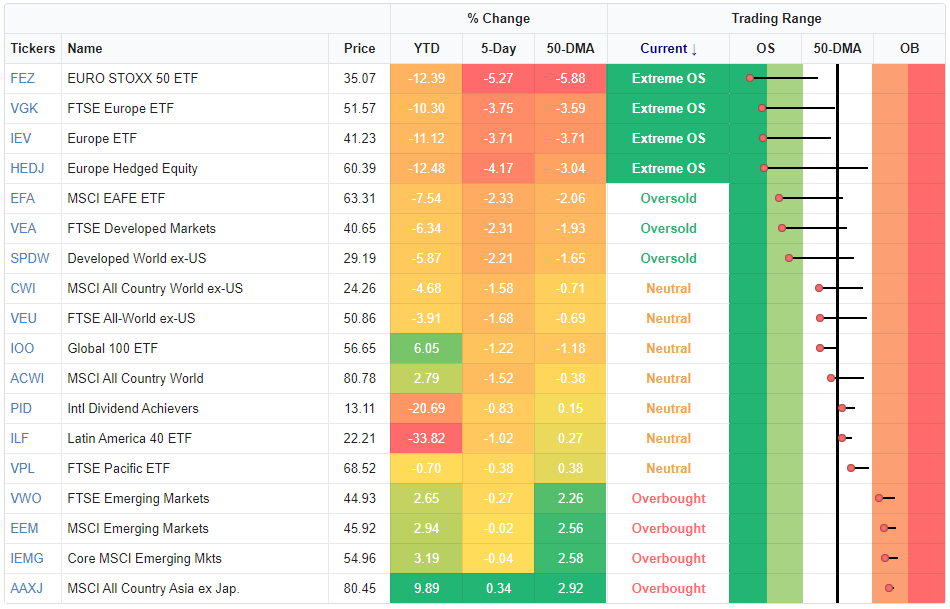
Looking across the various regions tracked in our Trend Analyzer tool, broadly speaking equities are lower over the past week, but some of the worst performance comes from across the pond in Europe. As shown, the ETFs tracking European equities are all down the most over the past five days through yesterday’s close. That leaves each one over 2 standard deviations below their 50-DMAs. On a year to date basis, these have similarly been serial underperformers along with the Latin America 40 ETF (ILF).
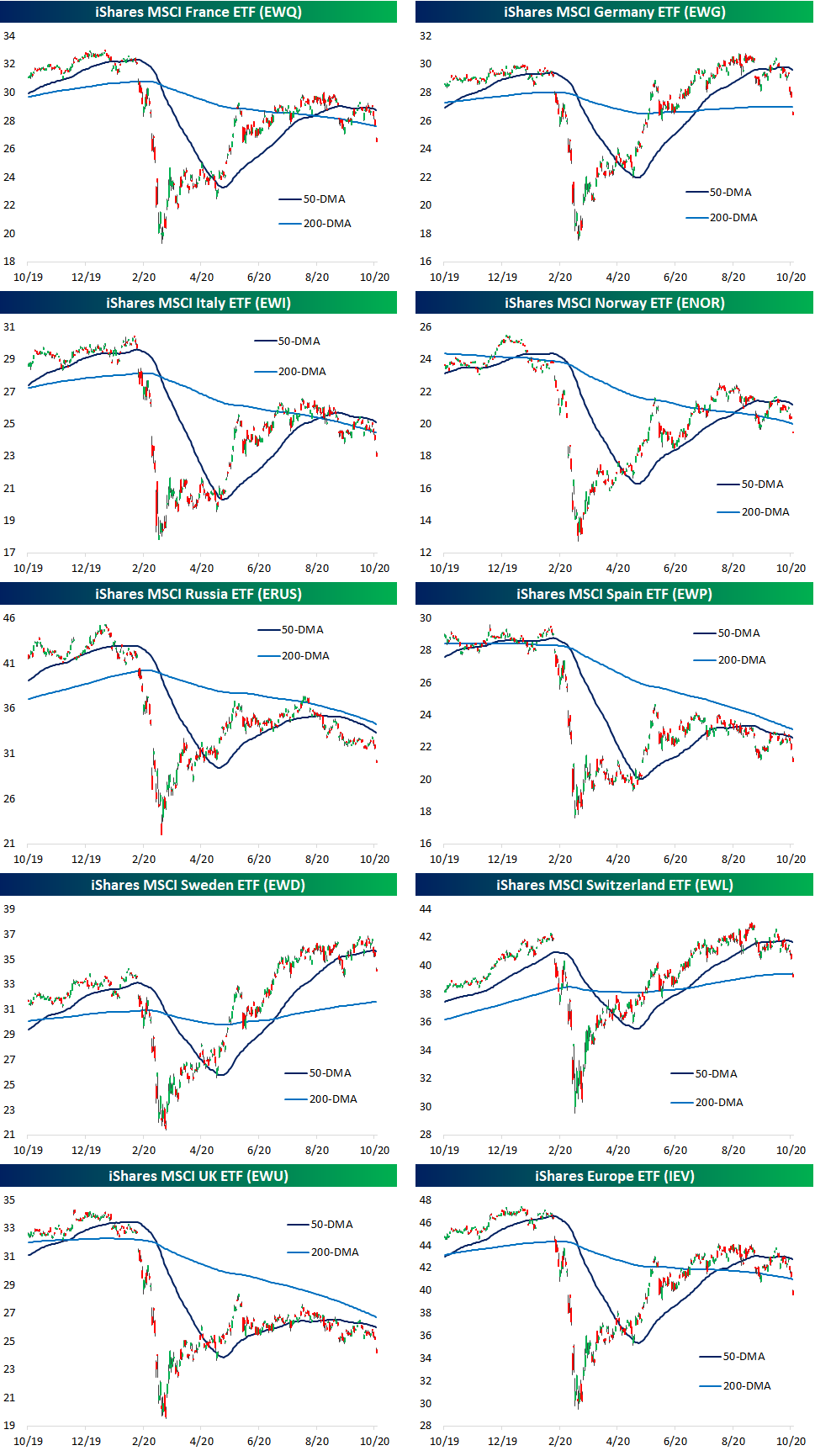
Taking a more granular look at specific European countries, in the charts below we show the ETFs tracking the equity markets of each of the European countries in our Global Macro Dashboard as well as an ETF tracking European equities more broadly: the iShares Europe ETF (IEV). As shown, whereas the region was already weak headed into today’s session, the pain has only gotten worse this morning. So far today, these 10 ETFs are down an average of around 4% as the region experiences an upswing in COVID cases and reinstating of lockdowns in places like Germany and France.
From a technical perspective, today’s big drops are not doing these country ETFs any favors. Most of these ETFs have been trading sideways over the past few months, and today’s sharp turn lower is marking breaks of various support levels. For some like Sweden (EWD), it is a break below the 50-DMA while others like Germany (EWG) are falling below their longer term 200-DMAs. Other country ETFs such as Spain (EWP) and Russia (ERUS) have been trading under their moving averages for some time now, but today’s decline has broken additional support that was formed from prior lows. Click here to view Bespoke’s premium membership options for our best research available.