
The Bespoke Report — 10/4/19
This week’s Bespoke Report newsletter is now available for members.
Stocks bounced big late in the week after the details of the Employment Situation Report helped a bid in equities that started Thursday. Big drops in equity markets in response to ISM numbers early in the week were mostly clawed back. So which should matter more, the soft ISM surveys or the hard data on jobs? We give a definitive answer, as well as discussing a range of other economic and market details. To read the Bespoke Report and access everything else Bespoke’s research platform has to offer, start a two-week free trial to one of our three membership levels. You won’t be disappointed!

The Closer: End of Week Charts — 10/4/19
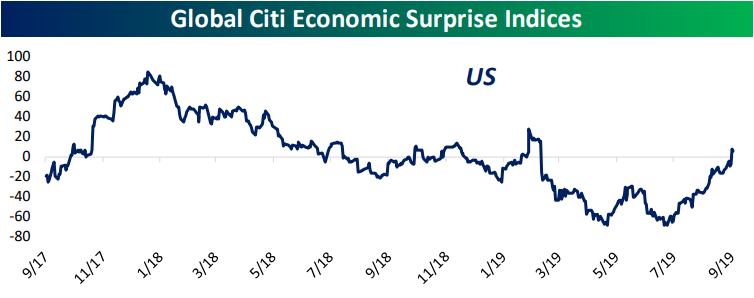
Looking for deeper insight on global markets and economics? In tonight’s Closer sent to Bespoke clients, we recap weekly price action in major asset classes, update economic surprise index data for major economies, chart the weekly Commitment of Traders report from the CFTC, and provide our normal nightly update on ETF performance, volume and price movers, and the Bespoke Market Timing Model. We also take a look at the trend in various developed market FX markets.
The Closer is one of our most popular reports, and you can sign up for a free trial below to see it!
See tonight’s Closer by starting a two-week free trial to Bespoke Institutional now!
Next Week’s Economic Indicators – 10/4/19
All-in-all, it was a pretty mixed week for economic data, specifically manufacturing and labor data. While Markit’s gauge on manufacturing was slightly stronger than both expectations and the August print, ISM’s version disappointed with little in the way of bright spots among its components. Hard data, on the other hand, is showing a bit of a different picture as Durable Goods appear healthy with the fastest 3m/3m growth rate since last November as we discussed in Thursday’s Closer. The Markit Services PMI and ISM’s Non-Manufacturing Index were also split with Markit’s reading holding steady as ISM disappointed once again. Employment data was the other major focus of the week with similar disappointments, but some silver linings. Ahead of Friday’s Nonfarm Payrolls Report, ISM’s Employment components for both the Manufacturing and Services sectors further weakened in September while this week’s initial jobless claims rose slightly more than expected (although continuing claims fell again). ADP’s reading on employment also fell more than expected. The NFP report followed suit showing fewer jobs added in September, but new lows in the unemployment rate and underemployment rate added to the case of continued labor market strength.

Economic data takes a bit of a breather next week with only two-thirds as many releases this week. Consumer credit is first up on the docket and is expected to moderate to $15 billion after a very strong print last time around. On Tuesday, we will get confidence numbers out of the small business world. NFIB’s Small Business Optimism is forecasted to fall to 102.5 from 103.1 in August. PPI is also out that morning, although no change is expected for both the headline and core numbers. CPI data is due to be released later in the week on Thursday and likewise, no change is expected. Further in inflation data, on Friday, import and export price indices are also scheduled to be released. In labor data, the Job Openings and Labor Turnover Survey (JOLTS) will come out on Wednesday followed by weekly claims numbers the following day. After rising to 219K this week, claims are expected to improve to 217K. Finally, Friday’s preliminary University of Michigan Sentiment for October will round out the week. It is expected to fall to 92.0 after last month’s rebound up to 93.2. Start a two-week free trial to Bespoke Institutional to access our interactive economic indicators monitor and much more.

Contrarian Takeaways From Our Monthly Consumer Pulse Survey
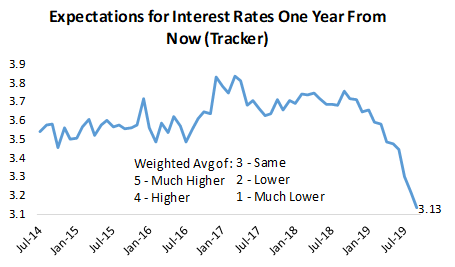
Each month Bespoke runs a comprehensive survey on the US consumer, giving us proprietary insights in nearly real-time to the major driver of the US economy. We ask dozens and dozens of questions related to every area of the economy, and we also ask about feelings towards financial markets. One of the questions we ask survey participants is where they think interest rates will be one year from now. Below is a chart showing the monthly reading for this question over the last five years.
When the line is falling, it means consumers expect interest rates to be lower, while a rising line means consumers think interest rates will be higher. As shown, expectations have fallen off a cliff this year as actual interest rates have collapsed, meaning consumers basically just look at what’s been happening and extrapolate it into the future. This is a bad sign for bonds, which fall when interest rates rise and vice versa, in our view. Whenever the masses get so one-sided, it’s usually a sign that a trend reversal is near. Start a two-week free trial to Bespoke Institutional for full access to our research and market analysis. To receive our survey analysis every month, you’ll need to purchase our Consumer Pulse add-on.
The Fall of the Mall
Bespoke’s Consumer Pulse Report is an analysis of a huge consumer survey that we’ve been running each month since 2014. Our goal with this survey is to track trends across the economic and financial landscape in the US. Using the results from our proprietary monthly survey, we dissect and analyze all of the data and publish the Consumer Pulse Report, which we sell access to on a subscription basis. Sign up for a 30-day free trial to our Bespoke Consumer Pulse subscription service. With a trial, you’ll get coverage of consumer electronics, social media, streaming media, retail, autos, and much more. The report also has numerous proprietary US economic data points that are extremely timely and useful for investors.
We’ve just released our most recent monthly report to Pulse subscribers, and it’s definitely worth the read if you’re curious about the health of the consumer in the current market environment. Start a 30-day free trial for a full breakdown of all of our proprietary Pulse economic indicators.
You don’t need the Consumer Pulse Report to tell you that it has been a difficult few years for traditional brick and mortar retailers, especially for department stores. Just this morning, the September Non-Farm Payrolls report showed that the retail sector shed 11,400 jobs in September and has lost a total of 197K jobs since the sector’s peak reading in January 2017. With things being so bad for the sector for so long, though, there seems to be an increasing number of investors who think that the sector is due for a rebound, but based on the latest data from our Pulse report, it doesn’t look like things are showing any sign of improvement. In fact, trends may actually be getting worse.
The chart below is from a question that asks respondents which department stores they have visited over the last month or whether they haven’t visited any of them at all. In this month’s survey, a record 55.4% of respondents said they didn’t visit any of the department stores listed, while the percentage of consumers visiting each individual department store is at or near record lows. There was a time in the not so distant past where the seven stores listed were the first store shoppers thought of when they were planning to shop, but today they don’t even come to mind.
You can see in the chart that the seasonal holiday shopping period has been getting worse and worse for department stores as well. In 2015 and 2016, we saw huge dips in the “None of the above” reading in December, meaning lots of department stores saw a pick-up in visits. In 2017 and 2018, though, the dips for “None of the above” were much smaller.
What’s it going to take to get consumers back to stores? That’s the question every brick and mortar retailer has been trying to answer for the last few years along with how to maximize sales online. Providing a better “experience” for in-store shoppers has been the major focus, but experience can only take you so far.

Bespoke’s Morning Lineup – 10/4/19
See what’s driving market performance around the world in today’s Morning Lineup. Bespoke’s Morning Lineup is the best way to start your trading day. Read it now by starting a two-week free trial to Bespoke Premium. CLICK HERE to learn more and start your free trial.

The Closer – Range Bottoms, Bull Steepener, Big Reversals, And Manufacturing – 10/3/19
Log-in here if you’re a member with access to the Closer.
Looking for deeper insight on markets? In tonight’s Closer sent to Bespoke Institutional clients, as equities found technical support today, we show the bull steepening of the curve and what it means in regards to policy. Next, we show other times that the S&P 500 experienced big intraday reversals as it did today. We finish with a look at today’s manufacturing data including durable and capital goods as well as consumer confidence and spending data.
See today’s post-market Closer and everything else Bespoke publishes by starting a 14-day free trial to Bespoke Institutional today!
Dividend Stock Spotlight: Cola Wars With PepsiCo (PEP) and Coca-Cola (KO)
PepsiCo (PEP) is one of the world’s largest food and beverage corporations. In its long history, PepsiCo has come to offer a much broader range of products than just Pepsi Cola, which was first introduced all the way back in 1893 (when the soda was named “Brad’s Drink”). At the time, the cola was actually being pitched as a healthy, energy drink by pharmacists at drugstores. “Delicious and Healthful” was one of Pepsi’s first big ad promotions in the early 1900s as it was supposed to aid in digestion as well (from Wikipedia).
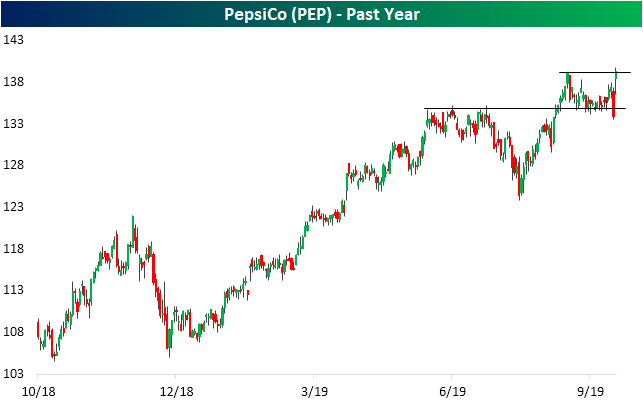
Over 125 years since its first product was created, consumers still are loving PEP’s offerings like Frito Lays and other popular sodas as the beverage giant announced strong third-quarter results this morning. EPS were reported at $1.56 per share, exceeding estimates of $1.51, while revenues came in $254 million above forecasts. This has led the stock price to respond well with a 4% rally today. That is a better than normal reaction as PEP has averaged just a +0.31% full-day change in response to earnings since 2000. In fact, over the last 19 years, this would be PEP’s sixth best one-day reaction to quarterly earnings if the gains hold into the close. From a chart perspective, this has led to a 180 from where things stood at yesterday’s close. Amidst yesterday’s broad market declines, PEP broke below support around $134. This support had been in place over the past month and could be traced back to prior resistance at spring/early summer highs. Today, the stock has reversed and the picture is much more bullish as the stock reached new 52 week highs.
In addition to solid technicals with today’s breakout, PEP also has an attractive dividend. PEP currently yields 2.75%, which is a higher yield than the broader market’s yield just under 2%. PEP is a member of S&P’s “Dividend Aristocrats” index, which is made up of stocks that have increased their dividends for at least 25 consecutive years. For Pepsi, the company has now increased its dividend for 46 consecutive years with the most recent increase being to the dividend paid in June. While the payout ratio for PEP is at the higher end among other dividend aristocrats, at 63.89%, the ratio is not overly concerning as the company has some cushion to continue to payout this dividend. Among other stocks in the Food, Beverage, and Tobacco industry, though, PEP’s dividend comes up just short of the group’s 3% average yield.
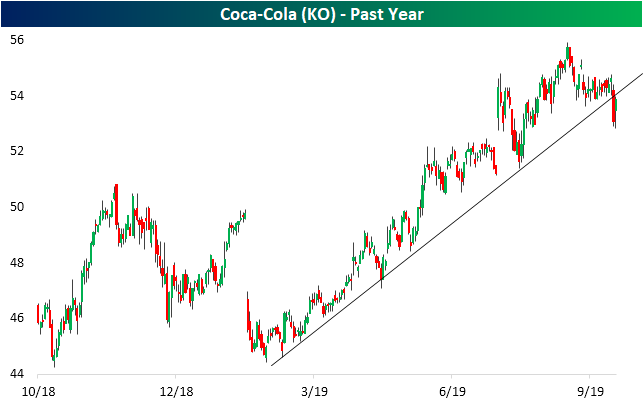
PepsiCo (PEP) stacks up closely with one of its oldest and largest competitors, Coca-Cola (KO). Like the broader industry group, Coca-Cola possesses a higher yield than that of PEP, but only slightly so at 2.97%. But KO also has a less attractive dividend payout ratio of 65.5%. Both stocks have P/E ratios right around 25. While KO is moving higher by 1.5% today on the back of PEP’s strong earnings, KO’s steep declines yesterday violated the past several months’ uptrend line from which it has not yet recovered, unlike PEP. Start a two-week free trial to Bespoke Premium for more dividend stock insights!
B.I.G. Tips -September Employment Report Preview
Recession fears continue to rise, and as potential cracks in the economy’s armor start to add up, weakness in Friday’s Non-Farm Payrolls report would definitely hurt sentiment. That’s especially the case after Thursday’s weaker than expected ISM Services report showed Employment at its weakest level in over five years. In terms of the market reaction, prior to this morning, one would have expected a weaker than expected report to be met with selling, but after today’s weaker than expected ISM Services report and the market’s subsequent positive reaction, who knows at this point!
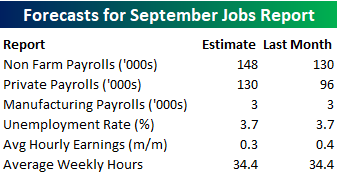
Heading into tomorrow’s Non-Farm Payrolls report, economists are expecting an increase in payrolls of 148K, which would be a slight increase from August’s disappointing reading of 130K. In the private sector, economists are expecting an increase to 130K from August’s reading of 96K. Job growth in the Manufacturing sector is expected to remain at an anemic pace of just 3K. The unemployment rate is expected to remain unchanged at 3.7%, average hourly earnings growth is expected to slow to 0.3% from 0.4%, and average weekly hours are expected to remain unchanged at 34.4.
Ahead of the report, we just published our eleven-page preview of the September jobs report. This report contains a ton of analysis related to how the equity market has historically reacted to the monthly jobs report, as well as how secondary employment-related indicators we track looked in September. We also include a breakdown of how the initial reading for September typically comes in relative to expectations and how that ranks versus other months.
For anyone with more than a passing interest in how equities are impacted by economic data, this September employment report preview is a must-read. To see the report, sign up for a monthly Bespoke Premium membership now!
ISM Services Sinks
In what could have been the most anticipated economic indicator of the week after Tuesday’s stinker ISM Manufacturing report, the ISM Services report for September was a pretty big disappointment relative to expectations. While economists were expecting the headline reading for the index to come in at 55.0, which would have been down 1.4 points relative to August, the actual reading came in at 52.6. That 3.8 point decline was the largest m/m decline since August 2016, which is also the last time the headline index was as low as it is now and the second largest one month decline of the entire expansion. Similarly, on a combined basis and accounting for each sector’s share of the overall economy, the Composite ISM report for September fell to 52.1 from 55.6. That’s also the lowest level since August 2016.

Breadth in this month’s report was mixed depending on how you look at it. On a month/month basis, half of the index’s sub-indices actually increased with the biggest gains coming from Backlog Orders and Inventory Sentiment. On the downside, New Orders and Business Activity both plunged. While m/m readings were a bit mixed, y/y readings were weak across the board with every component lower now than they were at this point last year.

In terms of the individual sub-indices, three we wanted to highlight are New Orders, Employment, and Prices Paid. First, New Orders saw the largest decline of any component this month falling to 53.7 and taking that index to its lowest level since August 2016. With tomorrow’s Non-Farm Payrolls report on deck, the Employment component of today’s ISM Services report wasn’t very encouraging as it dropped from 53.1 down to 50.4. That’s the lowest level and also the largest two-month decline for the index since February 2014. Finally, one area of the ISM Services report that had been bucking the trend lately is Prices Paid, which has now increased on a m/m basis in three of the last four months. That’s one area where we don’t want to be seeing steady increases in a sea of red everywhere else. Start a two-week free trial to Bespoke Institutional to access our interactive economic indicators monitor and much more.


