
Bespoke’s Morning Lineup – 7/2/20 – Fireworks Starting Early
See what’s driving market performance around the world in today’s Morning Lineup. Bespoke’s Morning Lineup is the best way to start your trading day. Read it now by starting a two-week free trial to Bespoke Premium. CLICK HERE to learn more and start your free trial.
There may not be as many fireworks as usual this weekend due to restrictions on social gatherings during the COVID pandemic, but on Wall Street, the fireworks are coming early. Futures are firmly in the green on what has historically been a strong period for equities, and things are likely to only get more explosive later this morning with the release of the June Non-Farm Payrolls report and Initial Jobless Claims. What color the fireworks end up will likely be determined by how these reports come in relative to expectations.
Given the observance of the July 4th Holiday tomorrow, US markets will be closed, so there will be no Morning Lineup tomorrow. Happy 4th!
Be sure to check out today’s Morning Lineup for a rundown of the latest stock-specific news of note, global and national trends related to the COVID-19 outbreak, and much more.

Across the universe of S&P 500 sectors, we’re seeing quite a wide disparity between performance coming into the third quarter. Leading the way to the upside, Technology still reigns supreme as the sector is more than 8% above its 50-day moving average (DMA), followed by Consumer Discretionary (6.0%) and Real Estate (5.4%). At the other end of the spectrum, Energy (-3.35%) is the only sector that is below its 50-DMA.
In addition to the three leading sectors highlighted above, the only other sector that is currently overbought is Communication Services, while every other sector is in neutral territory.

Gun Stocks Blazing
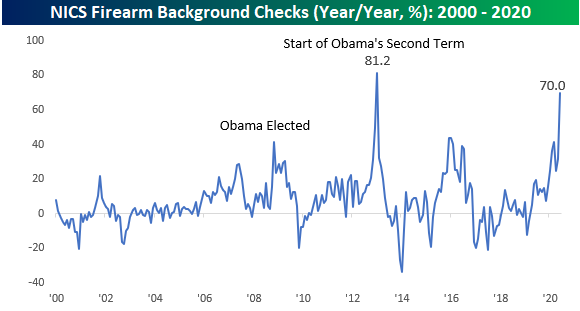
At first glance, the chart below looks a bit like a tally of COVID case counts, but what it really shows is the number of NICS background checks taking place for the purchase of firearms. In the month of June alone, there were 3.93 million background checks which represents slightly more than 1% of the entire US population. Historically, the pattern of background checks follows a saw-tooth pattern hitting their annual highs towards the end of the year, but after hitting a new record high back in March, background checks hit another record high in June. It’s not often that you see that. They say that gun sales increase during periods of uncertainty, and whatever your views are towards the shutdowns or the protests that have erupted all over the country, we can all agree that they have generated enormous amounts of uncertainty.

Besides the instability that has blanketed the country, the decline in President Trump’s poll numbers may also be fueling a rush to buy guns. If Biden were to win in November and the Democrats take control of the Senate, the odds of legislation curbing at least some types of gun sales would only increase. Historically, there is a precedent for this. Back in 2008, when President Obama was elected, the y/y pace of background checks surged at what was a record y/y pace to record highs. When Obama was re-elected, the pace of background checks surged again, increasing at a y/y pace of over 80% at the start of his second term.

With Americans in a rush to buy guns, the two publicly traded gun manufacturers have been on fire. The charts below show the performance of Sturm Ruger (RGR) and Smith and Wesson (SWBI) over the last year. In the case of both stocks, they have doubled off the lows. While financial markets hate uncertainty, these two stocks can’t get enough of it. Click here to view Bespoke’s premium membership options for our best research available.


First Half and Q2 2020 Asset Class Performance
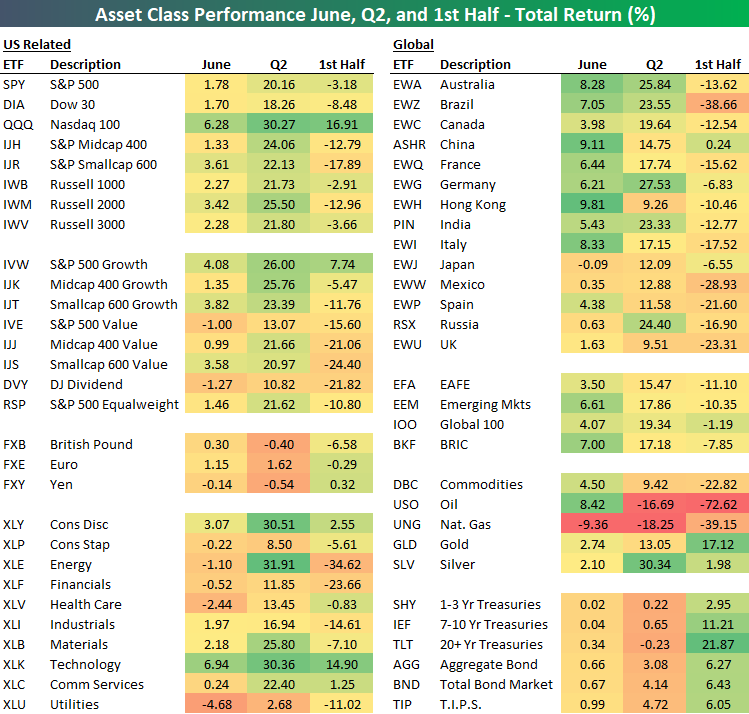
Global pandemics, bear markets, bull markets, countless records in economic data, and widespread protests made for an eventful first half of 2020, to say the least. In the table below we show the total return of various asset classes using key ETFs in June, Q2, and the first half of 2020. As shown, overall the best performing assets in June could be found outside the US as international stocks surged. Hong Kong (EWH) in particular was the best performing asset in June. Oil (USO) similarly saw solid returns of 8.42% during the month but remained the second-worst performing asset in Q2 behind Natural Gas (UNG) which was also the worst-performing asset in June. Additionally, oil was the worst-performing asset in the first half of the year. Meanwhile, although their returns were more muted in Q2 and June, Treasuries (namely at the long end of the curve) were some of the top performers in the first half. Precious metals similarly were strong performers in the first half with particular strength from silver (SLV) in Q2. Silver actually saw returns in line with cyclical equities in Q2.
In terms of the US equities space, the Tech heavy Nasdaq 100 (QQQ) drastically outperformed closing out June with a 16.91% gain in the first half. In Q2 and June, it was also the best performing major index by a wide margin. On a sector basis, Technology (XLK), Energy (XLE), and Consumer Discretionary (XLY) all rose over 30% in Q2 just like the Nasdaq did, though their first half and June returns were more modest with the exception of the Tech sector whose returns were more in line with that of the Nasdaq.
Investing based on market cap saw some interesting dynamics as well. Even though small caps are some of the major US indices down the most on the year—S&P 600 Small Caps (IJR) are down 17.89% and the Russell 2000 (IWM) is down 12.96% YTD—there was some catch up in June as these indices were some of the best performers. That applies to both growth and value names though small cap value (IJS) is still one of the most beaten-down groups in the US equities space. On the other hand, large-cap growth (IVW) offered the strongest returns in June, Q2, and the first half when compared to the various other style ETFs.
Outside of the US, even with big gains in June, countries like Brazil (EWZ), France (EWQ), Italy (EWI), and Spain (EWP) remain down big on the year. Click here to view Bespoke’s premium membership options for our best research available.
ISM Manufacturing Returns to Expansion
Last month, ISM’s headline manufacturing number saw a slight rebound rising from the April low of 41.5 to 43.1. That indicated that activity was still worsening in May albeit at a slower pace than April. Fast forward to June’s reading released this morning and ISM’s manufacturing report showed a huge rebound in activity with the headline index rising 9.5 percentage points to 52.6. That is the headline index’s highest reading since March of last year and was also the first back to back increases since June 2018. A reading above 50 also indicates the first expansionary reading in the manufacturing sector since February. Lastly, perhaps most notable about today’s report was that the 9.5 point m/m increase was also the third-largest on record behind a 10.5 point increase in August of 1980 and a 12.1 point jump all the way back in August of 1952.

Respondent commentary reinforced the rebound with most making some mention of demand or production improving in June. Important to note, while they point to improved conditions from the past few months, that is not to say activity has necessarily returned to pre-COVID levels. In fact, one comment out of the Chemical Products industry reported that it ha been a “slow recovery” and the Petroleum & Coal Products industry mentioned that things are still “below normal volumes”. Regardless, as the commentary from a Plastics & Rubber Products respondent put it, things are still “trending toward normal”. In other words, things are back on the right track, but activity has not fully recovered.

Taking a look across the various sub-indices of the report, the headline number was not alone in terms of historic monthly rebounds. Outside of the inventories index, every indices’ MoM rise was in the upper 90th percentiles of all readings. Now 6 of the 11 indices are showing expansionary readings compared to just two last month.
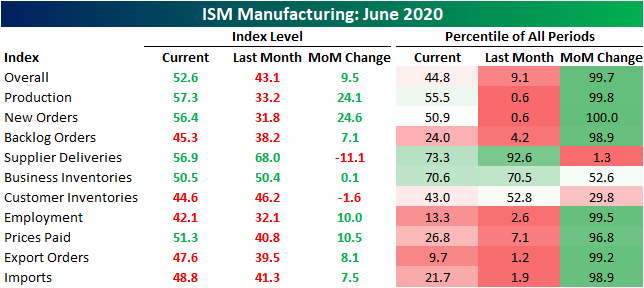
As previously mentioned, production has been ramping back up with the index rising to 57.3, its highest level since November of 2018. The only larger one month jump in production was in August of 1952 when the index rose 46.8 percentage points. Meanwhile, New Orders saw its largest one month increase on record. Granted that only leaves it in the dead middle of its historic range while backlog of orders are still in contraction for a fourth consecutive month. One interesting point of the data recently has been the index for Supplier Deliveries. Recent months have seen very elevated readings indicating longer delivery times meaning supply chains have appeared to have been disrupted. While this month’s reading of 56.9 still indicates longer delivery times, it is a much healthier reading pointing to at least some stabilization. The MoM decline of 11.1 percentage points was also the largest decline since May of 1979.

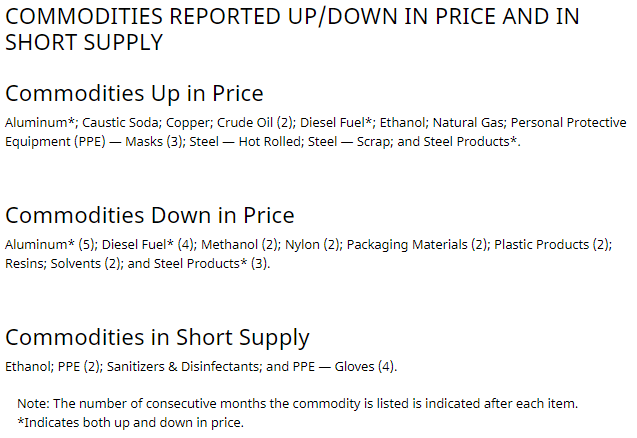
One final note on this month’s report concerns the commodities survey where businesses report price increases and decreases. As could be expected in a pandemic environment, protective equipment remains in short supply and up in price. Meanwhile, many cyclical products are also seeing higher prices indicating strengthened demand. For example, cyclical metals like copper and steel are up in price in addition to various fuels. That further reinforces the overall uptick in economic activity. Click here to view Bespoke’s premium membership options for our best research available.
Bespoke’s Consumer Pulse Report — July 2020
Bespoke’s Consumer Pulse Report is an analysis of a huge consumer survey that we run each month. Our goal with this survey is to track trends across the economic and financial landscape in the US. Using the results from our proprietary monthly survey, we dissect and analyze all of the data and publish the Consumer Pulse Report, which we sell access to on a subscription basis. Sign up for a 30-day free trial to our Bespoke Consumer Pulse subscription service. With a trial, you’ll get coverage of consumer electronics, social media, streaming media, retail, autos, and much more. The report also has numerous proprietary US economic data points that are extremely timely and useful for investors.
We’ve just released our most recent monthly report to Pulse subscribers, and it’s definitely worth the read if you’re curious about the health of the consumer in the current market environment. Start a 30-day free trial for a full breakdown of all of our proprietary Pulse economic indicators.
July Market Seasonality
At the start of each month, we send members our seasonality report that highlights the historical performance of the US stock market by month. In our July report published yesterday, we highlighted the chart below which shows the Dow’s average change by month over the last 100, 50, and 20 years. One notable trend is that over the last 20 years, the Dow has actually averaged declines in half of all months. The summer months have been particularly negative, but July is the one month that stands out on the bullish side. As shown in the table, July is the only month from May through September that has averaged gains over the last 20 years, and the average gain has been quite strong at 1.32%. Click here to view Bespoke’s premium membership options for our best research available.

Bespoke’s Morning Lineup – 7/1/20 – Slow Start to the New Quarter
See what’s driving market performance around the world in today’s Morning Lineup. Bespoke’s Morning Lineup is the best way to start your trading day. Read it now by starting a two-week free trial to Bespoke Premium. CLICK HERE to learn more and start your free trial.
It’s a new quarter for the market, and investors appear to be suffering a bit of a hangover after last quarter’s big gains. ADP Private Payrolls were just released and came in weaker than expected (2.369 million vs 2.900 million). In any other environment, a miss of over half a million payrolls relative to expectations would have been newsworthy by itself, but when you’re dealing in millions, what’s a few hundred thousand between friends?
Be sure to check out today’s Morning Lineup for a rundown of the latest stock-specific news of note, PMI Manufacturing data for June, global and national trends related to the COVID-19 outbreak, and much more.
When we first started putting the table below together this morning, SPY was indicated to open down by over half of one percent, but as of now, the margin of decline has been cut in half. Therefore, we have expanded the table to show all days where SPY opened a new quarter with a downside gap of 0.25% or more. Time will tell, but by the time the opening bell rings, we may not even be at that level.
While first impressions in these quarters weren’t very good, SPY’s performance from the open to close tended to be positive with an average gain of 0.38% (median: 0.42%) and positive returns over 70% of the time. For the rest of the quarter, performance was even better as the SPY averaged a gain of 5.40% (median: 6.94%) with gains over 80% of the time. Also, keep in mind that the largest downside gap to open a quarter was last quarter on April 1st when SPY gapped down over 3.5%. That certainly ended up being an April Fools’ joke as SPY rallied more than 25% from the close on 4/1 through yesterday’s close.

“Hodl” Off For Now
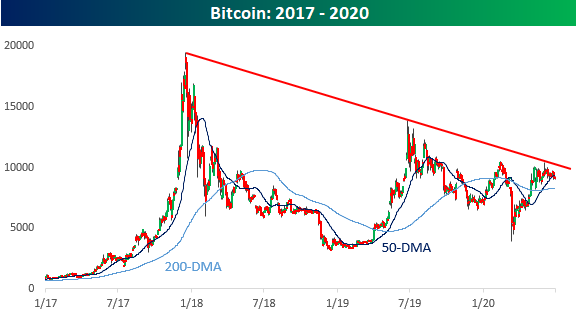
Unless we’re talking about long-term US treasuries which were modestly lower in Q2, just about every other asset class was higher. Among those, bitcoin was no exception. During Q2 alone, bitcoin was up slightly more than 40%, which is impressive even for a volatile asset class like cryptocurrencies. While bitcoin’s performance was very strong, though, closing out the quarter, there was a feeling of disappointment that it didn’t finish off the quarter even stronger.
Two things left bitcoin ‘hodlers’ looking for more. First, while the price briefly eclipsed $10,000 during the quarter, it wasn’t quite enough to take out the highs from February. Second, from a longer-term perspective, the intraday high of ~$10,400 on June 4th coincided nearly perfectly with bitcoin’s downtrend line from its record high back in late 2017 when crypto was all the rage. Until bitcoin can take out either its downtrend or make new highs for the year, investors may be best served to wait on the sidelines. Click here to view Bespoke’s premium membership options for our best research available.
Nasdaq to Russell 2,000 Ratio
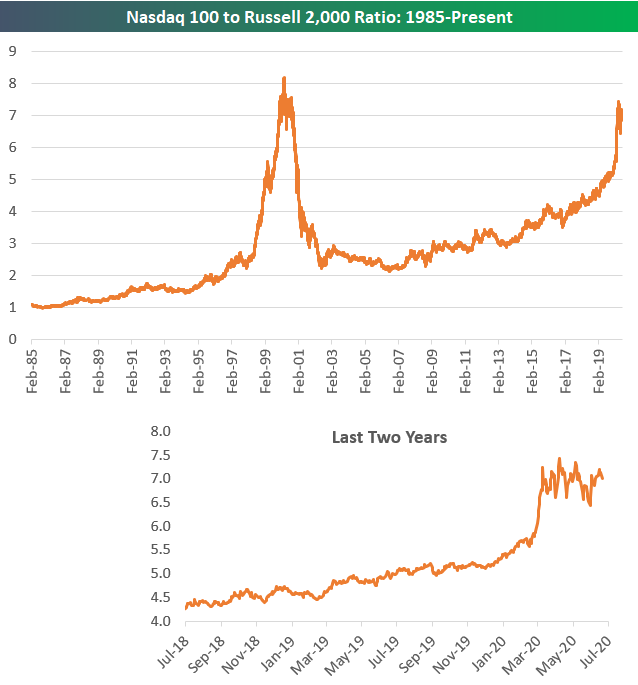
Last week we compared the recent performance of the Nasdaq to the small-cap Russell 2,000. Below is a look at the relative strength between the Nasdaq 100 and the Russell 2,000. The chart shows the ratio of the Nasdaq 100 to the Russell 2,000 since 1985. In the late 90s, the Nasdaq soared versus the Russell, with the ratio rising from 1:1 in the mid-80s up to 8+ at the peak of the Dot Com bubble. The ratio came crashing back down to the low 2s in the mid-2000s, but it has been on a steep upward trajectory for the last 12 years.
Over the first two months of 2020, with small-caps underperforming and the Nasdaq outperforming, the ratio spiked more than two points from ~5 up to 7.5 at its recent peak. We’d note, however, that since the Covid Crisis hit, we’ve seen the ratio trade sideways in what looks to be a peak for the time being. One day small-caps will have their day in the sun again, it’s just a matter of how long it takes for that to happen. Click here to view Bespoke’s premium membership options for our best research available.
Bespoke Market Calendar — July 2020
Please click the image below to view our July 2020 market calendar. This calendar includes the S&P 500’s average percentage change and average intraday chart pattern for each trading day during the upcoming month. It also includes market holidays and options expiration dates plus the dates of key economic indicator releases. Start a two-week free trial to one of Bespoke’s three research levels.
