
Bespoke’s Asset Class Performance Matrix
Below is a look at week-to-date, quarter-to-date, and year-to-date performance numbers across asset classes using US-listed ETFs. While this week started off with a big drop for stocks on Monday, equities have bounced back nicely and are sitting on WTD gains of ~1%. The Nasdaq 100 (QQQ) and Russell 2,000 (IWM) are up the most on the week, but IWM remains down 4.7% on the month and up 11.8% on the year. That 11.8% YTD gain is the weakest of the main US index ETFs.
Growth ETFs are outperforming value ETFs this week, and the DJ Dividend ETF (DVY) remains down 0.8% on the week. Even with this week’s declines, DVY has been one of the best style ETFs on a year-to-date basis. Looking at sectors, the two main defensives (Utilities and Consumer Staples) are still in the red this week, and they’re up less than any other sectors on the year. Consumer Discretionary (XLY) and Technology (XLK) have done the best this week, while their YTD returns sit right in the middle of the pack. Energy (XLE) and Financials (XLF) remain the two best sectors on the year even though they’ve been consolidating for the past couple of months.
Outside of the US, we’ve seen the biggest gains for Canada (EWC) and Spain (EWP) this week, while Brazil (EWZ) and Mexico (EWW) are the two countries furthest in the red. While the developed world ETFs (EFA, IOO, CWI) are up this week, emerging markets ETFs like EEM and BKF are down. In terms of YTD performance, the Global 100 (IOO) is handily outperforming emerging markets (EEM).
In the commodity space, the natural gas ETF (UNG) is up sharply this week with a gain of 8.7%. This week’s gains have boosted UNG’s YTD move above the 50% mark. The oil ETF (USO) is up the second-most on the year of the commodity ETFs listed with a gain of 48.95%. The broad commodities ETF (DBC) is also up sharply on the year at +29.6% even though the two main precious metals (GLD, SLV) are down 4-5%.
The two main crypto exchange-traded products — GBTC and ETHE — have finally bounced a bit this week with gains of 3-4%. They’re still solidly red on the month, although ETHE is still up 19.4% on the year. GBTC, on the other hand, remains down 15.5% year-to-date. Start a two-week trial to Bespoke Premium if you’d like to read our weekly Bespoke Report newsletter published every Friday afternoon.

Tech Earnings on Tap
While there aren’t a lot of earnings reports on tap after the close today, there will be some notable reports from Intel (INTC), Snap (SNAP), and Twitter (TWTR). Investors have plenty of reasons to be bullish or bearish on these companies ahead of earnings, but we thought we’d provide a brief snapshot of how each stock has typically reacted to earnings reports in the past on both an overall basis and broken out by earnings seasons. The snapshots below are from our Earnings Explorer tool and show a breakdown of how often each stock exceeds EPS and revenue estimates as well as the percentage of time each one raises guidance. In addition, we then show how each stock has historically reacted to its earnings report on the first trading day after the report, and we break that performance out based on the average opening gap, the change from the open to close, the full-day return, and volatility (absolute average percent change on the day).
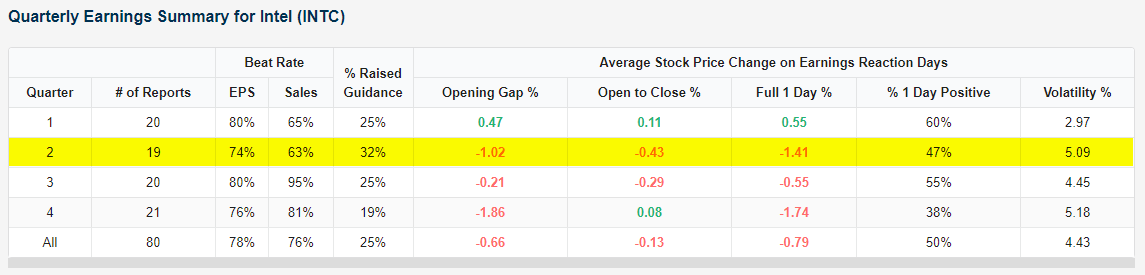
Starting with INTC, historically the stock has topped EPS forecasts 78% of the time, exceeded sales forecasts 76% of the time, and raised guidance 25% of the time. In the Q2 earnings season, the company’s EPS and sales beat rates are both less than average, but the company has raised guidance more often in the current earnings season than any other quarter. In terms of stock price performance, INTC typically doesn’t react particularly well to its earnings reports. For all of its earnings reports over the last 20 years, INTC has only risen on its earnings reaction day half of the time for an average one-day decline of 0.79%. In the Q2 earnings season specifically, INTC has been even weaker with an average one-day decline of 1.41%. When it comes to earnings, the only earnings season where the stock has reacted positively to earnings more often than it has reacted negatively is during the Q1 earnings season (April reports). More recently, earnings reports haven’t been particularly friendly to INTC as the stock has declined on its earnings reaction day following four of the last five reports.
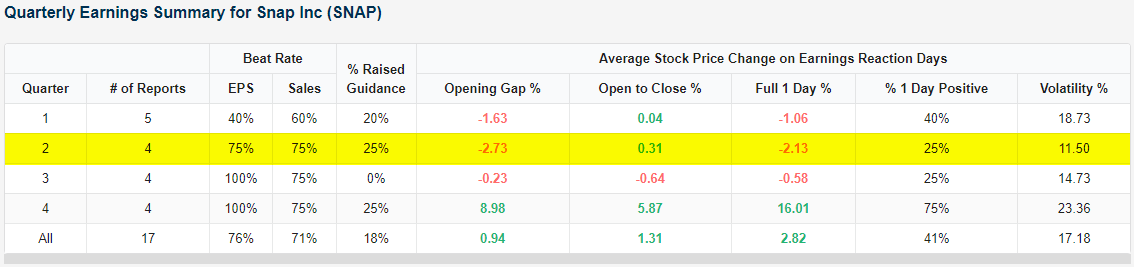
Snap (SNAP) has been public for less than five years, and its earnings track record has been mixed. While the stock’s average one-day reaction to earnings has been a gain of 2.82%, it has only posted positive returns in reaction to earnings 41% of the time. Q2 earnings season has been even tougher on SNAP stock as it has only risen in reaction to earnings following one of its four Q2 reports for an average decline of 2.13%. More recently, the stock has traded more positively to earnings with positive returns following four of its last five earnings reports. One thing you can count on when it comes to SNAP and earnings is the stock will be volatile. The stock’s average one-day reaction to earnings has been a move of +/- 17.2%.
Twitter (TWTR) has been public for nearly twice as long as SNAP, and even with a larger sample size, it hasn’t typically reacted well to earnings. Despite topping EPS and revenue estimates 80% of the time, SNAP’s average one-day reaction to earnings has been a decline of 2.94% with positive returns just 40% of the time. During the Q2 earnings season, TWTR’s EPS and revenue beat rates haven’t been as strong as the overall averages, and it shows in the stock’s average reaction to earnings. Of the seven Q2 earnings reports for TWTR, the stock’s average performance is a decline of 4.39% with gains just 43% of the time. The only quarter that has been weaker is the Q1 earnings season, and true to form, the stock dropped more than 15% on the day after its report back in April. You can track these stats for all of the stocks you follow using our Earnings Explorer tool. The Earnings Explorer is available with a Bespoke Institutional trial, which you can start today.

Bulls and Bears Dead Even
For the third week in a row, bullish sentiment has slid with this week’s reading from the AAII falling to 30.6%. With a cumulative 18-percentage point decline in that time, bullish sentiment is now at the lowest level since October 1st, 2020.

An identical share of respondents to the survey reported as bearish this week. That is only the 47th time in the survey’s history that an equal share reported as bullish and bearish with the most recent other occurrence being the end of October 2020. Now back above 30%, bearish sentiment is at the highest level since the first week of February which is also essentially right in line with the historical average for bearish sentiment (30.53%).

Identical readings in bullish and bearish sentiment means the spread between the two is at zero. As shown below, that is the first non-positive reading in the spread since the last week of January.

As previously mentioned, throughout the history of the AAII’s survey going back to the late 1980s, there have only been 47 instances of identical readings in bullish and bearish sentiment, or when the bull-bear spread equals zero, including the most recent instance. In the chart below we show the average performance of the S&P 500 over the next weeks and months following those instances. As shown, across the board the S&P 500 has tended to underperform the norm with the one-week and one-month periods averaging a decline. Again, while the gains are smaller than normal, the S&P 500 has at least been higher 71.7% of the time six months out and 84.4% of the time one year later.

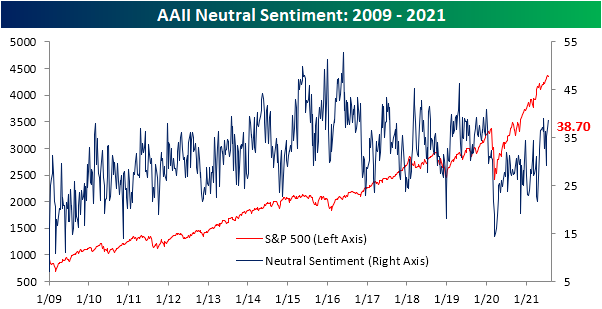
Not all of the losses to bullish sentiment turned bearish. Neutral sentiment rose 1.7 percentage points for a second week in a row. At 38.7%, neutral sentiment is at the highest level since June 10th.Click here to view Bespoke’s premium membership options.
State Withdrawals Show Face
Initial jobless claims were anticipating a 10K decline to 350K this week. Instead, claims rose back above 400K to reach the highest level since the week of May 14th. The 51K uptick to 419K this week was also the largest one-week increase since the final week of March. Not only was the most recent reading worse, but last week’s print was revised higher from 360K to 368K.
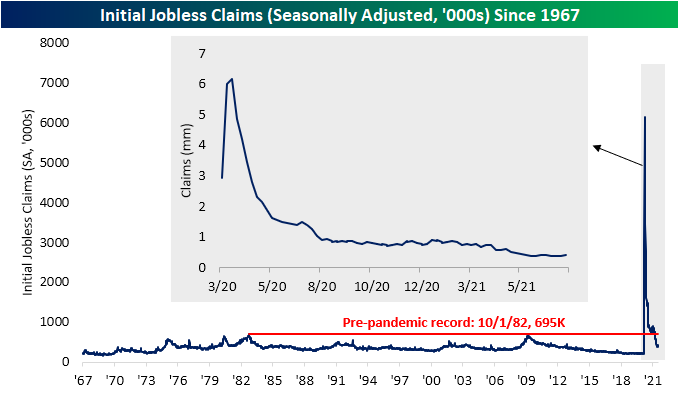
On a non-seasonally adjusted basis, it was a less dramatic increase with claims only rising 14.5K. Nonetheless, claims wound up above 400K. At 406.1K, it was the highest level in five weeks. Taking seasonality into account, NSA claims moving higher week over week during the current period of the year has historically been uncommon. Of all years since 1967, claims have only ticked higher during the current week of the year (29th week) 18.5% of the time.
Regular state claims were not the only area of deterioration though. PUA claims had fallen back below 100K last week, but the most recent print rose to 110.3K. That made for the largest increase in initial PUA claims since the week of June 18th as total combined claims between regular state and PUA programs is at the highest level in two months. Delving deeper into the data though, more than half of the uptick in the national count of PUA claims was on account of a single state: Indiana. PUA claims for that state rose from zero to 7,598 after a judge ordered the program to be restarted.
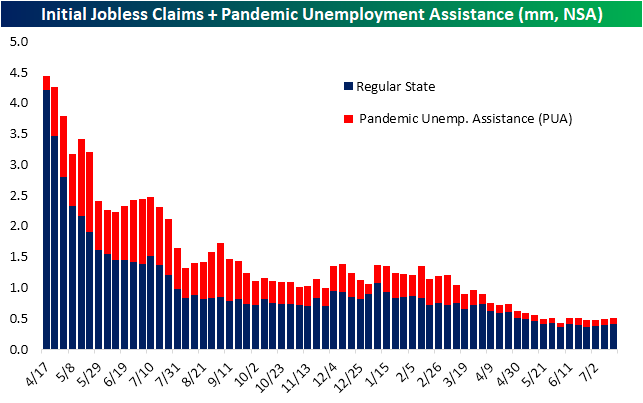
Continuing claims through regular state programs were also weaker than expected coming in at 3.236 million versus forecasts of 3.1 million. Similar to initial claims, last week’s print was also revised higher by 24K. While expectations were calling for a larger decline and last week’s print was not as strong, adjusted continuing claims are still at the lowest level since last March.

Delayed an extra week, the inclusion of all other programs are finally clearly showing the withdrawal of states from pandemic era programs. Total claims for the first week of July fell to 12.59 million from 13.86 million. That 1.27 million drop in a single week was the largest since March 12th. Obviously, the bulk of those declines were on account of PUA and PEUC programs while Extended Benefits and regular state programs also saw significant declines.Click here to view Bespoke’s premium membership options.


Bespoke’s Morning Lineup – 7/22/21 – Small Caps Bounce Big
See what’s driving market performance around the world in today’s Morning Lineup. Bespoke’s Morning Lineup is the best way to start your trading day. Read it now by starting a two-week free trial to Bespoke Premium. CLICK HERE to learn more and start your free trial.
“If you don’t study any companies, you have the same success buying stocks as you do in a poker game if you bet without looking at your cards.” – Peter Lynch
The rally off of Monday afternoon’s low continues to roll on this morning as futures indicate modestly higher levels at the open. There’s quite a bit of economic data coming up throughout the morning, so that will impact prices in the short term. Jobless claims just came out and both initial and continuing claims came in well ahead of expectations. After the close, we’ll have a number of high-profile earnings reports from companies like Boston Beer (SAM), Capital One (COF), Intel (INTC), Snap (SNAP), and Twitter (TWTR).
Read today’s Morning Lineup for a recap of all the major market news and events from around the world, the latest US and international COVID trends including our vaccination trackers, and much more.

It’s been an eventful four days for the Russell 2000. With declines of 1.2% on Friday and another drop of 1.5% Monday, the Russell 2000 came roaring back on Tuesday by surging 3%, erasing all of the declines from the prior two days. On Wednesday, the small-cap benchmark followed up with an impressive encore by tacking on another 1.8%.
Despite all the fireworks lately, the moves in the Russell 2000 have been a lot of sound and fury signifying in particular. As shown in the chart below, the Russell 2000 has been stuck in a sideways trading range since the beginning of February. The key level to watch in the short-term for small caps is the 50-day moving average (DMA), which for the Russell 2000 ETF (IWM) stands at about $224.70. If the index can break that level to the upside, it would be an encouraging signal, while a test and failure to take out that level would suggest more rough sledding ahead.

The US Is The Lone Overbought Country
While the S&P 500 (SPY) may have had a string of weakness over the past week and a half resulting in a test of its 50-DMA, SPY has held up much better than many other major economies. Looking across the ETFs tracking the equity markets of each of the 23 major economies in or Global Macro Dashboard, the US, Switzerland (EWL), and Sweden (EWD) are the only countries that are up month to date with each country posting an over 1% gain. Conversely, China (MCHI) has been the worst performer having fallen 6.42% MTD. Additionally, alongside MCHI, Malaysia (EWM) and Japan (EWJ) are the only countries in the red year to date.
While EWD and EWL are up a similar amount to the US MTD, the US has been the only country of the 23 to have hit a 52-week high in July. Most of the rest of the world saw 52-week highs in the first days of June or earlier. In addition to the US being one of the only countries up on the month and recently putting in a 52-week high, the past couple of days’ rally off of the 50-DMA has resulted in the US returning back to overbought territory. By comparison, Switzerland (EWL) and Taiwan (EWT) are the only other ETFs that are even above their 50-DMA whereas 13 countries are oversold.

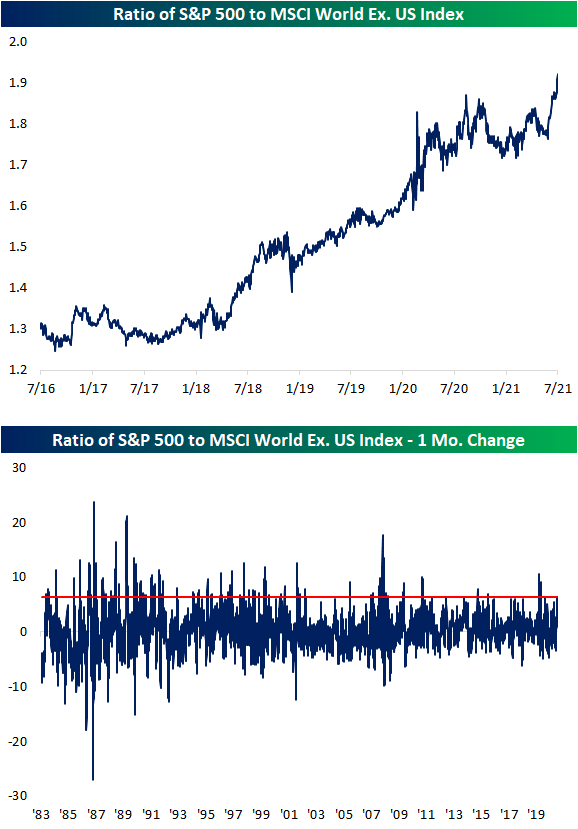
To show the outperformance of the US relative to other geographies, in the chart below, we show the ratio of the S&P 500 to the MSCI World Index that excludes the US. Since June, the ratio has taken off surpassing the highs from last summer in the process. In fact, the ratio has risen over 6% over the past month which stands in the top 5% of all monthly moves. That is the biggest one-month uptick in the ratio since it rose 9 percentage points last April. Prior to that, July 2016 was the last time in which the US has seen as large of a degree of outperformance. Click here to view Bespoke’s premium membership options.
Bespoke’s Morning Lineup – 7/21/21 – Sector Performance All Over the Place
See what’s driving market performance around the world in today’s Morning Lineup. Bespoke’s Morning Lineup is the best way to start your trading day. Read it now by starting a two-week free trial to Bespoke Premium. CLICK HERE to learn more and start your free trial.
“The market does not beat them. They beat themselves, because though they have brains they cannot sit tight.” – Jesse Livermore
Futures were higher across the board earlier but have given up some of their gains heading into the open as the Nasdaq is now indicated to open modestly lower. Small caps are continuing to build on yesterday’s gains with the Russell 2000 indicated to open up more than 0.7% as investors reassess whether concerns over the Delta variant were a bit overdone.
Read today’s Morning Lineup for a recap of all the major market news and events from around the world, the latest US and international COVID trends including our vaccination trackers, and much more.
It’s not often that the spread in 5-day performance between the best and worst-performing sectors in the market is over 10 percentage points, but that is where things stand heading into today’s trading. While Energy is down over 9% in the last five trading days, three sectors (Utilities, Real Estate, and Consumer Staples) are all up over 1% in the last week. Despite its recent sell-off, Energy is still one of the top-performing sectors in the S&P 500 this year with a gain of over 28%. While the losses in Energy have been painful, one could still argue that the sector remains in a consolidation mode following its monster gains off the late 2020 lows. Technology, meanwhile, remains right in the middle of the pack in terms of YTD performance, but in the short-term is one of the most overbought sector’s trailing only Health Care.

Bitcoin Drawdown
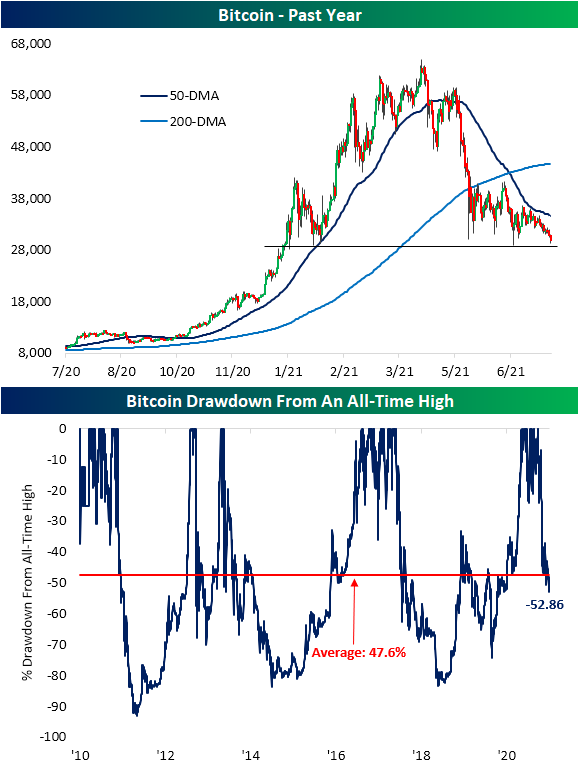
In today’s Morning Lineup, we detailed how the total market cap of crypto is reaching new lows in the context of a multi-month unwind. That is as the largest cryptocurrency, Bitcoin, falls below 30,000 for the first time since January 1st. Granted, back then Bitcoin had never been that high before. Today, Bitcoin is down for the fourth day in a row nearing extreme oversold territory (measured by 2 or more standard deviations below its 50-DMA) and is testing support around the lows from earlier in the spring. That all leaves Bitcoin 52.86% below its all-time high above 63,000 from April 15th. While the price of the crypto being cut in half may sound dramatic, as we have noted in the past, it is more or less par for the course for the speculative asset. As shown in the second chart below, through its history the average decline from an all-time high has been 47.6% (median 51.9%); only a few percentage points less than the current drawdown. Click here to view Bespoke’s premium membership options.
Strong Starts, Some Building Weakness In Permits
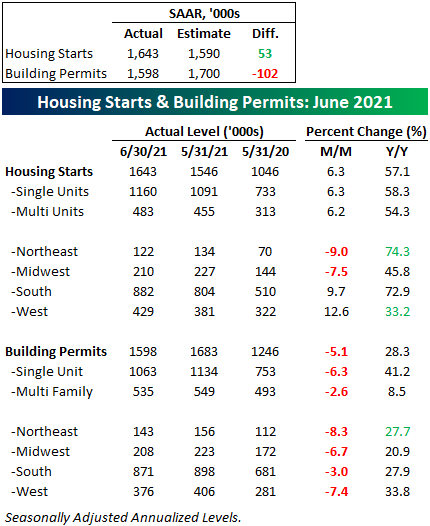
This morning’s release of Housing Starts and Building Permits for the month of June was mixed relative to both last month’s levels and expectations, but the overall trends remain positive. Starting out with the details, Housing Starts rose 6.3% versus March and topped expectations by 53K (1.643 million vs 1.590 million). Building Permits, meanwhile, missed expectations by nearly twice the amount that Starts beat expectations (1.598 million vs 1.7 million), and they also fell just over 5% relative to May.
In terms of single versus multi-family units, Housing Starts saw a uniform increase rising just over 6%, but on a regional basis, strength was seen in the West and South, while both the Northeast and Midwest experienced high single-digit declines. Building Permits were weaker at the single-family level than the multi-family level, which could be a result of higher input costs. On a regional basis, though, Permits were down all over the country with the South seeing the most modest declines.
One note regarding the miss in Permits – although they were lower than Starts in June, they were higher than Starts in each of the past 15 months, so they have been running at a stronger pace than Starts for quite some time. Click here to view Bespoke’s premium membership options and receive a more detailed analysis of economic data.
As far as overall trends in Housing Starts and Permits are concerned, the longer-term trend remains positive. Housing Starts are a great leading indicator of the business cycle, and the 12-month average continued to surge to new multi-year highs in June reaching the highest level since June 2007.
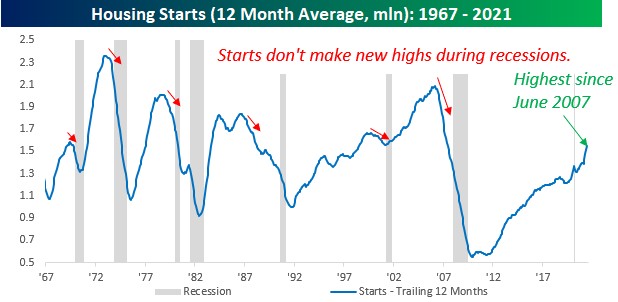
Zooming in on just the last ten or so years, both Housing Starts and Building Permits experienced a brief dip in the aftermath of the COVID outbreak but quickly resumed their upward trend and have been accelerating to the upside. Also, barring a complete cratering of the monthly numbers, these 12-month averages should continue to rise in the months ahead.

Single-family Housing Starts and Building Permits are rising at an even faster rate. Also notable is that despite the fact that there was a notable divergence between Building Permits and Housing Starts this month, the 12-month average of single-family Starts and Permits were practically the same (1.130 million vs 1.138 million).

The fundamental backdrop for Housing Starts and Building Permits may still look positive, but homebuilder stocks have been under pressure lately after an insanely strong rally earlier in the year. Since its peak in early May, the iShares Home Construction ETF (ITB) has dropped 15% in a series of lower highs and lower lows.
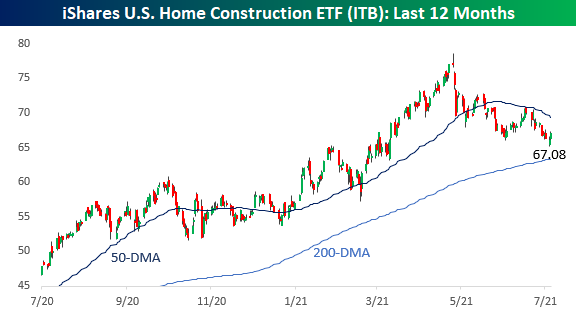
Higher labor and input costs have weighed on sentiment for the sector, but some of the input costs have reversed and lower interest rates should also act as a tailwind. Looking at a longer-term chart, there has been a positive correlation between Housing Starts relative to the performance of ITB, and as these charts illustrate, while the short-term picture for ITB (above) looks somewhat ominous, the longer-term picture looks much more benign. As shown below, the recent pullback in ITB looks more like a reversion to the mean as they got a bit ahead of themselves earlier this year. One trend to keep in mind going forward for the homebuilders is that if the recent price declines for housing inputs remain in place, they have the potential to see some significant improvements to margins if they can continue to command higher prices.

The Health Care Tortoise and the Hare
When COVID first started to worry equity markets in early 2000, one of the names investors immediately flocked to was telehealth provider Teladoc (TDOC). TDOC was the perfect COVID play as it enabled people to continue seeing doctors through digital means at a time when the world was locked down. TDOC actually performed very well in the normal months leading up to COVID, and shares continued to shoot higher even as the broad market declined in late February and March 2020. By early August 2020, TDOC was up over 100% since 2/19/20 — the date of the high point for the S&P just prior to the COVID Crash. After a consolidation period in the fall and early winter 2020, TDOC went on another run from December through February of this year and was up nearly 150% YoY on February 19th of this year.
While TDOC was a beloved stock during the first stages of the COVID pandemic, it has been a serious drag over the last five months. Since peaking in mid-February, shares are down roughly 50% from their highs. Notably, as TDOC has been falling this year, traditional health care providers like hospital company HCA and healthcare provider and insurer UnitedHealth (UNH) have been rallying to new highs. As shown below, the six-month chart patterns for HCA and UNH couldn’t look more different than the chart of TDOC. Click here to view Bespoke’s premium membership options.

What we find most surprising is that Teladoc (TDOC) is now underperforming both HCA and UNH since 2/19/20 when SPY hit its pre-pandemic high just before COVID began worrying markets. As shown below, at one point earlier this year, TDOC was outperforming its traditional health care competitors by more than 100 percentage points. That outperformance has been fully erased over the last five months. Since 2/19/20, TDOC is now up just 29% versus gains of 45% for HCA and 34% for UNH.
Last year there was a lot of talk about telehealth becoming one of the biggest long-term trends that we’d see accelerate because of COVID. That trend could certainly continue over the coming years and decades, but TDOC’s recent performance just goes to show you that sometimes the best-laid plans don’t necessarily play out the way investors may expect them to, and past performance is certainly not indicative of future performance over any time frame.

Of course, we should note that going back further over the last five years, TDOC is still significantly outperforming both HCA and UNH. In fact, TDOC is a 10-bagger over the last five years with a gain of 1,183%, while HCA and UNH have also performed well but are only up 169% and 206%, respectively.
