Chart of the Day: Healthcare and JP Morgan Healthcare Conference
Mystery Chart Unveiled – Tremendous Breakout
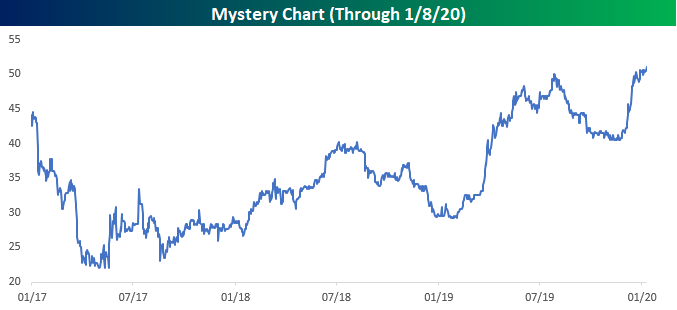
Last Thursday, we posted the following ‘mystery chart’ on Twitter, and asked whether it was a “buy” or a “sell.” Judging simply by the looks of it, the chart looks pretty attractive. It’s clearly trending higher, and after a brief pullback in the second half of 2019, it has seen a sharp rebound putting last year’s highs back into play.
While it was only last week that we originally tweeted the chart, since then there has been a clear breakout above the summer high (~50). From a technical perspective at least, it looks like our ‘mystery chart’ has experienced a classic breakout.
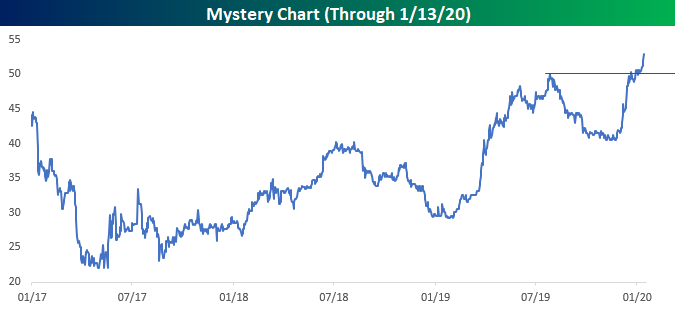
So what exactly is this mystery chart which appears to be in the early stages of a new leg higher? Drumroll, please! It’s actually the probability of President Trump winning re-election in November according to the website electionbettingodds.com. At the current level of 53.1%, the market’s pricing of President Trump’s re-election has never been higher.

While President Trump’s chances of winning re-election have seen a big boost lately, these gains have also been accompanied by some interesting moves on the Democratic side. Last Friday, a new Des Moines Register poll showed that Senator Bernie Sanders took the lead for the first time in its polling for the February 3rd Iowa caucus. At 20% in the poll now, Sanders hardly has a commanding lead, and three other candidates are polling at 15%+ (Warren, Buttigieg, and Biden). As a result of that poll, though, we saw a sharp drop in Biden’s chances of winning the nomination and further gains for Sanders after what has already been a strong showing in the last several weeks.
Whether the reasoning for Trump’s recent gains is that Sanders is less likely than Biden to win in a general election or that the party will be too divided to generate enough excitement around one candidate in a general election, the betting markets seem to be interpreting the recent surge in Sanders’ standing in the polls as a positive for President Trump’s re-election. That’s a positive for Trump fans in the present, but just like technical analysis, the election betting markets haven’t exactly had a perfect record at predicting the outcome of events. To read Bespoke’s most actionable stock market research, start a two-week free trial to Bespoke Premium. You’ll unlock our most popular reports like our Morning Lineup, Model Portfolios, and Chart of the Day.

Bespoke’s Morning Lineup – 1/13/20 – From Technology to Health Care
See what’s driving market performance around the world in today’s Morning Lineup. Bespoke’s Morning Lineup is the best way to start your trading day. Read it now by starting a two-week free trial to Bespoke Premium. CLICK HERE to learn more and start your free trial.

Last week was a good week for the Technology sector, and one catalyst for the sector was the Consumer Electronics Show (CES) which, as we highlighted in last Monday’s Chart of the Day, has historically provided a boost to the sector’s performance. With the CES now in the rearview mirror, this week may be the Health Care sector’s turn as the JP Morgan Health Care conference kicks off. Like the CES for Technology, this conference has historically been a positive catalyst for the Health Care sector.
Year to date, Health Care has already been the fourth-best performing sector and was the third best performing sector last week. Heading into this week, Health Care is already overbought (like just about every other sector), and its timing score in our Trend Analyzer is neutral. While the JP Morgan Health Care Conference is working in the sector’s favor, recent polling data that has Sanders and Warren in the top two spots in Iowa may limit some of that upside in the early going today.

Bespoke Brunch Reads: 1/12/20
Welcome to Bespoke Brunch Reads — a linkfest of the favorite things we read over the past week. The links are mostly market related, but there are some other interesting subjects covered as well. We hope you enjoy the food for thought as a supplement to the research we provide you during the week.
While you’re here, join Bespoke Premium for 3 months for just $95 with our 2020 Annual Outlook special offer.
Health Care
US cancer death rate sees largest-ever single-year drop, report says by Jacqueline Howard (CNN)
For a 26th year in a row, deaths from cancer dropped 2.2%, spurred by falling lung cancer death rates; treatment improvements across surgery and radiotherapy are the key to the general results in that area. [Link]
Crispr puts first human in-body gene editing to test by Hannah Kuchler (FT)
The precise method of gene editing has been around since 2012 but its first use in human beings is starting this year, as a treatment designed to restore sight is tried. [Link; paywall]
Elite Whimsy
How Carlos Ghosn Became the World’s Most Famous Fugitive by Matthew Campbell, Brian Bremner, Kae Inoue, and Ania Nussbaum (Bloomberg)
A tick-tock of the surprisingly easy escape staged by former Nissan executive Carlos Ghosn in his efforts to escape the Japanese justice system. [Link; soft paywall]
Iran’s Cyber Attack on Billionaire Adelson Provides Lesson on Strategy by Alyza Sebenius, Kartikay Mehrota, and William Turton (Yahoo!/Bloomberg)
In retaliation for a provocative comment made by Sheldon Adelson in 2013, Iranian intelligence deployed malware to the billionaire’s casinos in an attack that cost tens of millions of dollars to fix. [Link]
Tech
Dinner Bell vs. Doorbell: When Mom and Dad Cook, the Kids Send for DoorDash by Heather Haddon and James R. Hagerty (WSJ)
A developing front in the battle between parents and teenagers is the dinner bell: where once the stovetop gave parents a modicum of control, the ubiquity of new delivery services gives kids options that didn’t exist before. [Link; paywall]
Apple Airpods: iPhone Accessory Or The Next Big Thing? (Kevin Rooke)
The wireless headphones originally launched in 2016 have ramped up sales to roughly 60 million units representing as much as $12bn in revenue, almost 5% of the total for iPhone revenues; that’s more revenue than Adobe, NVIDIA, AMD, Spotify, Square, Twitter, Snap, or Shopify and just short of Uber top line numbers. [Link]
Admit It: You Have a Box of Cords You’ll Never, Ever Use Again by Katherine Bindley (WSJ)
An ode to the inevitable, massive, and utterly incomprehensible pile of cords that sits in the bottom of at least one closet in almost American home. [Link; paywall]
Incarceration
Lawmakers Refused to Increase an Infamous Prison’s Funding. Then, Chaos Erupted. by Jerry Mitchell (ProPublica)
Mississippi prisons have been underfunded for years, but in 2020 the combination of underpaid and understaffed workers, unsafe conditions, and large prison populations have reached a boiling point. [Link]
Retail
Four CEOs Found the Secret to Thriving During the Retail Apocalypse by Anders Melin and Jeff Green (Bloomberg)
Leadership teams at Ulta, Grocery Outlet, Wingstop, and Domino’s have helped steer their corporations through a collapsing traditional retail environment. It’s telling that two of the companies serve food rather than selling goods. [Link; soft paywall]
Sports
XFL Rule (XFL)
A fascinating set of rule changes for the new football league that promise to make the game of football more exciting, faster, and fairer for teams on the field. [Link]
Whiffs
How Jeffrey Gundlach’s Predictions for 2019 Turned Out by John Gittelsohn (Bloomberg)
The famed bond investor wrongly predicted EM outperformance, large dollar declines, no major change in energy prices, and a huge junk bond selloff in his outlook last year. [Link; soft paywall]
Economics
Economists Question the Benefits of Targeted Tax Breaks by Richard Rubin (WSJ)
A new paper suggests that while tax giveaways do help job growth in specific industries, they don’t tend to have large spillover effects that are often hoped-for by policymakers. [Link; paywall]
Read Bespoke’s most actionable market research by joining Bespoke Premium today! Get started here.
Have a great weekend!
The Bespoke Report — 1/10/19
This week’s Bespoke Report newsletter is now available for members.
The mess in Iran this week turned into a great contrarian indicator for equity markets as stocks ripped off the lows which geopolitical concerns forced equities to earlier in the week. Oil reversed off of its recent highs as well, with the crude-positive headlines offering an excellent chance to sell the news for a third time this year. European data has improved somewhat of late, part of a broader upturn in global economic surprises that has seen PMIs mostly return to expansion. Credit markets have confirmed that economic upturn and the equity market rally, and with the Fed likely to remain dovish thanks to weak wage growth revealed in the December Employment Situation Report released today, it’s easy to see why stocks have been so quick to shrug off the Iran mess.
In this week’s Bespoke Report, we provide our take on everything going on in the market this week, including the action in international markets, global economics, and cross-asset price action. To read the report and access everything else Bespoke’s research platform has to offer, start a two-week free trial to one of our three membership levels. You won’t be disappointed!

The Closer: End of Week Charts — 1/10/20
Looking for deeper insight on global markets and economics? In tonight’s Closer sent to Bespoke clients, we recap weekly price action in major asset classes, update economic surprise index data for major economies, chart the weekly Commitment of Traders report from the CFTC, and provide our normal nightly update on ETF performance, volume and price movers, and the Bespoke Market Timing Model. We also take a look at the trend in various developed market FX markets.
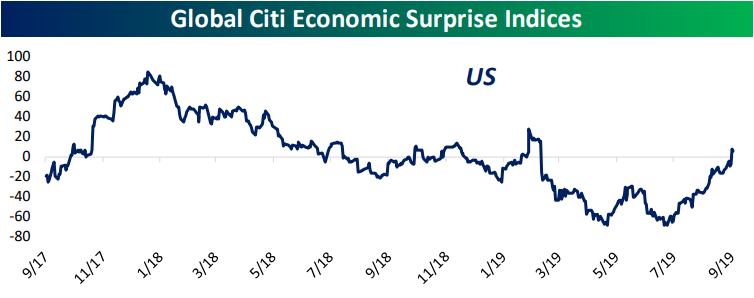
The Closer is one of our most popular reports, and you can sign up for a free trial below to see it!
See tonight’s Closer by starting a two-week free trial to Bespoke Institutional now!
Mega Caps, Last Year’s Winners Remain on Top to Start 2020
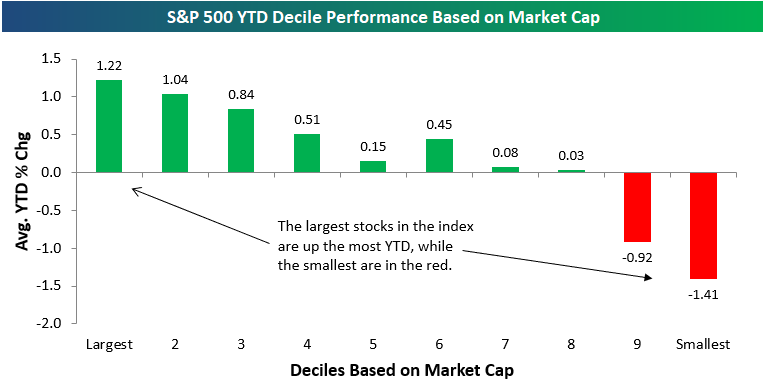
We’re seven trading days into 2020, and so far the market has been behaving a lot like it did in 2019. Below we have broken up the S&P 500 into deciles (10 groups of 50 stocks each) based on stock performance in 2019. Decile one contains the 50 stocks that performed the best in 2019, while decile ten contains the 50 stocks that performed the worst in 2019. The 50 best-performing stocks last year are up the most on average so far in 2020 as well. Decile two has been the second-best decile so far this year, while decile three has been the third-best.
On the bottom end of the spectrum, the 50 worst-performing stocks in 2019 have actually bounced with an average YTD gain of 0.70%. But the 2nd and 3rd worst performing deciles in 2019 have averaged pretty steep losses so far this year. So, while investors have been sticking with the winners so far, they’ve also been doing a little bit of dumpster diving as well.

Market cap has seemingly been the most important factor in terms of performance so far this year. The 50 largest stocks in the S&P are up the most this year with an average gain of 1.22%. The next 50 stocks are up the second most with an average gain of 1.04%, and so on and so forth. The 50 smallest stocks in the S&P are down an average of 1.41%. Only deciles 5 and 6 are out of order or else there would be a perfectly uniform relationship between market cap and YTD performance. The larger, the better so far in 2020. To read Bespoke’s most actionable stock market research, start a two-week free trial to Bespoke Premium. You’ll unlock our most popular reports like our Morning Lineup, Model Portfolios, and Chart of the Day.
“Take my crude, please”
Crude oil is just about as popular or maybe even less popular than tobacco these days. Sure, there was a brief spike in prices following the US drone strike on Iranian general Soleimani last Thursday night, but ever since then, crude oil has done nothing but trade lower. Just the fact that crude only managed to rally 3% in the lead up to what many thought to be a full-blown war with Iran shows just how out of favor crude is. This isn’t the first time crude hasn’t been able to hold onto gains either. As noted earlier this week, besides the last week, there have been two other periods of heightened tensions between the US and Iran over the last year where one would have expected prices to rally, but instead they sold-off.

When a stock consistently opens at one price and then closes lower than it opened, it’s considered a negative as it signals that investors are selling into strength. Applying that logic to crude oil confirms just how out of favor it has become. This week alone, the daily closing price has been lower than its open on all five days. The chart below shows daily streaks where crude oil closed below its opening price going back to the start of 2009. While the current five-day streak isn’t anything to write home about, we would note that even before this past week’s tensions in the Middle East, in late September/early October there was a streak of 13 trading days where the commodity closed lower than it opened, and that was the longest losing streak since at least the early 1980s! Before that, there was another streak of 7 trading days in July. In other words, two of the five longest streaks since 2009 where crude oil closed below its open both occurred in the last six months. Looking for more from Bespoke? Start a two-week free trial to Bespoke Premium and receive instant access to our best research today.

Uncovering Trends With Sector Relative Strength Charts
Our Daily Sector Snapshot does a great job of consolidating key fundamental, technical, and breadth info for the eleven major S&P 500 sectors. Our trading range charts show the path of each sector over the last year with overbought and oversold levels overlaid with the sector’s price and 50-day moving average. We also include relative strength charts which show how the sector has been performing versus the S&P 500. When the relative strength line is rising, the sector is outperforming the S&P and vice versa for a falling line.
Below we have pulled both the trading range charts and the relative strength charts from our Daily Sector Snapshot for each sector. Most sectors have been performing well on an absolute basis lately and are trending nicely higher, but in many cases the sector relative strength charts tell a different story.
Both the Communication Services and Consumer Discretionary sectors are in uptrends and have broken out to new highs recently, but their relative strength versus the S&P 500 leaves a lot to be desired. Communication Services has merely been performing inline with the S&P over the last year, while Consumer Discretionary fell off a cliff versus the S&P in the early part of Q4 2019 and has just started to recover.

Consumer Staples performed well versus the S&P over the first two-thirds of 2019, but performance versus the market plummeted from late summer through year-end as the yield curve un-inverted and investors shifted into Tech, Health Care, and Financials. Energy is the only sector that has not been in an uptrend for the better part of the last year, and thus its relative strength chart has basically been a straight path lower. More recently, the slope of Energy’s relative strength decline has started to flatten, and we’ve seen some outperformance lately as geopolitical tensions heat up. Even with the improvement, though, the sector still has a lot of work to do to turn around versus the rest of the market.

The Financial sector has performed exactly in-line with the S&P 500 over the last year, but things looked a lot worse in mid-2019 when the yield curve was inverted. Once rates started to tick higher again and the slope of the yield curve turned positive in Q4 2019, the Financials really took off. That shifted the sector’s relative strength from negative to positive, but over the last few weeks we’ve seen a slight downtick as the Financials have traded more sideways.
The Health Care sector has been on a tear for the last three months, but it hasn’t been enough to shift its relative strength back into positive territory versus the S&P over the last year. The rise of Elizabeth Warren’s poll numbers held back Health Care in 2019, and once Warren’s numbers started to dip, the sector took off. That’s the reason you see Health Care’s relative strength really picking up since making a low last October.

The Industrials sector broke out to new highs recently after trading sideways for most of 2019, but its relative strength has been mostly trending lower since peaking in the first quarter last year. Materials has seen its relative strength completely collapse to start 2020. While the S&P is up 1.4% year-to-date, the Materials sector has fallen 3%. That type of underperformance does major damage on a relative strength basis.

Real Estate (REITs) had very positive relative strength for most of 2019, but this rate-sensitive sector has struggled mightily over the last few months as the yield curve has un-inverted. The price chart for Real Estate has broken its uptrend and is struggling to hang onto its 50-day moving average. With the S&P in a steep uptrend, a near-term downtrend for a sector causes its relative strength chart to collapse.
Remarkably, the Technology sector is the only one with an upward sloping relative strength chart that’s solidly in positive territory. This tells you that Tech has been the main (and only) area of true outperformance in the US equity space over the last year. At some point this is sure to reverse, and when it does, the S&P is going to struggle given Tech’s weighting in the index.

Relative strength for Utilities looks very similar to that of other defensives like Consumer Staples and Real Estate. You saw strong outperformance for Utilities at the start of Q4 2019, but it has given it all back and then some since then. To see our Daily Sector Snapshot and track these charts on a regular basis, start a two-week free trial to Bespoke Premium. You’ll unlock additional investment research like our Morning Lineup, Model Portfolios, and Chart of the Day as well.

Sector Valuations Stretched
The S&P 500 is currently up 1.4% year-to-date, but as shown below, only three sectors are outperforming the index — Technology, Communication Services, and Industrials. Given Tech’s massive weighting of more than 23% in the S&P, its 3.2% YTD gain has a big impact on the overall market’s gain. Tech’s huge weighting is also the reason why eight of eleven sectors are underperforming the S&P.

We continue to see elevated P/E ratios. The S&P’s trailing 12-month P/E is currently 21.9, while Real Estate is at 49.9, Technology is up to 27.5, and Consumer Discretionary is at 25.3. The only sector with a P/E ratio below 19 is Financials at 14.5.
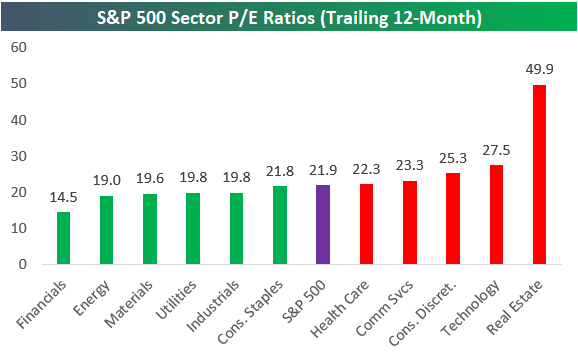
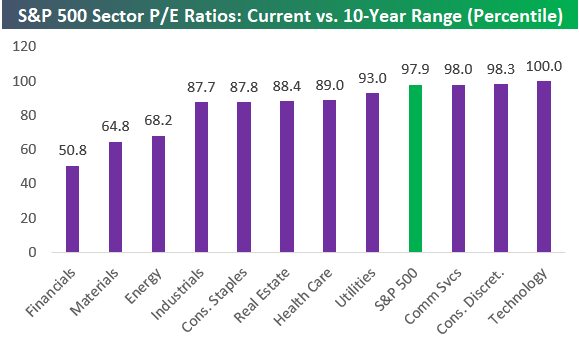
Absolute levels of valuations like the chart above don’t tell you much. The chart below shows where valuations stand for sectors relative to levels seen over the last ten years. As shown, the S&P 500’s current P/E ratio is higher than 97.9% of all other P/E readings seen for the index over the last ten years. That’s high! And three sectors have valuations in the 98th percentile or higher, with Technology at the top at 100%. Over the last ten years, Tech’s P/E ratio has never been higher.
The only sector where valuations are currently “average” compared to the last ten years is Financials. Sign up for Bespoke Premium and get half off your first three months. Click here for this special offer.