
Seasonal Winds Shifting
In the interactive section of our website, one of the features included is the Stock Seasonality Tool.

The Seasonality Tool allows users to monitor seasonal trends for US equities and other asset classes throughout the calendar year. One feature of the tool allows users to screen for which stocks and ETFs have historically performed the best and worst over the last ten years during periods with start and end dates that the user can set. Another feature of the Seasonality Tool are the gauges below that show the S&P 500’s median one-week, one-month, and three-month return over the last ten years from the close on the current date. In each gauge, we also show how each period’s performance stacks up on a percentile basis relative to all other periods within the calendar year.
The gauges below are from the Stock Seasonality Tool for today (5/28). Looking at historical returns going forward from today, the results aren’t particularly attractive. Over the last ten years, the S&P 500’s median one week return from the close on 5/28 has been a decline of 0.59% which ranks in just the 11th percentile of all one-week periods. Over the following month, the median decline of 0.85% is even worse and ranks in only the 7th percentile. For the following three months, the S&P 500’s median performance flips back to positive territory, but at less than +2% still only ranks in the 37th percentile. This year most certainly has not been a year to sell in May, but if seasonal trends are any indication, don’t be surprised to see a June swoon. Start a two-week free trial to Bespoke Institutional to access all of our interactive tools and analysis.

Weekly Sentiment Indicators Improving
Investors and newsletter writers are finally seeming to be convinced by the rally as the S&P 500 has retaken its 200-DMA over the past week. 33.07% of respondents in AAII’s weekly sentiment survey reported as bullish this week. That is up from 29% last week and the highest level of bullish sentiment since April 16th when it reached 34.86%.

As for bearish sentiment, after the 1.17 percentage point decline to 42.13% this week, AAII’s survey is reading the lowest level of bearish sentiment since mid-April. This week was the third consecutive week with bearish sentiment declining, but despite that it is still fairly elevated. In fact, this week marked the twelfth consecutive week in which bearish sentiment was at least one standard deviation above it historical average (30.48%). That is the longest such streak since a 14-week long streak in 2008.

Finally, neutral sentiment in the AAII survey fell for a second week in a row. Currently at 24.8%, it remains at a much lower level than has been the norm for the past several years (over the past decade it has averaged a reading of 33.76%) but also well off of its late March low of 14.5%. Start a two-week free trial to Bespoke Institutional to access our interactive economic indicators monitor and much more.

Fund Flows Still Show Little Equities Enthusiasm
The table below gives a summary of mutual and exchange-traded fund flows as compiled by the Investment Company Institute for the week ending May 20th.
Equity fund flows remain negative. While there’s been lots of anecdotal evidence of retail enthusiasm in the equity market, fund flows are a very different story. This week was relatively modest, with equity fund outflows in the bottom 6% of all readings across mutual funds and ETFs. That totals $13.7bn of AUM out the door, with the worst hits coming for global funds which saw flows in the bottom 3% of all readings. The last 3 months and year have been the worst on record for aggregate equity fund flows across mutual funds and ETFs, and the worst three months on record for world equity funds. ETFs tracking equities have not seen large inflows but they are also not suffering the same kind of outflows as mutual funds.
Commodity funds and bond funds are a totally different story. The last three months have been the best on record for commodity fund inflows, while bond funds have seen readings in the top 3% of all periods for the last week and month; recent commodity fund flows are slightly cooler than their record pace of the last three months but are very, very strong nonetheless. Start a two-week free trial to Bespoke Institutional to access our full research platform and our unique investor tools.

Texas Activity Starting To Recover
Yesterday the Dallas Fed released monthly activity surveys for the services and retail sectors in May. These surveys are similar to PMIs, with readings above zero indicating more respondents seeing improvement than those seeing declines, and vice-versa. Looking at revenue first, Services businesses reported much less widespread revenue declines than in April. As a reminder, though, a reading below zero still indicates revenue declines, so the May reading still indicates widespread drops in Services spending; that said, the outlook has bounced back into positive territory, which is a great sign.
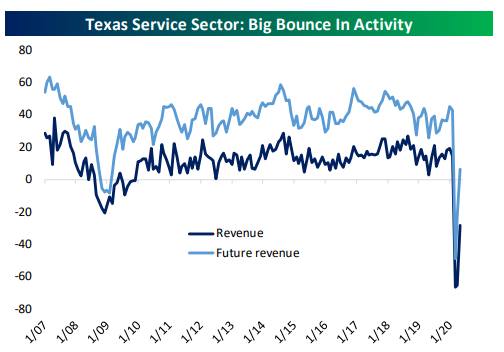
Retail businesses specifically have seen an even bigger bounce in revenues that brings that state’s retail sector to almost zero revenue declines in May. Retail businesses report an even more dramatic reading for future revenue expectations, with the series in totally normal territory at this point.

Finally, we note that while revenues look to be firming up, employment is still dropping and there isn’t a big surge in re-hiring yet for services businesses. The company outlook category, despite having half of its drop reversed, is still about where it was at the lows of the last recession. Start a two-week free trial to Bespoke Institutional to access our full research platform and our unique investor tools.

The Bespoke 50 Top Growth Stocks — 5/28/20
Every Thursday, Bespoke publishes its “Bespoke 50” list of top growth stocks in the Russell 3,000. Our “Bespoke 50” portfolio is made up of the 50 stocks that fit a proprietary growth screen that we created a number of years ago. Since inception in early 2012, the “Bespoke 50” has beaten the S&P 500 by 116.8 percentage points. Through today, the “Bespoke 50” is up 237.7% since inception versus the S&P 500’s gain of 120.9%. Always remember, though, that past performance is no guarantee of future returns. To view our “Bespoke 50” list of top growth stocks, please start a two-week free trial to either Bespoke Premium or Bespoke Institutional.
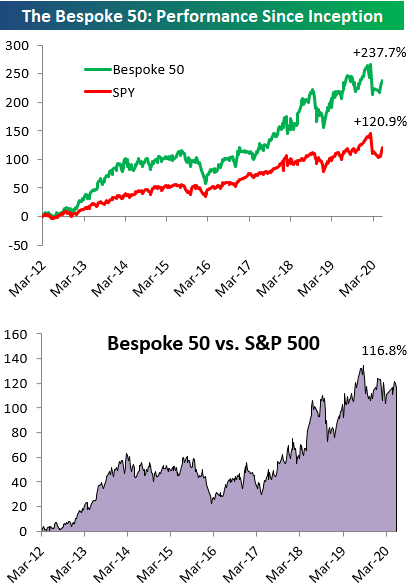
Chart of the Day: Continuing Claims Peaks Mean It’s Not Too Late
Continuing Claims Improve With A Caveat
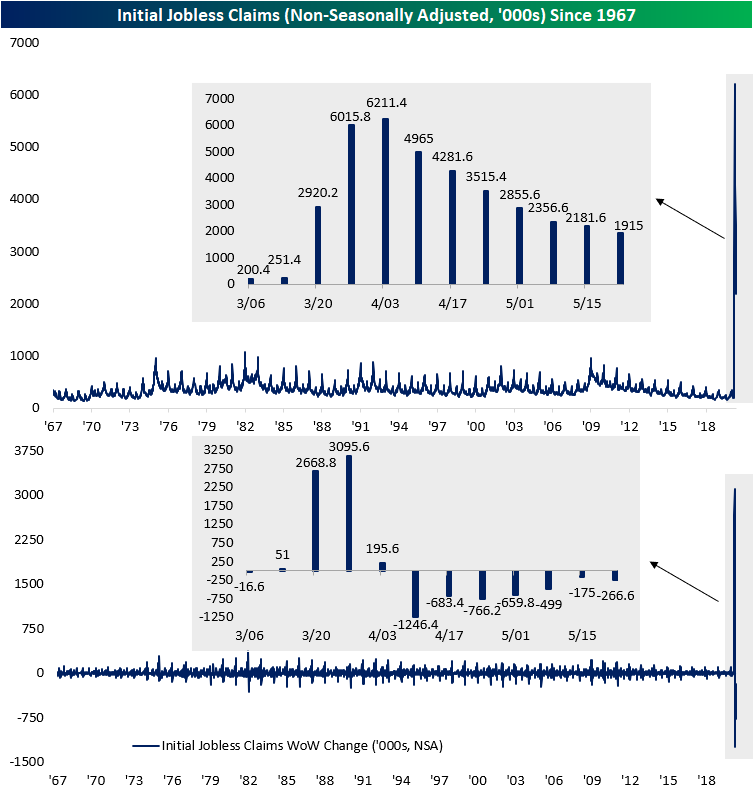
There has been a massive slate of economic data today including one of the most widely watched indicators of late: initial jobless claims. Claims fell again this week down to 2.123 million compared to a downward revised 2.446 million last week. Although lower, this week’s number was slightly above estimates of a 2.1 million print.

As we noted last week, although it doesn’t take from the fact that over 40 million jobless claims have been filed since the week of March 20th and claims continue to come in at higher levels than anything observed prior to COVID-19, they have been improving over the past couple of months. This week marked an eighth consecutive week with initial jobless claims declining sequentially. As shown in the chart below, that streak is now the longest ever, surpassing two seven week long streaks from October of 1980 and November of 2013.

As for the non seasonally adjusted data, it has only fallen for seven consecutive weeks now with the decline to 1.915 million this week. This week also marked the first sub-2 million NSA claims print since they first exploded higher at the end of March.
Albeit the labor market picture is still weak, initial jobless claims grinding lower in recent weeks is a positive. With states beginning to reopen, continuing claims are also beginning to fall. Seasonally adjusted continuing jobless claims fell to 21.052 million this week (NSA=19.052 million from 22.794 million last week). That is a massive 3.86 million or 15.49% drop from last week. That is the largest one week decline ever recorded (as was the NSA WoW decline of 16.42%) but that comes with a bit of a caveat.
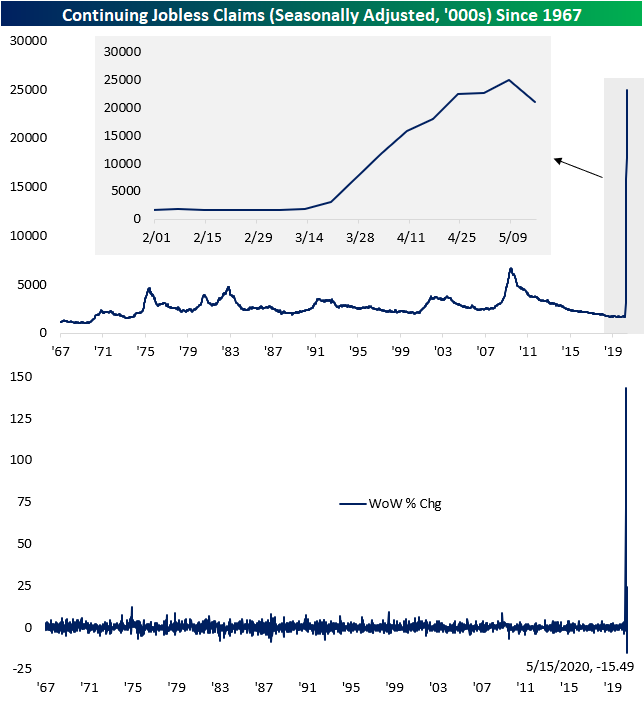
While continuing claims dropped, the improvement is potentially less dramatic than the headline numbers imply. For instance, the bulk of this week’s decline in the US total is thanks to extremely large and yet to be explained 40.46% sequential decline in California and an even larger 76.35% decline in Florida. Washington continuing claims also experienced a smaller but nonetheless significant decline of 39.69% WoW. For Washington and Florida those were the largest one week drops on record. As for California, it was the largest one week decline since a 40.72% decline two weeks ago. While those massive declines could absolutely be legitimate, the sheer degree of the move should be handled with some skepticism especially given issues with state reporting like in Connecticut and Massachusetts in recent weeks and hiccups in Florida regarding work search questions. Excluding the enormous moves of these three states, continuing claims would fortunately still be lower, but at a more modest 1.51%. Start a two-week free trial to Bespoke Institutional to access our interactive economic indicators monitor and much more.

Bespoke’s Morning Lineup – 5/28/20 – Zero, Nada, Zilch
See what’s driving market performance around the world in today’s Morning Lineup. Bespoke’s Morning Lineup is the best way to start your trading day. Read it now by starting a two-week free trial to Bespoke Premium. CLICK HERE to learn more and start your free trial.
As shown on the first page of our Morning Lineup today, there has been a ton of economic data to contend with, so we won’t go over it all here. The key (and most timely) report we would highlight is jobless claims. This morning’s reading came in at 2.123 million, which was a bit higher than expectations (2.1 million) but down from last week. In no means do we want to sugarcoat this report; 2 million claims is a ridiculously high number. We can take some solace in the fact that claims are moving in the right direction, though. This week’s reading was the 8th straight w/w decline, which is the longest such streak of declines on record (going back to 1962).
Be sure to check out today’s Morning Lineup for a rundown of the latest stock-specific news of note, news in global markets, global and national trends related to the COVID-19 outbreak, and much more.

In a post yesterday, we highlighted the fact that there were only four stocks in the entire S&P 500 that were more than 5% below their 50-day moving average. With so few stocks below their 50-DMA that also leaves a limited supply of candidates to be oversold (more than 1 standard deviation below their 50-DMA), and as of yesterday’s close, there were actually zero stocks in the S&P 500 that were trading at oversold levels. That is not only the first time in at least a year that there were no oversold stocks in the S&P 500, but based on a quick scan of our database going back to 2007, there has never been another time when no stocks in the S&P 500 were oversold. Conversely, the last time more than 70% of stocks in the S&P 500 were overbought (as is the case now), was back in February 2019.

Daily Sector Snapshot — 5/27/20
“Not So Fast”
While everyone was busy writing the Nasdaq’s obituary this morning, the index responded, “Not so fast.” After falling more than 2% intraday, the Nasdaq erased all of the early declines and not only finished higher, but it actually saw a healthy gain of over 0.5%. To put today’s move in perspective, even with the volatility of the last several months, the last time we saw a similar positive reversal (down 2%+ intraday, finished up 0.5%+) was back in February 2018 (2/6 and 2/9).
Before the two occurrences in February 2008, you have to go all the way back to the Financial Crisis to find another occurrence when there were nine in the period spanning January 2008 through February 2009. The real sweet spot for these types of reversals, though, was in the late 1990s and early 200s. In the runup to the March 2000 peak, there were ten similar reversals and then another 22 from the dot-com peak through the 2002 low. As for the Nasdaq’s return going forward, unfortunately, these types of reversals aren’t indicative of much besides the fact that there was an upside reversal that day. Start a two-week free trial to Bespoke Institutional to access all of our research and interactive tools.
