Daily Sector Snapshot — 6/15/20
Small Bounce For Small Business
Last Tuesday, the NFIB provided an update on small business sentiment in the month of May. In April the headline number had fallen down to 90.9 which was the lowest level since March of 2013. In May, the index rebounded to 94.4. That 3.5 point increase was the largest one month gain for the index since a 3.7 point increase in November 2017. While an improvement, the index now only remains around similar levels to 2016.
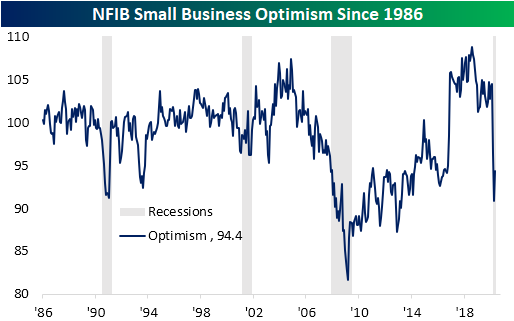
As shown in the table below, breadth in the May report was solid with all but two components of the headline number (Job Openings Hard to Fill and Actual Earnings Changes) rising month over month. Even with the nice bounce, though, there is still a negative net percentage of respondents reporting optimism for credit conditions, inventories, sales, and earnings. Similarly, poor sales have become one of the most pressing issues for businesses.

While current optimism remains at the lowest level of the past several years, the index for expected conditions is more positive. A net percentage of 34% of respondents reported that they expect the economy to be better rather than worse. That is the highest reading since August and July of 2018.

As shown in the charts below, activity indices have been some of the weakest areas of the report. A net of -19% reported sales were higher which was an 8 percentage point drop from the prior month. That is the weakest reading for that index in a decade. Bottom lines are also hurting with a net of 26% of respondents reporting lower earnings. That is a 6 percentage point drop MoM and the weakest level for this index since an equivalent reading in February 2014. NFIB highlighted that the bulk (46%) of owners reported weak sales as a source of the weak earnings while another 9% reported price changes as another reason. Meanwhile, a net 2% reported that they plan to accumulate inventories.

Labor market indices are another weak area. Some of the only indices to experience sequential declines outside of sales and earnings were labor-related. For example, the indices for Compensation, Actual Employment Changes, and Job Openings Hard to Fill all were down from April. Those indices are now at their lowest levels since July 2013, September 2009, and September 2014, respectively. Meanwhile, the outlook is less pessimistic with Hiring Plans and Compensation Plans both ticking higher, though, they too remain at their lowest levels of the past several years.

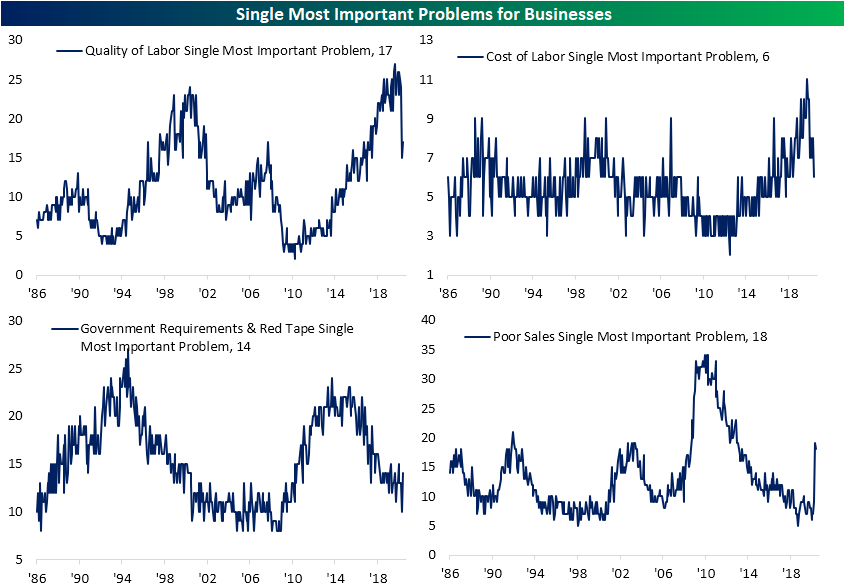
The weakening in labor activity is also showing through what businesses consider their biggest issue. Over the past couple of years, the quality of labor and the cost of labor had become some of the most pressing issues. But that is no longer the case as recent months have seen that trend reverse. Now 18% reported Poor Sales as the most pressing issue while Quality of and Cost of Labor as the most important issue are around similar levels to 2017. The amount reporting poor sales as the most important issue was actually down 1 percentage point in May but it is still elevated at its highest levels since 2013. Additionally, government red tape remains one of the most important issues though that is not at any multiyear high like Poor Sales.
Leading up to the COVID Crash, “poor sales” was at the bottom of the list when it comes to the biggest problems reported for small businesses. You know an economy is firing on all cylinders when that is the case. Conversely, when “poor sales” are the leading issue for small businesses, it obviously represents a major problem. As shown in the lower right chart below, “poor sales” has indeed spiked as a major issue, but it’s still only half of what was seen at the depths of the Financial Crisis. It’s a good sign that this reading actually ticked slightly lower in May versus April, and we’ll continue to watch it closely in the coming months as one of our key indicators for the recovery. Click here to view Bespoke’s premium membership options for our best research available.
B.I.G. Tips – Lower Highs and Lower Lows
Chart of the Day – Pullbacks in Bull Markets
Empire Strikes Back
Only a couple of months after the lowest (April) and second-lowest (May) readings ever, the New York Fed’s index on manufacturing activity was expected to improve with forecasts calling for a reading of -29.6. While that would have been a sizeable increase, it still would have resulted in the fifth-lowest reading on record. Instead, the headline number improved by much more coming in at -0.2 this morning. Of the survey’s respondents, 36.1% reported better general business conditions while another 36.3% reported worse conditions. That near-zero reading in the index indicates that activity on net in the region was essentially unchanged compared to last month rather than experience large contractions like the prior two months. That massive rebound likely has reopenings to thank as the survey results were collected between June 2nd and June 9th which coincided with every region in the state including New York City entering at least Phase One of the reopening cycle (allowing manufacturers, construction, and supply chain businesses to resume business). By the collection period, many regions, but not NYC had actually entered Phase Two which allows for an even wider array of activity.
As current conditions are no longer showing extremely weak activity and reopenings give hope of a return to normal, firms turned much more optimistic with the index for conditions six months out ripping higher to 56.5. As recently as March, the index was only at 1.2 which was the weakest reading since February of 2009. Just three months later, the 56.5 reading is the highest since October 2009 when the index was just 0.3 points higher.

With future expectations now elevated and current conditions still somewhat muted, albeit improved, there remains a massive disconnect between how businesses view their present and future situations. As shown below, that spread was at a record high of 85.2 back in April as the index for current conditions was at a record low. It has since fallen down to 56.7 which is still higher than all but six other months in the history of the survey excluding April and May. Prior to the past few months, the last time the spread was at these levels was back in November of 2010.

As shown in the table below, for the individual categories of the report, more than half for current conditions still remain in contraction though they are greatly improved from last month. On the other hand, of the indices for expectations, the only one in contraction in June was the one for inventories. For General Business Conditions, New Orders, and Shipments, the month over month increase in June was the largest on record. While not the biggest ever one-month increases, the indices for the expectations of those same categories, as well as Number of Employees, Capital Expenditure, and Technology spending in addition to current Prices Paid and Average Workweek all saw one-month gains in the 90th percentile or better. Broadly speaking, the readings for this month’s survey seem to indicate that activity has begun to find a footing in June, even if that is at weaker levels, as firms hold a rosier outlook for the future.

Again, one of the stronger aspects of this month’s report was businesses’ reporting optimism for the future. The indices for future plans for Cap-Ex and Technology spending embody this. Although they remain at the low end of their historic ranges even after historically large one-month gains, both indices showed more firms plan to invest rather than disinvest in their businesses.

As previously mentioned, the indices (both current conditions and future expectations) for New Orders and Shipments saw massive moves this month. That indicates demand has firmed (though is perhaps not rising) and is no longer declining at the dramatic rate of the past few months. As with the headline number, the current new orders showed a very slight contraction in June while the index for expectations was at its highest level since August of 2005.
Meanwhile, there was actually a slight pickup in Shipments as the index rose to a positive 3.3. Similar to New Orders, firms’ optimism about the future was one of the bright spots with the index for Shipments six months out rising to 53.1. That is the highest reading since August of 2014.


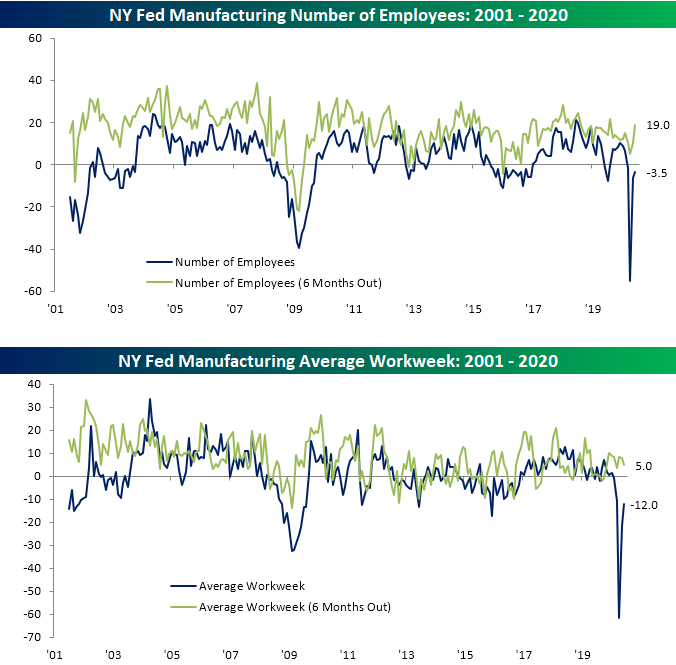
Employment indicators were actually a bit of a soft spot in this month’s survey. The current indices for Number of Employees and Average Workweek were some of the weakest readings across the various categories albeit they too improved from May. 21.9% of respondents reported a lower level of workers compared to 18.4% that reported an increase in their workforce. Meanwhile, 24.1% reported a shorter workweek while about half of that (12.1%) reported a longer workweek. Click here to view Bespoke’s premium membership options for our best research available.
Bespoke’s Morning Lineup – 6/15/20 – Neutral All Around
See what’s driving market performance around the world in today’s Morning Lineup. Bespoke’s Morning Lineup is the best way to start your trading day. Read it now by starting a two-week free trial to Bespoke Premium. CLICK HERE to learn more and start your free trial.
Ahe week isn’t starting off on a positive note for bulls as the S&P 500 is on pace to open the day with a decline of over 2%. After a 40% rally off the lows, investors are reassessing where the markets stand relative to the pace of economic growth and the potential of a wider outbreak across the country. While equities have come a long way and may have gotten ahead of themselves in terms of short-term fundamentals, trends in the coronavirus outbreak haven’t materially changed in the last few weeks. The only difference is that they have attracted more headlines.
Be sure to check out today’s Morning Lineup for a rundown of the latest stock-specific news of note, moves in overseas markets, economic data out of China, global and national trends related to the COVID-19 outbreak, and much more.

Last week was a nasty one for the major US equity indices. With declines in the range of 8% or more in the small-cap space to a drop of 1.59% for the Nasdaq 100, all of the major index ETFs we track in our Trend Analyzer were down on the week. While the week started out with every index at either overbought or ‘extreme’ overbought levels, by the end, every single one of them besides QQQ finished the week in neutral territory relative to their trading range and neutral in terms of their short-term timing scores. Concerns over an acceleration in the virus outbreak have clearly weighed on sentiment as of late, and how this week plays out will go a long way in determining how the summer is going to play out.

Bespoke Brunch Reads: 6/14/20
Welcome to Bespoke Brunch Reads — a linkfest of the favorite things we read over the past week. The links are mostly market related, but there are some other interesting subjects covered as well. We hope you enjoy the food for thought as a supplement to the research we provide you during the week.
While you’re here, join Bespoke Premium for 3 months for just $95 with our 2020 Annual Outlook special offer.
Policing
Police, Social Order, and Exemplary Violence by Patrick Wyman (Substack)
Historian Patrick Wyman analogizes the current moment of mass protest and social uprising, as well as the police response, to medieval peasant revolts, which featured desires for reform rather than revolution and brutal violent response from the existing power structure. [Link; paywall]
The City That Remade Its Police Department by Sarah Holder (Bloomberg)
Camden, NJ dissolved its police department in 2013 and shifted to a community policing model that increased interactions between police and citizens but made sure they happened more frequently in peaceful and amicable circumstances. [Link; soft paywall]
History
Alfred Winslow Jones by Abraham Thomas (Thread Reader)
The inventor of the modern hedge fund started his career working on a tramp steamer, worked in the diplomatic corps and saw the rise of the Nazis, and sipped whiskey with Hemmingway during the Spanish Civil War before coming up with the basic strategy which predominates today. [Link]
Ground-Penetrating Radar Reveals Entire Ancient Roman City by George Dvorsky (Gizmodo)
New radar technology has allowed archaeologists to explore the ruins of an ancient Roman settlement north of Rome without any actual digging. [Link]
COVID
Identifying airborne transmission as the dominant route for the spread of COVID-19 by Renyi Zhang, Yixin Li, Annie L. Zhang, Yuan Wang, and Mario J. Molina (PNAS)
Using event studies, the authors posit that airborne transmission is by far the most dominant means by which COVID is transmitted, and that mask-wearing is highly effective at reducing transmission both for those who are symptomatic and those who have not yet been infected. [Link]
Exclusive: Bottlenecks? Glass vial makers prepare for COVID-19 vaccine by Ludwig Burger and Matthias Blamount (Reuters)
The German company that is the leading manufacturer of glass vials which store vaccines is reporting huge interest in obtaining product, which may be needed in the billions. [Link]
New Jersey Businesses Defy Lockdown After Murphy Violates Own Order by Elise Young (Bloomberg)
Political opponents of the New Jersey governor and small business owners are mad that he attended a Black Lives Matter protest while the state has not allowed full reopening of businesses. [Link; soft paywall]
China
Two-husband strategy may be a remedy for China’s one-child policy, professor posits by Ann Fifield (WaPo)
The one child policy both crushed birth rates in China and created a huge imbalance between the number of men and women; one possible solution is polyandry, with multiple husbands per bride. [Link; paywall]
Grants & Loans
Structuring Federal Aid To States As An Automatic (and Autonomous) Stabilizer by Author Williams (Employ America)
An argument that the federal government needs an independent agency to stabilize state government tax receipt declines during recessions, using rules-based grants to prevent large retrenchments in state government employment which extends and exacerbates recessions. [Link]
Is There Really A “Looming Bank Collapse?” by Nathan Tankus (Substack)
A thorough debunking of the silly notion that collateralized loan obligations (CLOs) are about to destroy the financial system. [Link]
Treasure
97-year-old New Jersey man leaves behind treasure trove of signed baseball cards by Yaron Steinbuch (NYP)
A New Jersey man had collected baseball cards for most of a century before passing recently with millions worth of memorabilia including six different cards signed by Babe Ruth himself. [Link]
Forrest Fenn confirms his treasure has been found by Danielle Prokop (Santa Fe New Mexican)
After hundreds of thousands of seekers failed (including at least five deaths), hidden treasure stashed with a public set of clues by a Santa Fe artifacts dealer has finally been found. Naturally, the result of the hunt are already the subject of multiple pieces of litigation. [Link]
Investing
Playing the Market Has a Whole New Meaning by Jason Zweig (WSJ)
With casinos closed and no sports to gamble on, tens of thousands of risk-seekers have turned to the stock market, with some pretty incredible results. [Link]
Booze
Budget beer and spiked seltzer dominated during the pandemic by Jordan Valinsky (CNN)
Consumers unable to quaff their thirst at the bar or game turned to hard seltzer and cheaper domestic brand beers during the COVID crisis. [Link]
Copywrites
US Military Could Lose Space Force Trademark to Netflix Series by Jim Johnson (CBR)
The new branch of the military didn’t check for copywrites before rolling out their name, which had already been snagged by a Netflix comedy. [Link]
Read Bespoke’s most actionable market research by joining Bespoke Premium today! Get started here.
Have a great weekend!
The Bespoke Report — Stumble At The Finish Line
This week’s Bespoke Report newsletter is now available for members.
US equities stumbled into the end of the week after a brutal day Thursday. Narratives abound, but given how overbought global equities had gotten, we are skeptical to push explanation beyond that. What we’re less skeptical about is the ongoing disease burden of COVID-19, the accomodative stance of monetary policy, and the slow improvement of the US economy over the last few weeks. We discuss all of this as well as updating the outlook for the election in this week’s Bespoke Report.
To read the report and access everything else Bespoke’s research platform has to offer, start a two-week free trial to one of our three membership levels. You won’t be disappointed!