
Bespoke Brunch Reads: 11/22/20
Welcome to Bespoke Brunch Reads — a linkfest of the favorite things we read over the past week. The links are mostly market related, but there are some other interesting subjects covered as well. We hope you enjoy the food for thought as a supplement to the research we provide you during the week.
While you’re here, join Bespoke Premium with a 30-day free trial!
mRNA
How to make a messenger RNA vaccine: inside the RNA manufacturing process (GreenLight Biosciences)
A quick read on how vaccines which rely on messenger RNA (mRNA) are manufactured. This is the core technology behind both Pfizer (PFE) and Moderna (MRNA) vaccines. [Link]
Why Moderna’s Vaccine Win Is a Giant Leap Against Pandemics by Max Nisen (Bloomberg)
New mRNA technology offers the promise for very rapid and scaled vaccine development as new pandemics emerge, and offers a series of key advantages over traditional vaccine manufacturing processes. [Link; soft paywall]
Immunity to the Coronavirus May Last Years, New Data Hint by Apoorva Mandavilli (NYT)
While there have been some isolated cases of reinfections, clinical data from blood samples of post-infection COVID patients suggests that the immune response to infection provides antibodies which are likely to last for years. [Link; soft paywall]
Social Media
Twitter rolls out Stories, aka ‘Fleets,’ to all users; will also test a Clubhouse rival by Sarah Perez (TechCrunch)
This week Twitter introduced a copycat feature that has been a part of Snapchat for years, and is considering a feature that works like audio-based social space Clubhouse. [Link]
Parler Makes Play for Conservatives Mad at Facebook, Twitter by Jeff Horwitz and Keach Hagey (WSJ)
A social media company supported by the financial backers of Breitbart News is making a play to draw disaffected conservatives from more traditional social media networks. [Link; paywall]
Thanksgiving
GasBuddy Study Finds 45% Fewer Travelers on the Road This Thanksgiving, Gas Prices Projected to Be Lowest Since 2016 (GasBuddy)
With the threat of the pandemic, many Americans are forgoing their traditional Thanksgiving gatherings, and that’s going to mean a lot less gasoline demand than normal. For those who do drive to see family, gas prices are set to come in much lower than historically normal. [Link]
38% of Americans planning a big Thanksgiving despite COVID-19: survey by Jesse O’Neil (NYP)
While there are major risks to large group gatherings amidst a global pandemic, COVID isn’t stopping about a third of the company from getting together for turkey this year. [Link]
Pressured Business Models
A Covid Baby Bust Is Bad News for These Businesses by Saabira Chaudhuri (WSJ)
The coronavirus pandemic is driving birthrates down dramatically, putting fresh pressure on demand for products designed for babies. [Link; paywall]
Retail Chains Shed Stores, but It Isn’t Good for Business by Suzanne Kapner (WSJ)
With so many stores empty, retailers are shuttering locations en masse, and as a result may have a hard time capturing demand when consumers feel safe walking the aisles again. [Link; paywall]
Rent Seeking
New York’s 4-Year-Olds Are Mastering Zoom to Get Into Elite Kindergartens by Amanda L. Gordon and Janet Lorin (Bloomberg)
The traditional interview process for elite kindergartens in New York City (yes, seriously) has moved to online meetings. Best of luck to the parents that need to keep kids under 5 focused for a Zoom call. [Link; soft paywall]
The Weekly Planet: What Donald Trump Taught the Electric-Car Industry by Robinson Meyer (The Atlantic)
With the auto industry pursuing its inevitable transition away from fossil fuels, Big Car and Big Oil are no longer playing on the same team when it comes to lobbying in Washington DC. [Link; soft paywall]
Finding Homes
Seoul converts hotels into studios to ease housing crunch by Song Jung-a (FT)
The South Korean government is purchasing 114,000 units of hotels and offices which are standing mostly empty thanks to COVID, aiming to ease a housing crunch. [Link; paywall]
Semis
Steve Jobs’s last gambit: Apple’s M1 Chip (Om)
A technical walk-through and deep dive into the implications of Apple’s new M1 chip, which packs graphics, basic processing, RAM, and other aspects of system architecture into a single, extremely efficient package. [Link]
Read Bespoke’s most actionable market research by joining Bespoke Premium today! Get started here.
Have a great weekend!
B.I.G. Tips – Top Earnings Triple Plays
The Bespoke Report – Waiting is the Hardest Part
There’s the old saying that if at first you don’t succeed, try, try, and try again. After positive vaccine news from Pfizer (PFE) on November 9th helped to push the S&P 500 and the Nasdaq to new highs, the major averages couldn’t hang onto those gains. If it didn’t work the first time, though, maybe news this Monday that Moderna’s (MRNA) vaccine was even more effective would do the trick. Markets rallied again, but once again couldn’t hang on to the gains. Throughout this week, there were more positive vaccine headlines, but each booster shot was less effective. The result? While equities closed out the week right near all-time highs, they’ve essentially been rangebound for the last two weeks as well as the last two and a half months.
Since Pfizer’s positive vaccine news before the open on 11/9, the S&P 500 and Nasdaq have essentially been on a treadmill with a number of swings up and down, but really nothing to show for any of it. Investors just can’t seem to make up their minds at this point between placing more emphasis on the shorter-term concerns of rising COVID hospitalizations or the positive long-term impacts of viable vaccines. Decisions. Decisions. We discuss all the latest trends in the market and the economy in this week’s Bespoke Report.
This week’s Bespoke Report newsletter is now available for members.

To read the report and access everything else Bespoke’s research platform has to offer, start a two-week free trial to one of our three membership levels. You won’t be disappointed!

Daily Sector Snapshot — 11/20/20
Tracking The US COVID Surge As European Cases Peak
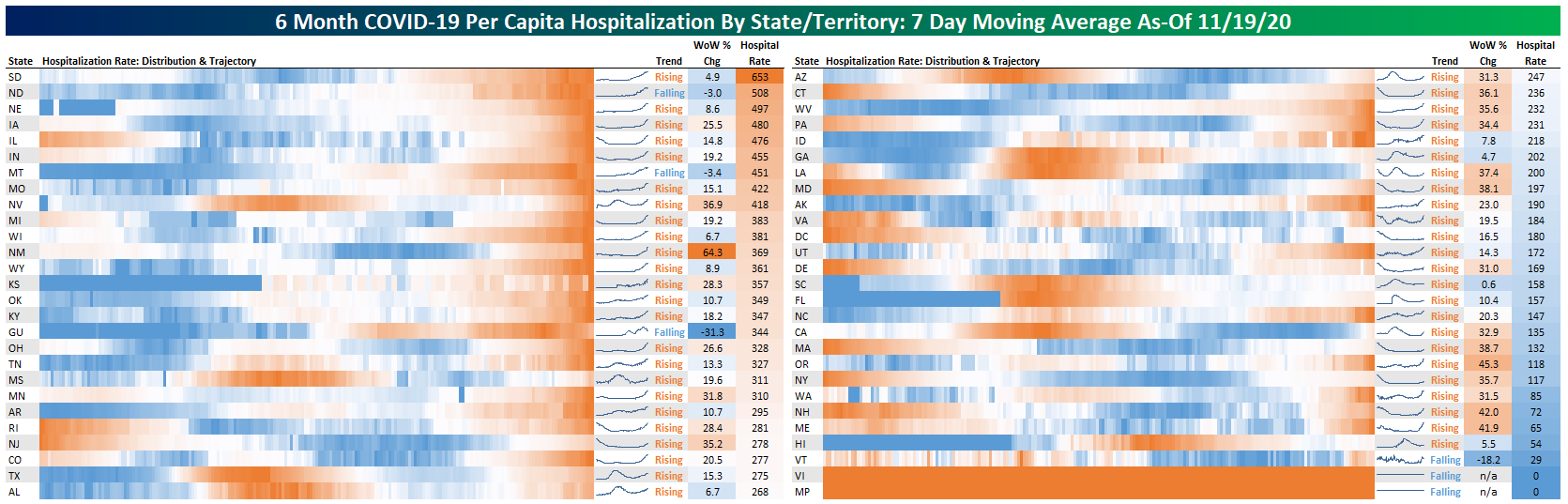
US COVID cases continue to rise sharply. Testing has also risen, but an increase to 10% positive test rates show that this is not simply about more testing. While there’s been a slow down in the percentage growth of confirmed positives that could be a leading indicator of a peak in daily new cases, Thursday’s numbers put a wrench in what had been a promising trend. A peak for daily new cases in the wake of Thanksgiving is still possible, but in the meantime millions of new cases will emerge. At a lag, hospitalizations will follow. Adjusted for the population of states reporting hospitalizations, hospitalization rates have reached new records. Like clockwork, deaths are following. Almost 2,000 Americans died yesterday, and at a lag to cases and then hospitalizations, the trend is accelerating. We update these charts and the analysis that goes with them every morning in our pre-market report The Morning Lineup. Click here to start a free trial to Bespoke Institutional and receive our daily Morning Lineup for the next two weeks, featuring more commentary and data on macro markets.
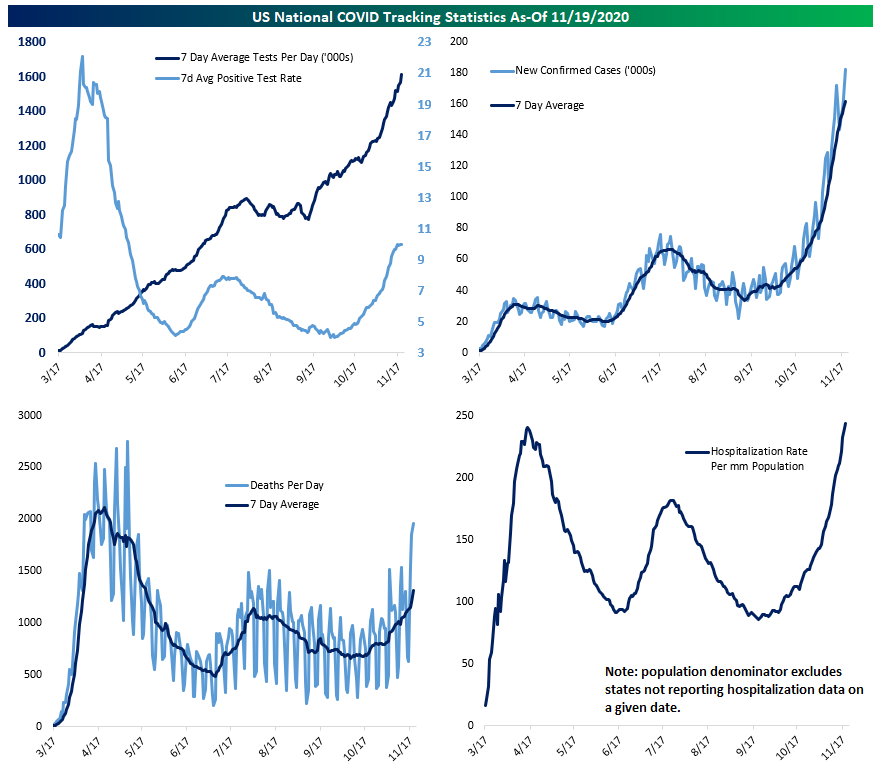
Switching to a granular look at states, below we show a table of state deaths, cases, tests, and positive test rate. We adjust for population on the right side of the table to make comparisons across states like-for-like. One note on positive test rates and test counts: some states under-report the actual number of tests run, so not all of these numbers can be taken at strictly face value. This table is still quite useful in seeing where testing, cases, positive test rate, and deaths sit across the country for the period ending on November 19th.
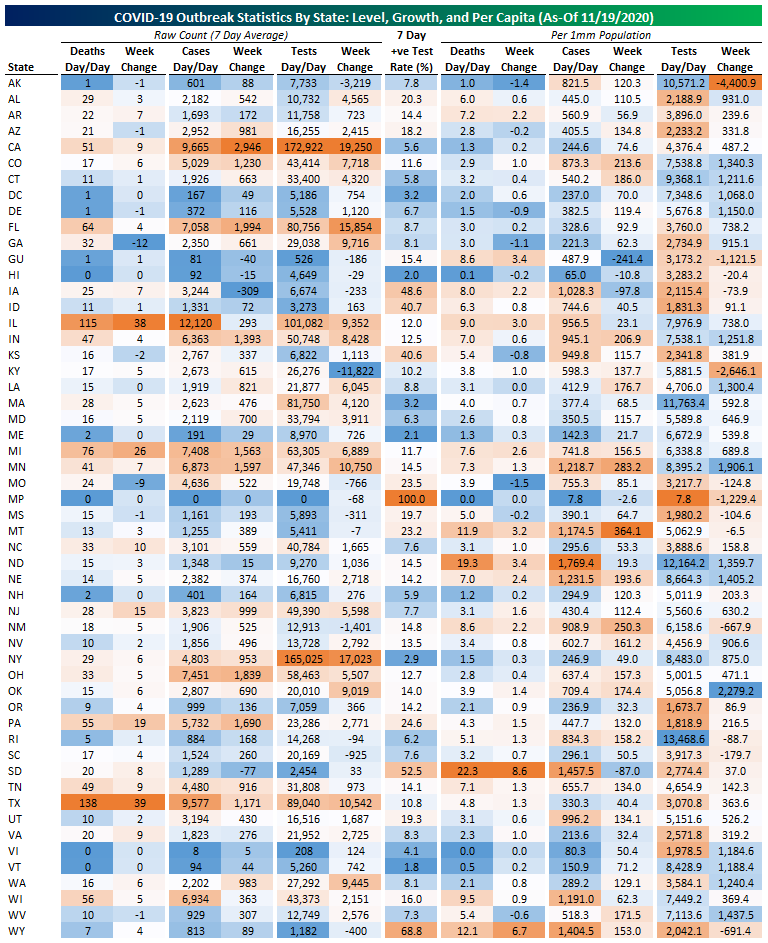
Another way to look at state performance is to compare tests over time. In the table below we show state 7 day average daily positive tests indexed to their peak (which in most cases is the current level). This allows a view of where the pandemic is currently worst versus the last six months. This helps to illustrate the national breadth of this massive increase in new cases currently underway.
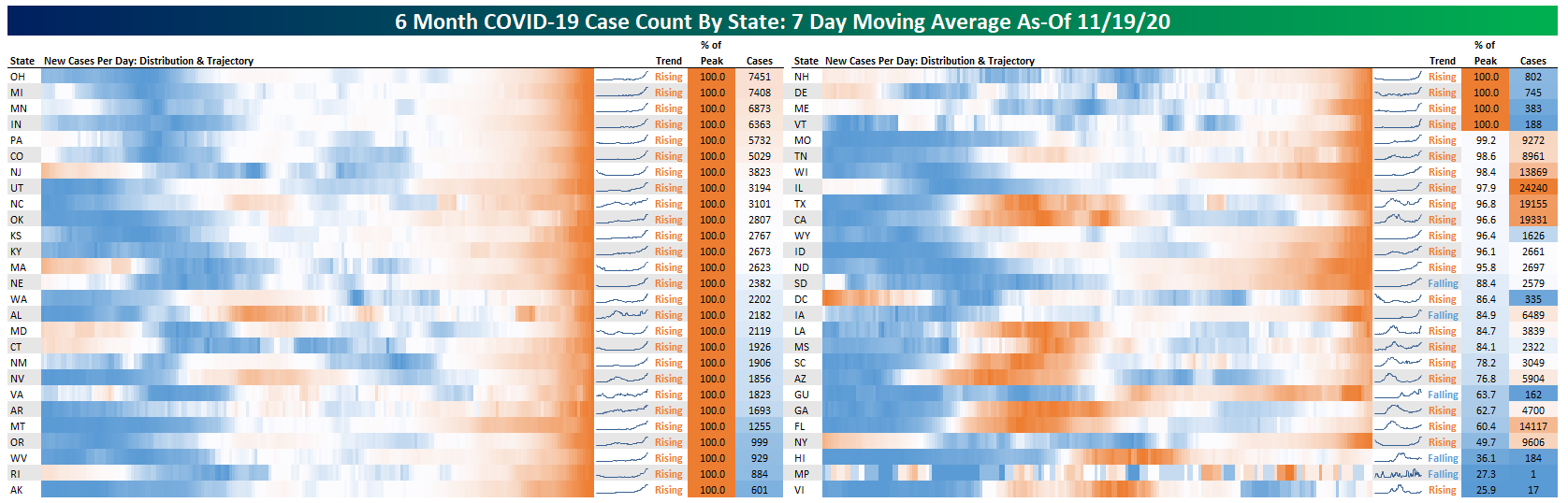
We have a similar chart for hospitalization rates. Hospitalization rates are not subject to vagaries of test counts, and while they tend to lag new positive tests as an indicator of COVID’s spread, they are closer to real-time than deaths, which lag hospitalization rates. As shown, a number of states have over 400 people hospitalized per million population, and in all but a very few cases, hospitalization is rising, mostly quite quickly. Anything under a few hundred hospitalizations per million population isn’t a sign of stress on health care systems, but above 300-400 hospitalizations per million, states generally start running out of beds. Surging resources can help, but there are practical limits on how many people can be hospitalized at once. With new cases continuing to accelerate, this is a bad sign, because hospitalizations tend to lag new case counts.
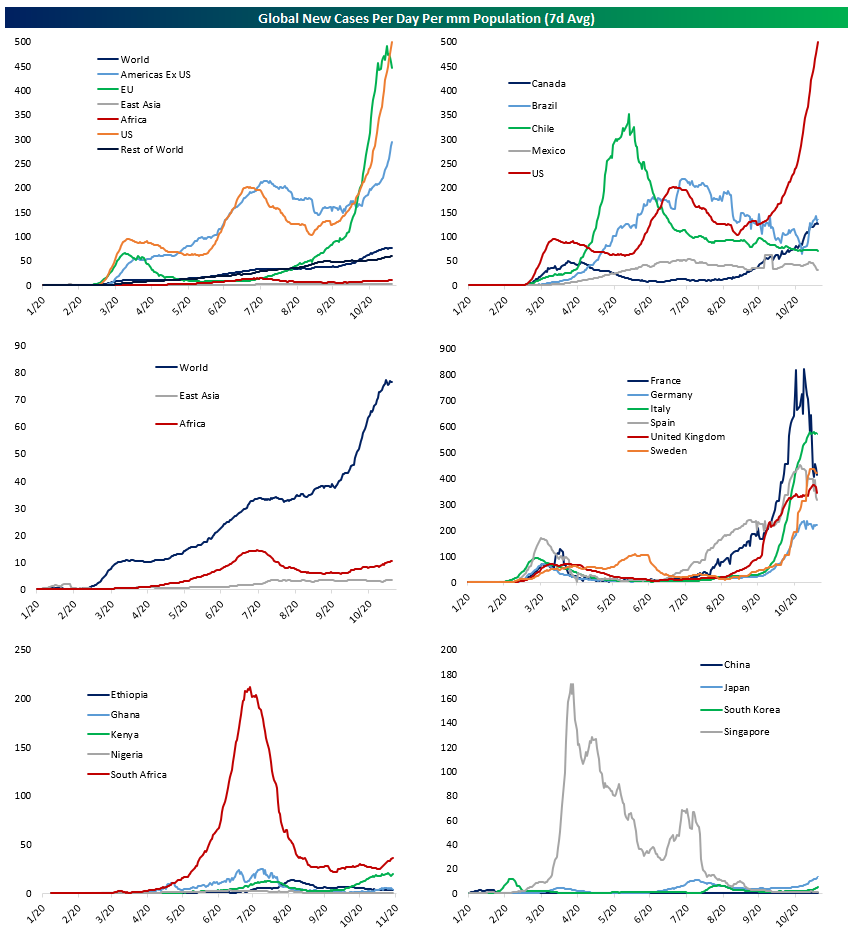
Below we show charts of new cases relative to population for a variety of regions and countries across the world at large. European cases spiked just ahead of the US. That includes Sweden, which introduced restrictions for the first time this fall amidst rising hospitalizations. We update these charts and the analysis that goes with them every morning in our pre-market report The Morning Lineup. Click here to start a free trial to Bespoke Institutional and receive our daily Morning Lineup for the next two weeks, featuring more commentary and data on macro markets.
Economic Activity Holding Up Okay Despite COVID Surge
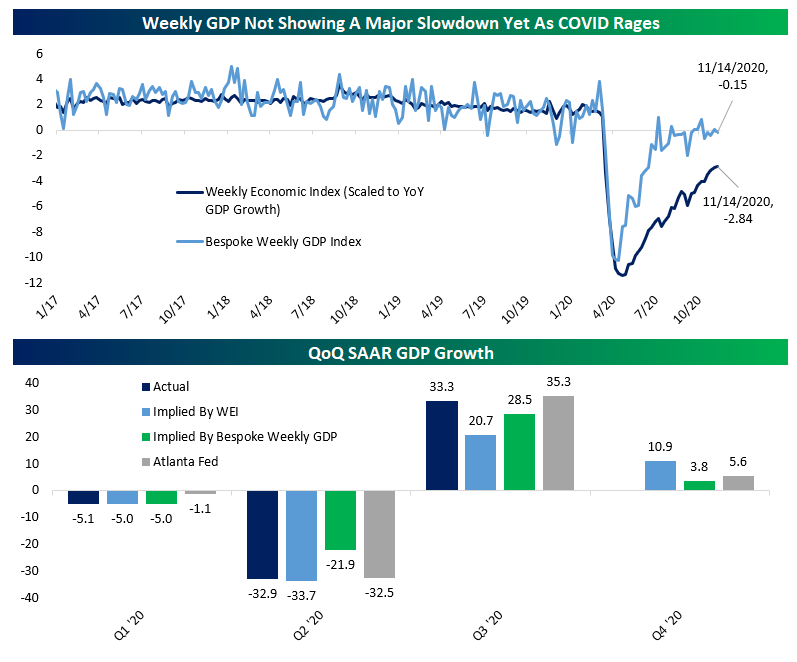
Below we update weekly economic growth trackers that we produce internally as well as the New York Fed’s Weekly Economic Index which is updated on a regular basis. Over the last five weeks, our index has reported negative YoY growth in output in four weeks, including a modest drop for the most recent week of data. For its part, the Weekly Economic Index has continued to rebound from the April lows and is at its highest levels since the March economic data collapse. That index still shows output down almost 3% YoY, but its ongoing rebound is suggesting a much stronger Q4 than what our index is tracking. Our data suggests output will be up a modest 3.8% QoQ SAAR in Q4, versus more than 10% QoQ SAAR forecasted by the WEI data. For context, Atlanta Fed GDPNow data suggests something more in-between, with their data tracking 5.6% QoQ SAAR. This analysis is published regularly in our post-market daily note The Closer. Click here to start a free trial to Bespoke Institutional and receive our daily Closer report for the next two weeks, featuring more commentary and data on macro markets.
Existing Home Sales Blow The Doors Off
The housing market continues to blow the doors off, with total annualized existing home sales coming in at a rate of 6.85mm in October, including 6.12mm single family units. Those numbers are only 5.7% and 3.5% respectively below the record levels from the housing bubble of the mid-2000s. Check out the enormous numbers recently in the chart below:

Unlike during the prior housing bubble, inventories are extremely low now both on an absolute basis (down 20% YoY for all homes and 23% YoY for single family) and relative to demand; both total existing and single family home inventories are below 2.4 months of demand. Inventories relative to demand are half of what they were at the last housing market peak on a months’ supply basis.
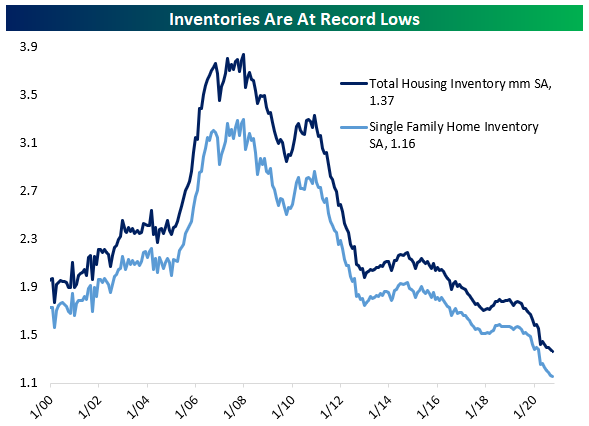
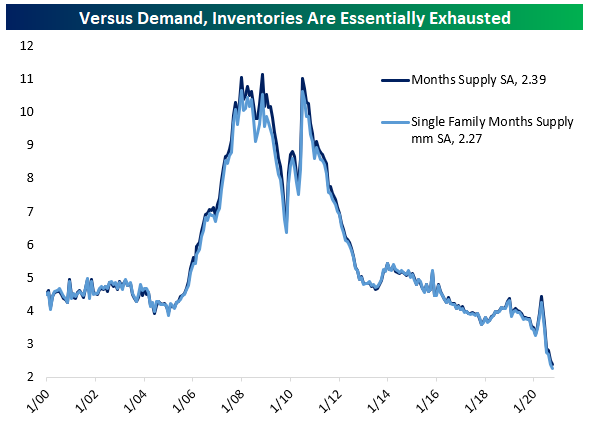
With so much demand for homes and so little supply, prices have exploded higher in the past few months. After adjusting for seasonality, prices are up a staggering 15% since the May lows, driven by both strong demand and a shift in mix towards higher-priced homes. This analysis was initially published in our post-market daily note The Closer. Click here to start a free trial to Bespoke Institutional and receive our Closer report and much more for the next two weeks, featuring more commentary and data on macro markets.

Bespoke’s Morning Lineup – 11/20/20 – Indecision
See what’s driving market performance around the world in today’s Morning Lineup. Bespoke’s Morning Lineup is the best way to start your trading day. Read it now by starting a two-week free trial to Bespoke Premium. CLICK HERE to learn more and start your free trial.
“I used to be indecisive but now I am not quite sure.” – Tommy Cooper
Depending on the index, futures are trading at either end of the flatline this morning, but that’s an improvement over where things stood last night. Following Treasury’s decision last night for the FOMC to returns funds from the emergency lending programs, futures initially traded lower, but shortly after the open in Asia, sentiment started to improve, and the losses were steadily erased.
In terms of data today, there’s nothing besides COVID to speak of as the economic calendar is blank and there’s very little in the way of earnings reports. With next week being Thanksgiving, maybe the market will have a few quiet days ahead of it. Or then again, maybe not!
Be sure to check out today’s Morning Lineup for a rundown of the latest stock-specific news of note, economic data in Japan, trends related to the COVID-19 outbreak, and much more.

While it seems like there has been a lot going on in the markets for the last two weeks, the reality is that we’ve essentially been rangebound. Below we show the intraday charts of the S&P 500 and Nasdaq over the last 15 trading days. Beginning with Pfizer’s positive vaccine news before the open on 11/9, the S&P 500 and Nasdaq have essentially been on a treadmill with a number of swings up and down, but really nothing to show for any of it.
Investors just can’t seem to make up their minds at this point between placing more emphasis on the shorter-term concerns on the impact of rising case counts or the positive long-term impacts of viable vaccines. Decisions. Decisions. One thing we are sure of is that there’s nothing wrong with some healthy consolidation to digest the big gains from earlier in the month and work off overbought conditions in the process, so this is perfectly normal.


The Bespoke 50 Top Growth Stocks — 11/19/20
Every Thursday, Bespoke publishes its “Bespoke 50” list of top growth stocks in the Russell 3,000. Our “Bespoke 50” portfolio is made up of the 50 stocks that fit a proprietary growth screen that we created a number of years ago. Since inception in early 2012, the “Bespoke 50” has beaten the S&P 500 by 185.2 percentage points. Through today, the “Bespoke 50” is at new all-time highs and up 345.0% since inception versus the S&P 500’s gain of 159.8%. Always remember, though, that past performance is no guarantee of future returns. To view our “Bespoke 50” list of top growth stocks, please start a two-week free trial to either Bespoke Premium or Bespoke Institutional.
