
Daily Sector Snapshot — 3/5/21
ARK Invest Still Sitting On Solid Gains, But They’re Sliding Away
The ARK Invest family of ETFs had a stellar 2020 that drew huge inflows. Across the five ETFs issued by Cathie Wood’s company, gains ranged from 105% to 178%, but 2021 has been much less friendly. The flagship ARK Innovation ETF (ARKK) is down 4.9% YTD (and getting worse), with a mixture of gains and losses across other themes. Flows haven’t yet had that kind of round trip: $20bn in 2020, with another $15bn this year (including $2bn of outflows since the peak in February). Looking at the total ARK Invest universe, we can calculate the amount of money investors have gained or lost in aggregate by subtracting flows from market cap. As shown below, back in December investors had a weighted average return of more than 60% across the five ETFs, weighted by the size of purchases. The selloff since has driven that down to just 19% through yesterday. With $15bn entering the funds this year, lots of investors are getting close to or further underwater, and declines could accelerate. So far this year, there’s only been $2bn of outflows, but the money that was quick to come in could just as quickly leave given the recent losses. This blog post is adapted from an analysis included in our nightly Closer report. Click here to start a free trial of Bespoke Institutional to get immediate access.

Bespoke’s Morning Lineup – 3/5/21 – Stronger Than Expected Jobs Report
See what’s driving market performance around the world in today’s Morning Lineup. Bespoke’s Morning Lineup is the best way to start your trading day. Read it now by starting a two-week free trial to Bespoke Premium. CLICK HERE to learn more and start your free trial.
“You must not only learn to live with tension, you must seek it out. You must learn to thrive on stress.” – J. Paul Getty
Thankfully, it’s Friday. After another week of declines for equities, futures were modestly positive this morning, but that changed with the release of the February employment report. The bond market was already showing some signs of concern heading into the release, and those concerns look to have been warranted as the headline number came in well above forecasts (379K vs 200K). In reaction to the report, the 10-year yield has risen from a pre-release level of 1.58% to 1.62% now.
Be sure to check out today’s Morning Lineup for updates on the latest market news and events, movements in the Japanese bond market, German factory orders, an update on the latest national and international COVID trends, including our series of charts tracking vaccinations, and much more.

Normally, when the equity market comes under selling pressure bonds rally providing some level of cushion to a diversified portfolio. In the last few weeks, though, that still hasn’t been the case. The chart below is from the second page of the Morning Lineup and shows the relative strength of the S&P 500 versus the US Treasury Long Bond Future. In an environment like the last couple of weeks where stocks have been weak, you would expect the relative strength line of the S&P 500 to decline, but so far during this pullback that hasn’t been the case. Despite a 4.6% pullback in the S&P 500, its relative strength versus the Long bond Future remains near 52-week highs.

The Bespoke 50 Top Growth Stocks — 3/4/21
Every Thursday, Bespoke publishes its “Bespoke 50” list of top growth stocks in the Russell 3,000. Our “Bespoke 50” portfolio is made up of the 50 stocks that fit a proprietary growth screen that we created a number of years ago. Since inception in early 2012, the “Bespoke 50” is up 437.7% excluding dividends, commissions, or fees. Over the same period, the S&P 500 is up in price by 173.5%. Always remember, though, that past performance is no guarantee of future returns. To view our “Bespoke 50” list of top growth stocks, please start a two-week free trial to either Bespoke Premium or Bespoke Institutional.

Bespoke’s Weekly Sector Snapshot — 3/4/21
B.I.G. Tips – Nasdaq 10%+ Corrections Since the Financial Crisis
Declines Keep Sentiment in Check
The drift lower in equity prices over the past couple of weeks has resulted in bullish sentiment to similarly turn lower. The AAII’s weekly reading on bullish sentiment fell for the second week in a row this week as only 40.3% of respondents reported as optimistic. That is the lowest level since only the first week of February as sentiment remains above the historical average of 38%.
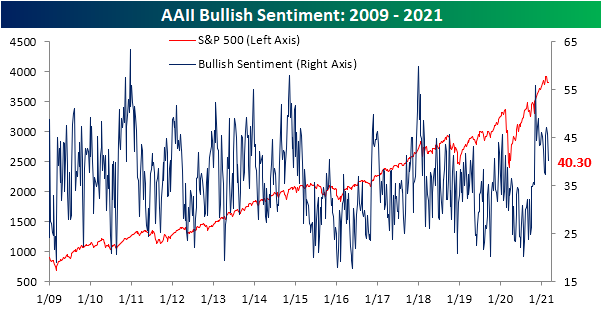
Just over a quarter of respondents reported a pessimistic outlook this week. That was up 1.5 percentage points from the previous week and the first increase in bearish sentiment in four weeks. Compared to the 5.6 percentage point decline in bullish sentiment (the largest since an 11.49 percentage point drop in November) the move in bearish sentiment was relatively small. In fact, even after the increase, outside of last week, every reading so far in 2021 has been higher than the current reading.

The decline in bullish sentiment drove the bull-bear spread to fall down to 15. That is only the lowest level since the first week of February as overall sentiment remains largely in favor of bulls, albeit less so than earlier this year.

Rather than the bearish camp, those losses to bullish sentiment went to neutral sentiment. 34.4% reported neutral sentiment this week, up 4.1 percentage points from last week. That is the biggest one-week increase and the highest level in neutral sentiment since the week of December 24th

As for the Investors Intelligence survey of newsletter writers, the same sort of moderation in optimism was evident. 53.9% of respondents to this survey reported as bullish this week while bearish sentiment saw a 0.1 point increase to 18.6%; those respectively made for the lowest and highest readings since the first half of November. While that means sentiment still favors bulls, a higher share of respondents are anticipating a correction. That reading rose to 27.5% this week, the highest level since the 29.1% reading for the week of September 23rd which was towards the tail end of a roughly 10% correction for the S&P 500. Click here to view Bespoke’s premium membership options for our best research available.

Chart of the Day: Repo Back In The Spotlight
Claims Coming In After the Storm
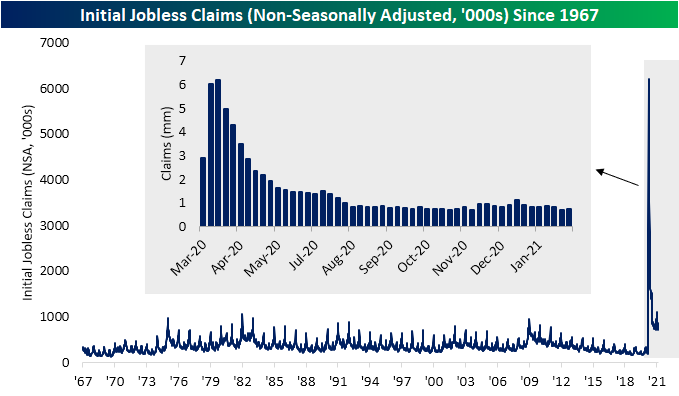
In addition to a higher revision of last week’s number (up 6K to 736K), initial jobless claims were higher this week moving up to 745K. While claims didn’t improve, they did come in 5K better than expectations and they remain around some of the lowest levels since November.

Unadjusted claims were also higher rising 31.5K to 748.1K. Again, in spite of that increase, claims are still at some of their best levels since the fall. Additionally, the current week of the year has normally experienced an uptick week over week. Going back through the history of the data, 72% of the time the current week of the year has seen a WoW uptick in claims.
Claims from the Pandemic Unemployment Assistance (PUA) program also saw a slight uptick this week rising from 427.45K to 436.7K. The increases in regular state claims and PUA claims means total initial claims for the most recent week rose to 1.18 million from 1.14 million the prior week.
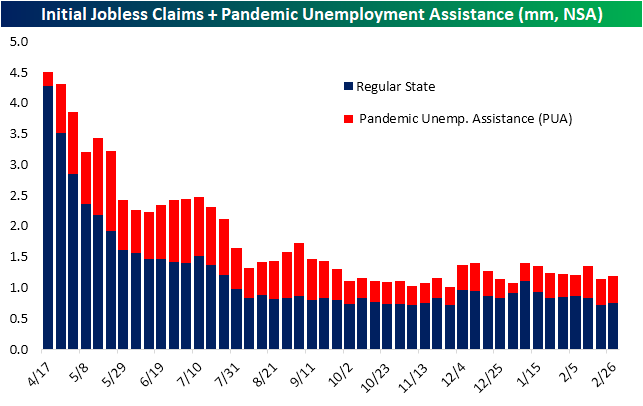
In the past few weeks, we have noted how state-level claims have seen some interesting quirks like very high readings out of Ohio. Again this week, Ohio was the single largest contributor to the level of national regular state claims followed by California, Illinois, New York, and Texas. Of these states, Texas also saw the largest week-over-week increase in regular state claims potentially as an after-effect of the winter storms in the region. That is after the state actually reported lower claims last week in the immediate aftermath of the storm. Although the Lone Star state saw a big increase in regular state claims, PUA claims saw a less significant uptick. Once again, Ohio saw a much more significant uptick by this measure.

While initial claims have not seen much of an improvement, the decline keeps on coming for continuing claims. This reading for the week of February 19th fell to a new pandemic low of 4.295 million; down 124K from the previous week.
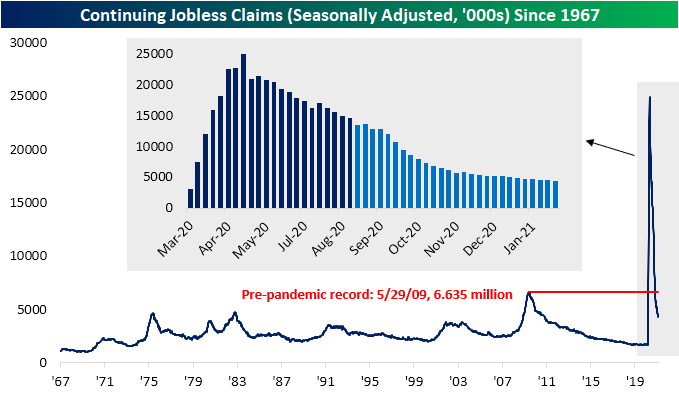
Tacking on all other assistance programs delays the data one more week. For the week of February 12th, continuing claims across all programs were lower at 18.061 million. That is the strongest reading since the week of January 15th when total claims had fallen to 17.873 million. The lower reading in total claims was a result of declines across almost all programs with the biggest decline coming from Pandemic Emergency Unemployment Compensation (PEUC) claims which fell by just over 600K. Click here to view Bespoke’s premium membership options for our best research available.


Treasuries Not Dancing To A Surging Inflation Tune
We’ve seen a lot of commentary suggesting that the recent increase in Treasury yields is being driven by a surge in fears over inflation. While it’s true that worries over inflation should drive bond prices down (higher yields), this recent episode isn’t consistent with that dynamic. In the chart below we show the change in the various segments of the UST curve since the end of October, in basis points. Higher readings indicate steepening, where a longer-term yield rises faster than a shorter-term bond yield. Generally speaking, Treasuries should steepen during inflationary episodes, with longer-term yields (more vulnerable to inflation) rising faster than shorter-term yields (more vulnerable to policy rate changes).
In the chart below we break the UST curve into 4 segments, each of which represents a certain kind of risk premium. Very short-term curvature is dictated by the Fed. As shown, the 3m2y curve has barely moved, because markets generally see the risk of near-term Fed hikes as little-changed over the last four months. The 2y5y curve is similarly tied to Fed policy action, but is much more speculative. As shown, this is where the biggest increase in yields has come. Effectively, the market sees the Fed as much more aggressive in its tightening once it lifts off. The next segment is the 5-10 year curve, which is a mixture of risk premium for Fed policy, growth, and inflation. The 5s10s curve has seen rapid steepening, but the long end of the curve (10s30s), which is most sensitive to inflation, hasn’t budged. If inflation concerns were surging, 10s30s would not be stable over the last few months.
We’ve also included on the chart market pricing for inflation over the five years starting five years from today. While we discourage investors reading too much into this metric as a forecast, it does represent a risk premium for inflation. As shown, this metric for inflation pricing has dropped considerably as yields have risen.

What to make of all this? In our view, the narrative that markets are worried about inflation is inconsistent with Treasury market movements in recent weeks. Instead, we see a market that is pricing in a much tighter Fed once interest rates do start to rise. Whether that will prove true or not is an open question, but what we can say is that inflation expectations are unlikely to be driving bond selling given where changes in yield are taking place on the curve and the performance of inflation pricing over the last few weeks. Interested in fixed income and macro analysis like this post? Click here to start a free trial of Bespoke Institutional to get immediate access to our nightly Closer and Fixed Income Weekly which focus on these markets.