
The Bespoke Report – 4/16/21 – Only One Way To Go With Risks So Low?
Policy stimulus continues to run at full tilt, and has carved off some of the worst possible forward outcomes for the economy and markets. Meanwhile, interest rates have been falling after a meteoric rise in Q1, while the bull market in commodities continues to run. Manufacturing activity gauges are roaring and retail sales are soaring. What does all of this mean for investors looking ahead to the rest of the year given the already-impressive move higher for stocks in 2021?
We discuss in detail along with an earnings round-up, review of recent economic data, a look at housing, and more in this week’s Bespoke Report.
This week’s Bespoke Report newsletter is now available for members.

To read the report and access everything else Bespoke’s research platform has to offer, start a two-week free trial to one of our three membership levels. You won’t be disappointed!

Daily Sector Snapshot — 4/16/21
March Housing Data Rebounds
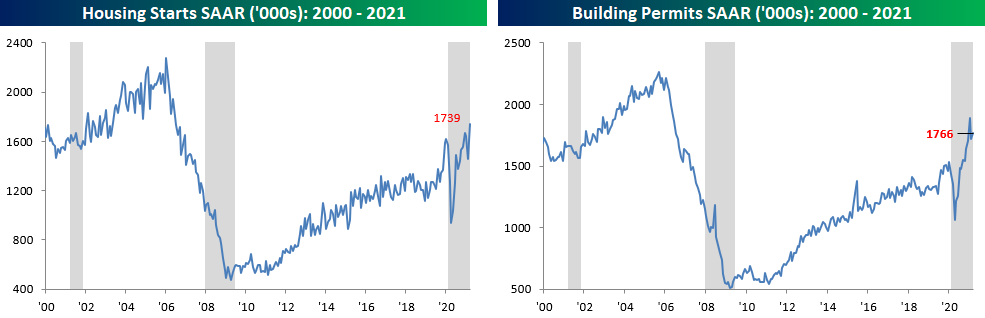
Data on Housing Starts and Building Permits for the month of March came in better than expected on Friday morning. That provided some relief to the concerns that surfaced from February’s weak and weather-impacted report. With March’s rebound, Housing Starts are now back at their highest levels since 2007. Building Permits still remain below January’s peak but also managed to rebound.
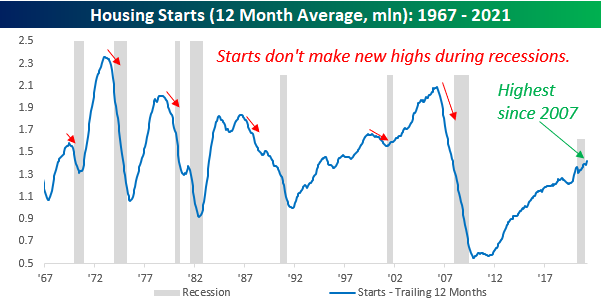
We pay a lot of attention to trends in residential real estate because it is such a large part of the US economy, and therefore has done a good job tracking trends in the overall economy. The chart below shows the 12-month average of Housing Starts relative to recessions going back to 1967. Looking at the chart, it’s easy to see how leading up to every prior recession, Housing Starts always started to roll over in advance of the recession. That didn’t happen leading up to the current recession, but given the suddenness of the contraction, there was really no way to anticipate it. Conversely, coming out of prior contractions, the recession was usually over before the 12-month average started to rebound. Here again, the current recession re-wrote the script. Not only did starts never meaningfully rollover, but they are also back at new post-financial crisis peaks. In the periods leading up to, during, and now after this current recession (even though the NBER hasn’t officially called, the COVID recession is over), the patterns of Housing Starts looks nothing like the trends we have seen in prior periods.
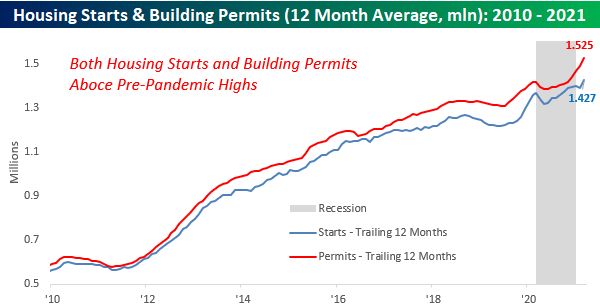
Taking a closer look at the current period, the chart below shows the 12-month average for Housing Starts and Building Permits going back to 2010. While Permits weren’t as strong as Starts in March, their 12-month average is actually considerably higher as both series climbed to new post-housing bubble highs.
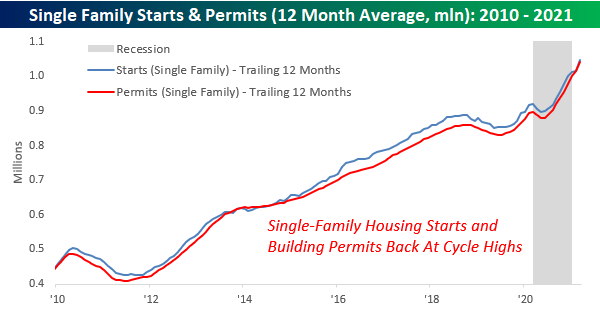
Within both the Housing Starts and Building Permits data, we have also broken out the trends in single-family units. In terms of their economic impact, single-family units are thought to have more of an economic impact than a multi-family unit. Here again, the current trend remains positive as both series reached their highest levels of the post-financial crisis period in March. Click here to view Bespoke’s premium membership options for our best research available.
Bespoke’s Morning Lineup – 4/16/21 – On the House
See what’s driving market performance around the world in today’s Morning Lineup. Bespoke’s Morning Lineup is the best way to start your trading day. Read it now by starting a two-week free trial to Bespoke Premium. CLICK HERE to learn more and start your free trial.
“It all comes down to interest rates. As an investor, all you’re doing is putting up a lump-sum payment for a future cash flow.” – Ray Dalio
The anti-gravitational pull higher in equities has continued this morning as some modest weakness in futures overnight has reversed with all of the major averages now looking to open in the green. Housing data has the spotlight this morning, and both Housing Starts and Building Permits topped consensus expectations. The latter saw only a small beat relative to expectations, while the former exceeded forecasts by more than 100K (1739K vs 1611K). The only other indicator on the calendar between now and the weekend is Michigan Confidence.
Read today’s Morning Lineup for a recap of all the major market news and events including a recap of the biggest overnight events including some key earnings reports, international economic data, as well as the latest US and international COVID trends including our vaccination trackers, and much more.
We’re already hard at work on this week’s Bespoke Report, but this morning we wanted to provide a quick update to a chart from last week’s report. The annotated chart below shows the yield on the 10-year US Treasury on an intraday basis over the last 15 trading days. Along with the move in yields, we’ve also annotated the chart with the releases of some key economic indicators over that time period. So, let’s recap them for you.
On 3/30, Consumer Confidence saw its biggest beat relative to expectations since at least 2000 and the third largest m/m gain on record. On 3/31, the Chicago PMI was the strongest since July 2018. The next day (4/1), the ISM Manufacturing report came in at the highest level in decades. The equity market was closed for Good Friday on 4/2, but Non-Farm Payrolls came in more than a quarter of a million above forecasts. The following Monday on 4/5, the ISM Services report, which goes back to the mid-1990s, came in at the highest level on record. After 4/5, there was a bit of a lull in the data, but last Friday (4/9), PPI saw its largest y/y increase since 2011 while this week’s CPI saw the largest m/m increase since 2009. Finally, in yesterday’s data dump, Jobless Claims dropped to their lowest level of the pandemic, Retail Sales came in at nearly twice consensus expectations with the second-largest m/m increase on record, and both the Philly and NY Fed Manufacturing indices surged.
With all of this great data following a period where the market was freaking out over interest rates, you could have expected to see a big jump in rates, but instead, we’ve seen the complete opposite with the yield on the 10-year at its lowest level since February. As Peter Lynch once said, “Nobody can predict interest rates”, or for that matter, “the future direction of the economy or the stock market.”

Bespoke’s Weekly Sector Snapshot — 4/15/21
Homebuilder Sentiment In The Doldrums
While housing data is still running hot, recently it has hit a bit of a rough patch as indicators like weekly purchase applications have shifted lower (we noted some of the reasons for this in last night’s Closer). This morning’s release of homebuilder confidence gave further pause. The NAHB’s Housing Market Index measuring homebuilder confidence rose by one point to 83 in April. Albeit higher month over month, the index has been in a couple of point range over the past few months and several points off the record high of 90 from November. While that range is still above any levels observed prior to the past year, it shows homebuilders are still optimistic but less so than last year.

Of the three indices contributing to the headline number, Present and Future sales have been a bit stagnant while Traffic has experienced a much more notable rise. That index has risen to 75 which is the highest level since the record of 77 in November. In other words, there still appears to be demand but it is not translating directly into sales.

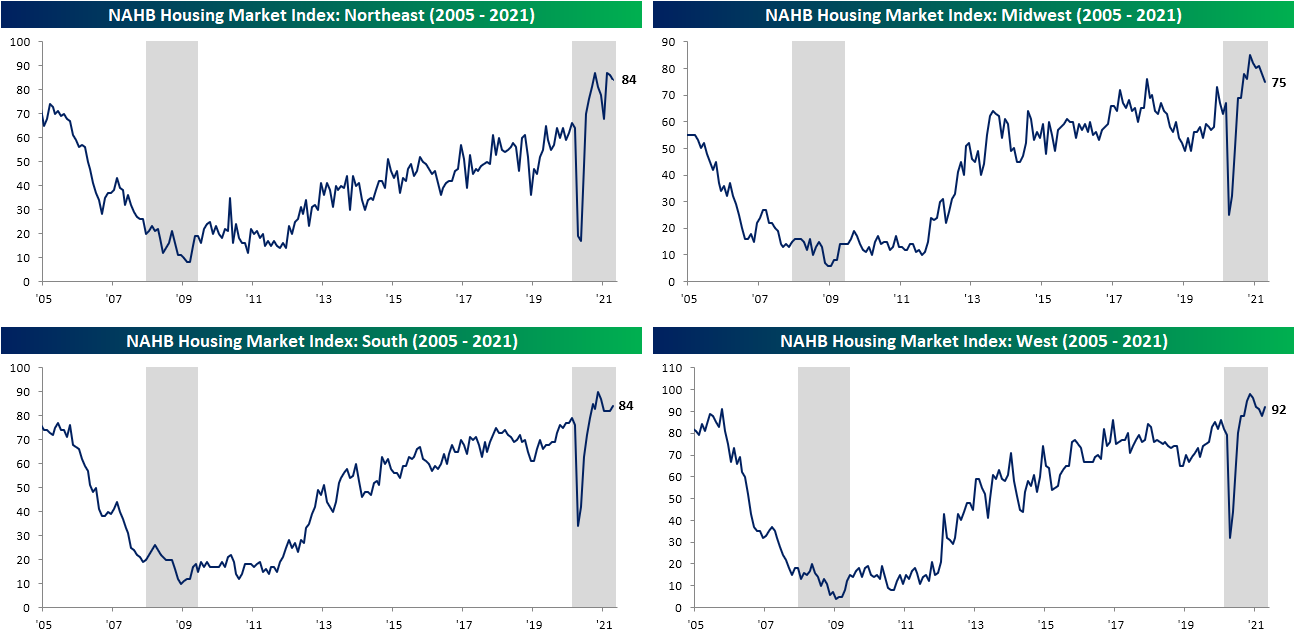
Breaking down sentiment by geographic region shows varying levels of optimism. Starting with the bad news, sentiment in the Midwest is the worst having fallen without much respite over the past several months. Meanwhile, the Northeast has also continued to pull back but sits just off the record highs of 87 from November and February. The South and West, on the other hand, both rebounded in April but remain further off their prior highs. Click here to view Bespoke’s premium membership options for our best research available.
The Bespoke 50 Top Growth Stocks — 4/15/21
Every Thursday, Bespoke publishes its “Bespoke 50” list of top growth stocks in the Russell 3,000. Our “Bespoke 50” list is made up of the 50 stocks that fit a proprietary growth screen that we created a number of years ago. Since inception in early 2012, the “Bespoke 50” is up 468.1% excluding dividends, commissions, or fees. Over the same period, the Russell 3,000’s total return has been +267.6%. Always remember, though, that past performance is no guarantee of future returns. (Please read below for more info.) To view our “Bespoke 50” list of top growth stocks, please start a two-week trial to either Bespoke Premium or Bespoke Institutional.
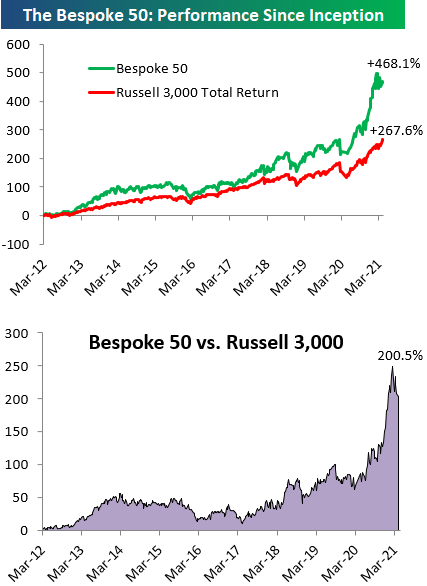
The Bespoke 50 performance chart shown does not represent actual investment results. The Bespoke 50 is updated weekly on Thursday. Performance is based on equally weighting each of the 50 stocks (2% each) and is calculated using each stock’s opening price as of Friday morning each week. Entry prices and exit prices used for stocks that are added or removed from the Bespoke 50 are based on Friday’s opening price. Any potential commissions, fees, or dividends are not included in the performance calculation. Performance tracking for the Bespoke 50 and the Russell 3,000 total return index begins on March 5th, 2012 when the Bespoke 50 was first published. Past performance is not a guarantee of future results. The Bespoke 50 is meant to be an idea generator for investors and not a recommendation to buy or sell any specific securities. It is not personalized advice because it in no way takes into account an investor’s individual needs. As always, investors should conduct their own research when buying or selling individual securities.
Explosive Empire
Manufacturing businesses in the New York area are roaring back to life this spring. After some readings showing only modest growth at the end of 2020 and at the start of this year, the New York Fed’s monthly manufacturing survey results released this morning showed the headline index rising to 26.3 which is the strongest level since October 2017. That indicates the region’s manufacturing sector is growing at a rapidly accelerated rate. In fact, only 12.2% of businesses reported worse overall business conditions in April which is the lowest level in nearly a decade (since May of 2011).
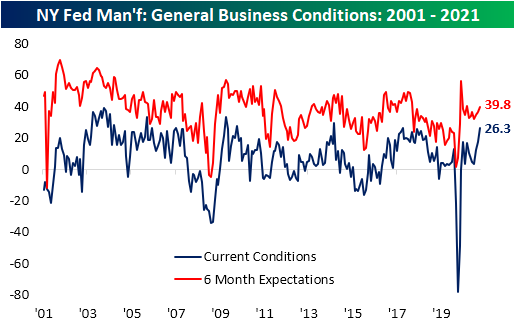
Given the strong reading in the index of General Business Conditions, every other area of the report also showed impressive readings. For the current conditions indices, every index is in expansionary territory with higher month-over-month moves. Some of these like those for Delivery Times, Prices Received, Prices Paid, and Unfilled Orders are also at or just off record highs after massive moves higher in the past month. Expectations generally remain positive although some indices are at less extreme places within their historical ranges while three of the indices were also lower versus March.

Beginning with a look at demand and production metrics, New and Unfilled Orders both surged in April rising 17.8 and 17.2 points, respectively. For New Orders, that month over month rise stands in the top 5% of all monthly moves and brings the index to its highest level since October 2009. That compares to last month when the index was essentially in the middle of its historical range. Meanwhile, Unfilled Orders had been elevated even before this report, but with the most recent surge in New Orders, Unfilled Orders are now at the second-highest level on record behind the reading of 36.5 from September 2001 when the fulfillment of existing orders was likely impacted by the September 11th attacks.
While demand has been very strong, firms have seen no lack of trying to fulfill those orders. Inventory levels were notably higher as that index rose to 11.6 which is in the top 2% of all readings and the highest since last February. The index for Shipments rose 3.9 points to 25 which is the highest level since August 2018. While that is a historically healthy reading, given the surge in unfilled orders and inventories it does indicate that the region’s manufacturers still have plenty of product to get out the door.

One likely reason for the weaker reading in shipments relative to orders and inventories is record length in delivery times. That index not only experienced the second-largest increase of any month on record (behind September 2001), but it also reached the highest level ever. At 28.1, the index surpassed the previous record by 11.9 points.

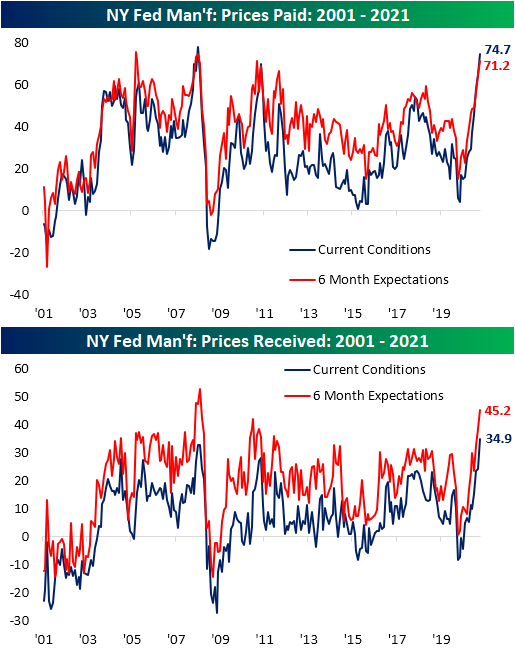
On top of—and likely because of—those supply chain disruptions, prices continue to rise at a record clip. Prices Paid came in at the second-highest level on record behind July 2008. Those price increases are also being passed onto customers as Prices Received rose to a record high. Additionally, businesses do not appear to see much of a chance for these trends to reverse as six-month expectations are also at very high levels.
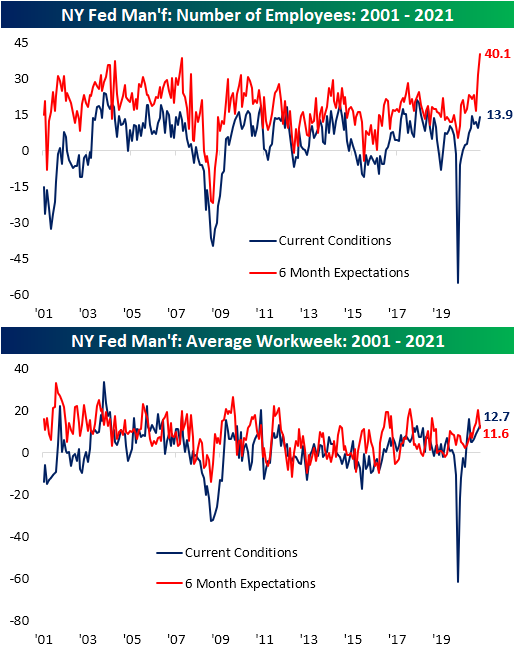
After a very strong nonfarm payrolls report at the start of the month and on the same day that initial jobless claims came in at a new low for the pandemic, this report also gave a rosy outlook for the labor market. The index for the Number of Employees was higher alongside Average Workweek meaning businesses took on more employees and increased hours for existing workers, but the real move was in expectations. Expectations for Number of Employees ripped higher to a new record of 40.1. That willingness to hire paints a very optimistic picture for the region’s labor market.
That sort of optimism extends beyond the workforce though. Six-month expectations for Capital Expenditures and Technology Spending were also higher, rising to the top 15% of all readings. Click here to view Bespoke’s premium membership options for our best research available.

Chart of the Day: Hospitals Heaping It On (HCA)
B.I.G. Tips – Boom Goes the Retail Sales
After a lousy report for the month of February when freak weather across the south temporarily shut down several areas of the south, Retail Sales bounced back with a vengeance in March as vaccine rollouts accelerated and stimulus checks were spent.
The moves higher in Retail Sales over the last few months have been incredible. As shown below, while it took 40 months to make a new high following their pre-Financial Crisis peak, COVID only caused a five-month drought without a new high. From the low in April 2020, Retail Sales have bounced 50%!
Even more impressive, though, is not only are total Retail Sales above their pre-COVID peak, but they are more than 17% above that peak just 14 months ago. The second chart shows the 14-month rate of change in Retail Sales since 1992. While the post-COVID decline was the steepest on record, the 14-month gain is the highest on record. Ironically, had it not been for COVID and the stimulus it resulted in, there is no way Retail Sales levels would be where they are now.

In our just-released B.I.G. Tips report, we broke out the details of the March report including its bright and dark spots. For anyone with more than a passing interest in how the COVID outbreak and subsequent stimulus is impacting the economy, our monthly update on retail sales is a must-read. To see the report, sign up for a monthly Bespoke Premium membership now!