Daily Sector Snapshot — 9/13/21
Apple’s Performance After iPhone Reveals
SPY Snoozing
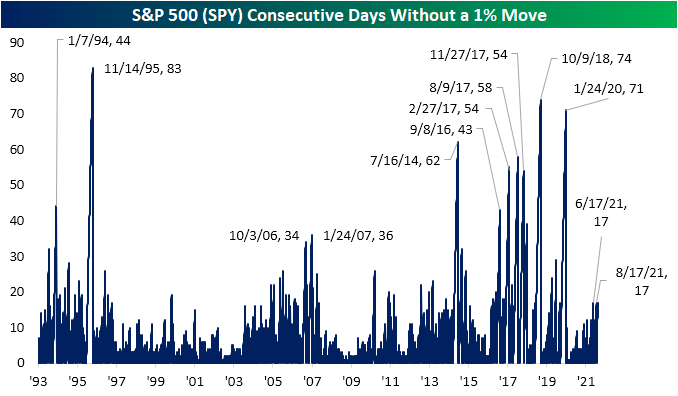
As of this writing, the S&P 500 (SPY) is currently up 0.24% today and is looking to snap a five-day losing streak. While the move has its own degree of excitement, overall the S&P 500 has been on a pretty boring stretch of late. August 18th was the last time that the S&P 500 rose or fell more than 1% in a single session. Not only does that make the current streak including today 17 trading days long, but that move on August 18th had also brought to an end another 17-day long streak without a move of at least 1%. With only a single day between the past two 17-day long streaks, there was also another streak identical in length ending in June. These three stretches tie for the longest run without a 1% move of the post-pandemic period with the prior streak ending in late January 2020. As shown below, going through the history of SPY this year’s non-volatile stretches stand out but are far from the longest streaks on record. For example, the second half of 2016 through 2018 saw multiple streaks without a 1% move that were between 43 and 74 trading days. To find the longest stretch without a 1% one-day move, you have to go back to 1995 when SPY went 83 trading days without a daily move of 1%.
Given there has only been a single day in the last 35 in which the S&P 500 (SPY) has gained or lost more than 1%, taking a look at the 3 month rolling average for the daily move in SPY shows daily volatility has certainly been at the low end of the historical range. Historically, SPY has averaged an absolute daily change of 78 bps. Over the past 90 days, though, SPY’s average daily move has been just 47 bps, ranking in the bottom quintile of readings. Investors expect ‘dull’ trading during the summer months, but now that the calendar says September, a lack of volatility would be out of the norm. Click here to view Bespoke’s premium membership options.
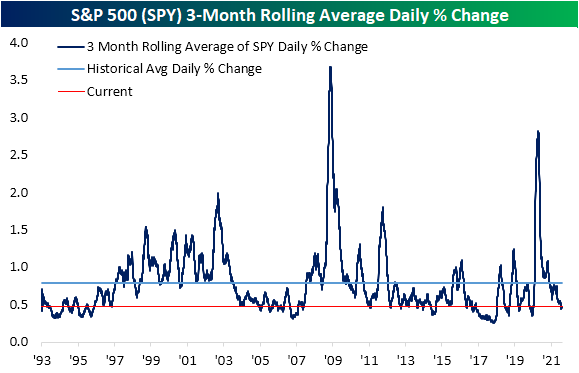
Chart of the Day: Look Out, It’s Options Expiration Week
Bespoke’s Morning Lineup – 9/13/21 – Green Start
See what’s driving market performance around the world in today’s Morning Lineup. Bespoke’s Morning Lineup is the best way to start your trading day. Read it now by starting a two-week trial to Bespoke Premium. CLICK HERE to learn more and start your trial.
“The reason I’ve been able to be so financially successful is my focus has never, ever for one minute been money.” – Oprah Winfrey
The post-Summer trading environment hasn’t been particularly positive for bulls as the S&P 500 hasn’t had a positive day since 9/2. Bulls are looking to regroup this morning, though, and futures on all the major averages are firmly in the green. Both the economic and the earnings calendars are essentially blank today and the Fed is in its pre-meeting blackout period as well, so don’t expect much in the way of tape bombs on that front either.
Read today’s Morning Lineup for a recap of all the major market news and events from around the world, including the latest US and international COVID trends.
After hitting a record high back on 9/2, the S&P 500 has now traded lower for five straight trading days. That’s tied for the longest losing streak since 2/22. That streak back in February was also the last time the S&P 500 experienced five straight down days after a record closing high. Since the end of the Financial Crisis in 2009, there have only been six prior periods where the S&P 500 was down for five straight trading days after closing at a record high, and before the most recent one in February, the one prior to that was right after the pre-COVID peak in February 2020.

Start a two-week trial to Bespoke Premium and read today’s full Morning Lineup.
Bespoke Brunch Reads: 9/12/21
Welcome to Bespoke Brunch Reads — a linkfest of the favorite things we read over the past week. The links are mostly market related, but there are some other interesting subjects covered as well. We hope you enjoy the food for thought as a supplement to the research we provide you during the week.
While you’re here, join Bespoke Premium with a 30-day free trial!
Power Plants
This wildly reinvented wind turbine generates five times more energy than its competitors by Elissaveta M. Brandon (Fast Company)
A Norwegian start-up is experimenting with a modular design for wind turbines that would replace a single very large blade system with a large grid of much smaller units. [Link]
New Orleans Built a Power Plant to Prepare for Storms. It Sat Dark for 2 Days. by Sophie Kasakove and Nicholas Bogel-Burroughs (NYT)
One knock on renewables is that decarbonized forms of power can sometimes be less reliable than coal or natural gas plants. But in the wake of Ida, a backup power plant New Orleans built to insure reliability wasn’t able to help the power-starved city. [Link; soft paywall]
College
College-Town Economy Hopes for a Boost, if Delta Variant Can Be Held at Bay by Amara Omeokwe (WSJ)
Small towns across the country that rely on students arriving for school every fall are geared back up for a more normal school year, but Delta variant cases may dash the hopes of small and large businesses that cater to undergrads across the country. [Link; paywall]
A Generation of American Men Give Up on College: ‘I Just Feel Lost’ by Douglas Belkin (WSJ)
Women now outnumber men in college 3:2, with the decline in students over the last several years mostly driven by fewer men taking classes. Given the persistence of the college wage premium and the historically higher attendance rates for men, this major shift is likely underappreciated as shift in the social fabric of the country. [Link; paywall]
Vaccines
BioNTech reports promising data on mRNA cocktail in mouse models of colon cancer and melanoma by Arlene Weintraub (Fierce Biotech)
Pfizer’s partner for its mRNA COVID vaccine has partnered with Sanofi to deliver mRNA therapies which stimulate carcinogenic factors that are already produced by the human body using an identical delivery package to the one that tricks cells into manufacturing spike proteins and getting a leg up on the coronavirus. [Link]
Job Postings Requiring Vaccination Soar by Ann Elizabeth Konkel (Indeed)
While the number of job postings on Indeed that require vaccination against COVID remains relatively low overall, they’re growing very quickly and have accelerated since full FDA approval of the vaccine. [Link]
Windshield Wipers
Tesla obtains patent on its wild idea to use lasers as windshield wipers by Fred Lambert (electrek)
Patents are of course a long way away from a production feature (even at feature first, perfection later Tesla) but there’s at least some possibility that the most popular electric car company will start using lasers to clean off windshields. [Link]
Platforms
How TikTok Servers Up Sex and Drug Videos to Minors by Rob Barry, Georgia Wells, John West, Joanna Stern and Jason French (WSJ)
Using bot accounts, the WSJ team explored how accounts representing themselves as minors are exposed to adult content by the powerful algorithms which use past interests to dictate what future content gets displayed. [Link; paywall]
Epic v. Apple ruling: Judge finds Apple has to let developers offer third-party payments by Alexis Keenan and Daniel Howley (Yahoo!)
A California judge sided with Fortnite developer Epic Games in a Friday ruling that leveled an injunction against App Store policies which prevent software developers from collecting payments through their apps without giving Apple a cut. [Link; auto-playing video]
Leverage
Bitcoin to Bucks: Crypto Fans Borrow to Buy Homes, Cars—and More Crypto by Rachel Louise Ensign (WSJ)
With more than $2trn in total crypto market cap, holders are starting to use their currencies as collateral for loans of US dollars, which are being used to buy houses, homes, and all manner of other things that are easy to trade for dollars but not so easy to get with crypto. [Link; paywall]
Sports
Fans Don’t See Much of a Difference Among NFL’s Broadcast Partners, Top Talent by Alex Silverman (Morning Consult)
Fans are generally pretty happy with the NFL broadcast teams offered by the major networks, with NBC, CBS, and Fox all about equally popular; ESPN is slightly behind but still viewed favorably by 65% of NFL fans. [Link]
Accents
With Drawl by Laura Relyea (Bitter Southerner)
While often viewed with derision by linguistic philistines, Southern twangs and drawls are accent heaven for those who study how language twists and bends (or holds firm) with the passage of time. NC State professor Walt Wolfram is leading the charge to keep Southern accents alive. [Link]
Taxes
Senior Democrats propose 2% US tax on stock buybacks by James Politi (FT)
Eager to bring on board members of the caucus that are concerned about deficit implications of the Democrats’ $3.5trn proposed budget, Senate Democrats are considering levying a 2% fee on corporate share buybacks as a way to generate revenue. [Link; paywall]
Read Bespoke’s most actionable market research by joining Bespoke Premium today! Get started here.
Have a great weekend!
Most Heavily Shorted Stocks
Over the course of 2021, we have seen some aggressive short squeezes, resulting in turmoil for certain financial institutions and millions in profits for some retail traders. The “reddit army” has gone after multiple stocks, most notably Game Stop (GME) and AMC (AMC). Let’s dive into the 25 companies in the Russell 3,000 currently with the highest short interest as a percentage of float. Of these 25 companies, only 8 have experienced positive returns in 2021, and 6 have seen their share price half. Since GameStop peaked in late January, 20 of the companies on this list have lost value, and 9 have seen their equity trade down by 50%. Since AMC’s peak in early June, 7 companies have seen price appreciation, and zero have seen their value decrease by 50%.
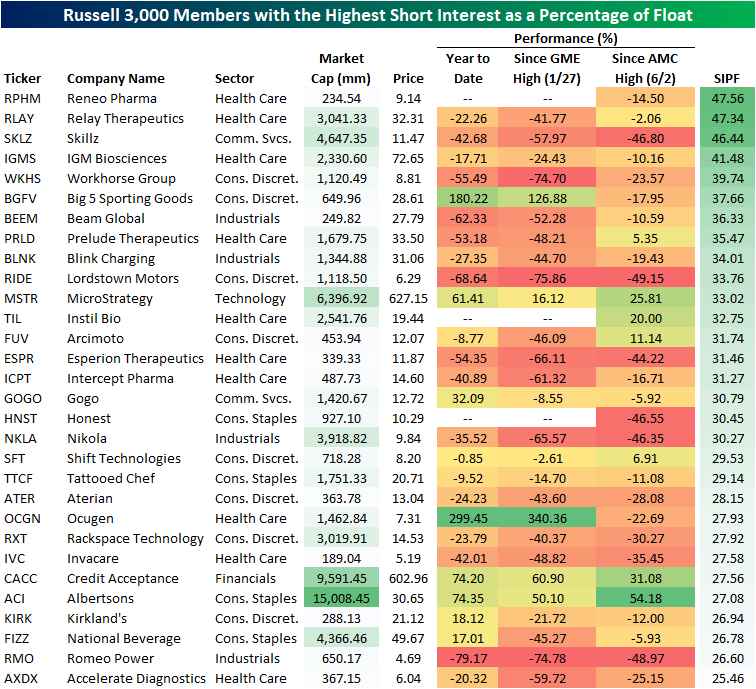
The average short interest as a percentage of float for the entirety of the Russell 3,000 is 3.46%, but certain sectors have much higher proportional short interest than others. Consumer Discretionary, Health Care, and Real Estate have the highest, while Utilities, Financials, and Consumer Staples have the lowest. High levels of short interest is a sign of negative investor sentiment, but certain sectors will consistently have higher figures due to the riskiness of their business models.

To dive deeper, let’s look at the average short interest in each industry. Retail, Pharma & Biotech, and Consumer Services have the highest levels, while Banks, Tech Hardware, and Utilities have the lowest levels. The average short interest in the retailing industry is more than three times higher than that of banks for companies in the Russell 3,000.

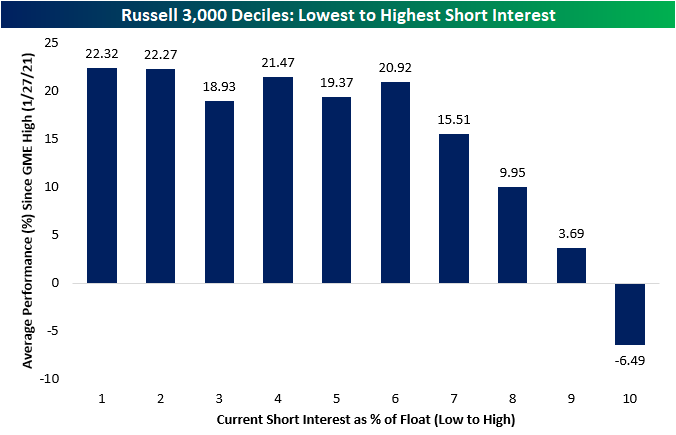
Although there are many exceptions to the rule, in 2021 equities with higher short interest have generally underperformed the remainder of the Russell 3,000. The average return for equities with short interest between zero and ten percent were higher than that of equities with 33%+ short interest.
To support this, let’s undergo a decile analysis. The stocks in the top 20% in terms of short interest have significantly underperformed the rest of the Russell 3,000 since GME hit its highs. While the equities in the bottom 20% of short interest have averaged a 22.23% return since January 27th (GameStop’s top), the top 20% of most heavily shorted stocks have declined by 1.40% on average.
Largest 25 Stocks in the S&P 500, Now vs 20 Years Ago
Yesterday, we took a look at the makeup of the S&P 500’s largest 25 companies in 2021 and compared it to that of 10 years ago. Today, we will be extending the study to 2001, twenty years ago right before the 9/11 attacks. On the day before 9/11, the sectors with the largest number of components in the top 25 in terms of market cap were Consumer Staples, Health Care, Technology, Financials, and Communication Services. While all of these sectors still hold a spot in the current top 25 list, the makeup has shifted substantially. Energy and Industrials, which each accounted for 8% of the top 25 companies in 2001, now have zero representation in today’s list. Consumer Staples also reduced its count from five to two.

Only seven companies that made up the list of top 25 names in September 2001 remain on the list today. Those seven companies are Microsoft (MSFT), J&J (JNJ), Walmart (WMT), Home Depot (HD), Procter & Gamble (PG), Bank of America (BAC) and Pfizer (PFE). The average increase in market cap of these seven equities, excluding dividends, is 241.88% with a median of 263.84%. While the turnover of this list has been high over the last 20 years, every member of this list is still in operation today, but two have been undergone mergers (Time Warner & Royal Dutch Petroleum). Interestingly enough, the members of this list have approximately the same proportionate makeup of the S&P 500, with only a 1.89% increase in the weightings of the top 25 stocks now relative to September 2001.

The US economy today is far different than it was in 2001. As it has changed, some companies have adapted and experienced massive growth, while others have been left in the dust. Apart from the two companies that are no longer independently publicly traded, the average return of the 25 largest companies from 2001 is 92.94% with a median return of 49.08%. Over that same period, the S&P 500 has returned 310.61%.

The Bespoke Report Newsletter — 9/10/21
This week’s Bespoke Report newsletter is now available for members.
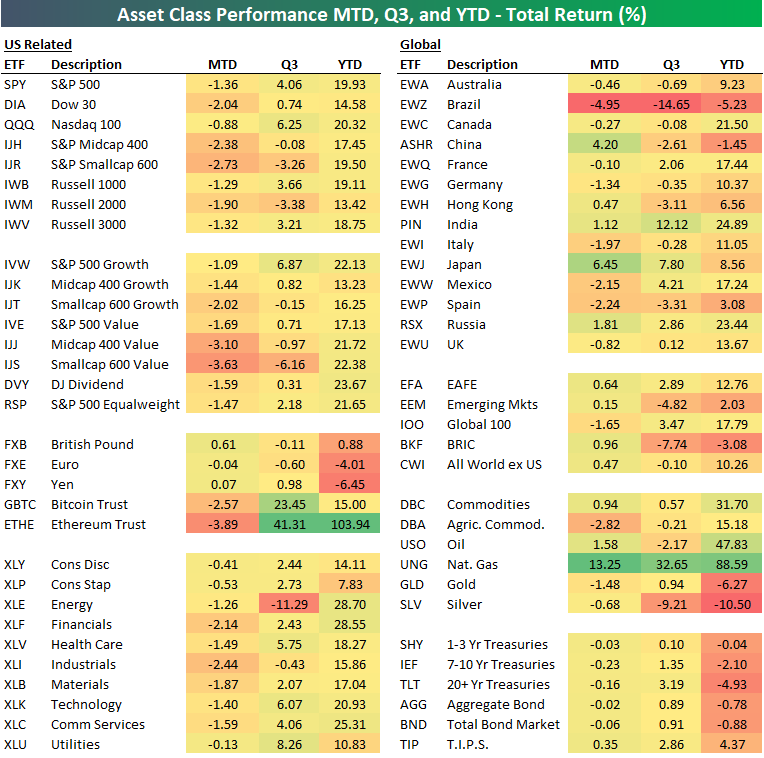
Below we highlight recent performance across a wide range of ETFs representing various asset classes, national equity markets, and US sectors or indices.
To read this week’s full Bespoke Report newsletter and access everything else Bespoke’s research platform has to offer, start a two-week trial to one of our three membership levels.