
The Bespoke 50 Top Growth Stocks — 9/2/21
Bullish Sentiment Finally Rises in Back to Back Weeks
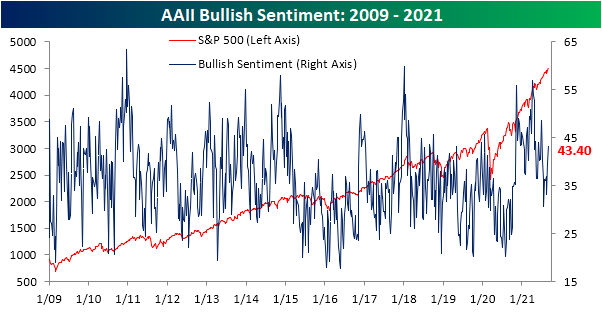
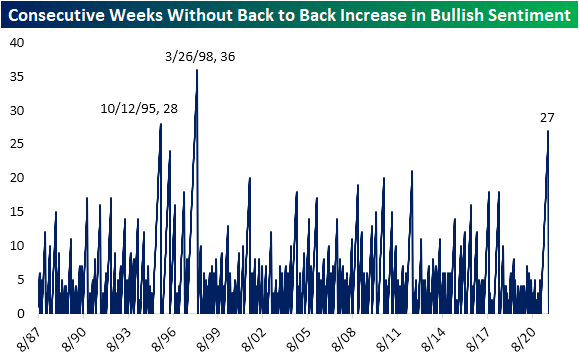
The S&P 500 has continued to press higher resulting in a coincident rise in sentiment. The AAII‘s weekly reading on bullish sentiment rose back above 40% for the first time since the week of July 8th. While 43.4% is not a particularly elevated reading on sentiment (72nd percentile of all periods), the move higher is particularly notable in that it was the first time bullish sentiment has risen in back-to-back weeks since February. That is especially surprising given the fact that bullish sentiment was very elevated at points between now and then, such as back in the spring when it eclipsed 50%. That is also a historically long stretch of time without back-to-back increases in bullish sentiment. As shown in the second chart below, at just over half of a year-long, the only two similar streaks on record were in 1995 and from 1997 to 1998.
Negative sentiment has broadly picked up over the past couple of months. In the AAII survey, bearish sentiment was slightly higher at 33.3% versus 33% last week. While below the peak from only a couple of weeks ago, that is still elevated versus readings from earlier this year.

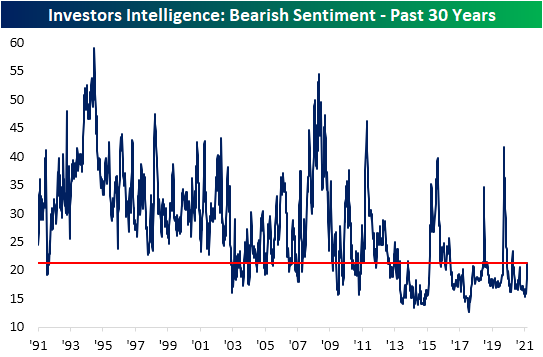
Similarly, the Investors Intelligence survey of newsletter writers has also seen bearish sentiment on the rise throughout the summer. This week, it topped 20% for the first time since March 10th. At 21.3%, bearish sentiment in this survey is at the highest level since last October. With that said, the current reading is also well below the 20 year average of 24.19%.
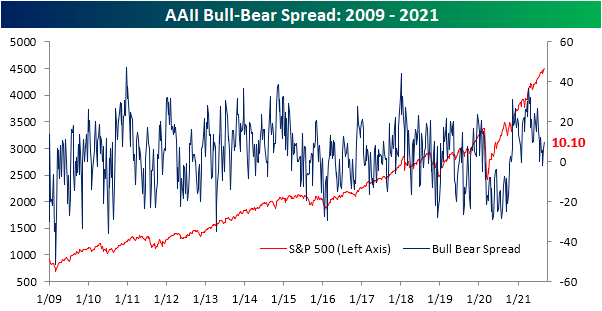
As a result of the larger gains to bullish versus bearish sentiment, optimism remains the favored response in the AAII survey. The bull-bear spread rose back into positive double digits this week for the first time since the last week of July.
Given both bullish and bearish sentiments were higher, neutral sentiment has continued to unwind. That reading fell 4.3 percentage points this week to a new low of 23.2%. That was the fourth decline in the past five weeks as neutral sentiment came in at the lowest level since mid-April. Click here to view Bespoke’s premium membership options.

Chart of the Day: Sub-Mach-E (For Now)
End of Pandemic Programs Loom
Ahead of tomorrow’s nonfarm payrolls report, this week’s initial jobless claims release came in at 340K; 5K below expectations. That was a 14K decrease from last week’s level which was revised higher by 1K. Additionally, this week’s decline entirely erased the move higher last week. With yet another drop in jobless claims, the indicator has made another pandemic low and is within 84K of the last sub-1 million print (256K on March 13, 2020) prior to the parabolic spike last spring.

As for on an unadjusted basis, claims fell further below 300K to 287.8K this week. This time of year typically sees seasonal tailwinds for claims, but this week did mark the sixth consecutive decline. That made for another pandemic low as claims by this measure are just 35.9K away from the March 2020 levels. Granted, the seasonal strength from the past few weeks is likely to wane until the end of the year. As shown in the second chart below, September (approximately week numbers 37 through 40) historically marks the time of year that week over week increases in the unadjusted number become more frequent, and as a result, claims begin to consistently tick higher. While seasonal headwinds are on the way for regular state claims, overall claim counts will begin to see drops due to the expiration of pandemic era programs. This includes the additional $300 per week payments and programs like PUA and PEUC. In the most recent week, PUA claims came in above 100K for a fourth week in a row.


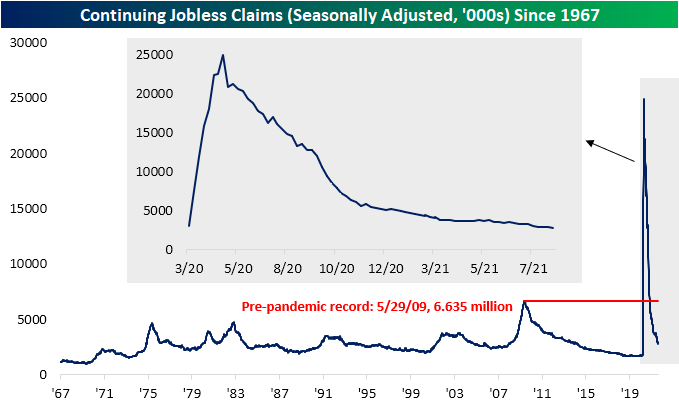
As for continuing claims, the headline number for regular state programs remains strong with claims hitting another pandemic low of 2.748 million, down from 2.908 million last week. That 160K decline was the largest since a 316K decline in the second to last week of July.
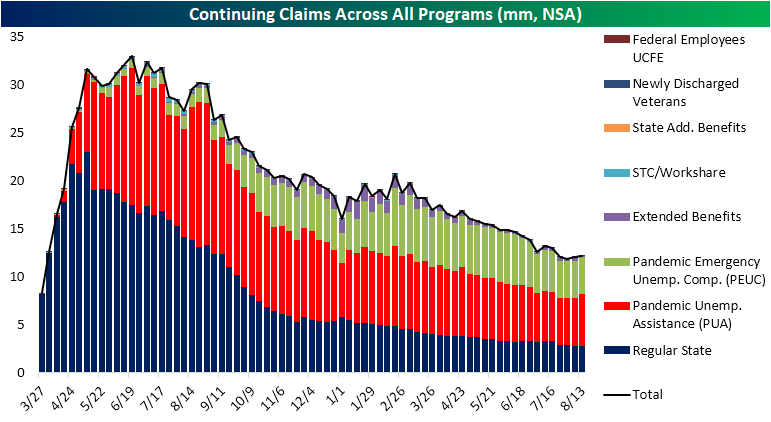
Factoring in all programs adds an additional lag to the data meaning the most recent reading is through the week of August 13th. In that week, total claims rose to 12.2 million from 12.02 million in the prior week. In spite of only having a couple of weeks until the end of the programs, that increase was driven by PUA claims which rose by over 400K and marked the largest one-week increase for the program since April 23rd (420.6K). That brings the total count of pandemic era programs (PUA and PEUC claims) a couple of weeks before their expiration to 9.2 million.
As for the other programs, regular state claims and PEUC claims were little changed at 1.6K higher and 6.04K higher, respectively. Meanwhile, the extended benefits programs saw a significant decline of 237.07K down to 114.4K, although, that program has been particularly volatile over the past several weeks, so we would caution again reading too deep into that move. Click here to view Bespoke’s premium membership options.

Bespoke’s Morning Lineup – 9/2/21 – Water Logged
See what’s driving market performance around the world in today’s Morning Lineup. Bespoke’s Morning Lineup is the best way to start your trading day. Read it now by starting a two-week trial to Bespoke Premium. CLICK HERE to learn more and start your trial.
“You are remembered for the rules you break.” – Douglas MacArthur
Things are getting off to a slow start this morning (sorry for the delay) as the New York metro area tries to dry out from some massive flooding in the area which has shut down roads, highways, and mass transit. If this had occurred a few years ago, people would be wondering how they would get to work this morning, but in the post-COVID world, work for many people is as close as the nearest computer.
Equity futures are modestly higher again this morning as the ‘everything’ rally continues. Jobless claims were just released and came in lower than expected on both an initial and continuing basis and falling to post-pandemic lows. Later this morning, we’ll get updates on Factory Orders and Durable Goods.
Read today’s Morning Lineup for a recap of all the major market news and events from around the world, including the latest US and international COVID trends.
The everything rally is also giving a lift to the crypto space this morning as bitcoin has traded back above $50K and trading at its highest levels since mid-May. Following this morning’s gains, bitcoin still remains more than 20% below its record highs from earlier this year.

Even more impressive than the rally in bitcoin has been the run in Ethereum which has more than doubled off its July lows. At current levels, Ethereum is less than 14% below its prior record, and its ratio relative to bitcoin is even closer to record highs.

Start a two-week trial to Bespoke Premium and read today’s full Morning Lineup.
Daily Sector Snapshot — 9/1/21
Bespoke Stock Scores — 9/1/21
India (INDA) Ignites
Looking across the various ETFs tracking the stock markets of the 23 countries tracked in our Global Macro Dashboard, by far the best performer in the month of August was India (INDA) which rallied 8.75%. A large portion of those gains occurred in the final days of the month as well. As shown in the matrix below, over the past five days alone INDA has gained 4.74% which brings it almost 3 standard deviations above its 50-DMA. INDA is also currently at a 52-week high alongside the US (SPY) and Russia (RSX).
INDA is not alone in having become deeply overbought after big moves in recent days. Japan (EWJ), Russia (RSX), Malaysia (EWM), and Mexico (EWW) are also trading over 2 standard deviations above their 50-DMAs. The latter two were also the runners-up in terms of strongest performers in August. In the case of the former two, just last week they were actually in neutral territory as is the case with a number of other country ETFs. No country has seen as dramatic of a move within its trading range than South Africa (EZA), though. One week ago, it was oversold. After rallying 5.79% in the past five days, it has not only taken out its 50-DMA but is now 1.6 standard deviations above it. Looking across the aforementioned countries, and as we mentioned yesterday, one common theme in August was the outperformance of emerging market countries. Tose countries gained an average of 2.21% last month versus a 0.85% gain for developed markets.

Looking at G7 countries, the US has stood out as a notably solid performer. As shown below, the US (SPY) has been in a consistent uptrend over the past year whereas other G7 members have been sideways at best since the spring. With that said, there have been improvements more recently for some countries. The most concrete example is Japan. EWJ has been consolidating over the past few months, but it broke out of its 2021 downtrend this week. Gaining 1.74% today alone, EWJ is at the highest level since early June. France (EWQ) is also having a big day with a 2.2% gain, bringing it right up to the highs from mid-August and early June.

Like France, there are a handful of emerging market countries that have also broken out recently or are nearing a breakout. Mexico (EWW) and Russia (RSX) both took out their highs from the spring and earlier this summer in the past couple of sessions. While it has not put in a new 52-week high just yet, Taiwan (EWT) is likewise attempting to take out prior highs. Meanwhile, we also wanted to highlight the chart of INDA. As previously mentioned, INDA posted big gains over the past month, and as such, the chart is looking quite elevated. Click here to view Bespoke’s premium membership options.

Bespoke’s Consumer Pulse Report – September 2021
Bespoke Market Calendar — September 2021
Please click the image below to view our September 2021 market calendar. This calendar includes the S&P 500’s average percentage change and average intraday chart pattern for each trading day during the upcoming month. It also includes market holidays and options expiration dates plus the dates of key economic indicator releases. Start a two-week free trial to one of Bespoke’s three research levels.
