
Chart of the Day: NASDAQ Composite Breaks Below Its 200-DMA
Decimated Demand Drops Empire Fed
The new year’s first regional manufacturing reading came out of New York this morning. Covering the month of January, today’s Empire Manufacturing report was outright bad at the headline level. While the December reading was at the high end of the post-pandemic and historic range (in the 95th percentile of all months), the January reading was far weaker falling into the bottom quartile of historic readings. At -0.7, it was the first contractionary reading for Empire Manufacturing in eighteen months (since June 2020). That 32.6 point drop was also the third-largest month-over-month decline on record behind March and April 2020.

Looking under the hood of the report, the massive drop in general business conditions is to a certain extent misleading and there is nuance to the various categories. Breadth was in fact bad indicating a broad deceleration in activity across categories, but the massive drop in general business conditions was largely due to a massive slowdown in demand. Like the headline number, both the indices for New Orders and Shipments fell dramatically. Alongside General Business Conditions, only New Orders saw a contractionary reading on that move. Again, other areas of the report did not help the headline index with only Inventories rising month over month. That being said, current levels remain far more elevated for those other categories with many in the upper decile of their historical ranges.

The decline in New Orders points to demand falling for the first time since August 2020. As a result, Unfilled Orders also fell significantly as Inventories rose, but the readings remain much healthier in the 93rd and 95th percentiles, respectively. In other words, even though there wasn’t the same massive inflow of orders as we’ve seen over the past year and a half, there is still plenty of demand left to be fulfilled. Unfortunately, Shipments decelerated sharply and only increased slightly which could be a result of higher COVID case counts holding back production/fulfillment.

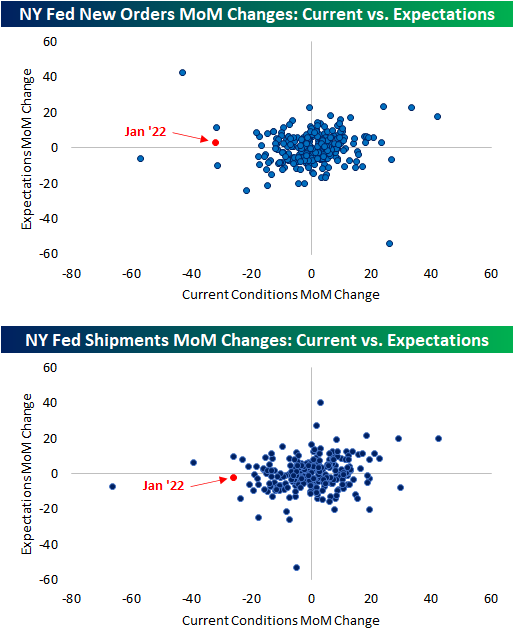
One interesting aspect to note for demand and shipments (and this also applies to the headline index) is the huge disconnect between the moves in current conditions and expectations. Expectations indices remain far healthier in comparison to current condition indices, and the drops, if any, were much more modest this month. In fact, in the charts below showing the month-over-month changes of all months on record between the two series, January was certainly an outlier month. A heavy burden from absentees as a result of COVID could be extrapolated as a reason for this disconnect. In other words, New York area firms were hit hard by COVID in January but they do not expect the current wave’s impact to last out through six months.
Even though New York area manufacturers were not seeing growth in the pace of getting products out the door as in past months, working in their favor has been a significant improvement in supply chains. Delivery times remain well above any period prior to the pandemic, but the index fell for the third month in a row.

Another more welcome sign of the report was that Prices Paid and Prices Received have both peaked. The drop in Prices Received was more significant of the two. On the downside, expectations have continued to rise unabated with each index hitting a record high.

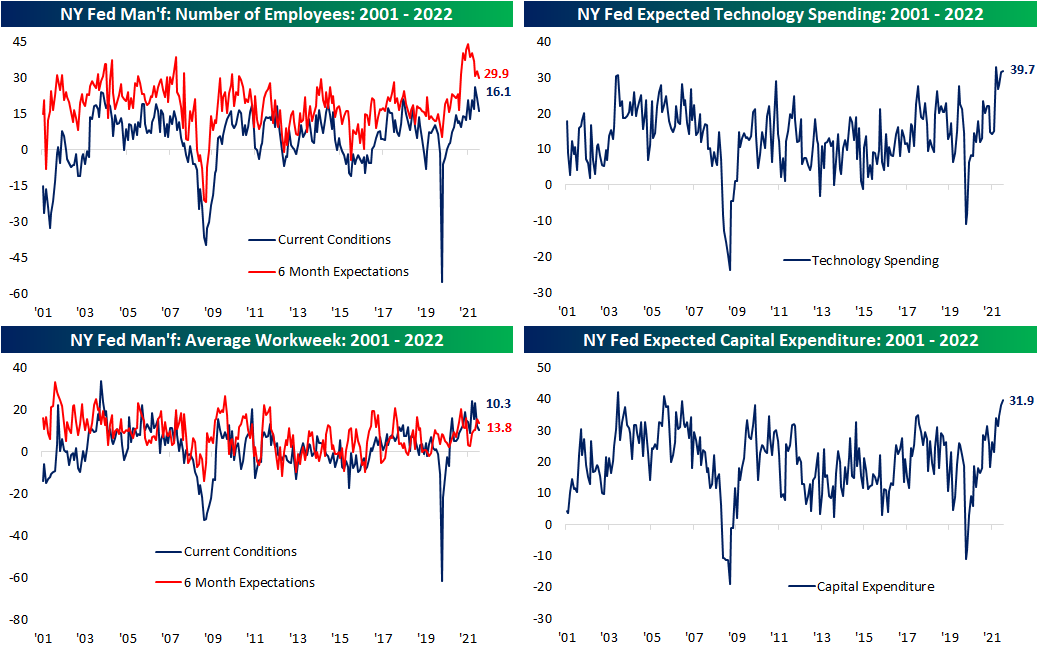
Hiring pulled back in January as did Average Workweek with the weakest readings since last August. Expectations for Number of Employees hit its lowest level since last February. Meanwhile, manufacturers plans for spending on Tech and Cap. Ex. is far more optimistic with January readings in the top 1% of all months on record. Click here to view Bespoke’s premium membership options.
Bespoke’s Morning Lineup – 1/18/22 – At Least It’s Tuesday
See what’s driving market performance around the world in today’s Morning Lineup. Bespoke’s Morning Lineup is the best way to start your trading day. Read it now by starting a two-week trial to Bespoke Premium. CLICK HERE to learn more and start your trial.
“A pessimist sees the difficulty in every opportunity; an optimist sees the opportunity in every difficulty.” – Winston Churchill
Despite an extra day off, the equity market is not looking like it’s going to get off to a good start to the trading week with futures on the major averages all lower. After outperforming the S&P 500 last week, the Nasdaq is leading the charge lower this morning with a decline of over 1%. The culprit this morning, as it seems to be every day, is interest rates as the yield on the 10-year tops 1.8% and the 2-year yield moved back over 1%.
On the earnings front, reports so far this morning have been mixed, but the most high-profile report so far has been Goldman (GS) which actually missed EPS forecasts and is trading down over 5%. It’s not looking like a positive start to the shortened week, but at least it’s Tuesday already.
Lastly, in just announced news, Microsoft (MSFT) is planning to acquire Activision Blizzard (ATVI) for $95 per share in cash. On the economic side, the Empire Manufacturing report for January came in much weaker than expected falling to -0.70 versus December’s reading of 31.9. That was the largest m/m decline since the early days of the pandemic in April 2020. This report comes on the same day the markets are now pricing in a 100% chance of a 25 bps rate hike in March and even a slight chance for 50 bps!
Read today’s Morning Lineup for a recap of all the major market news and events from around the world, including the latest US and international COVID trends.
The Nasdaq 100 tracking ETF (QQQ) is set to open down over 1% this morning which would be the fourth downside gap of at least 1% over the last 50 trading days. The way the Nasdaq has been trading lately, we were actually surprised that the number of downside gaps wasn’t higher. In any event, the rolling number of downside 1%+ gaps for QQQ is now at the highest levels since last July, but still just a fraction of the pace we saw during the COVID crash. Over the last five years, there have been 77 prior downside gaps of 1%, and on those days, the median change from the open to close for QQQ has been a gain of 0.30% with positive returns 57% of the time. However, when those downside gaps occurred on the first trading day of the week (Monday or Tuesday), the median change from the open to close was actually a decline of 0.08% with gains just half of the time.

Start a two-week trial to Bespoke Premium to read today’s full Morning Lineup.
Bespoke Brunch Reads: 1/16/22
Welcome to Bespoke Brunch Reads — a linkfest of the favorite things we read over the past week. The links are mostly market related, but there are some other interesting subjects covered as well. We hope you enjoy the food for thought as a supplement to the research we provide you during the week.
While you’re here, join Bespoke Premium with a 30-day free trial!
Politics
Flush With Cash, California Has Problems That Are No Quick Fix by Christopher Palmeri, Romy Varghese, and Laura Curtis (Bloomberg)
California has a budget surplus of nearly $50bn, California has lots of money to throw at a range of priorities which are steadily mounting, including homelessness and climate vulnerability. But lager problems, like a falling population and drought. [Link; soft paywall]
Women Legislators and Economic Performance by Thushyanthan Baskaran, Sonia R. Bhalotra, Brian K. Min, and Yogesh Uppal (SSRN)
The authors find areas that elect women to state legislative assemblies enjoy higher economic growth, with lower criminality and corruption, higher effectiveness, and lower political opportunism than their male counterparts. [Link]
Scarcity
A Simple Plan to Solve All of America’s Problems by Derek Thompson (The Atlantic)
Many of the economic problems of the last two years can be traced back to a failure to create abundance, which is easily attainable given American technology and productivity, but has not been the focus of policymaking or investment. [Link; soft paywall]
Supply-Chain Issues Leave New Homes Without Garage Doors and Gutters by Nicole Friedman (WSJ)
The ever-rising number of uncompleted homes is being driven by bottlenecks for a relatively small and inexpensive number of components which are preventing final completions of mostly-constructed new units. [Link; paywall]
COVID
Coronavirus Can Persist for Months After Traversing Body by Jason Gale (Bloomberg)
A new study reviewing autopsy results for 44 patients who died after contracting the virus reveals how serious infections can let the virus in to every one of the body’s organ systems. [Link; auto-playing video, soft paywall]
Cannabis compounds stopped COVID virus from infecting human cells in lab study by Kanoko Matsuyama (Fortune)
A new study shows that two different compounds fund in hemp may prevent COVID from entering in to human cells, making them a potential treatment for the disease. [Link; soft paywall]
Multiple Sclerosis
Longitudinal analysis reveals high prevalence of Epstein-Barr virus associated with multiple sclerosis by Bjornevik et al (Science)
A landmark study of US military personnel identifies the Epstein-Barr virus (which causes mononucleosis) as an extremely likely cause of multiple sclerosis. The study shows a 32-fold increase in risk of developing MS after infection with Esptein-Barr. [Link; paywall]
Trucks
Tesla Cybertruck Is Delayed Again, This Time Indefinitely by Nick Yekikian (Edmunds)
After being announced in 2019, Tesla expected its pickup truck to start deliveries by the end of 2021. But now the company has removed references to 2022 deliveries from its site, and nobody knows when the actual release will come. [Link]
Extreme RVs Grow Bigger, Bolder With Younger Consumers by Hannah Elliott (Bloomberg)
Glamping, meet tramping: adventure-seeking younger car buyers are leaving civilization and buying increasingly large and well-equipped vehicles to do it. [Link; soft paywall]
Fads
These TikTok Stars Made More Money Than Many of America’s Top CEOs by Josephy Pisani and Theo Francis (WSJ)
The highest-paid personalities on Tik Tok earn tens of millions per year, making them much better-paid than most large publicly traded companies. [Link; paywall]
Wordle Is a Love Story by Daniel Victor (NYT)
A once-a-day word guessing game has exploded in popularity, turning an idle side project for a Brooklyn software engineer into an obsession for hundreds of thousands of users. If you’d like to try your luck, you can play the game here. [Link; soft paywall]
Investors are paying millions for virtual land in the metaverse by Chris DiLella and Andrea Day (CNBC)
Real estate in the metaverse is selling for millions as investors eagerly anticipate a gold rush of users into virtual environments. [Link]
Economics
Don’t Extrapolate From This Fake Business Cycle by Dario Perkins (TS Lombard)
An argument that the data on the current economy is totally unique, with convincing arguments as to why the pandemic era is not a good indicator of longer-term economic trends or trajectories. [Link]
Climate Change
The 100th Meridian, Where the Great Plains Begin, May Be Shifting by Kevin Krajick (Columbia Climate Society)
The barrier between the humid, fertile east and the arid, dry west has historically run north-south along the 100th meridian. But desertification and climate change may be starting to shift that divide to the east, changing crop yields and drying out the plains. [Link]
Network Effects
Why Apple’s iMessage Is Winning: Teens Dread the Green Text Bubble by Tim Higgins (WSJ)
Younger mobile users fear being branded with the green bubble, illustrating the extremely strong network effects of the iMessage and broader iOS ecosystem Apple controls. [Link; paywall]
Read Bespoke’s most actionable market research by joining Bespoke Premium today! Get started here.
Have a great weekend!
The Bespoke Report Newsletter – 1/14/22 – The Fed Versus Growth
This week’s Bespoke Report newsletter is now available for members.
In The Bespoke Report this week we discuss the huge rotation out of growth and in to value stocks, preview earnings season, discuss the “buy-the-dip” mentality from US markets, review valuations, discuss the drivers of emerging markets outperformance, highlight the divergence between stock prices and analyst estimates by sector, review economic data from the US and around the world this week, and more.
To read this week’s full Bespoke Report newsletter and access everything else Bespoke’s research platform has to offer, start a two-week trial to one of our three membership levels.

Daily Sector Snapshot — 1/14/22
B.I.G. Tips – Retail Sales On the Path to Reality
Bespoke’s Morning Lineup – 1/14/22 – And They’re Off
See what’s driving market performance around the world in today’s Morning Lineup. Bespoke’s Morning Lineup is the best way to start your trading day. Read it now by starting a two-week trial to Bespoke Premium. CLICK HERE to learn more and start your trial.
“When you expect things to happen – strangely enough – they do happen.” – J.P. Morgan
If you were hoping for a quick bounceback following yesterday’s decline, think again. While futures were higher overnight, all of those prior gains have evaporated. Tech is leading the way lower once again, but Financials aren’t providing any support as investors have generally been selling JP Morgan (JPM), Wells Fargo (WFC), Citigroup (C), and Blackrock (BLK) following their reports. The only one of those four that’s higher this morning is WFC, while JPM and C are both down over 4%. As noted in our Earnings Season Preview yesterday, the major financials typically react negatively to their Q4 reports, so far this earnings season doesn’t appear to be an exception.
It may be Friday, but it’s a relatively busy day for economic data to close out the week with Retail Sales, Import and Export Prices, Industrial Production, Capacity Utilization, Business Inventories, and Michigan Confidence all on the calendar. Retail Sales just hit the tape and came in much weaker than expected.
Read today’s Morning Lineup for a recap of all the major market news and events from around the world, including the latest US and international COVID trends.
Yesterday was a gut punch for the technology sector. Take semiconductors, for example. Boosted by a strong earnings report from Taiwan Semiconductor (TSM), the Philadelphia Semiconductor Index (SOX) traded more than 2% higher in early trading but then reversed lower finishing right near its low of the day and down more than 2% from Wednesday’s close. That marked the first time the index was up 2%+ intraday but finished the day down more than 2% from its prior day close since April 2020.
In the entire history of the SOX dating back to the mid-1990s, there have only been 42 prior occurrences where it was up 2%+ intraday but finished the day down 2%+, and only three of those occurred in the post-Global Financial Crisis period. As shown in the chart below, the majority of the prior occurrences came during the unwind of the dot-com bubble from March 2000 through October 2002. What makes yesterday’s reversal unique is that even after the decline, the SOX is still just 6.3% below its 52-week high. The average distance from their respective 52-week highs of the other 42 occurrences was over 40%, and there wasn’t a single time where the SOX was as close to a 52-week high as it is now. The only other occurrence where the SOX was even within 10% of a 52-week high was on 3/14/00.

Start a two-week trial to Bespoke Premium to read today’s full Morning Lineup.
The Bespoke 50 Growth Stocks — 1/13/22
The “Bespoke 50” is a basket of noteworthy growth stocks in the Russell 3,000. To make the list, a stock must have strong earnings growth prospects along with an attractive price chart based on Bespoke’s analysis. The Bespoke 50 is updated weekly on Thursday unless otherwise noted. There were twelve changes to the list this week.
The Bespoke 50 is available with a Bespoke Premium subscription or a Bespoke Institutional subscription. You can learn more about our subscription offerings at our Membership Options page, or simply start a two-week trial at our sign-up page.

The Bespoke 50 performance chart shown does not represent actual investment results. The Bespoke 50 is updated weekly on Thursday. Performance is based on equally weighting each of the 50 stocks (2% each) and is calculated using each stock’s opening price as of Friday morning each week. Entry prices and exit prices used for stocks that are added or removed from the Bespoke 50 are based on Friday’s opening price. Any potential commissions, brokerage fees, or dividends are not included in the Bespoke 50 performance calculation, but the performance shown is net of a hypothetical annual advisory fee of 0.85%. Performance tracking for the Bespoke 50 and the Russell 3,000 total return index begins on March 5th, 2012 when the Bespoke 50 was first published. Past performance is not a guarantee of future results. The Bespoke 50 is meant to be an idea generator for investors and not a recommendation to buy or sell any specific securities. It is not personalized advice because it in no way takes into account an investor’s individual needs. As always, investors should conduct their own research when buying or selling individual securities. Click here to read our full disclosure on hypothetical performance tracking. Bespoke representatives or wealth management clients may have positions in securities discussed or mentioned in its published content.