
February 2022 Headlines
Bespoke’s Morning Lineup – 3/11/22 – It’s Friday
See what’s driving market performance around the world in today’s Morning Lineup. Bespoke’s Morning Lineup is the best way to start your trading day. Read it now by starting a two-week trial to Bespoke Premium. CLICK HERE to learn more and start your trial.
“And Lord, we’re especially thankful for nuclear power, the cleanest safest energy source there is. Except for solar, which is just a pipe dream.” – Homer Simpson
It’s just a coincidence that Google searches for the term ‘nuclear war’ are hitting a record high as we’re marking the 11th anniversary of the Fukushima nuclear disaster in Japan, but the term nuclear has been showing up a lot lately. Whether it is Germany’s plan to shut down its nuclear power plants and make it even more reliant on Russian energy, or the Russian invasion of Ukraine that has raised risks of a nuclear accident at the site of the former Chernobyl plant or Ukraine’s other nuclear power plants that are operational, or the risk of nuclear war with Russia if NATO comes in to actively help defend Ukraine, you can’t get away from the subject of nuclear lately.
Thankfully, equity markets look to be putting a lot of these concerns aside temporarily giving investors a reprieve heading into the weekend. S&P 500 futures are currently up over 1%, crude oil is up over 1%, gold is down 1.5%, the 10-year yield is flat right at about 2.0%, and bitcoin is right around $40,000. The positive tone in equities was present for most of the night but just got an added boost shortly before 7 AM on reports that Russian President Putin said there were positive shifts in talks with Ukraine. At this point, the markets will take whatever good news they can get, but keep in mind that Putin is also the one who said Russia wouldn’t invade Ukraine.
Read today’s Morning Lineup for a recap of all the major market news and events from around the world, including the latest US and international COVID trends.
It’s been a pretty nasty week for US equities since the close last Thursday. During that span, the S&P 500 is down over 2% while the Nasdaq is down 3%. The worst performing sector during this period has been Consumer Staples (XLP) which is down close to 5%, while Technology (XLK) and Financials (XLF) are both down over 3%. Rounding out the top five of biggest losers, Communication Services (XLC) and Consumer Discretionary (XLY) are both down over 2.5%. Not surprisingly, all five of the aforementioned sectors are also at short-term oversold levels.
While most sectors are lower, three have managed to buck the trend over the last week. Energy (XLE) has been the biggest winner, rising close to 6%, followed by Utilities (XLU) and Real Estate (XLRE). Unfortunately for the broader market, though, these three sectors are also the smallest sectors in terms of their weightings in the overall S&P 500.

Start a two-week trial to Bespoke Premium to read today’s full Morning Lineup.
The Closer – Inflation Surge Continues, Fiscal Tightening, Strong Bond Bidding – 3/10/22
Log-in here if you’re a member with access to the Closer.
Looking for deeper insight into markets? In tonight’s Closer sent to Bespoke Institutional clients, we start out tonight by taking a look at the backwardation of crude oil and crack spreads followed by an update on the situation in Ukraine. We then dive into today’s inflation data. Next, we look at government receipts and today’s historically strong 30 year bond sale.

See today’s post-market Closer and everything else Bespoke publishes by starting a 14-day trial to Bespoke Institutional today!
Bespoke’s Weekly Sector Snapshot — 3/10/22
Doomsday Fear Index
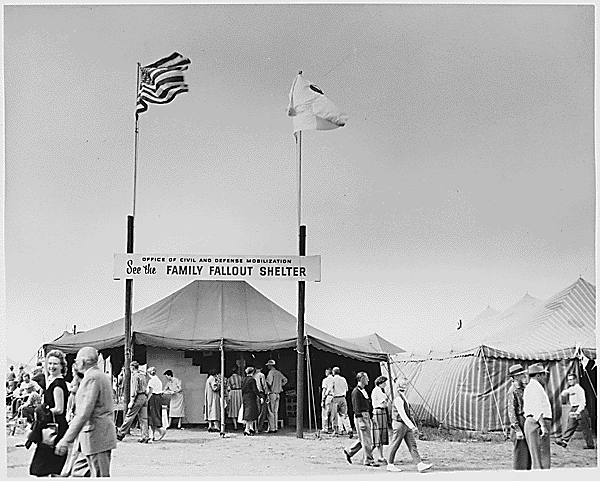
During the Cold War, American children and adults were educated on how to best protect themselves from a nuclear explosion. This included measures from the silly “duck and cover” campaign to nuclear fallout shelter instructions. If you happen to be curious about the federal government’s current recommendations in regards to protection from a nuclear blast, you can read up on the instructions here. We’re not sure how focused people will be about wearing a mask in the event of nuclear fallout, but we guess you can never be too careful!
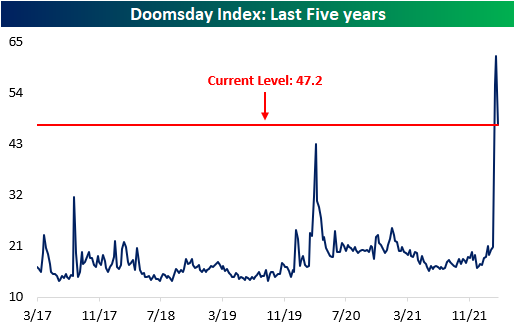
With tensions between Western nations and Russia reaching levels not seen since the Cold War, we took a look at Google Trends to identify the level of fear in the American population with respect to the current war in Ukraine. We looked at the search volumes for terms like nuclear war, WWIII, canned food, Potassium Iodide, and gas mask. Searches for many of these terms hit five-year highs in the early days of the Russian invasion but have subsided since. The current level is still well above normalcy, but fears appear to have eased over the last week as the West’s retaliation has been almost entirely economic (or maybe there is no internet service in the fallout shelters). The aggregate index is pictured below.
Below are charts of each search term we utilized in the composition of our index. Potassium Iodide, the compound utilized to mitigate the effects of excessive radiation exposure, is the only term that remains at a five-year high in terms of search volume. While searches for some of these terms were actually much higher during the early days of COVID, they all experienced upticks in the last few weeks. All-in-all, based on search trends based on fears of a nuclear situation or war with Russia spiked when the Ukraine invasion first started, but those fears have over the course of the last week. Click here to view Bespoke’s premium membership options.
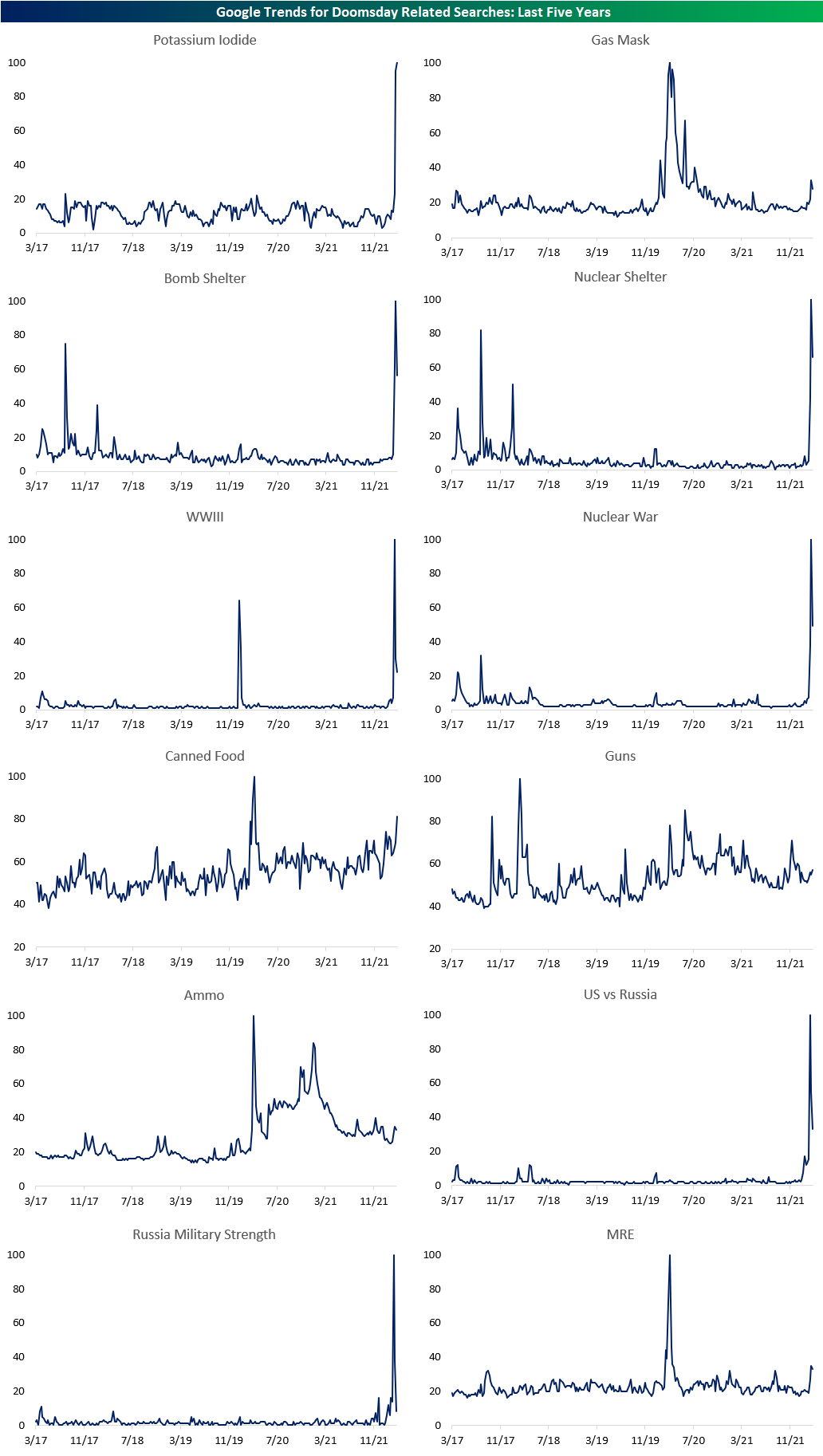
Chart of the Day: The Immaculate Correction
Investor Sentiment Remains Volatile
Considering equities and other risk asset prices continue to swing violently, so too have readings on investor sentiment. The weekly AAII survey of individual investors saw the percentage of respondents reporting as bullish fall back below 25% this week after rising above 30% last week. While that is not the largest drop in recent months (the second week of January saw bullish sentiment fall 7.9 percentage points compared to 6.4 today), it nonetheless reaffirmed that investor confidence is shaky, if not undecided, at the moment.

The drop in bullish sentiment was mostly picked up by those reporting as bearish. Bearish sentiment rose 4.4 percentage points to 45.8%. While that reading is roughly 15 percentage points above the historical average for bearish sentiment, the reading is still lower than an even more pessimistic reading only two weeks ago when more than half of respondents reported as bearish.
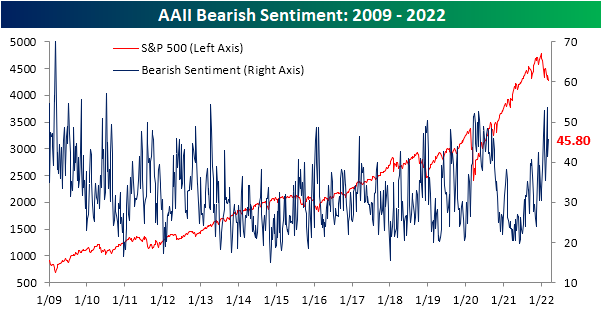
With the inverse moves in bullish and bearish sentiment, the bull-bear spread has pulled back to -21.8. As with bullish and bearish sentiment, even if that does not set a new low, it is only in the 5th percentile of readings going back to the start of the survey.
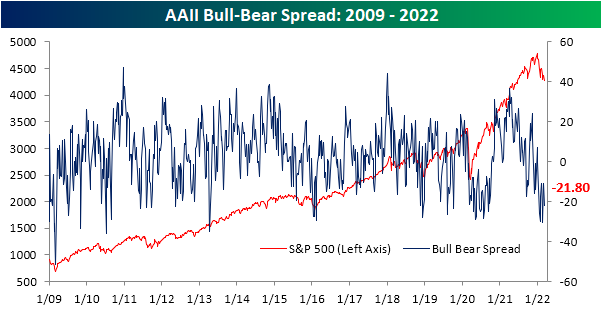
After the largest single-week decline in nearly 20 years two weeks ago, neutral sentiment has been clawing its way back into the range it was in for most of the past year. Gaining another 2 percentage points this week, the reading is now back above 30%.

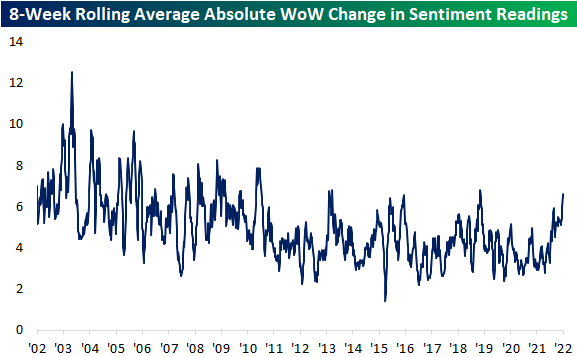
Across each category of the report, there have been sizable swings in the past two months. To highlight this, in the chart below we show the eight-week rolling average of the absolute week over week change for each sentiment reading (bullish, bearish, and neutral) over the past 20 years. Over the history of the survey, weekly changes have gravitated towards smaller swings meaning the past decade is structurally a bit different relative to the decade before that. That being said, the weekly swings in the AAII readings on sentiment have been some of the largest of any period of the post-Global Financial Criss era. In fact, not even the COVID crash saw such volatility in sentiment (given optimism collapsed and then remained muted for some time rather than swing back and forth) while the only times this average was as high as now in the past decade were the spring of 2013, February 2016, and January 2019. Click here to view Bespoke’s premium membership options.
Little Need to Worry About Rising Claims
While today’s CPI data did not come in hotter than expected as feared (matching expectations of 7.9% YoY growth), jobless claims came in worse than expected for both initial and continuing claims. Seasonally adjusted initial claims rose to 227K versus expectations of a 2K increase from last week’s unrevised level of 215K. In addition to the higher reading this week, the last print was also revised up by 1K. In spite of the lack of improvement in claims recently (it’s been over 3 months since the multi-decade low of 188K set in early December), the level of claims remains historically low.
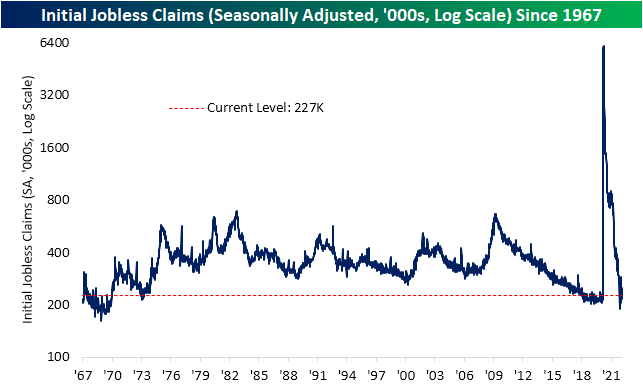
On a non-seasonally adjusted basis, claims for the current week of the year are in line with readings from the few years prior to the beginning of the pandemic. In terms of the seasonal pattern, the current week of the year typically has not seen claims rise week over week as they did this year. Claims tend to fall at this point of the year with the few weeks surrounding the current period marking some of the weeks of the year with the most consistent declines in claims. Regardless of the somewhat seasonally unusual move, the broader seasonal pattern this year has not marked a major divergence versus history.

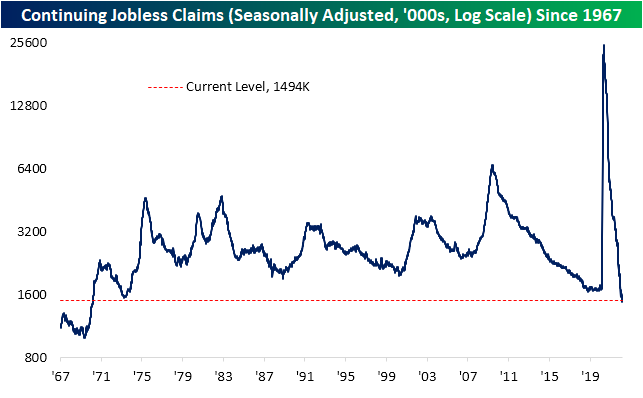
Continuing claims were expected to fall from 1.476 million down to 1.450 million. Instead, claims rose by 18K. As with initial claims, even though that is not as strong a reading as anticipated. It is far from leaving claims at any sort of worrisome level.Click here to view Bespoke’s premium membership options.
Bespoke’s Morning Lineup – 3/10/22 – Inflation Day
See what’s driving market performance around the world in today’s Morning Lineup. Bespoke’s Morning Lineup is the best way to start your trading day. Read it now by starting a two-week trial to Bespoke Premium. CLICK HERE to learn more and start your trial.
“The best way to destroy the capitalist system is to debauch the currency.” – Vladimir Lenin
It was fun while it lasted. After a much-welcomed rally Wednesday, futures are firmly in the red this morning and set to give up a little more than a third of their gains from yesterday, and as we’ve been typing this the losses have only been mounting. For the S&P 500, that would put this week’s losses at over 2% for the week. Meetings between foreign ministers from Russia and Ukraine did not yield any substantive results, so the fighting looks set to continue. Elsewhere in Europe this morning, the ECB left rates unchanged (as expected), but announced a faster timeline for its plan to wind down asset purchases.
The big economic event of the day is obviously CPI, and it’s not going to be pretty as the headline reading is expected to increase 0.8% relative to January, while the core reading is forecasted to increase 0.5%. Don’t forget about jobless claims, though. The weekly reading on initial claims is expected to come in at a level of 225K. One combination of data that the markets will not want to see is higher than expected readings on both fronts.
Read today’s Morning Lineup for a recap of all the major market news and events from around the world, including the latest US and international COVID trends.
There’s no arguing that the current levels of inflation are high and likely to go even higher in the months ahead. Since the start of 2021, there has only been one month (August 2021) where headline CPI has come in weaker than expected, and the compounded impact of these higher than expected monthly readings is the fact that today’s report for the month of February will mark the 9th straight month that y/y headline CPI has been above 5%. That’s a pretty long streak, but looking back over history, it’s nowhere close to as long as some of the prior streaks we have seen. Late in WWII and into 1920, headline CPI was above 5% for nearly five years. In the early 1940s during WWII through 1951, there were three separate streaks where headline CPI was above 5% y/y for at least a year. Then there was the 1970s coming out of the Vietnam War and into the early 1980s when there were three streaks that lasted at least 20 months including a five and a half year streak ending in 1982.
To put it another way, in the entire decade of the 1970s, more than 75% of all CPI readings were above 5% and the average y/y reading was 7.1%. Inflation is painful right now and will likely get worse from here, but the current period is still nowhere near the 1970s.

Start a two-week trial to Bespoke Premium to read today’s full Morning Lineup.