More 52-Week Lows for Homebuilders
Homebuilder stocks are under pressure again today following a weak earnings report from KB Home (KBH) which has the stock trading down over 3%. The weakness in KBH has also shown up in the iShares Home Construction ETF (ITB) which is down 1.6% and on pace for its lowest close in more than a year.

Rising rates have been cited as a major cause behind the weakness in homebuilder stocks, but they aren’t the only factor. As mentioned in the KBH call this morning, constraints in the supply of both labor and materials has also slowed down business for homebuilders. They literally can’t build houses fast enough to meet demand. The chart below compares the performance of ITB versus Bankrate.com’s 30-year mortgage rate (shown on an inverted basis in the chart). Over time, there has been a positive correlation between homebuilder stocks and rates, but there have also been periods where the two have diverged as well, and if you’re long homebuilder stocks, you should be happy that mortgage rates aren’t the only factor driving performance of homebuilder stocks. If that were the case, the recent surge in rates (shown by a falling red line in the chart) would have resulted in a crash in homebuilder stocks.

While homebuilder stocks trade near 52-week lows today and have underperformed the broader market, the current level of underperformance is hardly extreme relative to recent history. The chart below shows the rolling 50-trading day performance spread between ITB and the S&P 500 going back to the start of 2010. At the current level of 11.4 percentage points, the current level of underperformance by the homebuilders has been seen at three other periods since the start of the pandemic in 2020. Click here to view Bespoke’s premium membership options.
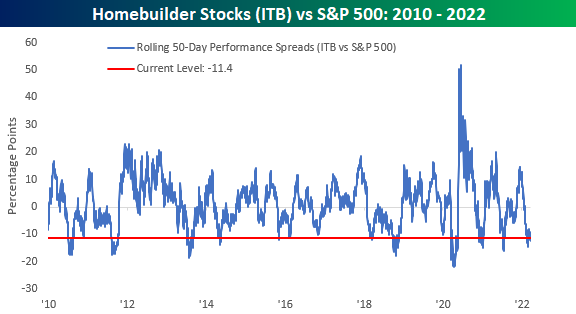
Chart of the Day: Bonds Wrecked Into Quarter End
Jobless Claims at Lowest Level in Over 50 Years
Since early December, initial jobless claims have risen and remained above multi-decade lows. That is until this week. Seasonally adjusted claims fell for a second week in a row down to 187K this week. That is the lowest reading since claims came in at 182K all the way back in September 1969.

While not to take away from the historically strong reading as NSA claims also hit a new low for the pandemic of 181.1K, before seasonal adjustment, jobless claims have not exactly fallen to as significant of a low as the adjusted number. Although that is the lowest level for the current week of the year since 1969, there have been recent periods like the fall of 2018 and 2019 in which claims were even lower. Declines in initial claims have historically been common for the current week of the year, but the next couple of weeks have typically seen claims experience a brief bump before resuming a seasonal downtrend roughly through mid-spring.

Continuing claims have fallen even more consistently with week-over-week improvements in 7 of the past 10 weeks. Now at 1.35 million, continuing claims are down to the lowest level since the first week of 1970. Click here to view Bespoke’s premium membership options.

Bespoke’s Morning Lineup – 3/24/22 – Energy Back on Top
See what’s driving market performance around the world in today’s Morning Lineup. Bespoke’s Morning Lineup is the best way to start your trading day. Read it now by starting a two-week trial to Bespoke Premium. CLICK HERE to learn more and start your trial.
“I may have been born at night, but it wasn’t last night” – T. Boone Pickens
We’ve had a positive tone in equity futures for most of the night and into this morning, although the magnitude of the implied gains has been waning in the last several minutes. Initial and continuing jobless claims were just released and both came in lower than expected falling to levels not seen in more than 50 years! Durable Goods Orders, however, weren’t as strong with both the headline and ex Transportation readings coming in at negative levels.
On the geopolitical front, today’s NATO summit is likely to result in some headlines later today as more sanctions will be announced. On the ground in Ukraine, Russian troops still appear to be facing much more significant than expected resistance. For more on that, check out our commentary in today’s report. The strong resistance on the part of Ukraine has been impressive and welcome, but also raises the risk of Russia taking more drastic measures to win the war, something none of us hope to see.
Read today’s Morning Lineup for a recap of all the major market news and events from around the world, including the latest US and international COVID trends.
After a brief period mid-month where the sector took a back seat performance-wise, Energy finds itself back on top of the leaderboard with a gain of over 8% in the last week. For the year, Energy is up nearly 40% and once again remains the only sector in positive territory for the year. For much of the year, Energy’s gain meant pain for sectors like Consumer Discretionary and Technology, but both of these sectors are currently ranked in the top four of the eleven sectors with gains of 4.2% and 2.5%, respectively, over the last week. At the bottom of the list, no sectors are down in the last week, but defensive like Real Estate, Health Care, Utilities, and Consumer Staples have lagged with gains of less than 1%. So the market has been in a bit of a risk-on mode lately. Despite their underperformance over the last week, Utilities and Health Care are two of just four sectors that are in overbought territory.

Start a two-week trial to Bespoke Premium to read today’s full Morning Lineup.
The Bespoke Emerging Market 50
The Bespoke Emerging Market 50 tracks emerging market equities that have either strong earnings growth, the potential to recover substantially in the foreseeable future, or unique upside based on the current geopolitical environment. As the name implies, all of these companies are domiciled in emerging market economies (with ADRs). In this report, we highlight risks and opportunities in emerging markets before diving into the differences between our basket and the iShares MSCI Emerging Markets ETF (EEM). The back half of the report involves a brief summary of each of the 50 stocks in the basket, including fundamental insights, growth opportunities, and risks. The Bespoke Emerging Market 50 is updated on a quarterly basis.

The Bespoke Emerging Market 50 is available at the Bespoke Premium level and higher. You can sign up for Bespoke Premium now and receive a 14-day trial to read our Emerging Market 50 report. To sign up, choose either the monthly or annual checkout link below:
Bespoke Premium – Monthly Payment Plan
Bespoke Premium – Annual Payment Plan
Daily Sector Snapshot — 3/23/22
Historic Two Year Rallies
Today marks the two-year anniversary of the COVID Crash low on March 23rd, 2020. After falling 34% from 2/19/20 to 3/23/20, the S&P has seen a gain of exactly 100% since then. Below is a chart showing the rolling 2-year price change in percentage terms for the S&P since index data begins in 1928. Remarkably, this has been the best two-year gain for the S&P since 1937!
As for two other major US indices, the NASDAQ Composite and Russell 2,000 have been on their strongest runs since the period coming out of the Global Financial Crisis. Looking further back, though, the late 1990s saw much larger rallies in two-year spans for the NASDAQ, while the post-GFC era is the only comparable period for small caps.

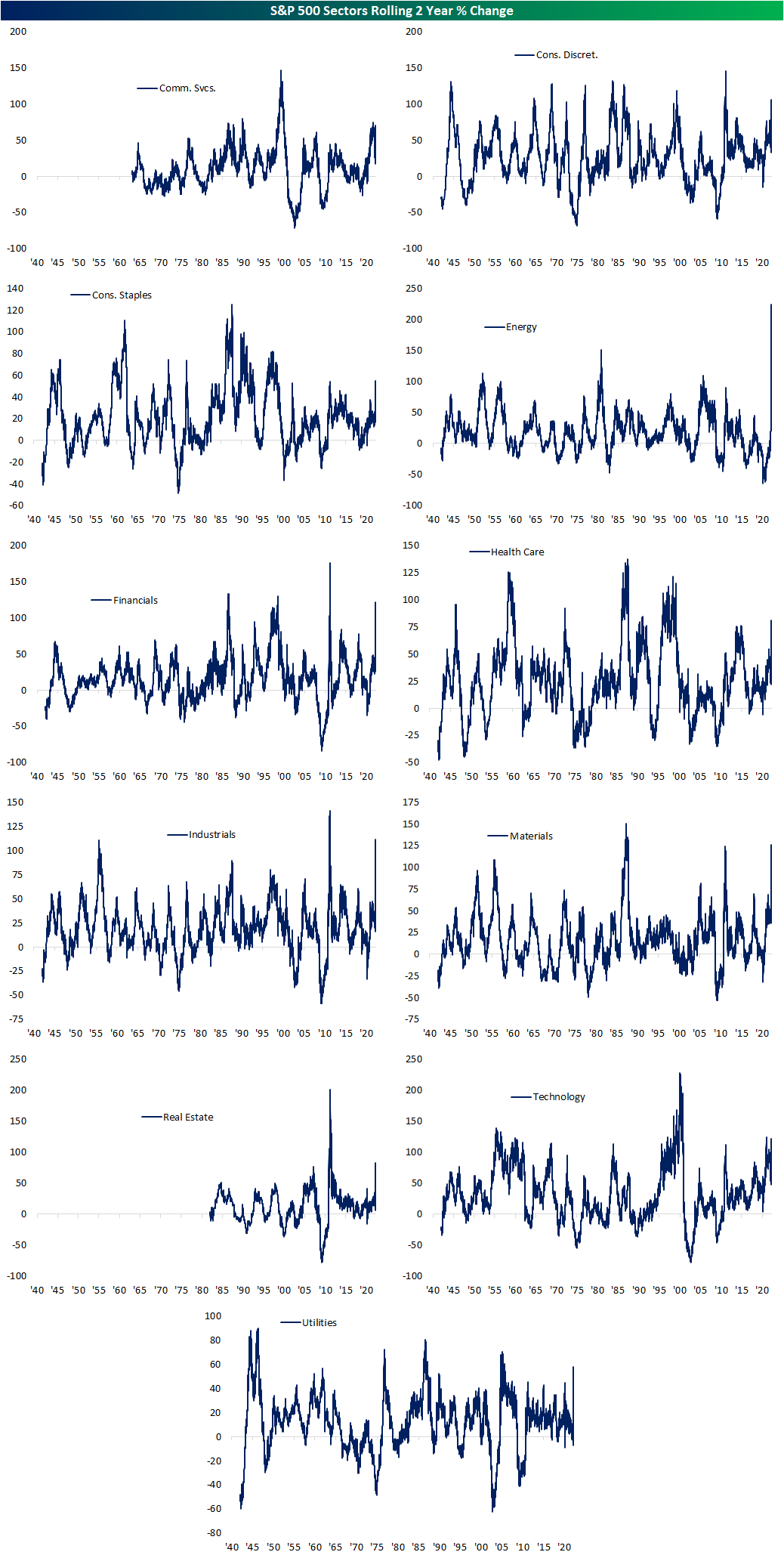
Below we show the rolling 2-year percentage change for the eleven S&P 500 sectors. As you can see, this two-year run stands out as one of the best for most sectors. Energy’s run has blown any previous record out of the water as the sector has risen 224% since the COVID low two years ago. Aside from Energy, the current two-year rallies for most sectors have been the largest since the couple of years coming out of the Financial Crisis or the 1990s for sectors like Technology and Health Care. Click here if you would like to see Bespoke’s premium research.
Best S&P 500 Stocks Since the COVID Crash Lows
Two years ago to the day, the S&P 500 put in a low after a 33.9% pullback from the closing high on 2/19/20. While the S&P 500 is once again off its highs, the index sits just over 100% above that 3/23/20, low and 32.7% above the pre-pandemic high. In the table below, we show the current S&P 500 components which have rallied the most since the COVID Crash low as well as how much each stock declined during the crash.
While it was not a member of the S&P 500 at the time of the COVID crash, being added on 12/21/20, Tesla (TSLA) is currently the S&P 500 member which has risen the most since the broader market low. After being more than cut in half, it has since risen over 1,000%. The next best performers are Devon Energy (DVN) and APA Corp (APA); a couple of Energy sector names that saw even larger declines of 72.8% and 84.86%, respectively from 2/19/20 to 3/23/20. Along since Freeport-McMoRan (FCX), both stocks have risen well over 800% over the past two years. Of the list of the 25 best performers in the S&P 500, the only one that managed to move higher during the COVID Crash was vaccine producer Moderna (MRNA) which had risen 40.43% as the rest of the market collapsed.

By the time of the 3/23/20 low, the index’s worst performers since the pre-pandemic high (2/19/20) had seen monumental declines with many of those stocks dropping over 70%. On the other end of the spectrum, only four stocks had eeked out a gain and only another seven stocks had fallen single-digit percentage points.
As for what those stocks have done since then, below we have created equal weight indices comprised of the S&P 500 members that are still actively traded that were the 20 best and 20 worst performers from 2/19/20 to 3/23/20. Each basket as well as the S&P 500 are indexed to 100 at the COVID Crash low. As shown, what had at one point been the most beaten-down names, have crushed it over the past two years; hypothetically having turned $100 into $481 having even held up well during the recent bout of weakness for equities. For comparison, the biggest winners in the early days of the pandemic bought at the lows would have only seen $100 turn into $137.64 while the S&P 500 as a whole would have a little more than doubled.Click here to view Bespoke’s premium membership options.

“OK” Breadth
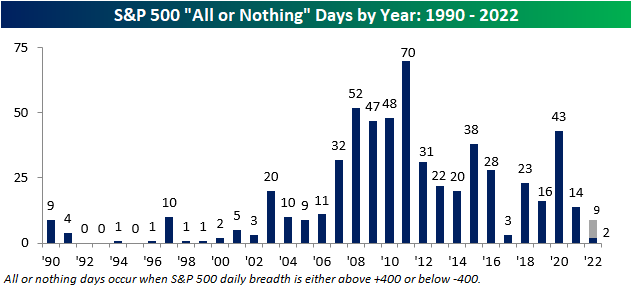
With the S&P 500 up over 1% in five of the last six trading days heading into Wednesday, we expected to see some strong breadth readings to go along with the gains, but in looking at the daily readings, since last week’s low, we were a little bit underwhelmed with the readings we saw. Going back to 1990, on days when the S&P 500 was up 1% or more, the average daily advance/decline reading for the index has been +323, and since the lows of the Financial Crisis, the average has been even stronger at +373. Furthermore, an average of one out of every four 1%+ daily gains for the S&P 500 since 1990 have qualified as ‘all-or-nothing’ days (when the net A/D reading for the S&P 500 is greater than +/- 400) while the percentage is 42% since the Financial Crisis low in March 2009. Turning to the five 1%+ days the S&P 500 has had since last Monday, the daily net A/D readings have been +389, +329, +341, +199, and +226, for an average of just +297. That average is modestly below the long-term average, but well below the post-financial crisis average. Not only that but there hasn’t been a single all-or-nothing day since last Monday’s low.
The pace of all-or-nothing days for the S&P 500 hasn’t just been on the low side since the beginning of last week. So far this year, there have only been two all-or-nothing days for the S&P 500 (2/25 and 3/2, both up days), which puts the pace for 2022 at just nine. Normally, when we provide updates on the number of all-or-nothing days in the market, we qualify it with the fact that volatility in the market tends to come in bunches, so the pace of all-or-nothing days usually comes in fits and starts as well. The only difference this time around is that we have already been in what has been a very volatile period for the markets, so if we aren’t getting all-or-nothing days now, how volatile will the market need to get before the pace starts to pick up?
The chart below shows the number of all-or-nothing days in the market by year going back to 1990. While the pace of all-or-nothing days was very slow from 1990 through the early 2000s, once the Financial crisis arrived, the frequency really started to pick up and has stayed elevated ever since. Since 2007, the average number of all-or-nothing days has been 32 per year, but at this year’s rate, the S&P 500 is on pace for just nine all-or-nothing days, which would be the lowest since 2017 and just the second year since 2006 that the total was in the single-digits. Again, there’s still a lot of time left in 2022 for this pace to change, but at the current rate, 2022 is shaping up to be an outlier of a year.
Now that we’ve established that there have been such a low number of all-or-nothing days in the market, what are the implications? One notable one is that with less correlation between individual stocks, there’s less of a tide lifting or sinking all ships environment in the market, and that puts an increased emphasis on stock picking relative to indexing. Click here to view Bespoke’s premium membership options.