
2022: Not the Year for Optimism
As we noted in a post on Thursday, the latest data from the weekly AAII survey showed bearish sentiment cross back above 50% while bullish sentiment is back below 25%. With further pessimistic readings, this year is on pace to be one of the worst years on record for investor sentiment as measured by that survey. Below we show the average reading for bullish and bearish sentiment by year as well as how many weeks during each year those readings were below 25% and above 50%, respectively. In a nutshell, 2022 has been a year popular with the bears.
With bullish sentiment having averaged a reading of only 24.22% in 2022, it is below the previous runner-up and record low of 27.29% and 27.08% in 1988 and 1990. That low average is thanks to twenty weeks so far this year where bullish sentiment has been below 25%. With four months to go in the year, this year would only need to see one more month with such a reading in order for 2022 to become the year that most often saw less than a quarter of respondents report as bullish.
Conversely for bearish sentiment, 2022 has averaged a reading of 45.87%, slightly above the previous record of 45.2% from 2008. Slightly different from bullish sentiment, however, by the end of the year there will need to be almost two more months of bearish sentiment readings above 50% to take out the 2008 record. Currently, this year is closing in on 1990 when there were 13 weeks in which over half of respondents reported pessimistic sentiment. Click here to learn more about Bespoke’s premium stock market research service.

Bespoke’s Sector Snapshot — 9/2/22
The Bespoke Report – 9/2/22 – Chair Powell, If You’re Out There, Read This
This week’s Bespoke Report newsletter is now available for members.
Labor Day marks the unofficial end of summer and the beginning of a new school year. Right now, there are thousands of 18-year-olds starting their first year of college around the country, and many of them have been dropped off in an environment they’ve never experienced. As they try to figure it all out, they’re going to make a lot of mistakes along the way. Everybody does.
Heading into the last four months of 2022, the Fed and everybody else are like first-year college students. We’ve never experienced anything like the current backdrop before. While we want to think that Jay from New York down the hall, Esther from Kansas City, or Jim from St. Louis somehow have all the answers, they, like everybody else, have no clue either. It’s not just the Fed. Everybody has been wrong more often than they’ve been right since COVID.
After having just told you how everyone has been wrong on everything for the last two years, you may be thinking to yourself, what do they know that everyone else doesn’t? We don’t have a crystal ball either. Our approach now is the same as it always has been and that’s to listen to what the market is saying, and in this week’s Bespoke Report, we cover all of the week’s major market events and how they may impact the market. To read this week’s full Bespoke Report newsletter and access everything else Bespoke’s research platform has to offer, start a two-week trial to one of our three membership levels.


August Firearm Background Checks
Although not a widely-utilized indicator, we like to look at the number of firearm background checks conducted by the NICS every month to gauge geopolitical uncertainty and volatility within the US. In uncertain times, firearm background checks tend to increase, as individuals increasingly acquire the means to protect themselves in a worst-case scenario. On the contrary, when times are ‘good’, background checks tend to decline. An additional factor that impacts background checks is the outlook on firearms legislation. When the populous fears that they may not be able to purchase certain firearms in the future, they will step up purchases in the short term to ‘stock up’.
At the end of June, the Supreme Court issued a ruling that expanded gun rights, prohibiting certain restrictions on carrying. This may have contributed to the rise in background checks this month, but there are other factors that likely contributed as well. Democrats are now expected to retain control of the Senate according to betting markets, and the Biden administration has proven their ability to enact legislation, so Americans may be worried about further gun control legislation. Additionally, the FBI’s raid of former President Trump’s Mar a Lago home could have added to the perception of domestic political instability. Click here to learn more about Bespoke’s premium stock market research service.
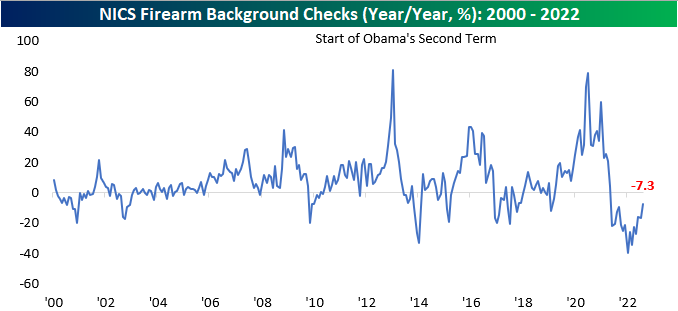
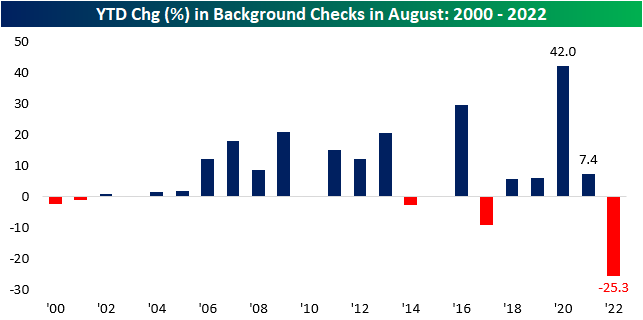
Although background checks rose by 4.7% month over month, they are still down 7.3% y/y. This is largely due to tough comps, as heightened geopolitical uncertainty and volatility in 2020 and 2021 led to extreme increases in background checks. We are now essentially out of the COVID-era, the Russia-Ukraine conflict is no longer top of mind for Americans, and the questioning of 2020 election results appears to be a thing of the past, and a more relaxed state of affairs has led to declines throughout 2022. However, the rate of decline has been leveling out. Through August, the number of background checks on a YTD basis has declined by 25.3%, but the y/y decline of just 7.3% for the month tells us that we have likely already experienced the largest declines in background checks on a percentage basis. It would not be unreasonable to expect checks to rise as we head into midterm elections.
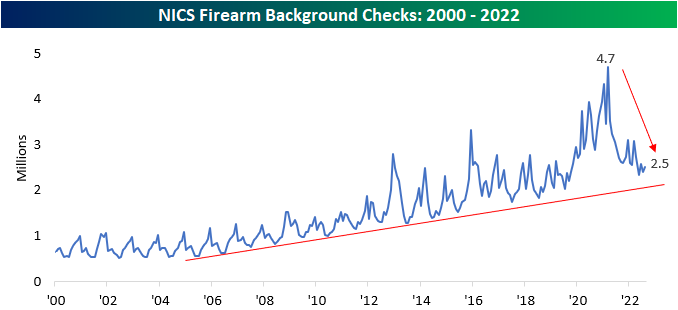
Background checks are still in a longer-term uptrend. At 2.5 million, August’s figure ranks in the top 15.1% of all months since NICS began reporting this data in 1998, and outside of late 2019 through 2021, there were only a few months that the number of checks was higher. Still, they are down 46.3% from the all-time highs seen in March 2021. This may be because demand was pulled forward, but it could also be due to a more normalized domestic situation. Click here to learn more about Bespoke’s premium stock market research service.
Sturm Ruger (RGR) and Smith & Wesson (SWBI) are the two publicly traded stocks with direct exposure to these trends. Historically speaking, the monthly performance of these stocks tends to be correlated to the trailing twelve-month volume of background checks. Although background checks rose month over month, the near-term downtrend persists in checks, which is following through to the performance of these two stocks. Over the last month, RGR and SWBI are down 20.7% and 4.8%, respectively. Click here to learn more about Bespoke’s premium stock market research service.

Bespoke’s Morning Lineup – 9/2/22 – Jobs Day to Labor Day
See what’s driving market performance around the world in today’s Morning Lineup. Bespoke’s Morning Lineup is the best way to start your trading day. Read it now by starting a two-week trial to Bespoke Premium. CLICK HERE to learn more and start your trial.
“I’m just opposed to a pure inflation-only mandate in which the only thing a central bank cares about is inflation and not employment.” – Janet Yellen

Below is a snippet of content from today’s Morning Lineup for Bespoke Premium members. Start a two-week trial to Bespoke Premium now to access the full report.
It’s understandable that the Friday before Labor Day is quiet as people look to get the most out of the last unofficial summer weekend, but the ‘flatness’ in futures is pretty remarkable given the volatility this week. The fact that it’s an employment report Friday makes the tranquility even more notable. Tune in at 4 PM to see if it lasts the entire day. Heading into this Friday’s report, the Non-Farm Payrolls report has been stronger than expected for four straight months, and the only other time in the last 25 years that it had a longer streak of beating expectations was in September 2020 when the August report topped estimates for a fifth straight month.
Outside of equities, energy is mixed with crude oil trading about 2% higher while nat gas is down over 3% and below $9/mmbtu. Treasury yields are modestly lower, but the 10-year yield is still at 3.25%.
The equity market had a pretty impressive reversal yesterday helping the S&P 500 to avoid a five-day losing streak following Fed Chair Powell’s hawkish speech in Jackson Hole last Friday. The rebound wasn’t enough to push the Nasdaq into positive territory for the day, although it did finish well off the intraday lows. Semis also managed to bounce, but the Philadelphia Semiconductor Index (SOX) still finished down over 1% on the day. Not only was it the 5th straight day of losses for the SOX, but it was also the 5th straight decline of 1% or more, a streak in which it has dropped more than 11%.
The current losing streak for the SOX ranks as the longest run of 1%+ daily declines since January 2016 and just the 12th such streak in the index’s history. Of those prior eleven, just three went on to last a sixth day and none extended to seven. Just as we noted in a post yesterday how the magnitude of the decline in reaction to Powell’s Jackson Hole speech ranked on the extreme side relative to history, losing streaks like the one the SOX is in (or hopefully on the tail end of) right now have been uncommon over time.

Our Morning Lineup keeps readers on top of earnings data, economic news, global headlines, and market internals. We’re biased (of course!), but we think it’s the best and most helpful pre-market report in existence!
Start a two-week trial to Bespoke Premium to read today’s full Morning Lineup.
Bespoke’s Consumer Pulse Report — September 2022
The Bespoke 50 Growth Stocks — 9/1/22
The “Bespoke 50” is a basket of noteworthy growth stocks in the Russell 3,000. To make the list, a stock must have strong earnings growth prospects along with an attractive price chart based on Bespoke’s analysis. The Bespoke 50 is updated weekly on Thursday unless otherwise noted. There were no changes to the list this week.
The Bespoke 50 is available with a Bespoke Premium subscription or a Bespoke Institutional subscription. You can learn more about our subscription offerings at our Membership Options page, or simply start a two-week trial at our sign-up page.

The Bespoke 50 performance chart shown does not represent actual investment results. The Bespoke 50 is updated weekly on Thursday. Performance is based on equally weighting each of the 50 stocks (2% each) and is calculated using each stock’s opening price as of Friday morning each week. Entry prices and exit prices used for stocks that are added or removed from the Bespoke 50 are based on Friday’s opening price. Any potential commissions, brokerage fees, or dividends are not included in the Bespoke 50 performance calculation, but the performance shown is net of a hypothetical annual advisory fee of 0.85%. Performance tracking for the Bespoke 50 and the Russell 3,000 total return index begins on March 5th, 2012 when the Bespoke 50 was first published. Past performance is not a guarantee of future results. The Bespoke 50 is meant to be an idea generator for investors and not a recommendation to buy or sell any specific securities. It is not personalized advice because it in no way takes into account an investor’s individual needs. As always, investors should conduct their own research when buying or selling individual securities. Click here to read our full disclosure on hypothetical performance tracking. Bespoke representatives or wealth management clients may have positions in securities discussed or mentioned in its published content.
Jackson Hole’s Increasing Importance
While the conference has been going on for decades now, the Kansas City Fed’s annual Jackson Hole Symposium has taken on increased importance and attention ever since the Financial Crisis as clues to future policy shifts have often been floated during the conference. Heading into this year’s conference and Powell’s speech last Friday, anticipation was extremely high. While markets weren’t expecting the Chair to say anything dovish, they were surprised by the directness and brevity of the speech in that the Fed would be hiking rates and it would likely cause pain for the markets and economy. Since that eight-minute speech last Friday, the reaction in markets has been swift. The chart below shows the S&P 500’s performance from the Thursday close during the Jackson Hole conference (the day before the Chair typically speaks) to the following Thursday. With this year’s decline of 5.5%, the market’s reaction this year now ranks as the second most negative since at least 1994, falling short of just 1998 when the S&P 500 declined by 5.8%. Click here to learn more about Bespoke’s premium stock market research service.

As mentioned above, the annual Jackson Hole conference has taken on added importance in recent years, so much so that anticipation of the conference is usually just as high or even higher than what we tend to see ahead of FOMC policy meetings. With that in mind, we wanted to see how this year’s decline following the Jackson Hole speech compares to market reactions to prior FOMC meetings. The chart below shows the historical one-week performance of the S&P 500 following all scheduled and unscheduled FOMC meetings since 1994 with the red line indicating the S&P 500’s performance in the week following this year’s Jackson Hole meeting. The S&P 500’s decline over the last week in response to Powell’s direct message ranks as more severe to the downside than only four other meetings since 1994 (two in March 2020, December 2018 and September 1998). Again, the reason for the market’s swift response has been Powell slamming the door shut for any hints of an upcoming Fed pivot and even referencing Paul Volcker by name when he discussed the importance of keeping inflation in check. That has led the market to price in sustained levels of higher rates, which disproportionately impacts growth and speculative stocks.
