
Bespoke Brunch Reads: 2/4/22
Welcome to Bespoke Brunch Reads — a linkfest of the favorite things we read over the past week. The links are mostly market related, but there are some other interesting subjects covered as well. We hope you enjoy the food for thought as a supplement to the research we provide you during the week.
While you’re here, join Bespoke Premium with a 30-day free trial!
Foreign Affairs
NAHB Welcomes Biden Administration Move to Lower Lumber Tariffs (NAHB)
A Biden administration proposal to reduce tariffs on lumber imported from Canada to the United States got a warm reception from the National Association of Homebuilders this week. [Link]
What the US could learn from China’s nuclear power expansion by Daniel Van Boom (CNET)
China will add ten new nuclear power plants per year over the next decade and a half as it seeks to meet soaring electricity demand while avoiding carbon-intensive power production like coal that has fueled electrification so far. [Link]
Ukraine and Dollar Weaponization by George Pearkes (Atlantic Council)
Bespoke’s macro strategist discusses the macroeconomics driving the unique properties of the dollar as a weapon that could be used to hem in Russian aggression towards Ukraine. [Link]
Battery Joe
Tesla, Who? Biden Can’t Bring Himself to Say It — and Musk Has Noticed by Dana Hull and Jennifer Jacobs (Bloomberg)
A difference of opinion over unions mean the President and the CEO of the world’s largest EV maker don’t see eye-to-eye despite huge enthusiasm for the emission-free vehicles from the White House. [Link; soft paywall, auto-playing video]
Biden’s Race to Convert Trump Voters to EVs by Gregory Korte (Bloomberg)
While EVs are gaining popularity, most GOP-leaning states have rejected the vehicles. Convincing conservatives to ditch gas or diesel for batteries will be a prerequisite for big uptakes in electric vehicles nationally. [Link; soft paywall]
Going Coastal
Jeff Bezos’ new megayacht is so big, the Dutch are going to have to take apart a historic bridge to let it pass by Avery Hartmans (Business Insider/MSN)
The massive, 417-foot yacht that is being built for Jeff Bezos up the river from Rotterdam won’t be able to pass under a bridge on its way to the Atlantic, so the company building the boat is paying to have the bridge temporarily dismantled. [Link]
The Last Oyster Tongers of Apalachicola by David Hanson (The Bitter Southerner)
Collapsing oyster populations in Apalachicola Bay mean that there will be no harvests for five years, part of an effort to rebuild beds so future tongers can ply their trade on ocean skiffs in the Gulf. [Link]
Crypto
Intuit CEO Warns of Tax Bill Shock for Bitcoin, NFT Traders by Joe Williams (Bloomberg)
Millions of small investors are at risk of serious tax liabilities this year, with capital gains taxes as high as 37% on gains from trading crypto and NFTs. [Link; soft paywall]
The Federal Reserve Bank of Boston and Massachusetts Institute of Technology release technological research on a central bank digital currency (Federal Reserve Bank of Boston)
The Boston Fed and MIT partnered in a research effort that was not designed to create a usable CBDC and is separate from the Federal Reserve Board’s own exploration of a CDBC. One codebase designed by the team was able to handle 1.7 million transactions per second with “the vast majority” settling in under 2 seconds. [Link]
Teachers
Teachers Are Quitting, and Companies Are Hot to Hire Them by Kathryn Dill (WSJ)
The pandemic is driving teachers out of the classroom even as the private sector goes on a hiring binge, and teachers are a popular target to work in a range of fields. [Link; paywall]
Novel Ideas
Our data centers now work harder when the sun shines and wind blows by Ana Radovanovic (Google)
This news is a bit old (published in 2020) but it’s still interesting: Google shifts data center use to ramp up when renewable electricity is more available, reducing the amount of non-renewable electricity data centers consume. [Link]
This company says it’s developing a system that can recognize your face from just your DNA by Tate Ryan-Mosley (Technology Review)
An Israeli startup claims it may be able to use DNA to predict what a person looks like, though the company is somewhat dodgy and experts see the technology as “pseudoscience”. [Link]
COVID
One Million Deaths: The Hole the Pandemic Made in U.S. Society by Jon Kamp, Jennifer Levitz, Brianna Abbott, and Paul Overberg (WSJ)
The US death toll from COVID is about to move above 1mm, with hundreds of thousands succumbing to the virus and huge numbers dying from related or adjacent causes. [Link; paywall]
Baseball Cards
This Philadelphia startup tells you what your old baseball cards are worth — with just a photo by Kennedy Rose (Biz Journals)
A start-up allows users to digitize their trading card collections with a mobile phone, making valuing and monetizing the cards much easier and more efficient than traditional assays. [Link]
Read Bespoke’s most actionable market research by joining Bespoke Premium today! Get started here.
Have a great weekend!
The Bespoke Report – 2/4/22 – Volatility In Markets, Volatility In Policy
This week’s Bespoke Report newsletter is now available for members.
We’ve seen some titanic shifts in response to earnings in the last couple of weeks, but even bigger ones are the pivots towards higher rates across global markets as central banks move to stifle growth as a path to lower inflation. We dive deep in to earnings results and reactions across equity markets on both sides of the Atlantic this week, economic data in the US and around the world, and cover a range of other topics in this week’s Bespoke Report.
To read this week’s full Bespoke Report newsletter and access everything else Bespoke’s research platform has to offer, start a two-week trial to one of our three membership levels.

A “Sell First, Ask Questions Later” Earnings Season
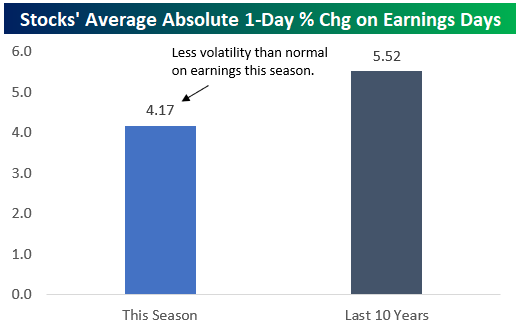
Through Thursday morning, 549 companies had reported Q4 2021 numbers since the current earnings season began the week of Jan. 10th-14th. While it may seem like stocks have been extremely volatile on their earnings reaction days this season due to a number of high-profile names seeing extreme one-day moves, on average, earnings-day volatility has actually been lower than normal. Over the last ten years, the average stock that has reported earnings has seen an absolute one-day change of +/-5.52% on its earnings reaction day. (For stocks that report before the open, its earnings reaction day is that trading day. For stocks that report after the close, its earnings reaction day is the next trading day.) So far this season, the average stock that has reported has seen an absolute one-day change of just +/-4.17%.
While earnings volatility has been lower than normal across all of the stocks that have reported this season, share-price reactions to earnings have also been much weaker than normal. Below are a number of charts showing how stocks have performed on their earnings reaction days this season versus the average over the last ten years based on a number of earnings scenarios.
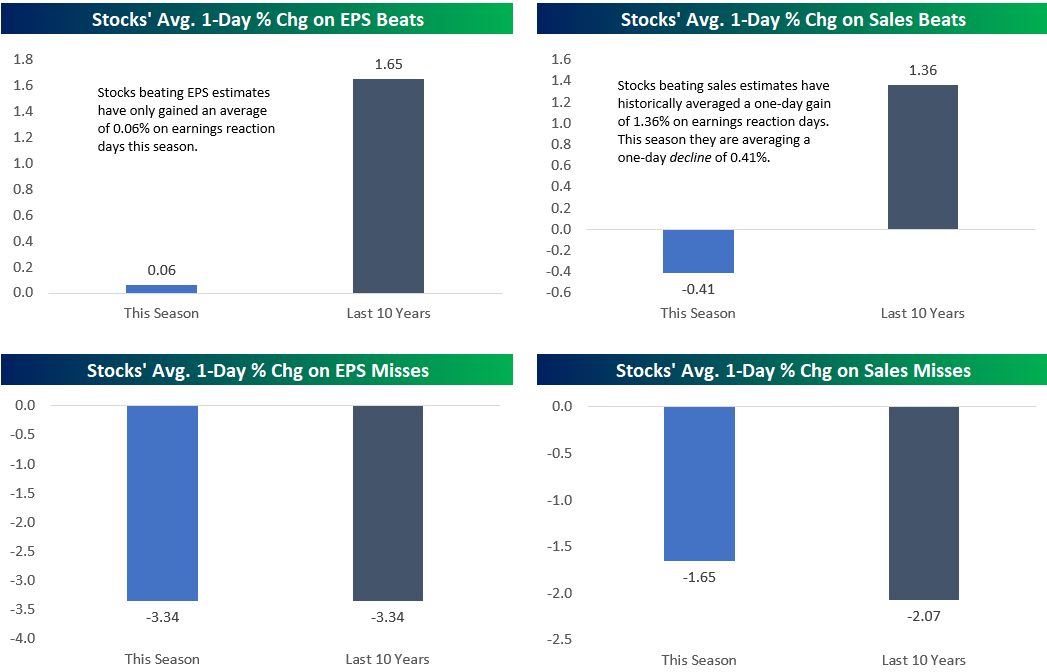
As shown in the first chart below left, stocks that have beaten consensus analyst EPS estimates have risen by an average of just 0.06% on their earnings reaction day this season. Over the last ten years, the average EPS beat has gained 1.65% on its earnings reaction day. Reactions to top-line sales beats have actually been negative. As shown, stocks that have beaten sales estimates this season have averaged a one-day drop of 0.41% on their earnings reaction days versus an average gain of 1.36% for sales beats over the last ten years.
While EPS and sales beats are usually rewarded with positive share-price reactions, this season they’re not being rewarded at all, and in the case of sales, beats are actually being punished!
Interestingly, while beats have experienced much weaker than normal performance this season, misses are performing in line to better than they normally do. The average stock that has missed EPS estimates has declined 3.34% on its earnings reaction day this season, which is the exact same as the average reading for the last ten years. The average stock that has missed sales estimates has fallen 1.65% on its earnings reaction day this season, which is actually better than the 10-year average of -2.07%.
Stocks that beat both EPS and sales estimates have averaged a one-day gain of 2.36% on their earnings reaction days over the last ten years. This season, stocks that have beaten on both the top and bottom line have seen a minuscule one-day gain of just 0.15%. On the flip side, stocks that have missed both EPS and sales have averaged a one-day drop of 4.22% this season, which is slightly better than the average drop of 4.47% seen for EPS and sales misses over the last ten years.

Finally, below we look at price reactions based on forward guidance. Normally, a stock that raises guidance sees the biggest reward on earnings reaction days with a one-day average gain of 4.04% over the last ten years. This season, the average stock that has raised guidance has gained just 0.82% on its earnings reaction day. Stocks that lower guidance have historically gotten crushed with an average one-day drop of 5.3%. This season, the average stock that has lowered guidance has fallen even more with a one-day drop of 6.03%.
To conclude, investors have simply not been willing to reward companies that have posted strong results this earnings season. In a “normal” market environment where investors are focused more on fundamentals at the micro-level, we see buying in reaction to positive reports and selling in reaction to negative reports. This season, there seems to be much less of a focus on the micro and a much bigger focus on the macro, with the economy (and Corporate America) facing the key headwind of higher interest rates down the road. Of course, this type of environment also presents opportunities for investors to find stocks that may be getting unduly punished because others are looking to “sell first and ask questions later.” Bespoke publishes in-depth earnings analysis for subscribers on a daily basis throughout earnings season, including Conference Call Recaps as well as individual results and share price reactions. You can see these reports by starting a two-week trial to Bespoke Premium today.

Bespoke’s Consumer Pulse Report – February 2022
Bespoke’s Morning Lineup – 2/4/22 – Jobs Day
See what’s driving market performance around the world in today’s Morning Lineup. Bespoke’s Morning Lineup is the best way to start your trading day. Read it now by starting a two-week trial to Bespoke Premium. CLICK HERE to learn more and start your trial.
“Always buy your straw hats in the Winter” – Benjamin Graham
There’s a lot of ‘straw hats’ on sale in the market lately, but the question is how far they are from their ‘final markdowns’. Futures were much higher overnight, but have been drifting lower ever since Europe opened for trading. Amazon.com (AMZN) is still up over 10% following its earnings report after the close yesterday, and that’s helping to keep Nasdaq futures marginally higher this morning while the S&P 500 is flat and Dow futures are down. One asset not on the sale rack is crude oil as WTI is firmly above $90 and looks headed to triple-digits.
The big market event of the morning was the January Non-Farm Payrolls report, and after two months where economists were expecting a strong report and received much weaker than expected news, today they were expecting a weak report due to Omicron, but as luck would have it, the results came in much stronger than expected. The initial reaction in the markets was for higher rates and lower equities, so it looks like bulls may be heading into the weekend disappointed.
Read today’s Morning Lineup for a recap of all the major market news and events from around the world, including the latest US and international COVID trends.
The market couldn’t keep bouncing forever, but even after the rally off of last week’s lows, yesterday’s decline was a tough one for bulls to stomach. As shown in the chart below, while the bounce brought the S&P 500 back above the 200-DMA – a level it still trades above now – it stalled out just below the 50-DMA, and yesterday’s sell-off brought it back below the highs from late last summer. How the S&P 500 trades today following AMZN’s strong report will likely say a lot in whether yesterday’s weakness is the beginning of another leg lower.

Start a two-week trial to Bespoke Premium to read today’s full Morning Lineup.
A Little Less Negative
While the S&P 500 and other major indices are being pulled lower today, the past week has generally seen them reverse some of January’s losses, and as a result, sentiment has become modestly more optimistic. The AAII sentiment survey showed bullish sentiment tip back above a quarter of respondents in the most recent week rising to 26.5%.

Bearish sentiment meanwhile fell back to 43.7% after hitting the highest level since April 2013 last week.
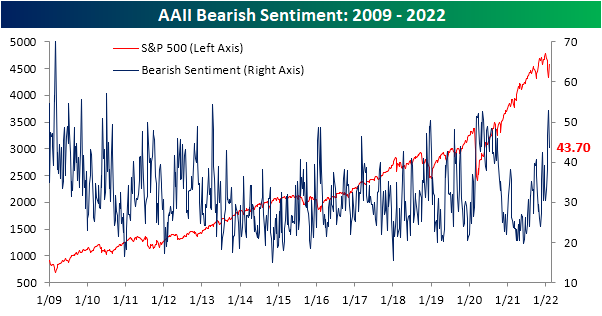
While bulls and bears both moderated in the most recent week’s survey, investor sentiment remains largely bearish. The bull-bear spread rose but remains deeply negative at -17.2. At that level, the bull-bear spread remains in the bottom 8% of all readings in the history of the survey.
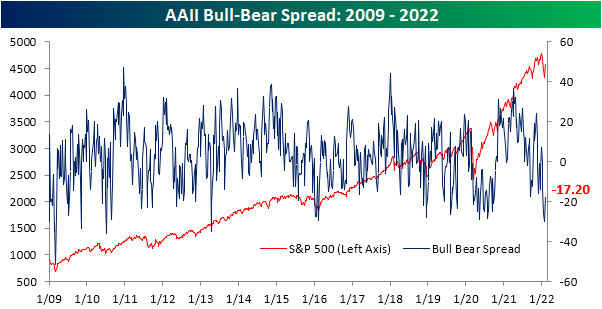
While bulls did borrow from the decline in bearish sentiment, a larger share reported neutral sentiment this week. That reading rose six percentage points to 29.9% which is the biggest increase since the second week of December, but that level is still below the 30%+ readings that were common throughout the final quarter of 2021.

Other sentiment surveys like the Investor Intelligence survey of equity newsletter writers and the NAAIM Exposure Index, also saw a rebound in bullish sentiment this week which led our sentiment composite to regain some of the recent large declines. As with the AAII survey though, sentiment remains at a fairly bearish level in spite of this week’s improvements. Click here to view Bespoke’s premium membership options.

Chart of the Day: Technical Timeframes
Berkshire (BRK/B) Unseats Meta (FB) For S&P 500’s Sixth Largest Stock
Yesterday, the news of the day was Alphabet’s (GOOG) massive gain on earnings that added $132 billion in market cap. The gain pushed Alphabet closer to the $2 trillion market cap club, which currently has two other members: Apple (AAPL) and Microsoft (MSFT).
Today, another mega cap Tech stock is in the spotlight for the opposite reason. After reporting weak quarterly results and forward guidance, Meta Platforms (FB) has shed over $225 billion in market cap. Given that is the stock’s worst single-day drop in its history as a public company, it is also the largest single-day drop in its history in terms of market cap. As a result of the decline, Berkshire Hathaway (BRK/B) has unseated FB for the S&P 500’s sixth-largest stock. At the moment, Berkshire’s market cap of ~$710 billion is more than $20 billion higher than Facebook’s (FB) $687 billion market cap.
Since the end of last year, BRK/B has actually now risen two spots in the rank of S&P 500’s largest stocks, eclipsing both Facebook (FB) and NVIDIA (NVDA). As for some other notables, Exxon Mobil (XOM) and Coca-Cola (KO) have made huge jumps in the rankings this year, rising 10 and 9 spots, respectively, to break back into the top 20 list. Looking at the change in rankings over the past couple of years, NVIDIA (NVDA) has also notably risen through the ranks at a very rapid pace, jumping 31 spots since the end of 2019. While Tesla (TSLA) was not a part of the S&P 500 at the end of 2019, taking where it would have ranked in the index back then, its 79-spot jump is even more impressive. Click here to view Bespoke’s premium membership options.

Claims Looking Healthier
Jobless claims spiked higher in early January, but the second half of the month saw some of that unwind with the most recent reading through the week of January 29th showing a drop to 238K from the previous week’s upward revised reading of 260K. That means claims have improved over the past couple of weeks and are still at a historically healthy level even if they remain off the pre and post-pandemic lows.
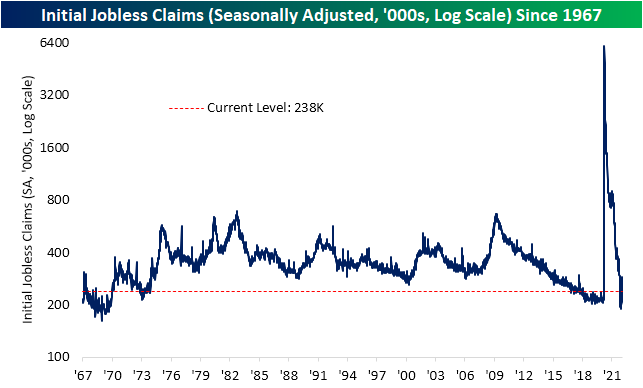
On a nonseasonally adjusted basis, after two weeks of smaller declines than what has historically been the norm, claims fell 11.7K WoW to 257K which was a larger drop than what could have been expected for the given week of the year (average decline of 4.89K since 1967). Heading into the next several weeks, NSA claims will continue to have seasonal tailwinds at their back while declining COVID caseloads will also likely help improve the claims situation.

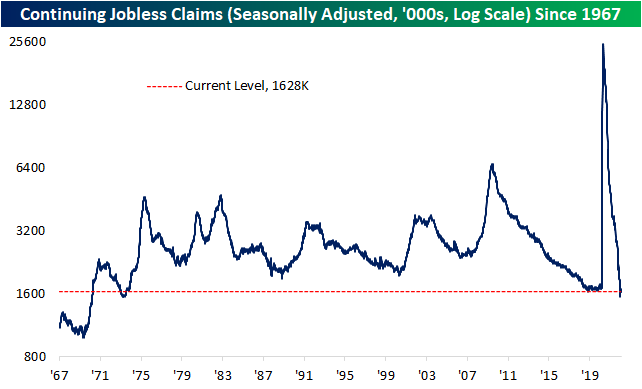
Delayed an extra week, continuing jobless claims continued to sit at the low end of the past several decades’ range. Seasonally adjusted continuing claims fell 44K this week down to 1.628 million. That is now slightly above the absolute low of 1.555 million set in the first week of January. Click here to view Bespoke’s premium membership options.
Bespoke’s Morning Lineup – 2/3/22 – It Was Fun While it Lasted
See what’s driving market performance around the world in today’s Morning Lineup. Bespoke’s Morning Lineup is the best way to start your trading day. Read it now by starting a two-week trial to Bespoke Premium. CLICK HERE to learn more and start your trial.
“There are decades where nothing happens, and there are weeks where decades happen.” – Vlad Lenin
Good Morning Subscriber,
This earnings season, you could even say there are after-hours sessions where decades happen. Between earnings reports from Netflix (NFLX), PayPal (PYPL), and Meta Platforms (FB) last night, some very large market cap stocks have lost a fifth of their value overnight. These kinds of declines in reaction to one quarter’s worth of corporate performance are not exactly normal market events, and in the case of FB, today’s decline could be the largest single-day decline in market cap for a single stock in history! These are some unprecedented moves, and we’re not even halfway through earnings season!
We have a busy day of economic data ahead as well with Non-Farm Productivity, Unit Labor Costs, Jobless Claims, ISM Services, Durable Goods, and Factory Orders. Jobless Claims were already released and came in right around expectations while Non-Farm Productivity topped forecasts and Labor Costs were lower than expected. Following last month’s weaker than expected ISM Services report, the headline index is expected to show further deceleration this morning but still come in at a healthy reading of around 60.0. Durable Goods and Factory Orders, meanwhile, are both expected to show declines of less than 1%.
Read today’s Morning Lineup for a recap of all the major market news and events from around the world, including the latest US and international COVID trends.
Yesterday looked like an encouraging day for the Nasdaq 100 as the index traded and closed back above its 200-DMA, but that’s unlikely to last long as the index is expected to gap down more than 2% at the open this morning putting it back below its 200-DMA.

Going back to 2000, today will likely be the Nasdaq 100 ETF’s (QQQ) 106th downside gap of more than 2%. In the charts below, we show its performance from the open to close on the day of prior downside 2%+ gaps broken out by weekday along with the frequency of positive returns for each day of the week. Overall, the best day for QQQ to gap down 2% has been Wednesday as it has averaged a gain of 1.52% from the open to close with positive returns 54.5% of the time. Average intraday gains on Tuesday haven’t been nearly as strong (0.42%), but QQQ has been more consistent to the upside with gains 60% of the time. Unfortunately, Thursdays haven’t been a very good day for QQQ to gap down 2%+. On those 17 prior occurrences, QQQ’s average performance from the open to close has been a decline of 0.02% with positive returns less than a third of the time.

Start a two-week trial to Bespoke Premium to read today’s full Morning Lineup.