
Sluggish Manufacturing in the New York Region
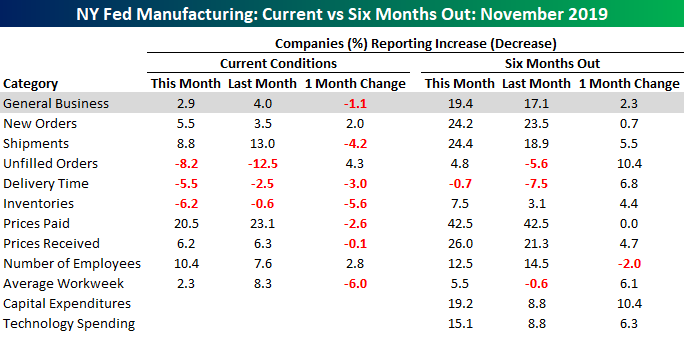
This morning saw one of the first looks at November activity with the NY Fed Empire Manufacturing report. Economists weren’t expecting much of a strong report to begin with as the consensus forecast for the headline General Business Conditions index was for a reading of 6.0 vs last month’s reading of 4.0. The actual reading actually showed a slight decline from last month, though, falling to 2.9. While the current conditions index declined, expectations actually saw a small boost rising from 17.1 up to 19.4.
One interesting thing to note is how little Empire Manufacturing has changed in recent months. With monthly readings of 4.3, 4.8, 2.0, 4.0, and now 2.9, the index has had a five-month range of just 2.8 points. In the history of the survey dating back to 2001, the only five-month window with a narrower range was in late 2011!

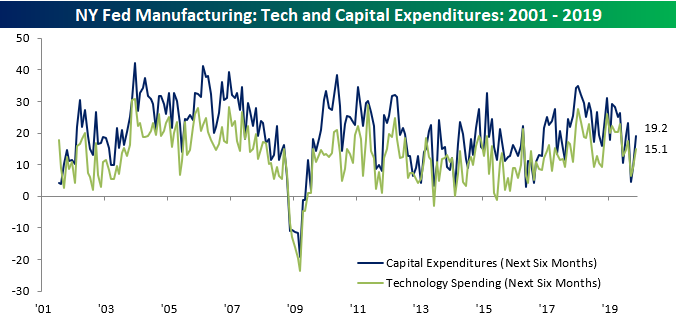
In terms of plans for Capital Expenditures and Technology Spending over the next six months, it was encouraging to see both of these readings rebound after falling sharply in recent months.
Finally, the table below shows the month/month change for each category of the Empire Manufacturing report in terms of both current conditions and expectations. What’s interesting to note about this month’s data is that while there was broad-based weakness in terms of current conditions, expectations rebounded, suggesting that manufacturers are expecting an upturn from current conditions. Sign up for Bespoke’s “2020” special and get our upcoming Bespoke Report 2020 Market Outlook and Investor Toolkit.
Bespoke’s Morning Lineup – 11/15/19 – Retail Sales Friday
See what’s driving market performance around the world in today’s Morning Lineup. Bespoke’s Morning Lineup is the best way to start your trading day. Read it now by starting a two-week free trial to Bespoke Premium. CLICK HERE to learn more and start your free trial.

The Closer – Wal-Mart Reversal, Volatile Fed, Transportation, Iron, Fund Flows – 11/14/19
Log-in here if you’re a member with access to the Closer.
Looking for deeper insight on markets? In tonight’s Closer sent to Bespoke Institutional clients, we begin with a look at what Wal-Mart’s (WMT) intraday reversal means for the stock as well as how consumer staples and other defensives have lagged recently. Next, we look into the relationship between the Fed’s balance sheet and volatility before moving onto today’s economic data including freight volumes, EIA data, and ICI Fund Flows.
See today’s post-market Closer and everything else Bespoke publishes by starting a 14-day free trial to Bespoke Institutional today!
Cisco (CSCO) Deja Vu
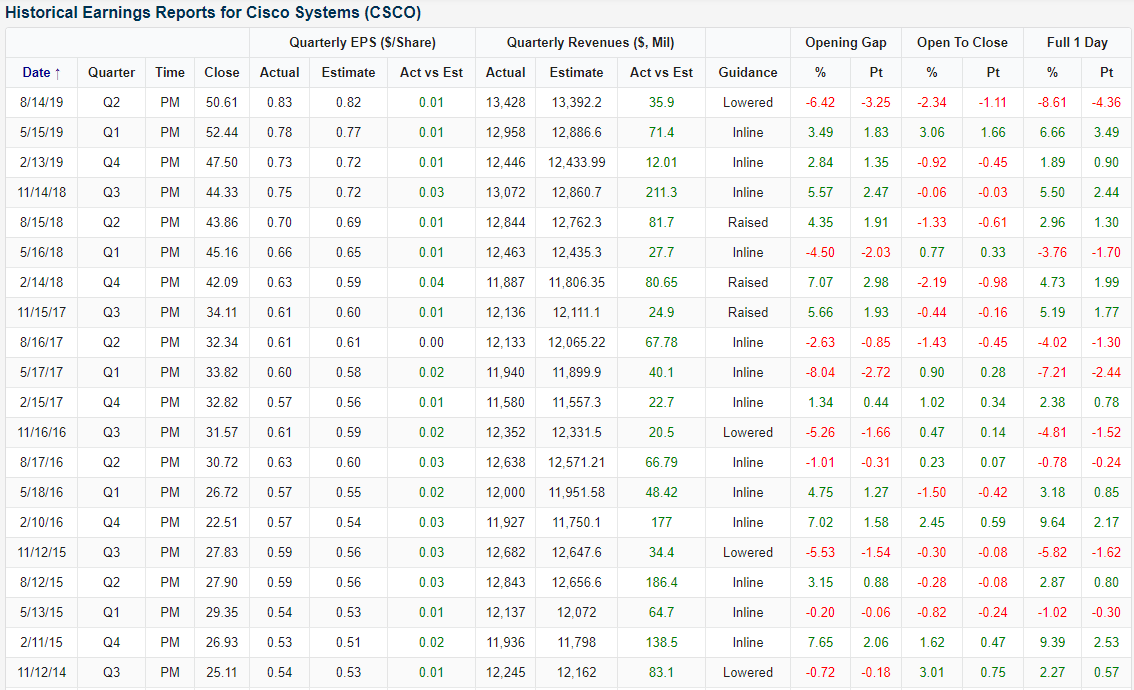
Call it deja vu, but Cisco (CSCO) is seeing a repeat of its August earnings report. Back in the summer, CSCO beat on the top and bottom line but lowered guidance leading the stock to fall 8.61% the following day. Fast-forwarding to today, CSCO reported after yesterday’s close with the same results. The company once again lowered guidance while beating EPS by 3 cents and revenues by $69.4 million. Although the stock’s performance in response has not been quite as bad as last time around, CSCO fell over 7% on Thursday. That is the worst single-day performance for the stock since its last earnings report. Two quarters in a row now, CSCO has fallen substantially on earnings. That is quite the difference from the previous four quarters when the stock rose each time.
Last Monday, we highlighted Cisco (CSCO) in a Dividend Stock Spotlight noting that although it has an attractive dividend, the technical picture was mixed with the stock at a bit of a crossroads at the bottom of a longer-term uptrend thanks to a rough-looking shorter term. The past few months’ declines have come following the aforementioned earnings report in August and a weak quarter from competitor Arista Networks (ANET) further dampening the outlook for CSCO. These catalysts since the summer in conjunction with today’s declines have brought the stock under support between $45-46 and also broken the longer-term uptrend that had been in place over the past few years. Since it’s high on July 15th, CSCO has declines more than 22% and shed $42.8 billion in market cap. To put that into perspective, that decline is within $1 bn of the current market caps of Advanced Micro Devices (AMD), Humana (HUM), Progressive (PGR), and Marriott Hotels (MAR). Start a two-week free trial to Bespoke Institutional to gain full access to our research and interactive tools.

Shrinking Ranges
In the S&P 500’s run to new highs over the last few weeks, overall volatility has really become subdued. For example, the S&P 500 hasn’t had an intraday swing of even 1% in more than a month now. The chart below shows streaks over the last ten years where the S&P 500 didn’t see a 1% spread between its intraday high and low and allows us to compare how the current streak stacks up to prior periods.
While the current 24 trading day streak without a 1% intraday move is far from the longest over the last ten years, there haven’t been a lot of streaks that were longer. Ironically enough, the three streaks that were the longest of the last ten years all occurred in the two years after the 2016 election. For all the turmoil that seems to surround this Administration, market turmoil hasn’t been one of them. Sign up for Bespoke’s “2020” special and get our upcoming Bespoke Report 2020 Market Outlook and Investor Toolkit.

Sentiment Stays the Same
Despite a couple closes at all-time highs in the past week, the S&P 500 is currently right around the same levels as last Wednesday’s close. With little in the way of price changes, sentiment has likewise seen little change. Per AAII’s weekly survey, bullish sentiment rose just 0.42 percentage points to 40.72% from 40.30% last week. That small increase is in the bottom 5% of all week-over-week changes in bullish sentiment in the history of the data.
While little changed, the bulk of investors are still optimistic. Another sentiment survey from Investors Intelligence also echoed these results. In that survey released yesterday, 57.6% reported as bullish. While that is the highest reading since July, it is up only around half of one percent from last week.

Bearish sentiment was also little changed. The percentage of investors reporting as pessimistic rose 0.89 percentage points to 24.82%. Like bullish sentiment, the one week change in bearish sentiment was small relative to history with this week’s change sitting in the 7th percentile of all readings. This week also marked the fourth in a row that bearish sentiment has been below its historical average. That is the longest such streak since a seven-week run from the end of March to early May of this year.

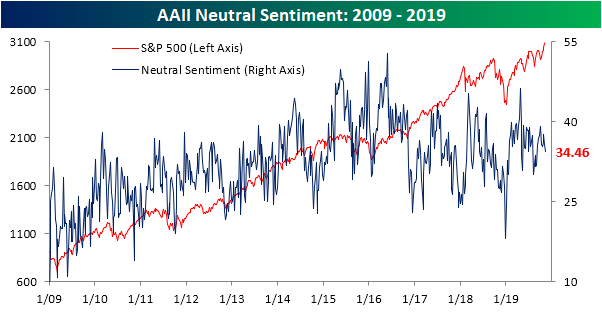
Neutral sentiment moved the most this week falling 1.31 percentage points. Now at 34.46%, neutral sentiment is the lowest since early September and back in the middle of the past few years’ range. Start a two-week free trial to Bespoke Institutional to access our interactive economic indicators monitor and much more.
Jobless Claims on the Rise
As we have mentioned over the past couple of weeks (see here and here), initial jobless claims have not done much over the past year as the indicator has been rangebound with an increasingly tighter range. That dynamic shifted a bit this week as claims came in worse than expected, rising to 225K from 211K last week versus forecasts of 215K.
While the record streaks at or below 300K and 250K are still in place by a healthy margin (those streaks now reaching 245 and 110 consecutive weeks long, respectively), this week marked a considerable break out from the upper end of the past several months’ range. This week was also the sixth highest reading for claims of 2019 and the highest since June 21st when claims were 4K higher. The 14K increase from last week was also the joint thirteenth largest one week increase of the past five years and the largest since April when claims rose by 37K right around the Easter holiday (the second-largest such increase of the past five years).

Given the new high in the seasonally adjusted data, the four-week moving average ticked higher to 217K from the previous reading of 215.25K. At 217K, the moving average is now the highest since July 12th when it was 218.75K. Despite this move higher, unlike the seasonally adjusted number, this increase did not break the moving average out of its recent range.

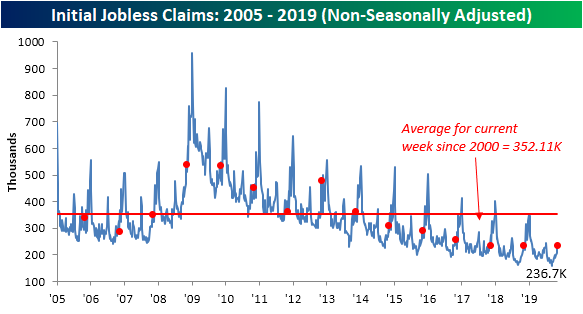
On a non-seasonally adjusted basis, claims rose by 31.1K to 236.7K. That is a slightly smaller change than the average change (+36K) for the current week of the year (45th) over the past ten years. Given these seasonal factors, it was also the largest one week increase to the non-seasonally adjusted data of 2019 and marked a 0.7K increase from the same week last year.
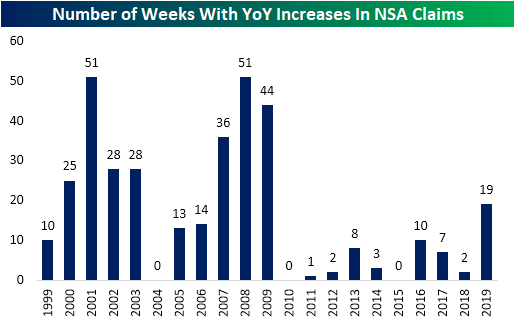
As we have mentioned in the past, 2019 has seen a big increase in the number of weeks with a year-over-year increase in the non-seasonally adjusted data. So far this year there have been a total of 19 weeks were claims have risen YoY. Given there are only 7 weeks left in 2019, it won’t be possible to reach similar levels to the financial crisis, but 2019 has seen the highest frequency these weeks for all years of the current cycle. One interesting point to note though is that weeks with these types of changes in claims have also been subdued in the years following the last recession. As shown in the chart below, of the past 20 years, the years prior to 2009 would typically see a high number of weeks with an increase versus the prior year, but that has simply not been the case from 2010 on. That is, until this year. Start a two-week free trial to Bespoke Institutional to access our interactive economic indicators monitor and much more.
Bespoke’s Morning Lineup – 11/14/19 – Walmart Ends on a Positive Note
See what’s driving market performance around the world in today’s Morning Lineup. Bespoke’s Morning Lineup is the best way to start your trading day. Read it now by starting a two-week free trial to Bespoke Premium. CLICK HERE to learn more and start your free trial.
The Closer – Above Average, Consumer Credit, CPI Slowing, Taxable Insight – 11/13/19
Log-in here if you’re a member with access to the Closer.
Looking for deeper insight on markets? In tonight’s Closer sent to Bespoke Institutional clients, we begin with a recap of the happenings on Capitol Hill as impeachment proceedings began alongside Fed Chair Powell’s visit. Next, we take a look at the S&P 500’s historic streak above its 50-DMA without any back to back declines over the past 25 days. Then we move onto a massive slug of macroeconomic data including the New York Fed’s quarterly household debt numbers, today’s CPI release, and the monthly budget statement.
See today’s post-market Closer and everything else Bespoke publishes by starting a 14-day free trial to Bespoke Institutional today!
Dividend Stock Spotlight: Texas Instruments (TXN)
About three weeks ago, Texas Instruments (TXN) reported a weak quarter with EPS and sales both below estimates alongside lowered guidance, a reverse triple play. In response, the stock dropped sharply the following day (October 23rd) with a decline of 7.48%. That was the largest decline on earnings since October of last year when the stock fell 8.22% and was the seventh-largest decline on earnings for all quarters since 2001.

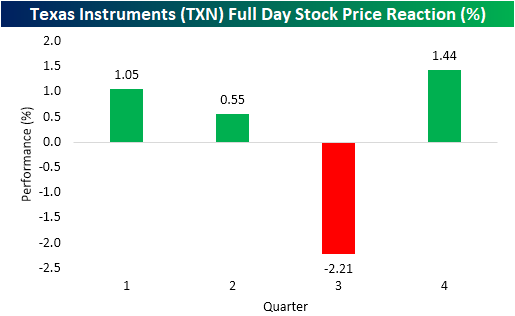
While that decline may sound worrying, it is important to take seasonality into account. The third quarter earnings report has by far been the weakest in terms of the stock price reaction for Texas Instruments. In response to all third-quarter earnings report since 2001, TXN has only risen 31.6% of the time; averaging a full day decline of 2.21% the day after the report. That is the only quarter that has averaged a decline.
Regardless of seasonality, that massive decline on earnings did some technical damage to TXN, but not all was lost. The gap down sent TXN collapsing through its 50-DMA from which it has yet to retake. Fortunately, TXN found support right around the late April highs at ~$116, and the stock has not moved below the price from that gap down on earnings ($115.91). In other words, things have not gotten worse since that initial decline on October 23rd. In fact, TXN has been grinding higher along a longer-term uptrend line.
Adding to the attractiveness of Texas Instruments is a solid dividend currently yielding over 3%. That is the fourth-highest yield of all S&P 1500 semiconductor stocks. Not only is this a higher yield than other stocks in the industry, but the dividend also has an extensive history. The company has paid shareholders uninterrupted for every quarter since it was first declared in 1962. Texas Instruments has also grown the payout for each of the past 15 years. While some other high yielders in the space like Intel (INTC) or Broadcom (AVGO) may have a lower valuation on a price-to-earnings basis, the dividends do not appear to be as safe as the payout ratios top 90%. TXN on the other hand only has a payout ratio of 50.8%. This means the safety of TXN’s dividend appears much more intact than its competitors.
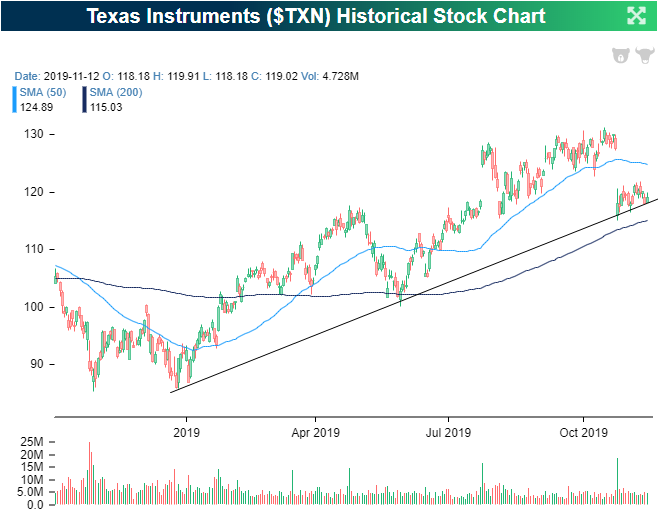
TXN has been a bit of a black sheep amongst the semis. Other quarterly reports this earnings season were strong, including triple plays from major players: Intel (INTC), Qorvo (QRVO), and Taiwan Semiconductor (TSM). Price action amongst other semis has similarly been stronger than TXN as well. As shown in the charts of other large-cap semiconductor stocks taken from our Chart Scanner, across the industry there have been several breakouts. In other words, even though TXN has lagged the rest of the sector recently, it is not as though the picture of the entire space is in bad shape. Start a two-week free trial to Bespoke Institutional to access our full library of reports and interactive tools.
