Oct 5, 2018
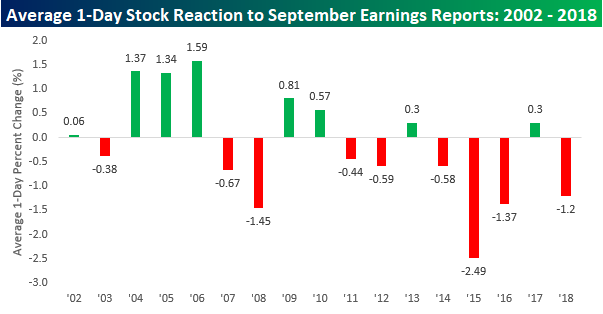
Most people are probably familiar with the Green Day song, “Wake Me When September Ends,” but in this case a more appropriate term may be “Wake Me When Earnings Season Ends.” While this past September was positive for the S&P 500, companies reporting earnings faced pretty brutal initial reactions. Of the 109 companies reporting earnings in September, the average one-day reaction to their earnings reports was a decline of 1.2%, and in the second half of the month, things were even worse. Of the 43 companies that reported in the second half of September, the average one-day reaction to earnings was a decline of 3.5% with only eight having positive initial reactions. While October has only just begun, things don’t look to be coming in much better as stocks like Stitch Fix (SFIX), Acuity Brands (AYI), and Cal-Maine (CALM) have all declined more than 5% in reaction to earnings, while only two stocks traded up (LW and PAYX).
Using our Earnings Report Screener, which is available to all Institutional clients, we ran a screen of how stocks reporting earnings in September have historically reacted to earnings going back to 2002. This is just one of the many useful screens clients can run using this invaluable tool.
As shown in the chart, the average one-day decline of 1.2% for companies reporting earnings in September wasn’t the worst of any year in our database, but it was the fourth weakest. The only other Septembers where stocks saw weaker one-day reactions to earnings were in 2015 (-2.49%), 2008 (-1.45%), and 2016 (-1.37%). The key question now is whether the weakness we have seen in reaction to earnings so far is a preview of what’s to come during the actual earnings season that runs from 10/10 through mid-November.
In a just-published B.I.G. Tips report, we did an extensive analysis of this topic which highlighted actionable trends. To see it, sign up for a monthly Bespoke Premium membership now!
Oct 4, 2018
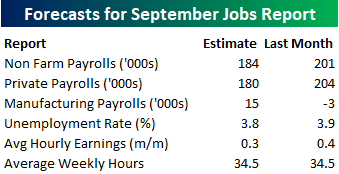
Heading into Friday’s Non Farm Payrolls (NFP) report for September, economists are expecting an increase in payrolls of 184K, which would be a modest decline from August’s stronger than expected reading of 201K. In the private sector, economists are expecting an increase of 180K. The unemployment rate is expected to tick down to 3.8% from last month’s reading of 3.9%. Average hourly earnings are expected to grow at a rate of 0.3% versus the 0.4% reading last month. Given the recent concerns over stronger than expected data, an average hourly earnings number as strong as last month would likely be problematic for the market. Finally, average weekly hours are expected to be unchanged at 34.5.
Ahead of the report, we just published our eleven-page preview of the September jobs report. This report contains a ton of analysis related to how the equity market has historically reacted to the monthly jobs report, as well as how secondary employment-related indicators we track looked in September. We also include a breakdown of how the initial reading for September typically comes in relative to expectations and how that ranks versus other months.
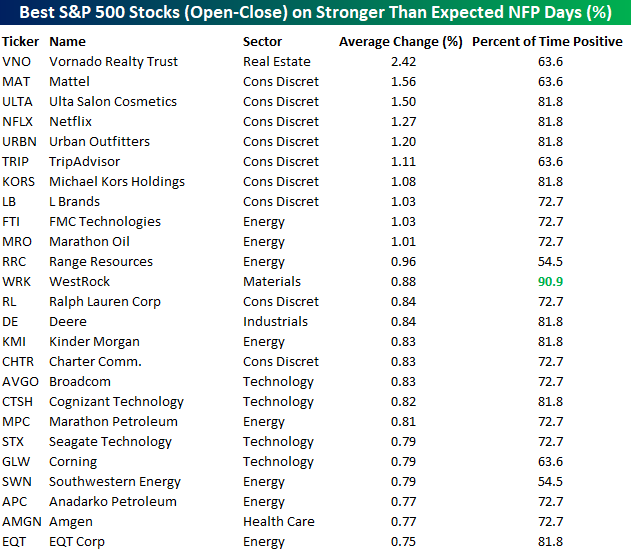
One topic we cover in each month’s report is the S&P 500 stocks that do best and worst from the open to close on the day of the employment report based on whether or not the report comes in stronger or weaker than expected. In other words, which stocks should you buy, and which should you avoid? The table below highlights the best-performing stocks in the S&P 500 from the open to close on days when the Non-Farm Payrolls report has been better than expected over the last two years.
Of the top performing stocks on days when NFP beats expectations, seven sectors are represented, but Consumer Discretionary leads the way with nine. Vornado (VNO) has been the best performing stock with an average open to close gain of 2.42%, but it is followed by seven stocks in the Consumer Discretionary sector which have all gained 1%+ from the open to close. Westrock (WRK) has been the most consistent stock to the upside with open-close gains 91% of the time.
For anyone with more than a passing interest in how equities are impacted by economic data, this September employment report preview is a must-read. To see the report, sign up for a monthly Bespoke Premium membership now!