Nov 8, 2022
Log-in here if you’re a member with access to the Closer.
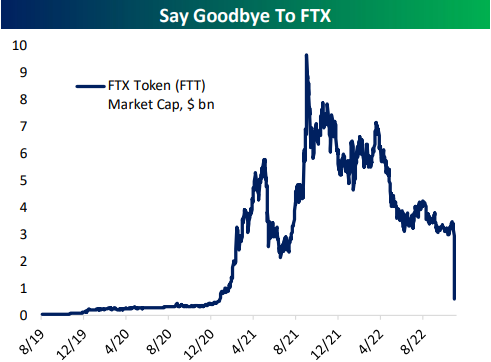
Looking for deeper insight into markets? In tonight’s Closer sent to Bespoke Institutional clients, we begin tonight with a look at the next slug of earnings including those of Disney (DIS), Lucid (LCID), and LoanDepot (LDI) (page 1). We then take a look at the massive decline in FTX’s token as well as check in on total crypto market value (page 2). We follow up with some observations across other assets like Treasury yields, heating oil, and European credit (page 3). Afterward we show S&P 500 performance surrounding midterms (page 4) before closing out with a look at the historically strong 3 year note auction held this afternoon (page 5).
See today’s full post-market Closer and everything else Bespoke publishes by starting a 14-day trial to Bespoke Institutional today!
Nov 8, 2022
As we noted in an earlier post, the pandemic trends of tight labor markets and high inflation continue to show up in the latest NFIB survey of small business optimism, albeit readings have begun to roll over. The survey also questions firms on what they perceive to be their most pressing problems. Perhaps even more than the other indices in the report, the results of these questions have shown how front and center labor and inflation concerns continue to be.
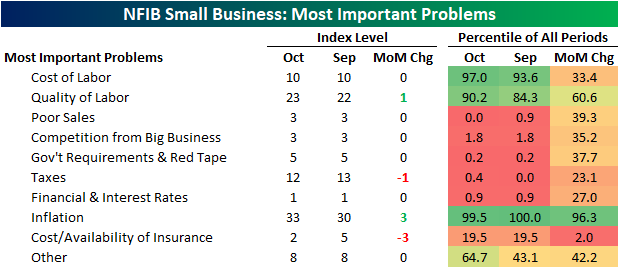
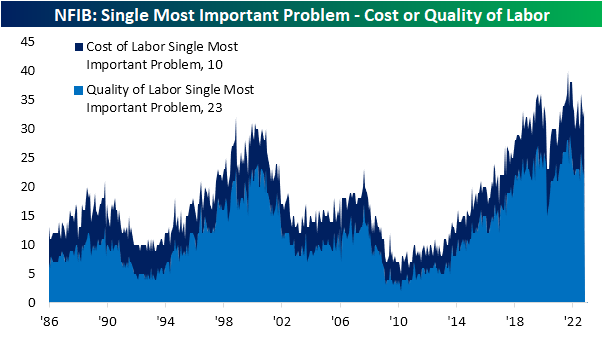
As shown below, most problems have seen record or near-record lows. Meanwhile, two-thirds of responses report either cost or quality of labor or inflation as their biggest problem.
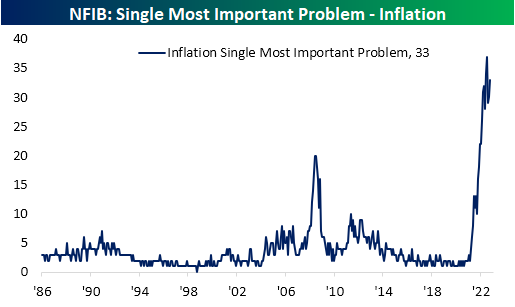
At 33%, inflation as the single most important problem has well surpassed the previous record high set during what was a much less dramatic inflationary spell in 2008. Although this reading rose 3 percentage points versus September, it is in the middle of the past few months’ range. In other words, inflation is slightly less of a concern than it was a few months ago (which is confirmed by the decline in the higher prices index), but that is certainly not to say it is no longer the single most pressing problem.
Another third of responses reported either cost or quality of labor as their biggest issues. Quality is the bigger concern of the two—which is normal from a historical perspective—accounting for a 23% share.
As we frequently note, the NFIB survey has a tendency to be impacted by politics with a bias towards Republican administrations. For example, during the Bush and Trump years, there was a far lower share of respondents reporting government requirements and taxes as their biggest concerns. With the prominence of inflation, Biden’s tenure has resulted in a different scenario in which these issues have been placed on the back burner. Granted, these issues still account for the most pressing problem of a combined 17% of responses. We would also note, these readings have seen some dramatic moves around midterm election months, but those have not always been lasting.

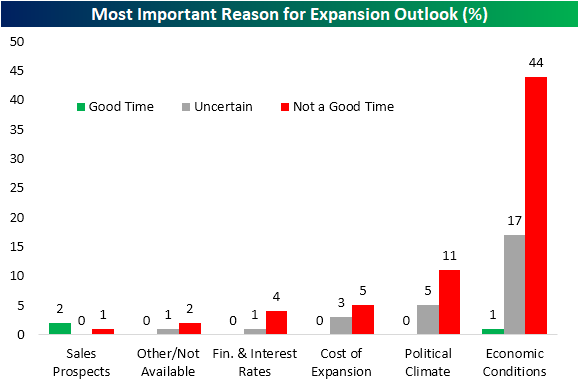
Finally, we would note that very few businesses (only 3%) are worried about poor sales. That is a record-low share and unchanged for the third month in a row. As we noted in our discussion of the other areas of the report, that lack of concern for the top line contrasts with businesses’ hopes for expansion and the outlook for the economy. In fact, of the reasons given for firms reporting now as not a good time to expand, sales prospects were the least pressing reason given. Click here to learn more about Bespoke’s premium stock market research service.

Nov 8, 2022
The NFIB released its October data on small business optimism this morning. The headline index was expected to show further deterioration in optimism, and exactly that occurred as the index fell to 91.3 from last month’s reading of 92.1 versus expectations of 91.4. This month’s reading is off of the spring lows which had surpassed the worst levels from the early stages of the pandemic but remains one of the weakest readings of the past several years.

In the table below, we provide a breakdown of each category of the report. The headline index is now just off the bottom decile of readings as most components are likewise historically depressed. While the report was weak, there were some exceptions with strong showings in labor market metrics like Plans to Increase Employment, Job Openings Hard to Fill, and Compensation.

Even though these labor market metrics have remained at very high levels from a historical perspective, they have largely been rolling over for the better portion of the past year. Hiring plans as well as the percentage of firms reporting cost or quality of labor as their biggest issues are back to similar levels as the year prior to the pandemic. Meanwhile, actual employment changes are negative (as they have been throughout the pandemic) implying businesses are reporting a net decline in workers. That is in spite of still elevated compensation and a sharp spike higher in compensation plans. In fact, that index is just shy of the peak from the final months of 2021 after a record 9-point month-over-month jump. Companies are also reporting job openings remain hard to fill, although that index has also been on the decline alongside hiring plans. This month, the reading was unchanged at 46, the lowest level since June 2021.

Sales components have experienced far greater degrees of deterioration than employment metrics. The outlook for general business conditions has rallied back somewhat in the past few months, but it remains well below its historical range. Given the weakness in small businesses’ economic outlook, few report now as an opportune time to expand their businesses. Actual sales changes dropped to -8 in October which matched August for the weakest showing for sales since August 2020. Back in 2020 though, this index was far lower than it is now.
While the reading on the top line has held up relatively well, high inflation has meant the bottom line has taken a big hit. A net 30% of small businesses reported earnings have fallen. That reading did improve last month, though, as there have been fewer businesses reporting higher prices. In spite of those improvements, each of those indices has a long way to go until returning to what have historically been more normal levels.

As mentioned above, a historically low share of businesses are reporting positive sentiment on the economy and that has dampened their hopes of expansion. When questioned on the reason for not expanding, 44% reported economic conditions as the reason. Another 17% reported economic conditions as the reason for uncertainty on whether or not they would expand. Aptly coming out on Election Day, we have highlighted in the past the political nature of the NFIB survey. As such, it should come as little surprise that the next biggest reason for small business hesitancy in expanding has been the political climate. Assuming the survey results react to the current election in a similar way as in the past, a strong election showing for Republicans could provide a boost to small business sentiment and plans for expansion. Finally, given continued high inflation and rates rising to combat it, the next two most widely mentioned reasons to not expand were the cost of expansion and financial conditions and interest rates with a combined 9% of responses Click here to learn more about Bespoke’s premium stock market research service.