
B.I.G. Tips – Down But Not Out Yet
Chart of the Day – Streaks Without a 1% Intraday Range
Bespoke Stock Scores — 12/3/19
November 2019 Headlines
Bespoke’s Morning Lineup – 12/3/19 – Turnaround (of a Turnaround) Tuesday
US equities are poised to open down over a half percent this morning, and equity index futures are at session lows thanks to fresh trade tape-bombs from the President. His comments, which suggested that he doesn’t think a trade deal is necessary before the election, quickly turned what was a positive picture for equity futures negative (see chart below).
There’s little in the way of economic data on the calendar today, so it looks like another day of China-trade related back and forth. Keep in mind too, that even after yesterday’s pullback, the S&P 500 is over 2.5% above its 50-day moving average and nearly 6% above its 200-day moving average. In other words, we have been overdue for a pause at the very least.
See what’s driving market performance around the world in today’s Morning Lineup. Bespoke’s Morning Lineup is the best way to start your trading day. Read it now by starting a two-week free trial to Bespoke Premium. CLICK HERE to learn more and start your free trial.


The Closer – No News Is Good News – 12/02/19
Log-in here if you’re a member with access to the Closer.
Looking for deeper insight on markets? In tonight’s Closer sent to Bespoke Institutional clients, given the impact trade headlines have had on the market in the past year, we begin with a look at how little tariffs have been mentioned in the news recently. We also show the rare simultaneous movements of stocks, rates, and the dollar. Next we make note of where global manufacturing activity stands and what it means for the economy and forward equity returns. We finish with a review of today’s construction spending data.
See today’s post-market Closer and everything else Bespoke publishes by starting a 14-day free trial to Bespoke Institutional today!
After Hours vs. Regular Trading Hours
The S&P 500 tracking ETF (SPY) is up roughly 25% year-to-date. But below we have broken out SPY’s 2019 move by after hours versus regular trading hours. The “after hours” strategy represents SPY’s move outside of regular trading hours — its change from the prior day’s close to the current day’s open. Given that most major events that impact the stock market occur outside of regular trading hours from 9:30 AM ET to 4 PM ET (like earnings reports, economic indicator releases, and anything that occurs in Asia or Europe before the US opens for trading), SPY nearly always opens at a different price that it closed at the prior trading day. When you see S&P 500 futures trading up significantly in pre-market trading, SPY’s opening price at 9:30 AM ET is going to be a lot higher than the price it closed at the prior day. When equity futures are down in pre-market trading ahead of the opening bell, it means SPY will open lower that day.
Conversely, the “regular trading hours” strategy represents SPY’s move from its opening price at 9:30 AM ET to its closing price at 4 PM ET. This strategy shows how well the stock market is performing on an intraday basis. When you combine the “after hours” move with the “regular trading hours” move, you get SPY’s full-day change from its prior close to that day’s close.
Below we show how well an investor would have done this year by just owning SPY after hours versus just owning SPY during regular trading hours. As shown, had you bought SPY at the close every day and sold it at the next day’s open, you would have a gain of 11.1%. On the other hand, if you did the opposite and bought at the open every day and sold at the close, you’d be up 12.3%.
Interestingly, the “regular trading hours” strategy started the year extremely strong, making up essentially all of the market’s gains over the first three months of the year. During that time period, the “after hours” strategy was essentially flat, which means SPY was opening flat and then seeing a lot of intraday buying.
During Q2 and Q3, there was a lot of back and forth with the “after hours” strategy. During periods when the trade war was really hot, we saw a lot of lower opens, but that stopped once the trade rhetoric cooled down. As shown, since the beginning of August, we’ve seen the “after hours” strategy go from up 0% YTD to up 11% YTD. Over the same time period, we’ve seen the “regular trading hours” strategy trade lower, although it’s up a little over the last two months. This has caused the two strategies to converge to near even on a year-to-date basis as we approach year-end.

if we run the strategy back to the start of 2018, the “after hours” strategy is still crushing the “regular trading hours” strategy. As shown below, had you bought at the close every trading day and sold at the next open, you’d be up 25.6% since the start of 2018. Had you instead just bought every open and sold at the close, you’d actually be down 7%. This means that more than 100% of the S&P’s gain over this time period has come outside of regular trading hours. Start a two-week free trial to Bespoke Institutional to access our research reports, interactive tools, and more.

Warren’s Loss is Health Care’s Win
From late summer through mid-November, betting markets (electionbettingodds.com) gave Senator Elizabeth Warren a considerable lead in the Democratic primary race. In fact, from late September through mid-October, betting markets gave her around a 50/50 shot at winning the primary. While there have been other spikes of interest in certain candidates like for Harris in July and Bloomberg more recently, no other candidate has been given the same type of high win probability at any point in the past several months. With that said, no other candidate has seen the type of fall from grace that Warren has either. As Warren’s policies and tactics like a wealth tax, attacks on billionaires, and health care reform have come under increased scrutiny, betting markets have retreated in their pricing in of a win for the senator. Warren’s probability to win the Democratic nomination is now down to just 16.5%. That is a 36.4 percentage point drop from the high. The only comparable decline is the 32.2 percentage point fall from the high for Senator Kamala Harris. This decline has led markets to give both Mayor Pete Buttigieg and former Vice President Biden higher chances of winning than Warren.

Taking a look at more primary data, this time from the Morning Consult’s weekly survey of Democratic Primary voters, Warren’s falling out of favor has been less dramatic but is in place nonetheless. After her favoritism among Democratic primary voters was on the rise consistently all year, it peaked out at 21% and has been rapidly declining over the past few weeks while Sanders and other candidates who have held a smaller share of votes, namely Buttigieg, have been on the rise.
Warren’s costly Medicare For All plan would essentially put private sector health insurers out of business. Her rise in the polls in 2019 did major damage to the insurers, and that held back the broad Health Care sector ETF (XLV) as well. That’s why Warren’s fall in the polls recently has gone hand-in-hand with a sharp rally for the Health Care sector, as shown in the second chart below. Start a two-week free trial to Bespoke Institutional to access our research reports, interactive tools, and more.

Manufacturing ISM-iserable
Manufacturing activity contracted more than expected last month as the ISM Manufacturing report for November came in weaker than expected. While economists were expecting the headline index to come in at a level of 49.2, the actual reading was 48.1, which was a slight decline from October’s reading of 48.3. While November’s reading didn’t mark a new short-term low for the ISM Manufacturing index, it’s not far from September’s low of 47.8.
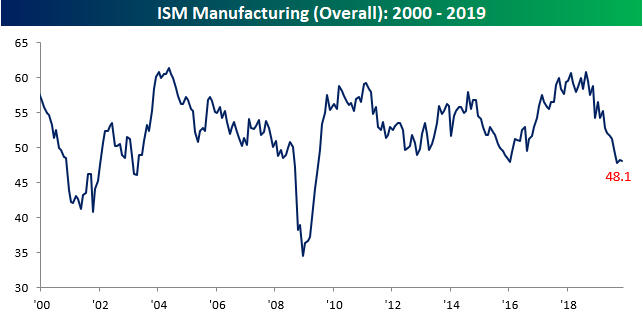
Breadth in this month’s report was also weak. Of the report’s ten subcomponents, six declined on a m/m basis while four increased, but all but one are still in contraction territory for the fourth straight month, which is a trend we haven’t seen since late 2008/early 2009. The biggest increases this month were in Imports and Production, while Inventories showed the largest declines. Looking at the changes in each component relative to last year at this time, though, shows how quickly conditions have changed as all but one (Customer Inventories) are down on a y/y basis.

Two charts we wanted to highlight individually are Employment and Prices Paid. In the case of Employment, that component dropped to 46.6, which is still modestly above the recent low of 46.3 in September. Even still, this doesn’t bode particularly well for Friday’s employment report. More important to watch, though, will be the ISM Services report on Wednesday.

Similar to Employment, Prices Paid also turned back lower this month and is right near its recent lows. This indicator serves as a reminder that inflation readings are still showing no signs of accelerating to the upside. That coupled with the fact that the Fed has suggested on multiple occasions that it is willing to remain on hold until well after inflation rates reach or exceed their target levels indicates that any rate hikes by the FOMC are a way off. Sign up for Bespoke’s “2020” special and get our upcoming Bespoke Report 2020 Market Outlook and Investor Toolkit.
