
Daily Sector Snapshot — 6/3/20
Big Gains From Smaller Tech
It’s still difficult to fathom the moves in the US equity market over the last four months. The fact that the Nasdaq and more specifically the Technology sector aren’t far from record highs is definitely something no one was expecting two months ago. There’s an old market saying that equities take the stairs up and the elevator down, but in the latest market cycle, the elevator up was almost as fast as the way down!

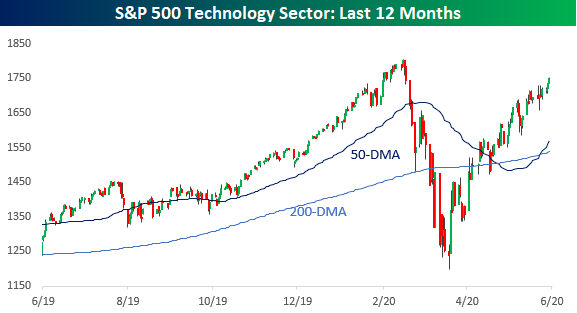
If you’ve been following the markets, all you’ve likely heard up until recently is that large-cap tech, and more specifically, Microsoft (MSFT), Apple (AAPL), Amazon (AMZN), Alphabet (GOOGL), and Facebook (FB), are single-handedly driving the market higher. The reality is not nearly as clear-cut. Given their market caps, the “Big 5” (as they’re often referred to) have done a lot of heavy lifting, but in terms of performance, they’re hardly the only game in town.
The table below lists Technology sector stocks in the Russell 3000 with market caps of more than $1 billion that are outperforming all of the ‘big 5’ tech stocks on a YTD basis. Actually, since Amazon is doing so well relative to the rest of the “big 5” these are all stocks that are outperforming Amazon. If we looked for stocks that were doing better than the average return of the “big 5” the list would be a lot, lot longer (+16.4%).
Looking through the list of names below, the two top-performing names are Zscaler (ZS) and Twilio (TWLO), which have both more than doubled. Behind these two, DocuSign (DOCU) and Sprout Social (SPT) are both knocking on the door of triple-digits. All 28 of the names listed have market caps of $1 billion, but the average market cap is just over $21 billion, while Nvidia (NVDA) is the largest company on the list with a market cap of $216 billion. For the most part, these aren’t names that have been driving the indices, but anyone holding these stocks in their portfolio probably doesn’t care! Start a two-week free trial to Bespoke Institutional to access all of our research and interactive tools.
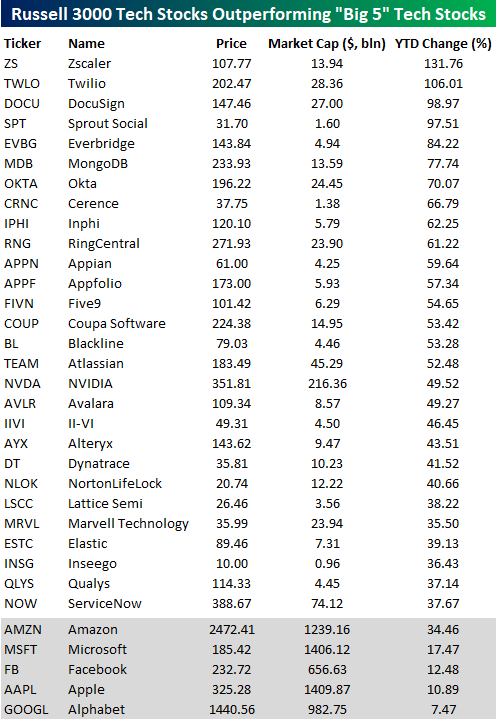
Chart of the Day: Best 50-Day Rally in 75+ Years
Service Sector Still Sliding
Despite beating expectations of 44.4, the ISM Services report for May showed another month of contractionary activity. Although still at contractionary levels, May was not as weak as April as the headline index rose 3.6 points to 45.4. Along with January of 2018, that 3.6 point MoM increase was the largest one month increase in the index since September of 2017. So like the manufacturing report on Monday, this month’s report for the non-manufacturing sector showed activity is still declining.
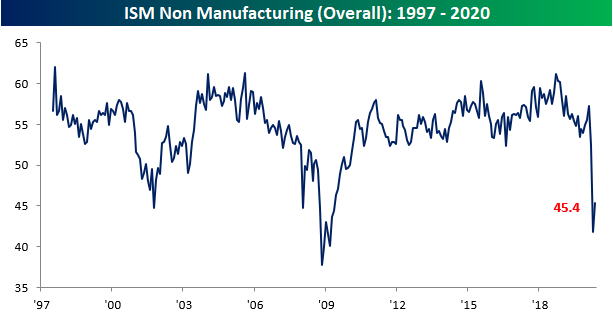
In combination with Monday’s manufacturing release, the composite index for manufacturing and services has shown back to back months with contractionary activity for the first time since August of 2009. Though activity for manufacturing and services both continue to contract, there was a significant pickup in May with the largest month over month increase (3.7 points) since September of 2017.

Like the headline number, most of the sub-indices also remain in contraction territory and around some of the weakest levels on record despite massive improvements from the prior month. Six of the ten sub-indices are still in the bottom 5% of all readings (since 1997) even after some of the largest one month increases on record.

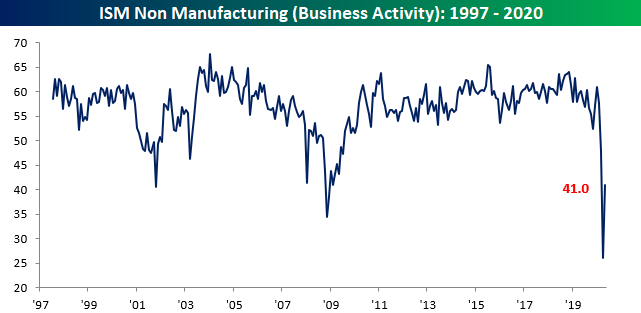
The indices for Business Activity and New Orders are two categories that declined to record lows in April, but in May both experienced massive rebounds. For Business Activity, it’s 15-point m/m increase was the largest on record, and yet it still remains at a contractionary level of 41. For New Orders, the 9 point increase to 41.9 was the second largest one month gain on record behind April of 2009 (+9.6). Here again, though it remains in the bottom 2.5% of all readings.

As we noted in Monday’s manufacturing report, the pandemic has seemed to massively disrupt supply chains. Even after experiencing the second largest drop ever (11.3 points to 67), Supplier Deliveries remain at their third highest level for any month in the history of the data. That indicates further slowing lead times. The respondent commentary offered some interesting insight’s into why supplier deliveries have slowed. One commented that “Production shutdowns have greatly increased lead times” while another noted that “if the product is coming out of China, the delays are even longer.”
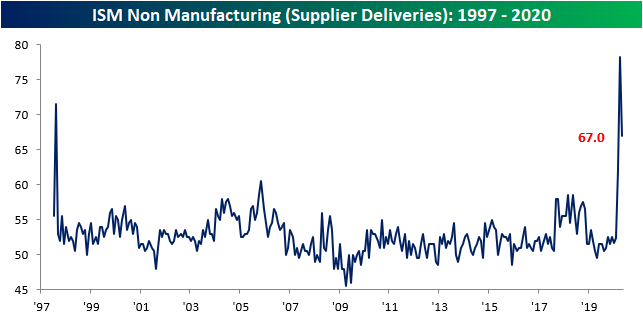
In addition to the supply shock being observed, another area worth mentioning in this month’s report was that of commodities in short supply. With measures to thwart the spread of the virus still in place and supply chains still disrupted, cleaning supplies and protective equipment still dominate the commodities that are reported to be in short supply. As such, they also continue to rise in price.

One of the areas that perhaps remains the weakest in ISM’s survey has been that of Employment. There was not a single industry that reported an increase in employment in May, and the index for that sector only rose 1.8 points to 31.8. Even with that uptick, it is below the lows from 2009. Start a two-week free trial to Bespoke Institutional to access our interactive economic indicators monitor and much more.

Bespoke Consumer Pulse Report – June 2020
Bespoke’s Consumer Pulse Report is an analysis of a huge consumer survey that we run each month. Our goal with this survey is to track trends across the economic and financial landscape in the US. Using the results from our proprietary monthly survey, we dissect and analyze all of the data and publish the Consumer Pulse Report, which we sell access to on a subscription basis. Sign up for a 30-day free trial to our Bespoke Consumer Pulse subscription service. With a trial, you’ll get coverage of consumer electronics, social media, streaming media, retail, autos, and much more. The report also has numerous proprietary US economic data points that are extremely timely and useful for investors.
We’ve just released our most recent monthly report to Pulse subscribers, and it’s definitely worth the read if you’re curious about the health of the consumer in the current market environment. Start a 30-day free trial for a full breakdown of all of our proprietary Pulse economic indicators.
B.I.G. Tips – Economic Indicator Diffusion Index
B.I.G. Tips – Pandemics, Protests, and Gun Powder
Trends for US Indices, Sectors, and Country ETFs
Our Trend Analyzer tool lets Bespoke members quickly and easily check on the status of US stocks and ETFs. Below are snapshots of our Trend Analyzer tool as of yesterday’s close for various ETFs across US indices and sectors as well as key country stock market ETFs.
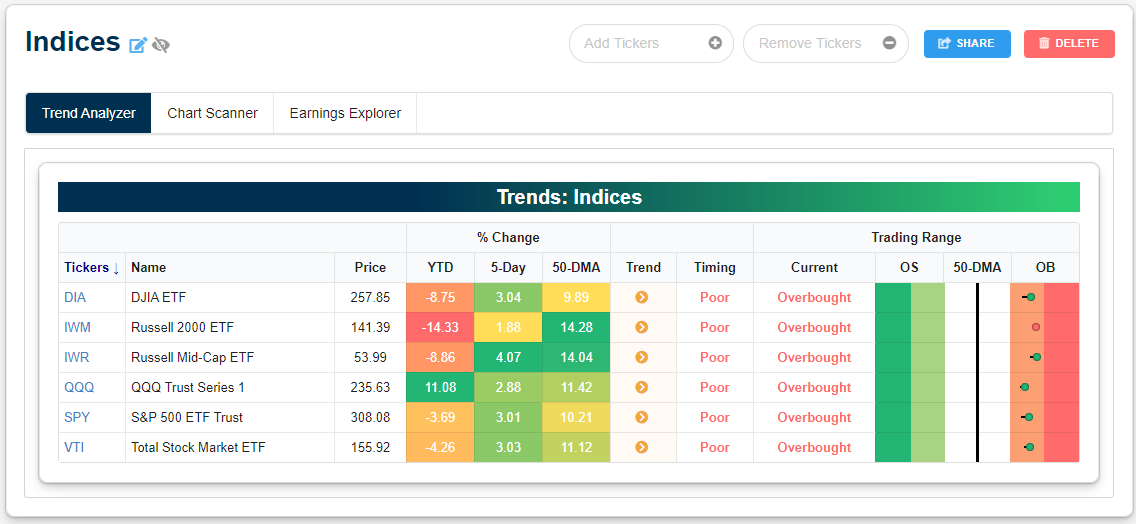
Below is a look at the major US index ETFs from large caps to small caps. All of them are currently in overbought territory in long-term sideways trends. For these ETFs to turn back into uptrends, we’ll need to see a breakout to new highs in the near term. New highs are quite a bit away for indices like the Russell 2,000 (IWM) that are still down significantly year-to-date. But the Nasdaq 100 (QQQ) is a lot closer to a new high given that it’s up 11% on the year! Heading into today, QQQ is only 0.8% away from its high made back in February.
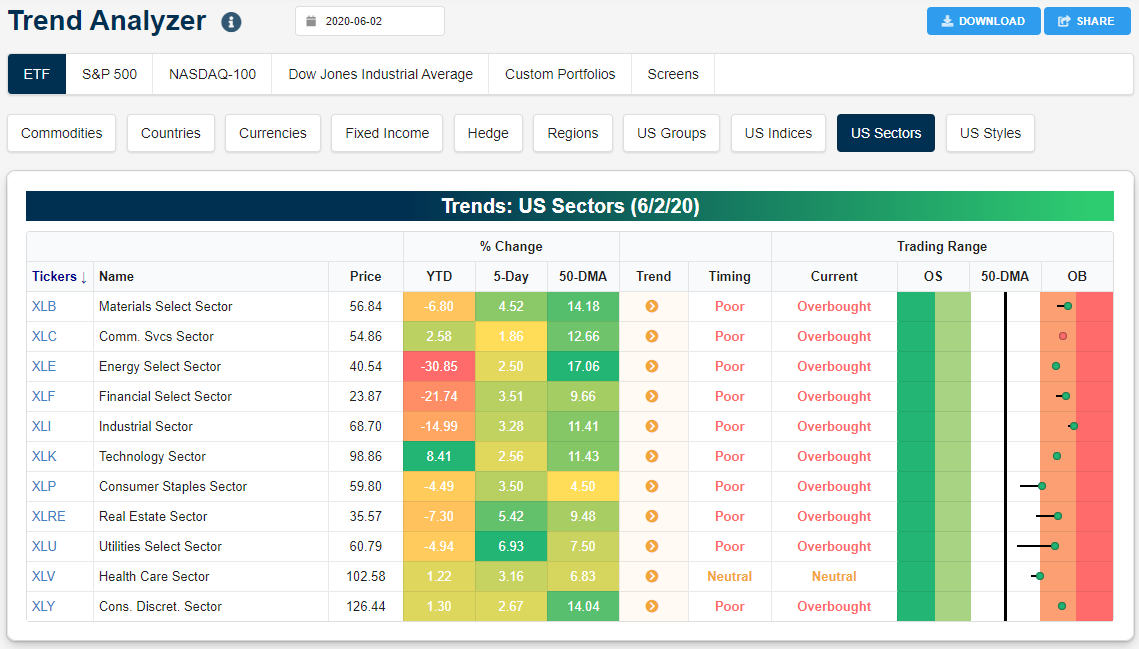
Ten of the eleven major S&P 500 sectors are currently trading in overbought territory with Health Care (XLV) the only sector that’s not overbought. Health Care is very close to overbought, however, which you can see in the snapshot below.
Notably, four of eleven sectors are now up year-to-date — Communication Services (XLC), Technology (XLK), Health Care (XLV), and Consumer Discretionary (XLY). Energy (XLE) and Financials (XLF) are still down 20%+ year-to-date, while the Industrials sector is down 15%.
All of the major country ETFs are overbought as well, with four in extreme territory (which means they’re more than two standard deviations above their 50-DMAs). These four that are the most extended from their normal trading ranges are Germany (EWG), Italy (EWI), Japan (EWJ), and France (EWQ).
On a year-to-date basis, the US (SPY) is now doing the best with a decline of just 3.69%, while the UK (EWU) is down the most at -21.55%. Start a two-week free trial to Bespoke Premium to start using our Trend Analyzer tool today.

Bespoke’s Morning Lineup – 6/3/20 – Global Rally Rolls On
See what’s driving market performance around the world in today’s Morning Lineup. Bespoke’s Morning Lineup is the best way to start your trading day. Read it now by starting a two-week free trial to Bespoke Premium. CLICK HERE to learn more and start your free trial.
Futures are indicated higher, setting the stage for a 7th daily gain in the last 8 sessions. Futures were already higher, but the May ADP Private Payrolls report which came in much less bad than expected (-2.76 million vs 9.0 million consensus estimate).
Be sure to check out today’s Morning Lineup for a rundown of the latest stock-specific news of note, surging mortgage applications, the latest round of Service sector PMIs, news in global markets, global and national trends related to the COVID-19 outbreak, and much more.

After underperforming in a big way for most of 2020 (and even longer than that), European equities have gotten a big boost in recent days, aided in part by the weaker dollar. The relative strength of Europe’s STOXX 600 in dollar adjusted terms has shown signs of life versus the S&P 500 and appears to have broken its short-term downtrend. That’s a trend to watch in the coming weeks as Europe is ahead of the US in terms of re-opening, and last week’s announced collective fiscal relief plan for member countries suggests more cohesion within the bloc.

On a short-term basis, European equities have looked more attractive, but a long-term picture shows a much different picture. Here, the recent strength off the May lows isn’t even visible. In other words, Europe still has quite a hole to dig itself out of. But hey, you have to start somewhere!
