
Chart of the Day – Emerging Markets Slice Through 200-DMA
B.I.G. Tips – Recession Calls vs Market Performance
The National Bureau of Economic Research (NBER) made it official and said that the longest economic expansion in US history ended in February at a record 128 months. While the NBER typically defines a recession as lasting “more than a few months,” it noted in the release that the pandemic caused a “downturn with different characteristics” than prior recessions. It went on further to say that the scope and magnitude of the decline in economic activity warranted the designation of a recession even if it ends up being shorter than the traditional definition of a recession or any other one for that matter.
Now that the NBER has made the recession official, as an investor, should you care? In a report just published, we looked at prior periods where the NBER formally declared a recession had started and looked at S&P 500 performance leading up to and after prior recessions announcements. For anyone looking for answers in how the NBER’s recession call could impact market performance, this report is a must-read. To see it, sign up for a monthly Bespoke Premium membership now!
Sectors Not Positive YTD Yet
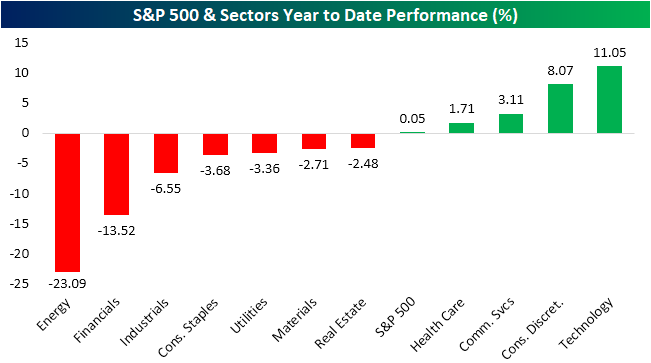
In addition to the Nasdaq reaching a new all time high, the big news yesterday was the S&P 500 turned positive on the year; albeit not by much at only 5 bps. That is a far cry from where things stood just under 3 months ago. On the bear market low on March 23rd, the S&P 500 was down 30.75% YTD. Five sectors were down even more with Energy being the worst of these at a 60.34% loss. On the other hand, Consumer Discretionary, Health Care, Communication Services, Technology, and Consumer Staples were down less than 30% at the lows on 3/23.

Turning to today, while the broader index closed Monday in the green, less than half of the individual sectors are sitting on a gain YTD. Health Care, Communication Services, Consumer Discretionary, and Technology are all positive YTD. Of these, Tech is up the most at 11.05%. Consumer Discretionary also boasts a sizeable gain of 8.07%, while Health Care and Communication Services are both up less than 4%. While over half of the eleven sectors are still sitting on a loss YTD, for most it is not by much. Four of the seven that are in the red—Consumer Staples, Utilities, Materials, and Real Estate—are all within 5% of the flat-line. Meanwhile, Energy and Financials are still well below their levels at the start of the year, down 23% and 13.5% respectively.
While the YTD gain milestone has been reached (though not holding just yet), bulls still have more work to do to reach levels from the last all time high on 2/19. The S&P 500 closed yesterday within 5% of that 2/19 high and Communication Services, Materials, Tech, and Health Care are also within a few percentage points of those levels. Other more hard hit sectors like Energy, Utilities, and Financials are much further below; all double digits below their 2/19 levels. Conversely, as of yesterday’s close, only Consumer Discretionary has managed to move above its 2/19 levels. That’s largely due to Amazon’s (AMZN) massive move higher throughout the COVID crisis. Click here to view Bespoke’s premium membership options for our best research available.

Bespoke’s Morning Lineup – 6/9/20 – Turnaround Tuesday (The Wrong Way)
See what’s driving market performance around the world in today’s Morning Lineup. Bespoke’s Morning Lineup is the best way to start your trading day. Read it now by starting a two-week free trial to Bespoke Premium. CLICK HERE to learn more and start your free trial.
What always seems like a great idea late one night, rarely looks good the next morning, and that’s what’s happening for a lot of stocks today. Many low to no quality stocks that were bid sharply higher yesterday, even after rallying to levels they probably had no business trading at, are down sharply this morning. The poster child for the move is Chesapeake, which is trading down over 40% after nearly tripling on Monday. Even with the pre-market declines, though, CHK is up more than 177% from Thursday’s close!
Be sure to check out today’s Morning Lineup for a rundown of the latest stock-specific news of note, European markets, economic data out of Japan, Australia, and Germany, global and national trends related to the COVID-19 outbreak, and much more.

With the S&P 500 poised to gap down just under 1%, we screened our database for prior occurrences where the S&P 500 tracking ETF (SPY) gapped down more than half of a percent after trading up more than 1% the prior day. We then broke out those occurrences by the day of the downside gap and calculated SPY’s average open to close performance on those days. Since 1994, there have been a total of 140 prior occurrences that fit the criteria. On those days, the S&P 500 saw an average rest of day decline of 0.08% with positive returns just under half of the time.
When the downside reversal occurred on a Tuesday (20 prior occurrences), the average rest of day performance was only slightly better at -0.06% with gains 45% of the time. While these results don’t provide much in the way of info for a Tuesday, we can at least be thankful the reversal isn’t occurring on a Wednesday or Thursday where rest of day returns have been the weakest. The only day of the week where SPY saw positive rest of day returns on an average basis was Friday (+0.30%).


Chart of the Day: Search Trend Struggles
Daily Sector Snapshot — 6/8/20
IPOs Surging
The Renaissance IPO Index actually peaked a day later than the S&P 500 on February 20th, and after a 38.2% decline, it would find a bottom a week earlier than the S&P 500 on March 18th. Since then, the index has surged. In addition to IPOs beginning to come out of the woodwork, that strong performance is partially thanks to holdings in recent IPOs like Slack (WORK) and Zoom Video (ZM) which have become staples of the COVID economy. As shown in the charts below, the index has rallied 77.8% since that March 18th low; double the S&P 500’s performance in the same time-frame. As shown in the second chart below, that has led the ratio of IPOs to the S&P 500 to have gone nearly vertical and is now at new highs; pressing above the prior decade high for the ratio from 2014.

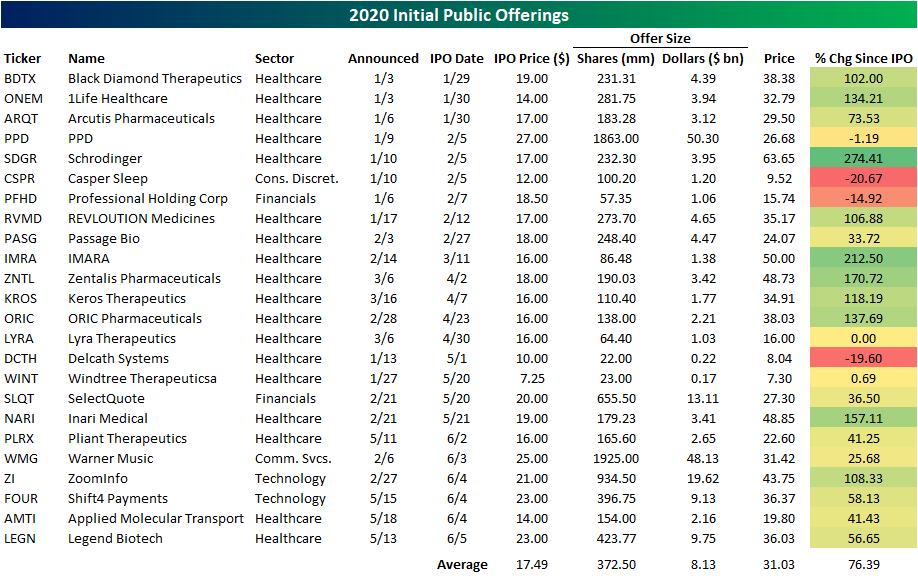
On an individual level, IPOs in 2020 have actually done very well. So far in 2020, there have been 72 companies to announce initial public offerings. Only 24 of those have already begun trading (shown below) while another 3 have withdrawn. On average, these stocks are up 76.39% from their IPO. Fitting for a year with a global pandemic, the bulk of these IPOs have been Health Care names. The largest and one of the earliest of these was for Schrodinger (SDGR) which offered $50.3 billion. This has also been the best performing IPO this year having risen 274.41% since its IPO. IMARA (MRA) is also up over 200% since IPO though it was a much smaller offering. The second largest of the year was for Warner Music (WMG) which offered $48.13 billion of stock last Wednesday. In addition to WMG, there have been five other IPOs to hit the market in the past week. Click here to view Bespoke’s premium membership options for our best research available.
High Flying Airlines
It has been a slow crawl, but as the economy has begun to reopen travelers are slowly beginning to take to the skies again. Although TSA Total Traveler Throughput is still down 83.47% from last year, it has made headway over the past several weeks. Daily total throughput has averaged 361K over the past week compared to its worst day in mid-April when throughput was down over 96% YoY, averaging around just 95K travelers per day. In other words, air traffic has been improving but is far from out of the woods and still down significantly from last year.

That small improvement in addition to drastic underperformance earlier this spring has acted as the catalyst for massive buying into the sector. One ETF that has served as a proxy for airlines recently has been the US Global Jets ETF (JETS) which tracks airline industry-related stocks from around the globe. From its high on February 12th to its low on March 19th (both prior to the broader market’s respective high and low) JETS had fallen over 61%. After trending sideways for a bit and successfully retesting those lows, JETS has ripped higher. As of today, it is up over 75% from its recent 5/13 low.
With such a massive gain in less than a month, it has left its 50-DMA far in the rearview sitting 46.9% above its 50-day (though it is still 16.5% below its 200-DMA). That also means JETS is now at its most overbought levels ever since it first began trading in 2015 (second chart below). Tacking on another 6.4% gain today, JETS is trading 3.6 standard deviations above its 50-DMA. Prior to this run, the most overbought JETS ever became was 3.06 standard deviations above its 50-DMA in 2016.

As for the individual US airlines, it is broadly the same story. The surge in buying over the past few weeks has left those S&P 1500 stocks in the airlines industry up 60% or more since 3/23. United (UAL) and American Airlines (AAL) have gained the most with both stocks up over 100% since 5/13. As with JETS, these names are all extremely overbought now with all but three airlines (Hawaiian- HA, Allegiant- ALGT, and Southwest LUV) more than 3 standard deviations above their 50-DMAs. That is around some of the most overbought levels of the past decade as shown in the table below. Click here to view Bespoke’s premium membership options for our best research available.

Boeing (BA) Boosting the Dow
In recent weeks, we have highlighted how there has been rotation away from the best performing stocks in the first leg of the rally off of the 3/23 low while the stocks that had been the laggards have become the new market must-haves. Boeing (BA) is a prime example of this trend. Heavily connected to the decimated airline industry, BA only rose 15.04% in the first part of the rally from 3/23 to the recent 5/13 low. While not the worst stock in the index during that time, it lagged the Dow Jones Industrial Average which rose over 25%. But along with others in the industrial sector like the airlines, recent performance has been much more impressive with BA up 69.08% from 5/13 through Friday’s close. Today alone the stock is up another 11% after rallying 11.47% on Friday and 12.95% last Wednesday! That leaves it at its highest level since early March.

With such large gains in a little less than a month for a stock with one of the higher stock prices in the index, BA has added roughly 575 points to the price weighted Dow. That has by far been the largest contributor to the Dow since 5/13 accounting for roughly 14.9% of the overall move and nearly double the next biggest contributor, Goldman Sachs (GS), which added 316.32 points to the Dow, or roughly 8.19% of the overall move since 5/13. Other major contributors from the Financials sector like Travelers (TRV), American Express (AXP), and JPMorgan Chase (JPM) are some more examples of the recent rotation into stocks that lagged in the immediate wake of the bear market. Click here to view Bespoke’s premium membership options for our best research available.

Bespoke’s Morning Lineup – 6/8/20 – To the Extreme
See what’s driving market performance around the world in today’s Morning Lineup. Bespoke’s Morning Lineup is the best way to start your trading day. Read it now by starting a two-week free trial to Bespoke Premium. CLICK HERE to learn more and start your free trial.
Futures are continuing the momentum from last week as the S&P 500 is poised to open up over half of a percent. The key driver this morning? Momentum. There’s literally no data on the economic calendar to speak of and the pace of earnings is at a trickle. Traders are out in full force again bidding up stocks tied to the re-opening trade as the airlines ETF (JETS) is up over 5%, Boeing is up over 8%, and bankrupt Hertz is up 25%. The wackiest move of the day, though, belongs to Chesapeake (CHK). Shares are up nearly 100% in the pre-market after rallying over 75% on Friday. Even after the rally of the last two days, though, CHK is down 90% from its 52-week high more than 99% from its all-time high.
Be sure to check out today’s Morning Lineup for a rundown of the latest stock-specific news of note, European markets, the latest Sentix data, global and national trends related to the COVID-19 outbreak, and much more.
By all accounts the last week was extraordinary for the stock market. Sure, we’ve seen stronger weeks in the last several months, but they came from levels where prices were down sharply. After what had already been a near-record rally for US stocks in such a short period of time, the gains were only piled on in last week’s rally.
Of the 11 S&P 500 sectors, their average gain last week was over 6% and they are now an average of 13.8% above their 50-day moving averages! In our Trend Analyzer tool, we track the OB/OS conditions of 14 different major US index ETFs on a daily basis, and through Friday’s close, last week’s average performance was a gain of 6.5%. The top-performing index ETF on the week was the Core S&P Small-Cap ETF (IJR) which rallied just under 12%, while the Nasdaq 100 (QQQ) was the weakest performer of the week gaining 2.7%. In any other week, a rally of 2.7% would be a reason to celebrate.
Unfortunately, markets don’t only go in one direction, though, and after the gains we saw last week, all but two of the major index ETFs we track in our Trend Analyzer are now at ‘Extreme Overbought’ levels. That doesn’t mean we necessarily have to go down from here, but it does make the odds for at least a short-term period of consolidation more likely. If you are a long-term investor that would be a good thing.
