
Tepper and Treasuries
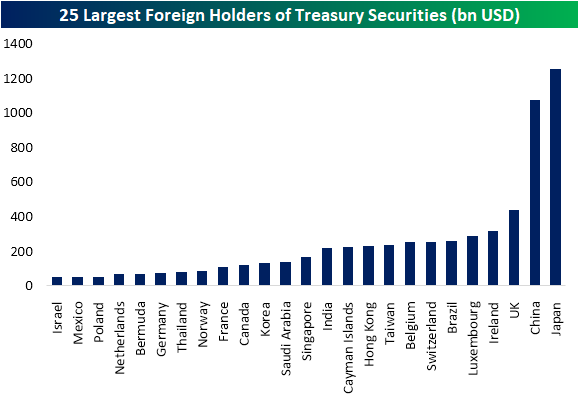
One catalyst being given credit to the generally positive performance equities today were bullish comments in a CNBC interview with Appaloosa Management’s David Tepper. Tepper stated that in his view “rates have temporarily made the most of the move” and ” “it’s very difficult to be bearish.” Tepper also stated a belief in the possibility of Japan stepping in as a buyer for US Treasuries following the recent rise in yields. As for why exactly Japan doing so would benefit Treasuries, it should be noted that Japan is the largest foreign holder of US Treasuries (per Treasury International Capital TIC data). As of December data (January data is set to be released next Monday, 3/15), Japan held $1.25 trillion in Treasury securities. The only other country that comes even close is China with $1.072 trillion in Treasury holdings. Behind those two, the UK is the next largest holder with not even half that amount: $440.6 billion.
Using the same TIC data, from early 2015 through the end of 2019, Japan was a net seller of US Treasury and Federal Financing Bank securities. For most of 2020, that had changed with Japan becoming a net buyer though that waned towards the end of the year. The recent uptick in yields coincided with Japan returning to being a net seller.

While Japan has purchased fewer Treasuries, they have still been making up the difference as big buyers of MBS. According to the TIC data for December, positive flows of MBS purchases offset the decline in Treasury purchases. As for Japanese data with less of a delay, in the chart below we show weekly net purchases of all foreign bonds and notes in US dollar terms summed by month. As for this more high-frequency data, again, there has yet to be evidence that Japan is buying Treasuries. For the month of February, the country was a net seller of $19.6 billion in foreign bonds and notes. But Click here to view Bespoke’s premium membership options for our best research available.
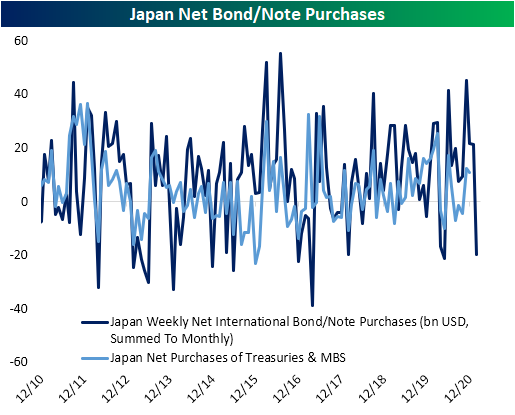
Chart of the Day – Inflation Week
Bespoke’s Consumer Pulse Report — March 2021
Bespoke’s Consumer Pulse Report is an analysis of a huge consumer survey that we run each month. Our goal with this survey is to track trends across the economic and financial landscape in the US. Using the results from our proprietary monthly survey, we dissect and analyze all of the data and publish the Consumer Pulse Report, which we sell access to on a subscription basis. Sign up for a 30-day free trial to our Bespoke Consumer Pulse subscription service. With a trial, you’ll get coverage of consumer electronics, social media, streaming media, retail, autos, and much more. The report also has numerous proprietary US economic data points that are extremely timely and useful for investors.
We’ve just released our most recent monthly report to Pulse subscribers, and it’s definitely worth the read if you’re curious about the health of the consumer in the current market environment. Start a 30-day free trial for a full breakdown of all of our proprietary Pulse economic indicators.

How Long Can Dividends (DVY) Outperform Growth (VUG)?
Over the past few weeks, high growth names have turned into a pain trade with the Vanguard Growth ETF (VUG) having fallen 11% from its February 12th closing high to the intraday lows last Friday; with a small rally in the second half of Friday’s session which has continued today, the ETF is now down 7.16% since the 2/12 high. Meanwhile, in the same time frame, the iShares Select Dividend ETF (DVY) has risen 8.13% since its February 12th close, breaking out to new all-time highs both on Friday and again today


Looking at the screen of various styles of ETFs in our Trend Analyzer, the recent moves have brought VUG deep into oversold territory as of Friday’s close. Other growth-focused ETFs are similarly oversold. Meanwhile, the strong performance of dividend stocks has resulted in DVY alongside the S&P Dividend ETF (SDY) to be extremely overbought at more than two standard deviations above their respective 50-DMAs.

In the chart below, we show the ratio of the Dividend ETF (DVY) versus the Growth ETF (VUG). Times in which the line is declining indicate outperformance of growth while an upward trending line indicates outperformance of dividend stocks.
As could be expected given the different risk premiums of the two styles of these ETFs, growth stocks have seen fairly consistent outperformance in recent years. But more recently, the opposite has been the case, and in a big way. As shown in the second chart below, over the past month (21 trading days) the ratio of DVY to VUG has risen over 16%. In the history of the data going back to early 2004, the only period that has seen this line rise at a more rapid pace was in September 2008 when it rose by 25.46%. Looking at that instance, the outperformance of dividend stocks did not lead to any sort of a longer-term trend though. In fact, the ratio peaked only a couple of months later erasing the entirety of the move by early March 2009. Click here to view Bespoke’s premium membership options for our best research available.

February 2021 Headlines
Bespoke’s Morning Lineup – 3/8/21 – More Tech Pain?
See what’s driving market performance around the world in today’s Morning Lineup. Bespoke’s Morning Lineup is the best way to start your trading day. Read it now by starting a two-week free trial to Bespoke Premium. CLICK HERE to learn more and start your free trial.
“Even a mistake may turn out to be the one thing necessary to a worthwhile achievement.” – Henry Ford
It’s looking like more pain may be in store for tech stocks to start the week as Nasdaq futures are trading down by more than 1%. As bad as that sounds, things were worse about a half-hour ago before comments from David Tepper through CNBC where he said he doesn’t see rates rising in the short-term and that therefore, equities look attractive.
Be sure to check out today’s Morning Lineup for updates on the latest market news and events, the passage of the COVID relief bill, Chinese trade data, an update on the latest national and international COVID trends, including our series of charts tracking vaccinations, and much more.
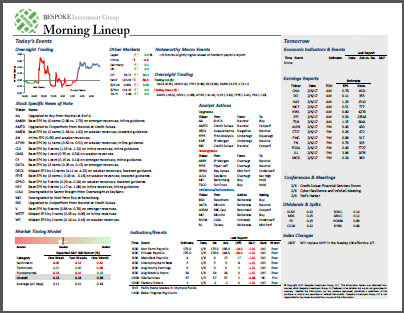
Last week was a painful one for the Nasdaq 100, but for the majority of other US indices, last week was a positive one with the DJIA up over 1% while the S&P 500 was up just shy of 1%. Following a month-long period of consolidation, all but two of the indices in our Trend Analyzer currently have good timing scores.

Bespoke Brunch Reads: 3/7/21
Welcome to Bespoke Brunch Reads — a linkfest of the favorite things we read over the past week. The links are mostly market related, but there are some other interesting subjects covered as well. We hope you enjoy the food for thought as a supplement to the research we provide you during the week.
While you’re here, join Bespoke Premium with a 30-day free trial!
Mania
Leading Card Grader PSA Doubles Prices as Industry Booms by Darren Rovell (Action Network)
Two weeks after being sold for a bit less than $1bn, the leading grader of sports trading card quality, has doubled prices and raised minimum batch counts amidst an epic order backlog numbering millions of cards. [Link]
How a 10-second video clip sold for $6.6 million by Elizabeth Howcroft and Ritvik Carvalho (Reuters)
A non-fungible token purchased for $67,000 is telling for 100x that price less than six months after being sold for the first time last fall. [Link; auto-playing video]
First Trust Takes Aim At ARK; Launching Innovation ETF by David Dierking (The Street)
Following in the footsteps of ARK Invest’s extremely successful Innovation ETF (ARKK), ETF giant First Trust has filed for an ETF that takes a similar approach. [Link; auto-playing video]
Meme Stocks
Hertz, the Original Meme Stock, Is Turning Out to Be Worthless by Steven Church (Bloomberg)
The original retail-fueled short squeeze from 2020 saw Hertz declare Chapter 11; that process is now finishing up with equity owners getting nothing. [Link; soft paywall]
Bots hyped up GameStop on major social media platforms, analysis finds by Michelle Price (Business Insider/Reuters)
A Massachusetts-based cyber security company has identified a large number of social media bot accounts helped amplify the craze for GameStop (GME) stock. [Link]
Washington
The Evolution of the Oval Office Décor (American Home Shield)
Ever wonder what the President’s office looked like in the past? Décor changed little in the first half of the 20th century, but since Truman each President has redecorated to suit their personal styles and the fashions of the time. [Link]
Divided Senate Passes Biden’s Pandemic Aid Plan by Emily Cochrane (NYT)
Despite some confusion over specific unemployment provisions that delayed passage Friday, this weekend the Democratic-controlled Senate passed a $1.9trn aid bill that will result in thousands of dollars of aide for the middle class, expanded jobless claims benefits, and is estimated to cut poverty by an astounding one-third this year. [Link; soft paywall]
Whoops
Hey Citi, your bitcoin report is embarrassingly bad by Jemima Kelly (FT)
This week an effort to discuss crypto currency with clients led to some pretty spectacular whiffs from Citi’s research group, including a remarkable mix-up over basis points versus percentage points. [Link; paywall]
The Reemergent 1977 H1N1 Strain and the Gain-of-Function Debate by Michelle Rozo and Gigi Kwik Gronvall (NIH)
During the 1970s, a virulent flu strain that wrecked havoc likely represented a failure of containment at a bio research lab. The genetics of the virus were almost identical to strains first collected decades prior. [Link]
Shifting Gears
‘I’ve Never Seen Anything Like This’: Chaos Strikes Global Shipping by Peter S. Goodman, Alexandra Stevenson, Niraj Chokshi and Michael Corkery (NYT)
Shipping can be a volatile business, but the rapid swings in demand across goods and geographies have created unprecedented chaos across transportation markets around the world. [Link; soft paywall]
How Remote Work Is Reshaping America’s Urban Geography by Richard Florida and Adam Ozimek (WSJ)
Roughly half of Americans are working remotely, and while that share will decline as vaccine rollouts make normal offices safe again, some of the shift will persist amidst a longer-term trend towards the practice of working without going in to a physical desk. [Link; paywall]
Read Bespoke’s most actionable market research by joining Bespoke Premium today! Get started here.
Have a great weekend!
The Bespoke Report — Nasty Nasdaq
This week’s Bespoke Report newsletter is now available for members.

To read the report and access everything else Bespoke’s research platform has to offer, start a two-week free trial to one of our three membership levels. You won’t be disappointed!

Daily Sector Snapshot — 3/5/21
ARK Invest Still Sitting On Solid Gains, But They’re Sliding Away
The ARK Invest family of ETFs had a stellar 2020 that drew huge inflows. Across the five ETFs issued by Cathie Wood’s company, gains ranged from 105% to 178%, but 2021 has been much less friendly. The flagship ARK Innovation ETF (ARKK) is down 4.9% YTD (and getting worse), with a mixture of gains and losses across other themes. Flows haven’t yet had that kind of round trip: $20bn in 2020, with another $15bn this year (including $2bn of outflows since the peak in February). Looking at the total ARK Invest universe, we can calculate the amount of money investors have gained or lost in aggregate by subtracting flows from market cap. As shown below, back in December investors had a weighted average return of more than 60% across the five ETFs, weighted by the size of purchases. The selloff since has driven that down to just 19% through yesterday. With $15bn entering the funds this year, lots of investors are getting close to or further underwater, and declines could accelerate. So far this year, there’s only been $2bn of outflows, but the money that was quick to come in could just as quickly leave given the recent losses. This blog post is adapted from an analysis included in our nightly Closer report. Click here to start a free trial of Bespoke Institutional to get immediate access.
