
Daily Sector Snapshot — 3/22/22
Chart of the Day: S&P 500 (SPY) Slings Ahead While Treasuries (TLT) Tumble
Richmond Rebounds Sans Expectations
So far this month, regional Federal Reserve District readings on manufacturing have been mixed with a stronger than expected reading out of Philadelphia and a much weaker than expected reading out of New York. Today’s release of the Richmond Fed’s index saw the composite reading rise by 12 points to 13 rather than the modest single-point increase that was expected.

The one-month swing in the composite index was on the large side relative to the report’s history. The 12 point month over month gain ranks in the 90th percentile of all monthly moves bringing the index from the low end of its historical range (35th percentile) to the upper end (79th percentile). Given the large increase, breadth in this month’s report was strong across categories with a majority of categories seeing significant month over month increases. Expectations, however, were generally more dour.

Quantifying just how wide of a difference there was in the changes of current conditions and expectations, in the chart below, we show the average spread across each categories month over month change in the current conditions versus expectations indices. In other words, more positive readings would mean current conditions are rising much more rapidly than expectations and vice versa for more deeply negative readings. This month’s reading was the second-highest reading on record outside of March 2020. In other words, this month’s report saw a historic disconnect between the moves in readings on the present situation versus the future outlook.

Whereas the February report saw new orders contract alongside order backlogs and shipments, this month, each index saw a sizeable rebound. New orders grew at a healthy rate as the index rose to 10 and the shipments index is now in a similar area of its historical range after an even larger monthly increase. In fact, one month after one of the largest monthly declines on record for the index, this month’s 20 point gain came up just short of a top 5% monthly increase. Given the strength in new orders, order backlogs also rose while supply chain stress showed further signs of easing as the vendor lead times index fell to 41. While still above December’s low, it marks a significant improvement from October’s high of 67.
Although there were broad improvements in the current condition indices for these categories, expectations were far weaker. The expectation indices for New Orders, Shipments, and Order Backlogs experienced declines ranking in the bottom few percent of all month-over-month changes on record. Similarly, vendor lead times saw a top decile month-over-month gain. In other words, Richmond area manufacturers do not appear to expect the improvement in conditions to carry through over the next several months.

Likely as a result of the abating number of COVID cases, employment metrics improved in March. Firms reported taking on more workers and raising wages at a higher rate. Meanwhile, the length of the average workweek saw a huge 19 point rebound back into positive territory. Firms also reported it was harder to find workers with necessary skills, though, that reading remains significantly improved from record lows set a little under one year ago. We would also note, while demand metrics saw big declines and much weaker levels of expectations indices, expectations indices for employment categories continue to sit at much more historically elevated levels even in spite of some modest declines in March.

Manufacturers continue to report massive price increases relative to other periods in the survey’s history. Prices paid were reported to have risen at an 11.05% annualized rate and prices received rose at a 9.16% clip. While elevated, both readings are still off their January peaks.Click here to view Bespoke’s premium membership options.

Bespoke Stock Scores — 3/22/22
Bespoke’s Morning Lineup – 3/22/22 – At the End of the Day…
See what’s driving market performance around the world in today’s Morning Lineup. Bespoke’s Morning Lineup is the best way to start your trading day. Read it now by starting a two-week trial to Bespoke Premium. CLICK HERE to learn more and start your trial.
“Patience and fortitude conquer all things.” – Ralph Waldo Emerson
Treasuries have continued to sell-off this morning following yesterday’s trouncing in the wake of Powell’s comments regarding the potential for a 50 bps rate hike at upcoming FOMC meetings. Equities, on the other hand, have seemingly ignored the higher rates and traded higher. In the commodity space, crude oil and gold are both essentially flat.
In the Russia-Ukraine war, talks for a potential ceasefire have seemingly stalled as the Russians argue that Ukraine is dragging its heels, while Ukraine asserts that it will not cede any land to Russia. Zelensky has now even asked the pope to step in and mediate. As the talks stall, Russia hasn’t let up with its military strikes even after reports suggest that its ground game has been faltering.
Read today’s Morning Lineup for a recap of all the major market news and events from around the world, including the latest US and international COVID trends.
The last week of trading has really seen some extraordinarily strong finishes for the market. The chart below shows the S&P 500’s performance in the last hour of trading so far in 2022. For much of January and through February, the majority of days saw the equity market sell-off into the close. In fact, at one point in late January, the performance of the S&P 500 in the final hour of trading was the weakest since October 1987. Over the last five trading days, though, in the middle of a war in Europe where you would think concerns of overnight headline risk would be at their highest, we have seen five straight days where the S&P 500 has gained at least 0.33% in the last hour of trading. It may not be uncommon to see one or two days of similar gains in the last hour of trading, but to see five straight is extremely rare. In fact, to find the last time this happened, you have to go all the way back to July 2002! Talk about finishing off on a high note!

Start a two-week trial to Bespoke Premium to read today’s full Morning Lineup.
Daily Sector Snapshot — 3/21/22
Boeing (BA) and 737 Crashes
Shares of Boeing (BA) are down nearly 4% in today’s session as of this writing on news of a fatal crash of one of the company’s 737 jets in China. Any plane crash which results in fatalities is obviously a tragedy, and our hearts go out to all the victims and their families. While it’s hard to pivot to the market-related implications of these types of events, investors in Boeing and related companies are obviously interested in how these types of events, whether due to mechanical or other issues, will impact their investments. Today’s crash involved one of the company’s 737-800 planes and not the 737-MAX (the variant which was involved in crashes in 2018 and 2019). At this point, there are no details regarding the cause of the crash, but details will likely be forthcoming in the days and weeks ahead.
In the chart below, we show the chart of BA since the start of 2000 and include red dots indicating each time that there has been a fatal incident involving a 737 (any generation of the plane). There have been a total of three dozen incidents internationally prior to today, and historically, these past events have not had any consistent impact on the performance of BA stock.

That being said, the immediate reaction in today’s session is set to rank pretty high up on the list of worst declines after a crash involving a 737. Below we show the daily percent change of BA in the first session after a 737 variant had a fatal incident. As might be expected, the 737-MAX crashes in 2018 and 2019 were the two worst single-day declines for the stock of these instances with drops of 6.59% and 5.33%, respectively. The Turkish Airlines Flight 1951 crash in 2009 ranks as the next largest drop of 4.32%. In general, since the 737 MAX issues surfaced, on news of any fatal incident involving 737s, investors have been quick to sell first and ask questions later.

The 737 Next Generation (abbreviated 737NG) which includes the 737-600, 700, 800, and 900 variants is the generation that Boeing produced from 1996 and ceased assembly of in 2019 as the company’s production switched to the 737 MAX. Of the 737NG generation, the 800 variant (the variant involved in today’s crash) is the most common. Given this, in the table below, we show those fatal incidents involving the 800 series since 2000 as well as the two MAX crashes given their importance in recent years. This was the seventh fatal incident involving this plane without any survivors.
Boeing’s stock has mostly seen a negative reaction in response to these incidents and even though the next week has typically seen the stock rebound, performance over the next one and three months, especially since the issues with the MAX began, have tended to be followed by declines. Of course, each of these incidents has a fair degree of nuance to each one. For example, there are numerous reasons as to why these crashes occurred, and the majority had nothing to do with an inherent flaw in the BA aircraft. Whereas the 737-MAX problems were accredited to a design flaw, and thus are more directly negative for Boeing, many of the other incidents were on account of the flight crew or pilot error. Additionally, there is also the issue of poor timing like the early 2020 instances which lined up with the COVID crash. In other words, the weak performance following these crashes had more to do with factors outside of the crashes themselves. Again, any crash, whatever the cause, is a tragedy, but from a market perspective, it’s important to differentiate between the cause behind them. Click here to view Bespoke’s premium membership options.
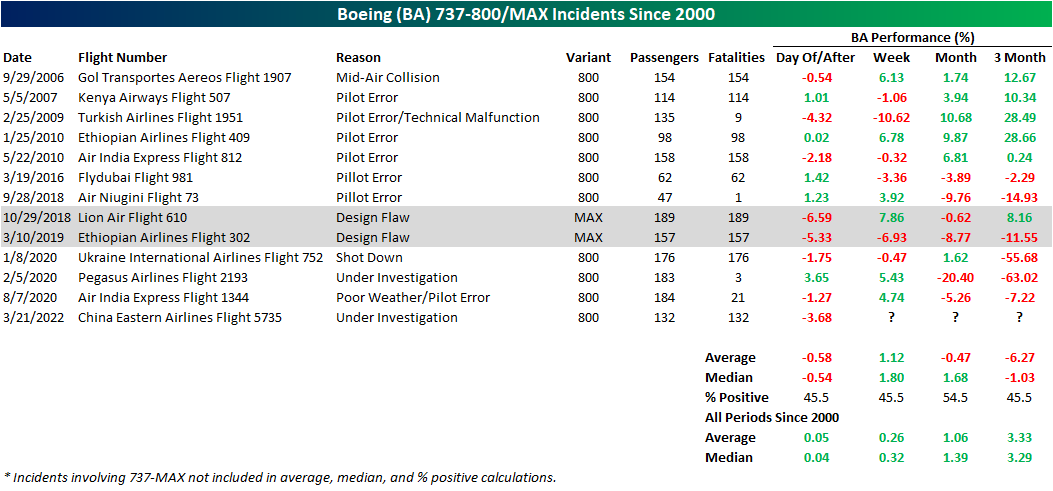
Chart of the Day – Sector Performance During Rate Hike Cycles Not Always Uniform
Bespoke’s Morning Lineup – 3/21/22 – Every Dog Has Its Day
See what’s driving market performance around the world in today’s Morning Lineup. Bespoke’s Morning Lineup is the best way to start your trading day. Read it now by starting a two-week trial to Bespoke Premium. CLICK HERE to learn more and start your trial.
“Let Hercules himself do what he may / The cat will mew and dog will have his day.” – William Shakespeare
After a big rally last week, equity markets are heading into the week a bit groggy this morning as futures are indicated lower to kick off the week. As we note in the commentary of this morning’s report, though, it’s not unprecedented to see weakness following a strong rally into a triple witching options expiration.
Oil prices are near $110 per barrel this morning as Russia-Ukraine tensions show no signs of abating. In fed-speak, there’s a number of speakers on the calendar and the week kicked off with Atlanta Fed President Bostic who said he sees a total of six rate hikes for 2022 and another two in 2023.
Read today’s Morning Lineup for a recap of all the major market news and events from around the world, including the latest US and international COVID trends.
In what was a strong week for the equity market, it was clearly an example of every dog having its day as the worst-performing sector’s YTD led the rally while Energy, the one sector that was up YTD heading into the week, finished in the red. Whether you want to call it a dash for trash or some other variation, sectors that had faced the most serious selling pressure had their shining moment of 2022.

Start a two-week trial to Bespoke Premium to read today’s full Morning Lineup.
Bespoke Brunch Reads: 3/20/22
Welcome to Bespoke Brunch Reads — a linkfest of the favorite things we read over the past week. The links are mostly market related, but there are some other interesting subjects covered as well. We hope you enjoy the food for thought as a supplement to the research we provide you during the week.
While you’re here, join Bespoke Premium with a 30-day free trial!
From The Front Lines
Ukrainian Counteroffensive Near Mykolaiv Relieves Strategic Port City by Yaroslav Trofimov (WSJ)
Russian forces have been pushed back from Mykolaiv in the biggest Ukrainian counter-attack since the start of the war. How the people are digging out as the steady steam of war dead continue to flow back from the front. [Link; paywall]
Ukraine
Economic complexity emerges as a new restraint on wars of conquest by George Pearkes (Atlantic Council)
Sanctions levied against Russia in response to the war in Ukraine illustrate the new, existential restraint on wars of conquest: the threat of broken value chains which underpin the staggeringly complex web of production that supports modern standards of living. [Link]
Aircraft Insurers Brace for Deluge of Russia Claims, With Lloyds on Hot Seat by Katherine Chiglinsky, Siddharth Vikram Philip, and Max Reyes (Bloomberg)
Companies that own commercial aircraft and lease them to airlines are facing massive losses from the requisition of those planes by the Russian government. The question is, how much of that hit will be absorbed by insurance companies? [Link; soft paywall]
Commodities
The $140 Billion Question: Can Russia Sell Its Huge Gold Pile? by Eddie Spence (Yahoo!/Bloomberg)
Gold holdings were meant to “sanctions-proof” the Russian central bank’s massive reserve hoard. In practice, it’s proving hard to deploy that hoard of value to protect the Russian economy from western sanctions, bringing in to question the utility of holding gold as reserves. [Link]
Energy traders call for ‘emergency’ central bank intervention by Claire Jones, Neil Hume, and Martin Arnold (FT)
European commodities trading firms have requested central bank liquidity facilities to help them manage unprecedented disruptions from Russian sanctions and the war in Ukraine. [Link; soft paywall]
Food Prices
How is the Egyptian government dealing with the global wheat crisis? by Nada Arafat (Mada Masr)
A detailed review of policy steps being taken by the world’s largest wheat importer (heavily dependent on Ukrainian and Russian supply specifically) to secure sufficient grain volumes amidst the loss of supply from the breadbasket of Europe. [Link]
We’re Not Facing a Global Food Crisis by Aaron Smith (UC Davis)
While the loss of wheat and to a lesser degree corn supplies from Russia and Ukraine will be significant, the overall shock is largely priced in at this point and unlikely to cause a significant global shortage. [Link]
High & Low Drama
Inside the Succession Drama at Scholastic, Where Harry Potter and Clifford Hang in the Balance by Joy Press (Vanity Fair)
A real-life version of Succession is pitting the girlfriend of the former CEO for children’s book company Scholastic against his sons. [Link; soft paywall]
California city may declare Chick-fil-A a “public nuisance” by Kate Gibson (CBS News)
Huge lines for the fried chicken purveyor in Santa Barbara are spilling into streets and blocking lanes for hours at a time, leading civic leaders to slap the business with penalties. [Link]
Tech
How the Pandemic Broke Silicon Valley’s Stranglehold on Tech Jobs by Christopher Mims (WSJ)
Remote work is becoming more prevalent, and it’s most concentrated in tech where powerful geographic network effects have historically concentrated talent in a narrow cluster of cities around the country. [Link]
Vimeo is telling creators to suddenly pay thousands of dollars — or leave the platform by Mia Sato (The Verge)
Price hikes have been rolled out on video sharing website Vimeo’s users, many of whom use the site because of its integration with popular subscription platform Patreon. [Link]
Whoops
UPS missed Nantucket ferry reservation window: ‘It’s going to put us in a world of hurt’ by Joshua Rhett Miller (NYP)
An early priority window for booking Nantucket busy season ferry capacity was missed by UPS, leaving the shipping company scrambling to figure out how it will book capacity and businesses on the island wondering how they will ship and receive packages this summer. [Link; auto-playing video]
Everyone Was Surprised By The Senate Passing Permanent Daylight Saving Time. Especially The Senators. by Paul McLeod (BuzzFeed)
Apparently the Senate was too busy deliberating this week to notice that they had accidentally passed legislation that (if passed by the House and signed by the President) would eliminate the bi-annual changing of the clocks. [Link]
Stress
Cold Showers, Hot Saunas and the New Way to Tame Stress by Betsy Morris (WSJ)
Occasional bursts of stress may help the body adapt to more permanent stress, with exercise, temperature changes, and fasting all playing a role. [Link; paywall]
Veto Points
Why America can’t build quickly anymore by Alan Cole (Full Stack Economics)
A proliferation of ways for individuals and groups opposed to development have created huge logjams for major projects, with environmental reviews raising project risks and pushing timelines for construction of everything from transit to wind energy into the years. [Link]
Read Bespoke’s most actionable market research by joining Bespoke Premium today! Get started here.
Have a great weekend!