May 2016 Headlines
ETF Trends: Hedge – 6/6/16
Below is our daily list of the twenty best and twenty worst performing ETFs over the last five trading days. Gold ranked among the top performers again while oil exposures remained among the worst performers. Asian stocks continued to do well, with the exception of hedged Japanese exposure which came in atop the worst performers. It’s notable that thanks to the huge dollar selloff after Friday’s poor jobs print, currency hedges in DXJ and HEDJ worked the “wrong way”; stocks didn’t move much in Europe and Japan but the EUR and JPY surged versus USD, making the hedges lose while the underlying was close to flat. Biotech remained strong, and European exposures still ranked poorly. Financial sector stocks were stuck among the worst performers.
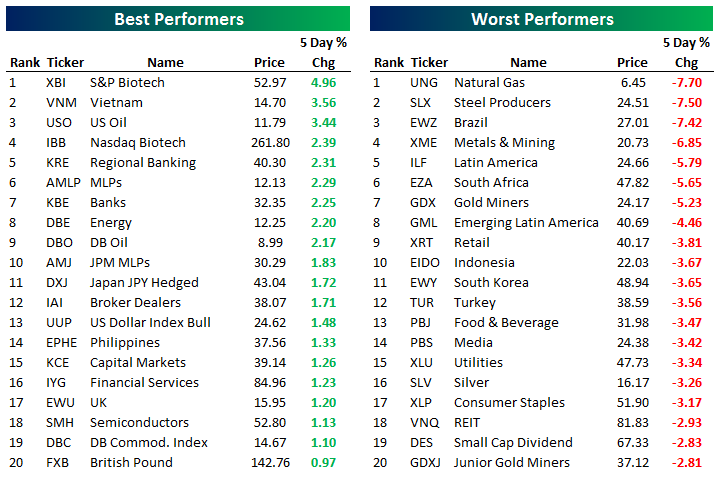
Bespoke provides Bespoke Premium and Bespoke Institutional members with a daily ETF Trends report that highlights proprietary trend and timing scores for more than 200 widely followed ETFs across all asset classes. If you’re an ETF investor, this daily report is perfect. Sign up below to access today’s ETF Trends report.
See Bespoke’s full daily ETF Trends report by starting a no-obligation free trial to our premium research. Click here to sign up with just your name and email address.
Bespoke Stock Seasonality: 6/6/16
Consumer Pulse: Chewbacca, Social Media, and Kohl’s
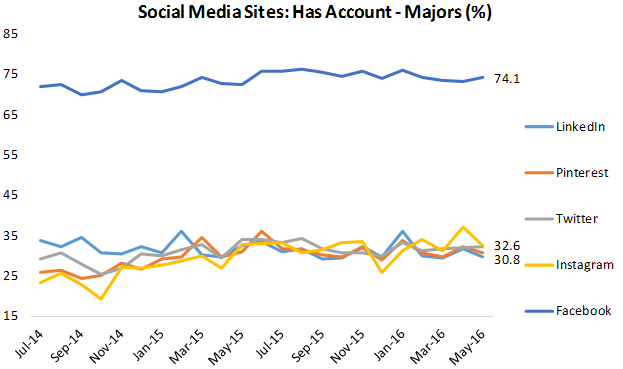
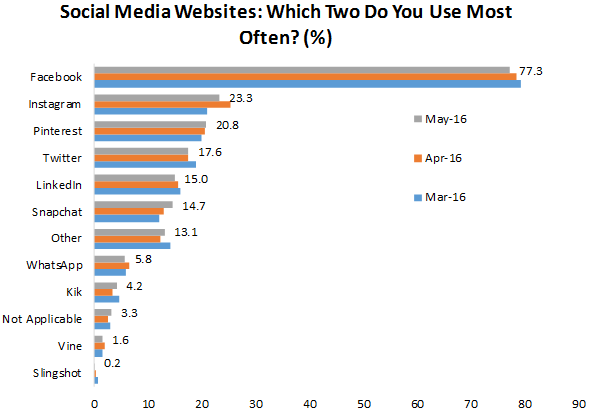
Facebook Still King: In Friday’s article, we wrote about how daily active users (DAUs) of Snapchat have overshadowed DAUs on Twitter. What we also saw in those charts is that Facebook has consistently remained the most popular social network, both in terms of users and engagement. The social media giant has remained popular among consumers, but it continues to increase its popularity among retailers as well.
Survey Says: An overwhelming majority of consumers have a Facebook account and engagement is also exceptionally high. With this kind of reach, Facebook continues to change the consumer landscape, both for social media and retail. Retailers have noticed this trend among consumers and have done their best to keep up with the ever-changing preferences and attention spans of the consumer. A case and point: Kohl’s recently saw a big boost in popularity after a customer posted a video of herself on Facebook after purchasing a Chewbacca mask at one of their stores and putting it on when she got in her car. The video went viral and has 154+ million views, the most ever for a Facebook video. Not bad for Kohl’s since she mentioned it twice in the video that she purchased the mask in a Kohl’s store. When the video began to go viral, Kohl’s app became the most popular retail app in the iOS App Store, and it has continued to try to feed off of this recent popularity.
You can see our entire data-set of proprietary survey analysis with a 30-day free trial to our Consumer Pulse offering. We have said it before, but we’ll say it again: The value in the Bespoke Consumer Pulse offering is tremendous. We strongly encourage you to give our Consumer Pulse subscription a try!
Click here to learn more about the Consumer Pulse offering, or go ahead and start a 30-day free trial using one of the checkout links below.
Annual — Bespoke Consumer Pulse — $365/Year w/ 1-Month Free Trial
Monthly — Bespoke Consumer Pulse — $39.99/Month w/ 1-Month Free Trial
Dynamic Upgrades/Downgrades: 6/6/16
Bespoke Brunch Reads: 6/5/16
Welcome to Bespoke Brunch Reads — a linkfest of the favorite things we read over the past week. The links are mostly market related, but there are some other interesting subjects covered as well. We hope you enjoy the food for thought as a supplement to the research we provide you during the week.
Market Mavens
Ivy Zelman: Housing Hazards and Opportunities by Leslie P. Norton (Barron’s)
The former Credit Suisse housing analyst who saw the last recession’s root cause thinks there are opportunities in housing but is worried about Miami and New York. [Link, paywall]
Joel Greenblatt: Don’t make this investing mistake by Kelly Evans (CNBC)
An insightful overview of Greenblatt’s investing process and views on the market overall. [Link; auto-playing video]
Economics
How to Teach Intermediate Macroeconomics after the Crisis? by Oliver Blanchard (Peterson Institute for International Economics)
A reasonable proposal on how to teach the basic framework of macroeconomics in the context of the global financial crisis and recent developments. [Link]
Growing like Spain: 1995-2007 by Manuel García Santana, Josep Pijoan-Mas, Enrique Moral-Benito, Roberto Ramos (Voxeu)
An analysis of how Spain managed to grow at excessive rates for over a decade despite falling total factor productivity. [Link]
Today In Tweeting
Why did I tweet that? by Duncan Weldon (Medium)
Former BBC Newsnight Economics correspondent gives an honest accounting of what Twitter means to him at both a personal and professional level. [Link]
Why Turkey’s Paying Attention to U.S. Attorney’s Oklahoma Thunder Tweet by Isobel Finkel (Bloomberg)
Only in 2016 could a tweet from a US attorney in New York related to an Oklahoma City basketball player could be politically sensitive in Turkey because of cleric living in Pennsylvania. Yeah, we’re confused too. [Link]
Internet Interests
Mary Meeker’s 2016 internet trends report: All the slides, plus analysis by Ina Fried (recode)
May Meeker of Kleiner Perkins compiles an annual report on the state of play for the online world. It weighs in at 213 pages, so recode provided its top three takeaways along with the full presentation. [Link]
Rise of Ad-Blocking Software Threatens Online Revenue by Mark Scott (NYT)
1 in 5 smartphone users have adblocking software installed, threatening the burgeoning advertising empires of Facebook and Google, let alone the revenues of other digital media companies. [Link, soft paywall]
Lending, Old & New
Dimon Says Auto-Loan Market Stressed, Sees Pain for Banks by Hugh Son (Bloomberg)
While by no means predicting a crisis, two major US banking executives have warned on the US auto lending market, which has gotten extremely competitive. [Link]
Inside Uber’s Auto-Lease Machine, Where Almost Anyone Can Get a Car by Eric Newcomer and Olivia Zaleski (Bloomberg)
In order to attract a supply of drivers, Uber has started leasing cars to drivers who want to drive but don’t have a car and can’t procure one on their own. [Link, auto-playing video]
Deloitte just trashed the hype around a $180 billion fintech market by Oscar Williams-Grut (Business Insider)
Specialists might be able to succeed in niches, but fintech likely won’t make a major dent in the business models of banks, according to Deloitte. [Link]
Sports
Muhammad Ali: Champion of the World by Keith Olberman (The Ringer)
A personal summary of four different encounters between the author and Ali, one of the greatest sports and cultural icons of the 20th century if not ever. [Link]
How many more homes is ESPN in than FS1 and NBC Sports Network? (June 2016 edition) (Sports TV Ratings)
An accounting of the narrow lead that ESPN has over its rival FS1 in terms of US home penetration. [Link]
Food & Drink
A Renegade Muscles In on Mister Softee’s Turf by Andy Newman and Emily S. Ruebb (NYT)
The iconic New York City soft ice cream brand has lost a battle on the ground in Midtown to a brash upstart. [Link; soft paywall and auto-playing video]
SodaStream Launches Homemade Beer System by SodaStream International (PRNewswire)
The Israeli upstart and challenger to the big two of global soda has shifted its eyes to another massive beverage market. [Link]
Tech Troubles
The Apple Watch is being shunned by Apple’s most important community by Julie Bort (Business Insider)
There’s a death of interest in the Apple Watch from developers, who Apple needs to keep engaged in order to develop new use cases of its hand-wearable computers. [Link]
These May Be the Only People Who Want Yahoo to Thrive by Andy Hoffman (Bloomberg)
While Yahoo’s core business may not have much value in total, specific units have a devoted, dependent user base…including Yahoo Messenger, which is beloved by crude oil traders. [Link]
Social Studies
‘Demographic dividend’ is under way with collapse in fertility by Sanjeev Sanyal (India Times)
India is the fastest growing major economy in the world, but much of that growth is due to rapid population expansion. Contrary to popular perception, the fertility rate in India is actually plunging, which probably makes eliminating poverty easier. However, it could create pain for growth. [Link]
The Tragic Side of Weddings by Amanda Foreman (WSJ)
What’s supposed to be the happiest day is often anything but. [Link, paywall]
Why I Was Wrong About Liberal-Arts Majors by David Kalt (WSJ)
A mea culpa admitting that some of the best, highest productivity, and most innovative coders come from a background that’s anything but computer science. [Link, paywall]
Conflicted Future
Business Leaders Share Their Biggest Concerns About The Future Of Business by Vivian Gang (Fast Company)
While we all like to worry about the future (don’t even get us started on the stock market angst we see daily!) the worries can sometimes be instructive. [Link]
States, Cities Clash on Pay and Benefit Rules by Anna Louie Sussman (WSJ)
With progressive cities raising minimum wages, state governments are attempting to prevent the local adjustments – an ironic inversion of the argument so often made to concentrate power in the hands of states. [Link, paywall]
The case for black holes being nothing but holograms just got even stronger by Bec Crew (Business Insider)
We aren’t astrophysicists and our lack of understanding was almost painful while we read this article. An interesting set of developments, however. [Link]
The Closer 6/3/16 – “End of Week Charts”
Looking for deeper insight on global markets and economics? In tonight’s Closer sent to Bespoke clients, we break down weekly Commitment of Traders data from the CFTC, recap weekly price action, and update economic surprise indices for world economies.
The Closer is one of our most popular reports, and you can sign up for a trial below to see it and everything else Bespoke publishes free for the next two weeks!
Click here to start your no-obligation free Bespoke research trial now!
The BESPOKE REPORT — 6/3/16
Below is a look at the recent performance of various asset classes using key ETFs tracked by Bespoke on a daily basis. While the S&P 500 (SPY) closed the week up 2 basis points, we saw weakness in sectors like Energy, Financials and Telecom, and we saw strength in Consumer Staples, Health Care, Materials and Utilities. Outside of the US, Brazil and China both posted big gains this week, while Italy, Mexico, Spain, Russia and the UK fell. Oil fell as well, while natural gas saw a big move higher. Treasury ETFs rose significantly on Friday following the weak jobs report. They’re now up solidly on a year-to-date basis as well.

Each week, Bespoke sends clients across all of its subscription levels the Bespoke Report newsletter. If you’re looking for Bespoke’s analysis of current market internals, economic data, earnings beats and misses, individual stock ideas, and more, the Bespoke Report has it all.
Continue reading this week’s Bespoke Report by starting a 14-day free trial to our paid content below.
Have a great Memorial Day weekend!
Spot the Pattern
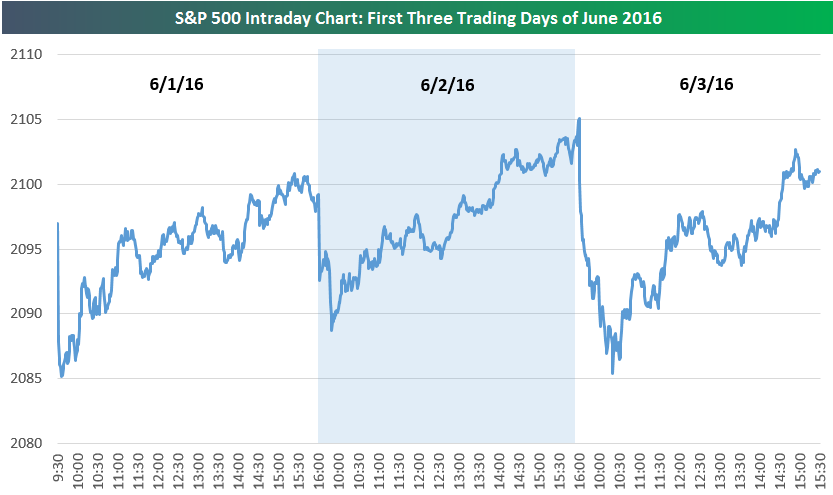
We’re now three trading days into the month of June, and the market is pretty much right where it ended May. But while the S&P 500 is up a whopping 3 points so far this month, the action we’ve seen has been very impressive. How so you may ask. Have a look at the chart below. It’s an intraday minute-by-minute chart of the S&P 500 over the first three trading days this month (Wednesday, Thursday and Friday).
As you can see, we’ve seen a big sell-off each morning just after the open of trading, but then we’ve seen steady buying throughout the trading day all the way into the close. Even today as the market digested a horrible jobs report at 8:30 AM ET, we saw buyers step in by 10:30.
Early-morning selling followed by steady intraday buying, especially into the close, is seen as a bullish signal for the market. Let’s see if this trend carries over into next week. Start a free research trial below for additional market analysis.
Dow 30 Trading Range Screen
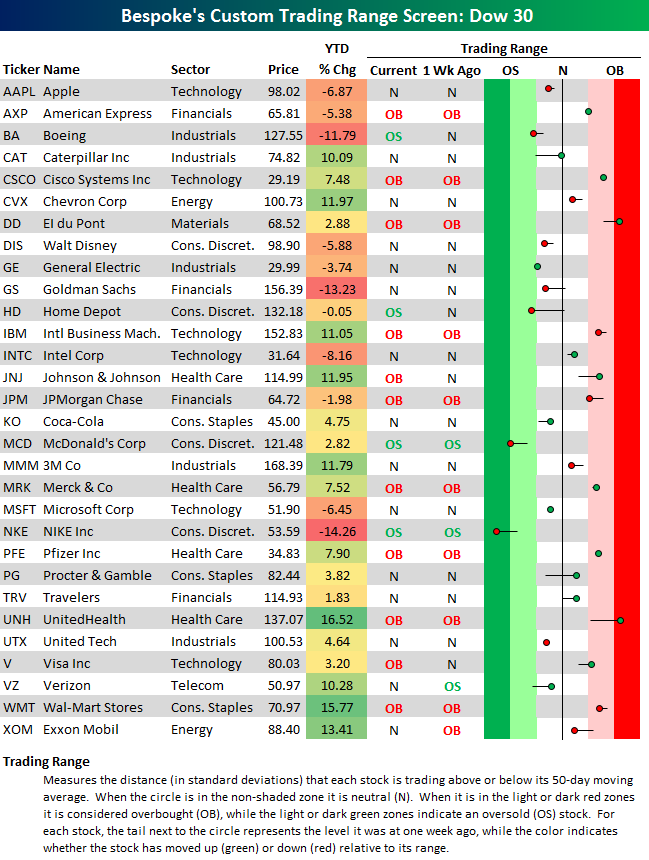
Below is an updated snapshot of our Dow 30 trading range screen. For each stock, the black vertical “N” line represents its 50-day moving average, while the dot represents where it’s currently trading within its range. You can read more about our calculations at the bottom of the screen.
To close out the week, 11 Dow stocks are “overbought” while just 4 are “oversold.” DuPont (DD) and UnitedHealth (UNH) are at the most extreme overbought levels, while Nike (NKE) and McDonald’s (MCD) are the most oversold.
Looking at YTD returns, 9 of 30 Dow stocks are now up double-digit percentage points on the year, with UNH up the most at +16.5%. Nike (NKE) and Goldman Sachs (GS) — two of the Dow’s most recent additions — are down the most with declines of 14.26% and 13.23%, respectively. Start a free research trial below if you’d like to see more of our trading range screens.