
B.I.G. Tips – US Economic Indicator Diffusion Index Remains Positive
The Closer — Oil & EURCHF Break Out, PPI Surge, BoC Business Outlook — 4/10/18
Log-in here if you’re a member with access to the Closer.
Looking for deeper insight on markets? In tonight’s Closer sent to Bespoke Institutional clients, we review recent price action in crude and a currency cross that’s breaking out and indicative of solid risk sentiment. We also discuss a strong PPI report today and yesterday’s Business Outlook and Senior Loan Officer Surveys from the Bank of Canada.
See today’s post-market Closer and everything else Bespoke publishes by starting a 14-day free trial to Bespoke Institutional today!
Gas Prices Near Two Year Highs
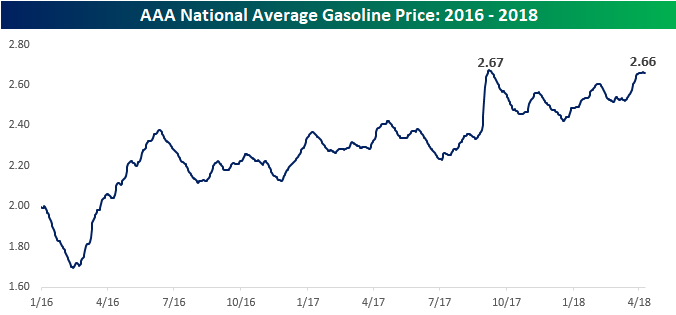
With all of the concern over inflation recently, nowhere do rising prices hit closer to home than at the gas pump (unless you’re driving a Tesla of course). As you might expect given that crude oil prices are in the mid-60s, prices at the pump have been on the rise. According to AAA, the national average price currently stands at $2.66 per gallon, which is just off the $2.67 post-crash high that we saw late last summer in the aftermath of the hurricanes.
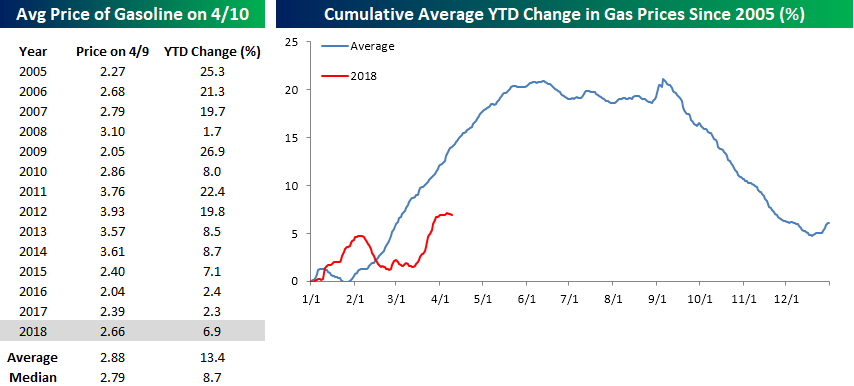
While prices have been on the rise this year, the magnitude of the move has hardly been out of the ordinary for this time of year. The table to the lower left shows the YTD change (through 4/9) for the national average price of a gallon of gas going back to 2005. While prices are up 6.9% this year, that’s actually only slightly more than half the average YTD change of 13.4% as of early April and nearly two percentage points below the median change of 8.7%. In the lower right chart, we have created a composite chart of the average price of gasoline throughout the year. As shown, it’s very common for gas prices to rise in the first three months of the year. In fact, there hasn’t been a single year since 2005 that the national average price was down YTD through 4/9, and this year’s 6.9% gain is the fourth smallest YTD gain of the last fourteen years.
Based on historical trends, we’re also only about two months from the point in the year where gas prices typically peak (mid-June). From that point through the Summer, prices typically level off before plummetting to close out the year.
Biggest Drop in Small Business Sentiment Since 2015
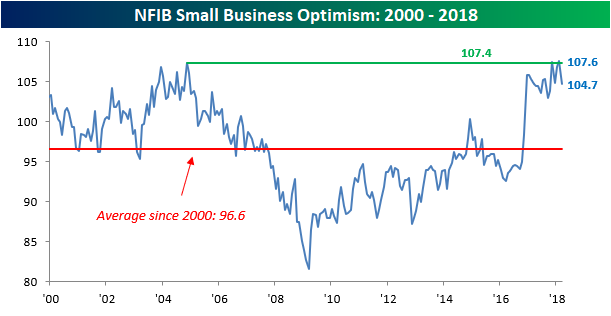
After hitting multi-decade highs in February, optimism on the part of small businesses pulled back a fair amount in March. While economists were expecting the headline index to see a slight pullback to 107.0 from last month’s reading of 107.6, the actual decline was much larger as the index dropped to 104.7. With a m/m decline of 2.9 points, this month’s drop was the largest drop since 2015. In terms of the report’s reading relative to expectations, however, we actually saw a bigger miss back in January with the release of the December 2017 report.
Even with this month’s decline, however, we would note that sentiment on the part of small businesses remains positive and is well above the historical average reading of 96.6. Also, as noted in the report, of the 432 historical monthly readings, only 20 have been higher than this month’s level.
In terms of the biggest problems facing small businesses, the table below summarizes this month’s breakdown. Topping the list once again this month is Quality of Labor which received 21% of the votes. That’s a high reading, but it’s actually down from February’s reading of 22%. Falling further and further down the “problems list” is Govt Red Tape and Taxes. While markets have grown increasingly concerned about price pressures in the last couple of months, small business owners aren’t seeing it yet as only 1% cited inflation as their number one problem, and that’s down from 2% last month.

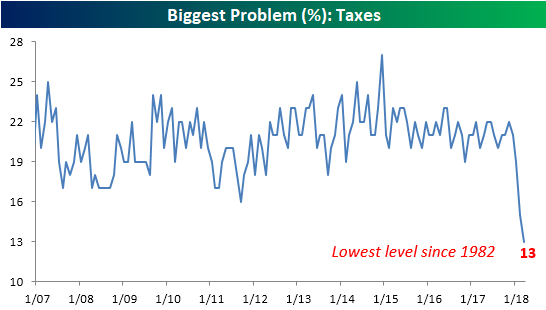
In the case of Taxes, the percentage of businesses citing that issue as their biggest problem has plummetted ever since the Tax Reform bill was signed into law. According to the NFIB, it hasn’t been cited by this few a percentage of businesses since 1982!
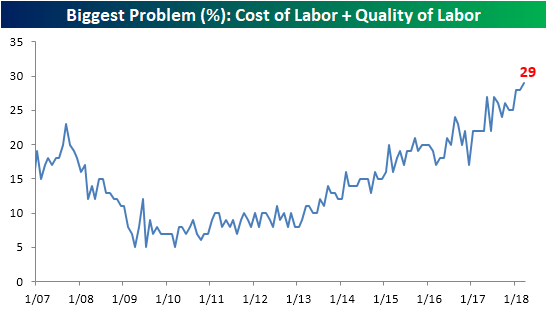
Inflation may not be a big concern at this point for small businesses, but with issues arising regarding labor quality and costs, that could very well lead to higher wages and ultimately higher prices. As shown in the chart below, 29% of small businesses cited either labor quality (21%) or labor costs (8%) as their number one problem this month. That’s the highest level in at least a decade.
Bespoke Stock Scores — 4/10/18
Chart of the Day: The Day After The Big Reversal
The Closer — CBO Charted — 4/9/18
Log-in here if you’re a member with access to the Closer.
Looking for deeper insight on markets? In tonight’s Closer sent to Bespoke Institutional clients, we chart changes to the long-term economic growth and budget outlook today as forecast by the Congressional Budget Office.
See today’s post-market Closer and everything else Bespoke publishes by starting a 14-day free trial to Bespoke Institutional today!
Chart of the Day: ISM Commodities Survey Pauses
Bespoke’s Most Volatile Stocks on Earnings: April 2018 Edition
The first quarter earnings season begins today. With the stock market struggling lately, there seem to be a lot of bulls hanging their hopes on earnings strength to help pull the market out of correction territory.
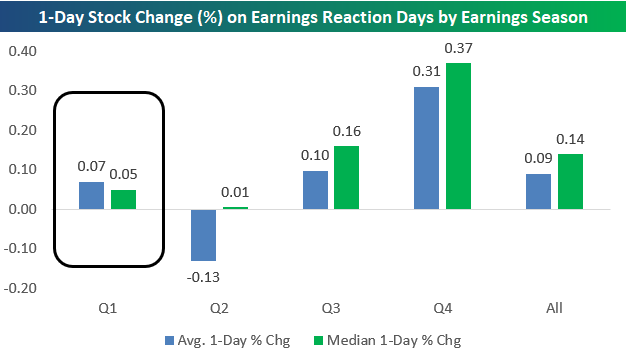
From a seasonal perspective, stocks don’t typically react all that great to their first quarter earnings reports. Using our Earnings Screener tool, we can see how stocks typically react to earnings reports by quarter. Historically, the average stock has gained 0.07% on its earnings reaction day during the first quarter earnings season. That’s the second worst quarter behind only the second quarter reporting period. The best earnings season for stock prices is Q4, when the average stock gains 0.31% on its earnings reaction day. This held true last season when the average stock gained 0.45%.
(For a stock that reports in the morning before the open, its earnings reaction day is that trading day. For a stock that reports after the close, its earnings reaction day is the next trading day.)
Start a free trial to Bespoke Institutional to begin using our Earnings Screener now.
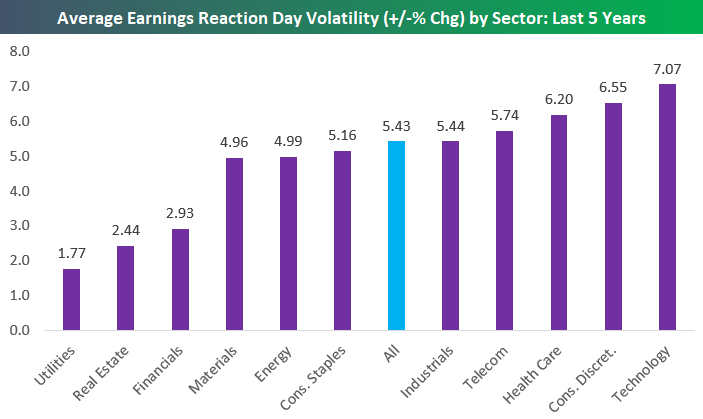
Over the last five years, the average stock that has reported earnings has gained or lost 5.43% on its earnings reaction day. That’s a huge move for investors to deal with once every three months.
Below we have broken out the average daily move for stocks reporting earnings by sector. As expected, Utilities stocks experience the least amount of volatility in reaction to their earnings reports. Notably, though, Financial stocks are the third least volatile in reaction to earnings with an average one-day move of +/-2.93%. The remaining sectors all experience average moves of roughly +/-5% or more.
At the high end of the list is Technology. As shown, the average Tech stock moves +/-7.07% on its earnings reaction day. Consumer Discretionary stocks are the second most volatile to earnings with an average absolute move of 6.55%. Health Care ranks third at +/-6.2%, followed by Telecom and Industrials.
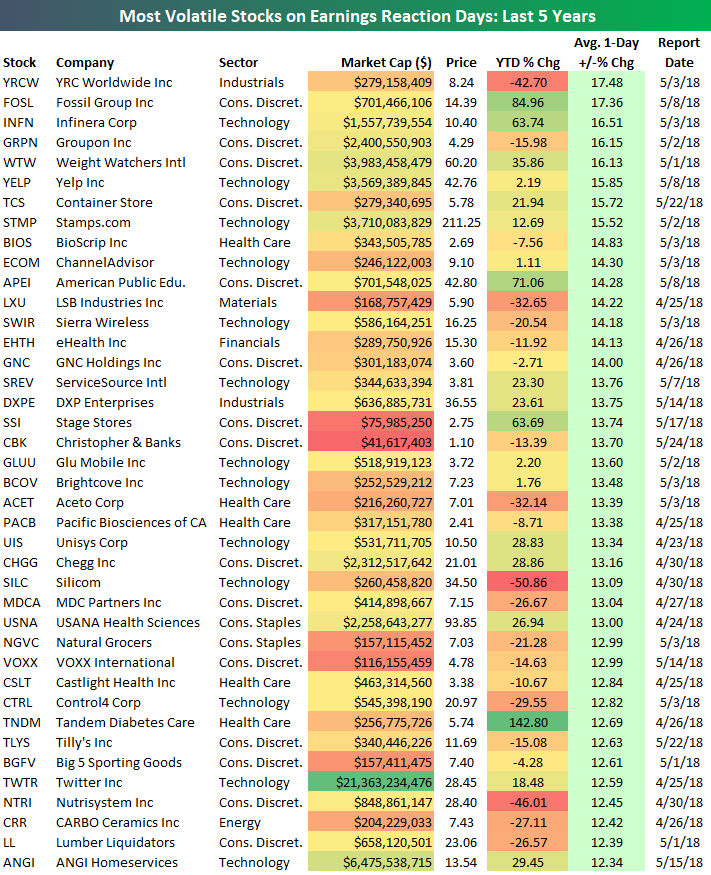
As we do ahead of each earnings season, below is a list of the most volatile stocks on earnings over the last 5 years (last 20 earnings reports). To make the list, a stock needs to have at least 4 years (16 earnings reports) worth of earnings, and it must be set to report its next quarterly number between now and the end of May.
As shown, YRC Worldwide (YRCW) is the most volatile stock on earnings with an average move of +/-17.48% on its earnings reaction day. Fossil Group (FOSL) ranks second just behind YRCW at +/-17.36%. Three more stocks have averaged moves of more than 16% on their earnings reaction days — Infinera (INFN), Groupon (GRPN), and Weight Watchers (WTW).
Other notables on the list of most volatile stocks on earnings include Yelp (YELP), GNC Holdings (GNC), Twitter (TWTR), and Nutrisystem (NTRI).
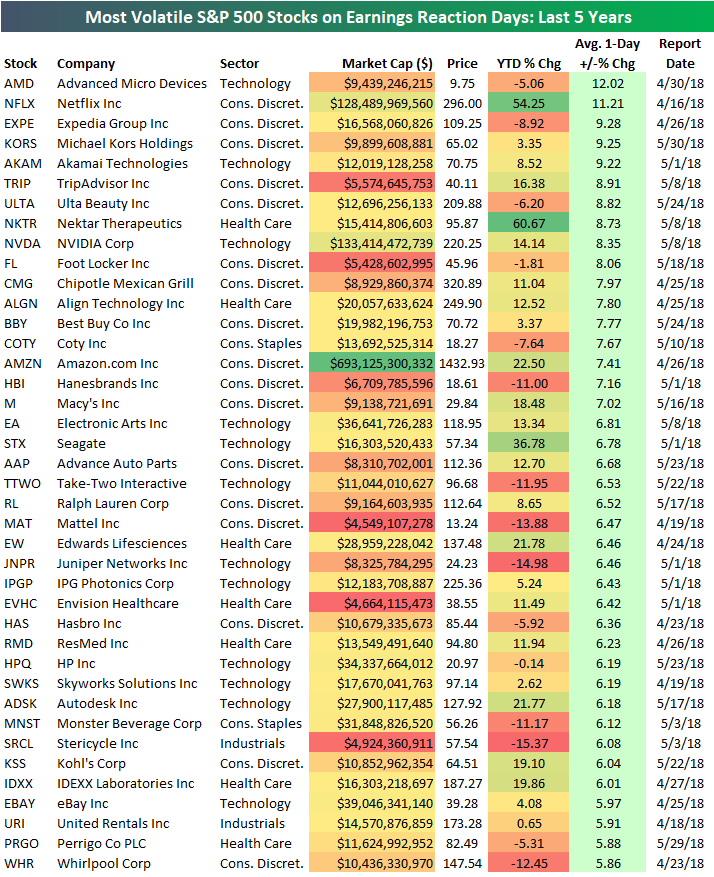
Not one S&P 500 stock made the list of the top 40 most volatile stocks on earnings, so below we show the 40 most volatile S&P 500 stocks on earnings.
Advanced Micro Devices (AMD) ranks first with an average move of +/-12.02% on its earnings reaction days over the last 5 years. Netflix (NFLX) ranks second with an average move of +/-11.21%. AMD and NFLX are the only two S&P 500 stocks that typically experience moves of 10% or more on earnings.
Expedia (EXPE), Michael Kors (KORS), and Akamai (AKAM) round out the top five. Other notables on the list include NVIDIA (NVDA), Chipotle (CMG), Best Buy (BBY), Amazon.com (AMZN), Electronic Arts (EA), and eBay (EBAY).
Analysts Retreat
Earnings season kicks off this week as the first of the major companies start to report Q1 numbers. Most of the big names reporting are Financials like Blackrock (BLK) on Thursday after the close, and then Citigroup (C), JP Morgan (JPM), PNC, and Wells Fargo (WFC) on Friday morning. Besides these names, the only non-Financials of note are Bed Bath & Beyond (BBBY) on Wednesday and Delta (DAL) and Rite Aid (RAD) on Thursday.
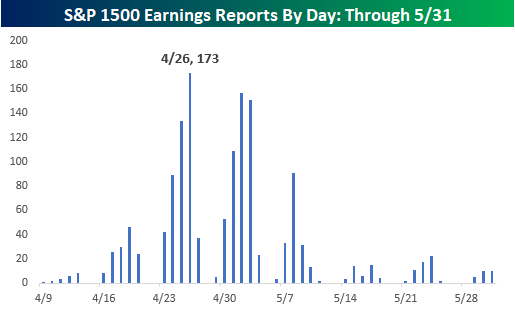
The pace of reports will pick up next week when 134 companies in the S&P 1500 are expected to report, but the peak period of earnings season will be over the following two weeks when more than 450 companies are scheduled to report each week. The busiest day during that period will be on 4/26 when 173 companies in the S&P 500 are expected to report in a single day! For a more detailed rundown of the earnings schedule for the upcoming season, please see our Interactive Earnings Calendar, and to prepare for how individual companies you follow tend to react to earnings, make sure to check out our Earnings Screener (available to all Institutional clients).
We just published our quarterly look at analyst EPS revisions heading into this earnings season. In this report, we look to see if analysts are bullish or bearish on earnings for the upcoming quarter. Analyst sentiment at the start of earnings season has historically had a big impact on the stock market’s performance.
This report is a must-read. To see it, sign up for a Bespoke Premium membership now!