
Chart of the Day: Wicked Wednesday, Turnaround Thursday?
Bespoke’s Sector Trading Range Charts
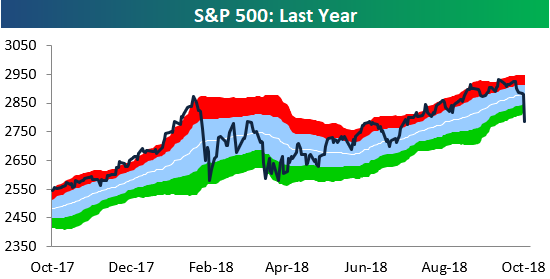
The S&P 500’s 3.3% drop on Wednesday (10/10) leaves the index down 4.4% month to date already. Below is a look at our updated Bespoke sector trading range charts to see what’s left in the rubble after a truly horrific start to the month for stocks.
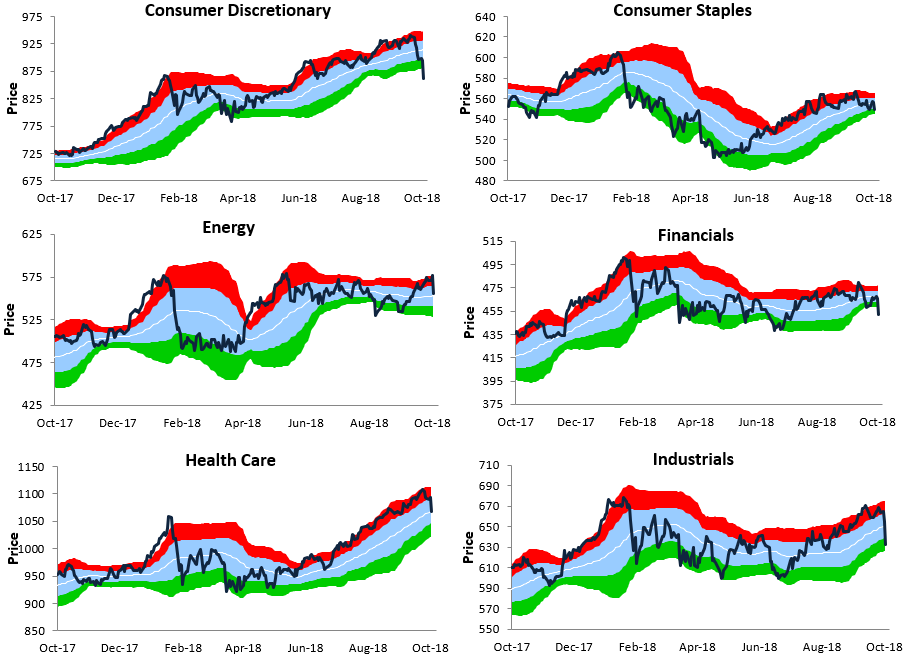
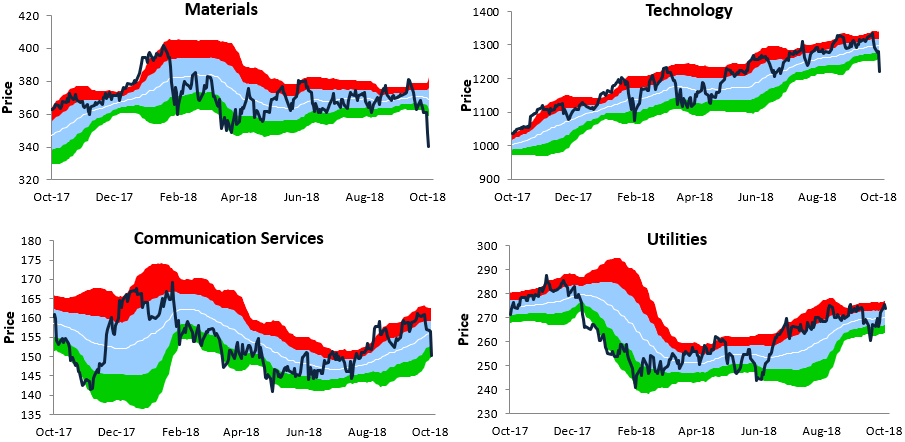
The light blue shading in each chart represents each index’s “normal” trading range, which is one standard deviation above and below the 50-day moving average. Moves into the red or green zones mean the index has gotten “overbought” or “oversold.” An “oversold” reading means price is more than one standard deviation below the 50-DMA, and vice versa for an “overbought” reading.
After yesterday’s drop, the S&P 500 has reached its most oversold level since the end of the first quarter when the index successfully re-tested its February correction low.
Looking at individual sectors, a number of them broke down badly yesterday and are now trading at or close to their most extreme oversold levels of the last year. These include Consumer Discretionary, Materials, and Technology.

The Closer — Stocks Smoked — 10/10/18
Log-in here if you’re a member with access to the Closer.
Looking for deeper insight on markets? In tonight’s Closer sent to Bespoke Institutional clients, we go into detail on today’s equity market selloff, including index technicals, the collapse of growth versus value, a huge decline in the Nasdaq 100, and the role interest rate term structure has played in equity selling.
See today’s post-market Closer and everything else Bespoke publishes by starting a 14-day free trial to Bespoke Institutional today!
PPI Maintains Its Pace
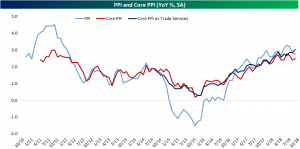
The BLS released September Producer Price Index numbers this morning. PPI has been gradually accelerating since late 2015/early 2016, but recent months saw PPI begin to slow by its headline measure. The headline PPI decelerated again last month down to 2.73% YoY from 2.83% the month before. This continues a trend over the past few months of the headline measure surprising lower. Meanwhile, Core PPI which removes food and energy accelerated slightly to 2.48% YoY from 2.4%. A more refined measure of PPI excluding foods, energy, and trade services increased the most, up 3.02% YoY compared to 2.84% in August. This is the first time this measure of core PPI has been higher than the headline number since June 2017. While the headline data may confirm multiple recent Fed members claiming to not see any striking issues concerning inflation on the horizon, the core measures indicates pretty broad price pressures after removing volatile components (food, energy) and margins for retail and wholesale operators.
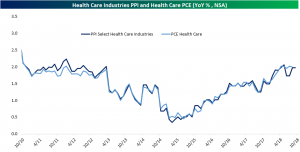
We also like to look at the PPI index for Select Health Care Industries, which the BEA uses as a direct input for PCE Health Care. As shown below, the PPI measure shows that health care inflation continues to run at a reasonably strong clip and about in-line with core inflation.
B.I.G. Tips – Analysts Increasingly Pessimistic
Earnings season kicks off this week as the first of the major companies start to report Q3 numbers. Most of the big names reporting are Financials like Citigroup (C), JPMorgan Chase (JPM), PNC, and Wells Fargo (WFC), which all report on Friday morning. Besides these names, the only non-Financials of note are Delta Air Lines (DAL) and Walgreens Boots (WBA), which both report before the open on Thursday.
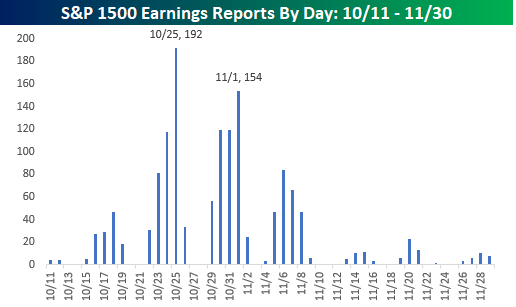
While the pace of reports is quiet this week, things will pick up next week when 126 companies in the S&P 1500 are expected to report. The peak period of earnings season, though, will be in the two weeks that follow as more than 900 companies in the S&P 1500 are scheduled to report. That’s 60% of the entire index in just two weeks! The busiest day during that period will be on 10/25 when 192 companies in the S&P 1500 are expected to report in a single day, while the second busiest day of earnings season is one week later on 11/1 when another 154 companies will report. For a more detailed rundown of the earnings schedule for the upcoming season, please see our Interactive Earnings Calendar, and to prepare for how individual companies tend to react to earnings, check out our Earnings Screener (available to all Institutional clients).
Just in time for earnings season, in a just-published B.I.G. Tips report, we presented an analysis of how analyst sentiment heading into earnings season impacts stock market performance during the ensuing reporting period. For access to this must-see report, sign up for a monthly Bespoke Premium membership now!
Fixed Income Weekly – 10/10/18
Searching for ways to better understand the fixed income space or looking for actionable ideals in this asset class? Bespoke’s Fixed Income Weekly provides an update on rates and credit every Wednesday. We start off with a fresh piece of analysis driven by what’s in the headlines or driving the market in a given week. We then provide charts of how US Treasury futures and rates are trading, before moving on to a summary of recent fixed income ETF performance, short-term interest rates including money market funds, and a trade idea. We summarize changes and recent developments for a variety of yield curves (UST, bund, Eurodollar, US breakeven inflation and Bespoke’s Global Yield Curve) before finishing with a review of recent UST yield curve changes, spread changes for major credit products and international bonds, and 1 year return profiles for a cross section of the fixed income world.
This week we look at where real yields are sitting around the world.
Our Fixed Income Weekly helps investors stay on top of fixed income markets and gain new perspective on the developments in interest rates. You can sign up for a Bespoke research trial below to see this week’s report and everything else Bespoke publishes free for the next two weeks!
Click here and start a 14-day free trial to Bespoke Institutional to see our newest Fixed Income Weekly now!
Small Cap Stocks Getting Crushed Across Sectors
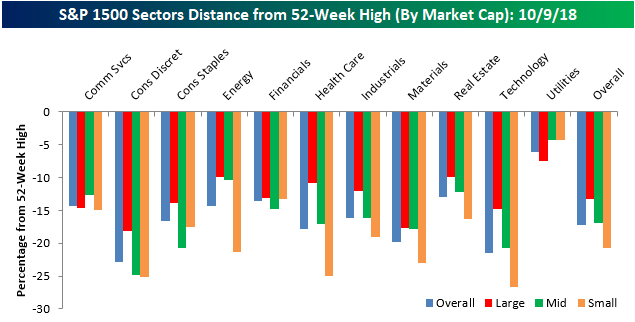
In a post yesterday, we highlighted the fact that while large-cap stocks in the S&P 500 were down an average of 13.2% from their 52-week highs, small-cap stocks were faring much worse, with stocks in the S&P 600 Small Cap index down an average of over 20% from their respective highs. Today, we wanted to go into a little more detail on these market cap divergences by looking at how far stocks are down from their 52-week highs within individual sectors.
While small-cap stocks are down an average of 20.7% from their 52-week highs, small-cap Technology, Consumer Discretionary, and Health Care stocks are down an average of much more. In the Technology sector, for example, the average spread between where individual small cap tech stocks are trading relative to their 52-week highs is 26.7%, while in the Consumer Discretionary sector that same spread is just over 25%. While stocks in these sectors have sold off sharply from their 52-week highs, stocks in the Utilities sector are down less than 5% on average from their 52-week highs. Utilities is also the only sector where the average small-cap stock is down less from its 52-week high than the average large-cap stock in the sector.
Speaking of large caps, stocks in the Consumer Discretionary and Materials sector are trading down the furthest from their 52-week highs (~18%), while Utilities (-7.4%), Energy (-9.9%), and Real Estate (-9.95%) are the only three sectors where stocks are down less than 10%, on average, from their 52-week highs.
Bespoke’s Global Macro Dashboard — 10/10/18
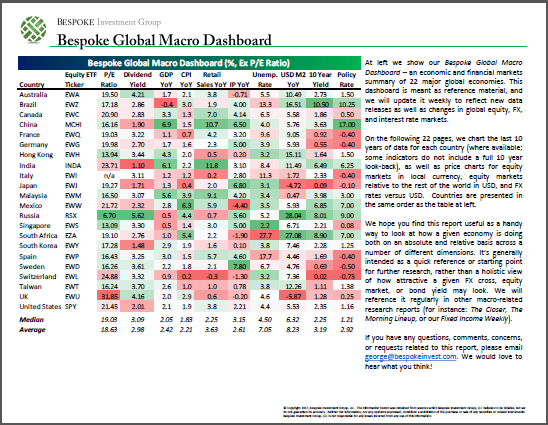
Bespoke’s Global Macro Dashboard is a high-level summary of 22 major economies from around the world. For each country, we provide charts of local equity market prices, relative performance versus global equities, price to earnings ratios, dividend yields, economic growth, unemployment, retail sales and industrial production growth, inflation, money supply, spot FX performance versus the dollar, policy rate, and ten year local government bond yield interest rates. The report is intended as a tool for both reference and idea generation. It’s clients’ first stop for basic background info on how a given economy is performing, and what issues are driving the narrative for that economy. The dashboard helps you get up to speed on and keep track of the basics for the most important economies around the world, informing starting points for further research and risk management. It’s published weekly every Wednesday at the Bespoke Institutional membership level.
You can access our Global Macro Dashboard by starting a 14-day free trial to Bespoke Institutional now!
Morning Lineup – Sector Divergences
Futures may be trading pretty flattish ahead of the open, and the S&P 500 may be right at its 50-day moving average, but don’t let the sense of calm fool you. There’s still a lot of rotation and big swings underneath the surface.
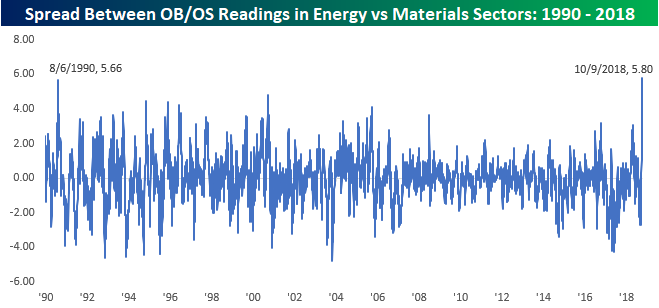
One example of that rotation is evident in the Materials and Energy sectors. As of yesterday, the Materials sector closed 3.83 standard deviations below its 50-DMA after dropping more than 3% yesterday. Meanwhile, the Energy sector has been acting well and finished the day 1.97 standard deviations above its 50-DMA. Going all the way back to 1990, there has never been a point where the spread between the two sectors Overbought/Oversold readings was wider. The prior record spread between the two sectors was in August 1990 just after Iraq invaded Kuwait. Talk about a divergence!
Start a two-week free trial to Bespoke Premium to see today’s full Morning Lineup report. You’ll receive it in your inbox each morning an hour before the open to get your trading day started.

Worst Performing Stocks This Month
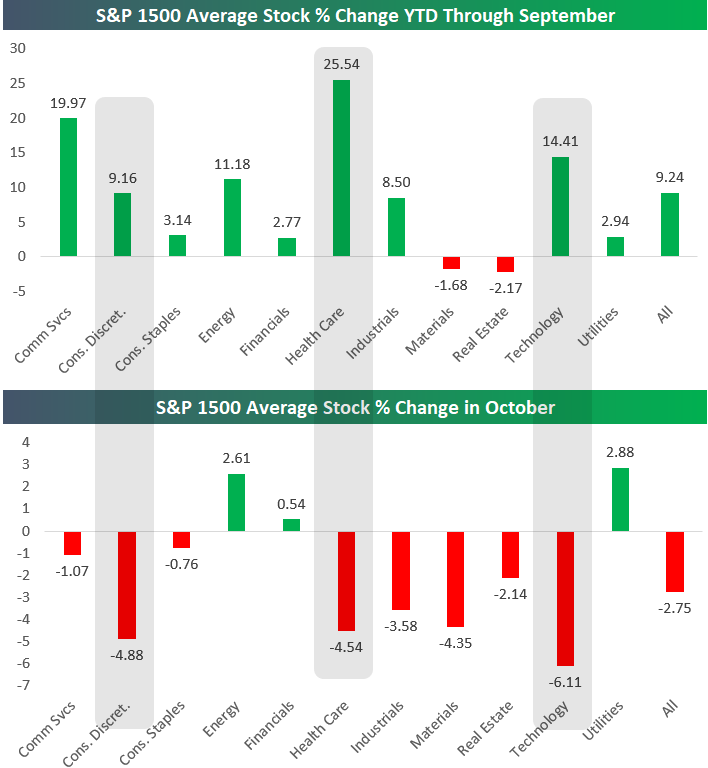
The average stock in the S&P 1500 was up 9.24% year-to-date through September, but October has been brutal for stocks thus far. On the surface, the S&P 1500 is only down 1.4% month-to-date, but what lies beneath is much worse. As shown in the chart below, the average stock in the index has fallen 2.75% this month, and cyclical sectors have taken it on the chin even harder.
While just 15 stocks in the S&P 1500 are up 10% or more this month, a whopping 106 are down more than 10%!
Technology stocks have been hit the hardest so far in October. After averaging a gain of 14.41% YTD through September, the average Tech stock has fallen 6.11% already this month. Other cyclicals like Health Care and Consumer Discretionary have been nearly just as bad with average declines of more than 4.5%.
As cyclicals have gotten crushed, investors have rotated into Utilities (defensives) the most with an average gain of 2.88% MTD.
Two other themes of October have been rising oil prices and the steepening of the yield curve. Rising oil prices have had a direct impact on Energy stocks, which have averaged a gain of 2.61% this month. The steepening of the yield curve helps banks make more money, and Financial stocks have averaged a gain of 0.54% in October.
Below is a list of the worst performing stocks in the S&P 1500 so far this month. All of the stocks listed have lost more than 15% of their value in just nine calendar days.
Akorn (AKRX) is down the most at -49.65%, followed by Cutera (CUTR) at -32.81% and LeMaitre Vascular (LMAT) at -30.2%. Both AKRX and CUTR were down on the year already coming into October, but LMAT was up 21.67% YTD as of the end of September. Now it’s down 15% YTD.
Other notables on the list of biggest losers include G-III Apparel (GIII), RH (Restoration Hardware), Microchip (MCHP), and American Airlines (AAL).
