
Morning Lineup – Flat-line
It’s hard to remember a time in recent memory when futures were as muted as they have been this morning. For the last three hours now, Dow futures have essentially been in a range of indicating an open of +/- 15 points from yesterday’s close! There’s not much incentive to do anything major, though, as many traders appear content to sit on their hands ahead of this weekend’s G-20 meeting where both sides seem to be actively lowering expectations ahead of the meeting. Things could get a little more interesting for the rest of the day, though, as five FOMC voters (including Powell) are scheduled to speak today.
Please read today’s Morning Lineup to get caught up on everything you need to know ahead of the new trading day including a look at Gold’s overbought levels, the weak UK Retail Sales earlier today, and weak manufacturing confidence out of France.
Bespoke Morning Lineup – 6/25/19

As mentioned above, there’s going to be a lot of Fed commentary on the wires today, beginning with Williams coming up in a few minutes. The big one, though, will be Powell, who is scheduled to speak at 1PM New York time. Besides the Fed speak, we have some important economic data, including the Richmond Fed, which will likely be weak on the heels of the very disappointing prints from New York, Philly, and Dallas. Besides that, New Home Sales are expected to show a modest increase, while Consumer Confidence is expected to dip from last month’s print of 134.1.

Start a two-week free trial to Bespoke Premium to see today’s full Morning Lineup report. You’ll receive it in your inbox each morning an hour before the open to get your trading day started.
The Closer – Moving Average Hurdling, Manufacturing Stumbling – 6/24/19
Log-in here if you’re a member with access to the Closer.
Looking for deeper insight on markets? In tonight’s Closer sent to Bespoke Institutional clients, we begin with a look at forward returns when investment grade credit makes 52-week lows and the price action in small caps and EURUSD in reference to their moving averages. We also show models using credit spreads, rates, and Citi Economic Surprise indices as inputs to predict EURUSD and bank movements. Turning to economic data, we recap today’s surprisingly weak Dallas Fed Manufacturing Activity Index and what it means for our Five Fed Composite. We finish with a glance at Mexican economic activity.
See today’s post-market Closer and everything else Bespoke publishes by starting a 14-day free trial to Bespoke Institutional today!
Bitcoin Soars and Retail Investors Pile In
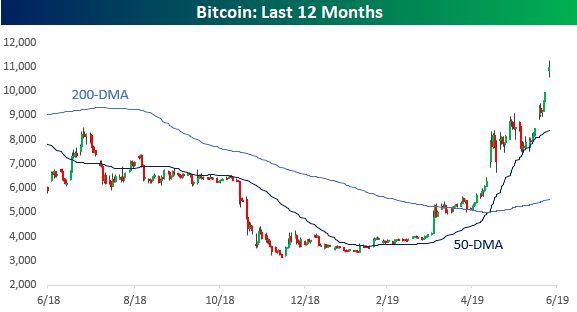
Bitcoin has been in massive rally mode for pretty much of all 2019, but the pace of gains has really accelerated in the last several days. While the price briefly topped $11,000 earlier, prices have pulled back slightly to just under that level now. Even with the pullback from earlier highs, though. year to date, bitcoin is up just about 200%, while in the month of June, the gain has already been just under 30%.
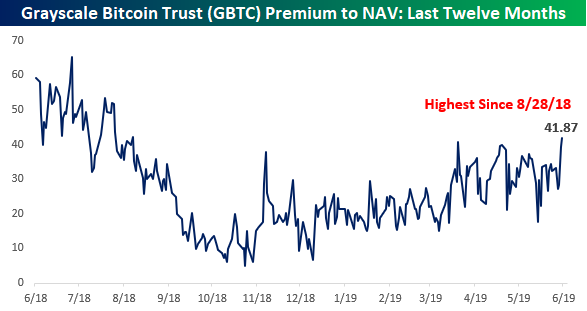
As prices have started to run up in recent days, retail enthusiasm for bitcoin has predictably increased. Because acquiring bitcoin isn’t nearly as simple of a process as buying traditional stocks, bonds, or other currencies, for many investors it simply isn’t worth the bother. One easier (and much more expensive) way to gain exposure to bitcoin, though, is through the Grayscale Bitcoin Trust (GBTC) which is the only ETF-like security that tracks the price of bitcoin. One major drawback to GBTC is that it is a very expensive way to trade bitcoin. Not only does the Trust charge a 2% annual fee, but it also traditionally trades at a massive premium to the actual value of the bitcoin held in the trust. Over the last year, for example, GBTC has traded at an average premium to NAV of 27%. That means that if you liquidated the Trust, the value of the assets would be worth considerably less than the price that the trust is trading at.
Because of the management fee and the fact that the trust trades at such a premium to NAV, it’s widely assumed that most of the buyers and sellers of GBTC are more retail-oriented as opposed to serious bitcoin investors. Therefore, when the premium to NAV is relatively low, it indicates that so-called retail interest in bitcoin is low, while higher premiums represent retail interest on the rise. With that in mind, a look at the recent trend in the trust’s premium to NAV suggests that retail investors have been increasingly warming up to bitcoin as prices rise. At the current level of 42%, GBTC’s premium is the highest since last August. While that’s a ten-month high, the premium was consistently higher in the first half of last year, and back when the retail frenzy over bitcoin was at its peak in early 2018, the premium topped 80%. Sentiment on the part of retail investors has been on the rise, but they aren’t quite yet going ga-ga for bitcoin. Start a two-week free trial to Bespoke Institutional to access our interactive tools and much more.
B.I.G. Tips – Stocks and Treasuries Both Capping Off a Strong First Half
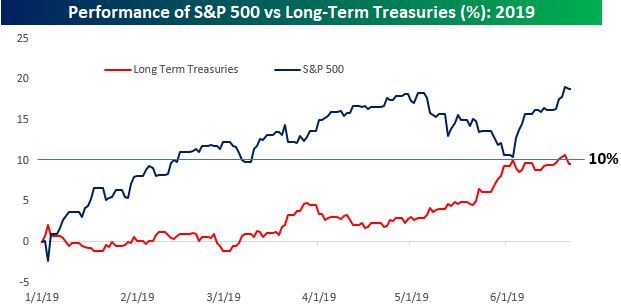
While the relationship between the performance of equities and US Treasuries has changed over time, throughout most of the bull market in equities off the March 2009 lows, positive equity performance has coincided with weaker performance in Treasuries and vice versa. This year has bucked that trend. While the S&P 500 has rallied nearly 19% on a total return basis, long-term Treasuries, as measured by the Merrill Lynch Long-Term Treasury index, have rallied just under 10% and were actually up over 10% on the year through last Thursday’s close. In our latest B.I.G. Tips report, we provided an analysis of prior years where equities and long-term treasuries both saw strong first half returns to see if there were any discernible trends for the second half. To see the report, sign up for a monthly Bespoke Premium membership now!
Bespoke CNBC Appearance (6/24)
Bespoke co-founder Paul Hickey appeared on CNBC Squawk Box on Monday (6/24) to discuss our outlook for Emerging markets. To view the segment, click on the image below. Start a two-week free trial to Bespoke Institutional to access our interactive tools and much more.

Citi Economic Surprise Indices: Eurozone Breaks Even
Global economic data has been quite a source of concern for policymakers on both sides of the Atlantic of late, with both the Fed and ECB opening the door to easing in part thanks to the weakness of global data. Ironically, recent Eurozone data has actually been less bad than recent history when measured by Citi’s Economic Surprise indices. Higher economic surprise index readings indicate data coming in stronger than forecast, while negative readings indicate misses. While both the US and global series have been near the bottom of the recent range, the Eurozone data surprise picture is more positive. While still just barely negative, the Eurozone index is at the best level since last summer. That stands in sharp contrast to the US and the global series, where data surprises are relatively low and trending lower. Start a two-week free trial to Bespoke Institutional to access our interactive tools and much more.
Chart of the Day: Gold Breakout Interest and Returns After Strong Months
Trend Analyzer – 6/24/19 – Health Care Getting Extended
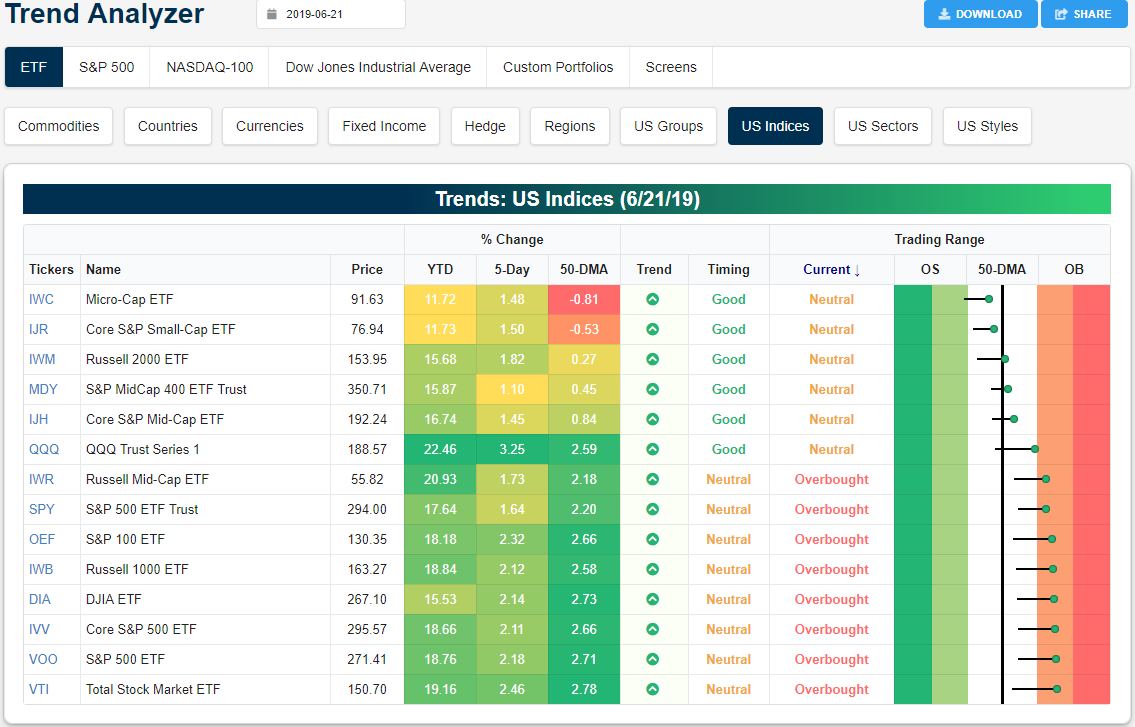
While the market pressed to new highs last week, conditions for large-cap index ETFs have become firmly overbought. Meanwhile, small and mid-cap major index ETFs lagged behind slightly. The Micro-Cap (IWC) and Core S&P Small Cap ETF (IJR) both remain neutral and currently sit below the 50-DMA. Another small-cap index, the Russell 2000 (IWM), saw slightly stronger performance than the aforementioned two and is just barely above its 50-DMA. Mid-caps are also neutral but sit more firmly above the 50-DMA, although the Russell Mid Cap (IWR) has moved into overbought levels. The Nasdaq (QQQ) was a bit of an outlier last week. In addition to considerably outperforming the other ETFs with a 3.25% gain over the past five days, it is also the only large-cap index to remain neutral after it was below the 50-day only one week ago. But these gains have now led the index to sit on the border of neutral/overbought.
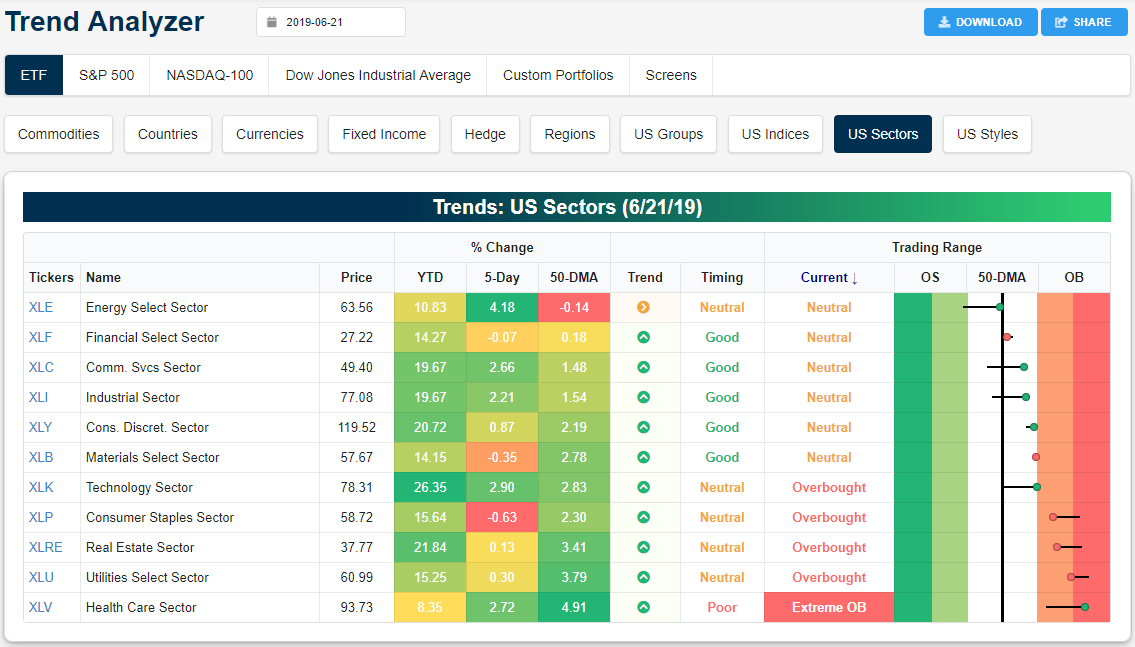
Turning to the individual sector ETFs, Energy (XLE) went on a tear last week rising 4.18%. This lifted XLE off of oversold levels, and despite handily outperforming the other sectors, it still sits just below the 50-DMA. While there are five sectors that are currently overbought, Health Care (XLV) has actually reached extreme levels. While XLE and XLV have been ripping higher, defensives—Real Estate (XLRE), Utilities (XLU), and Consumer Staples (XLP)—have taken a breather after hitting extreme overbought levels last week. Start a two-week free trial to Bespoke Premium to access our Trend Analyzer tool and our unique equity market research.
Bespoke’s Morning Lineup – Two-Minute Warning
Please read today’s Morning Lineup to get caught up on everything you need to know ahead of the new trading week. Start a two-week free trial to Bespoke Premium for access.
Bespoke Morning Lineup – 6/24/19
Bespoke Brunch Reads: 6/23/19
Welcome to Bespoke Brunch Reads — a linkfest of the favorite things we read over the past week. The links are mostly market related, but there are some other interesting subjects covered as well. We hope you enjoy the food for thought as a supplement to the research we provide you during the week.
While you’re here, join Bespoke Premium for 3 months for just $95 with our 2019 Annual Outlook special offer.
Real Estate
Drug Cop Worth $400 Million After Bets on Brooklyn Real Estate by Sophie Alexander and Tom Maloney (Bloomberg)
Greg O’Connell has a heck of an eye. The former cop turned real estate investor spent decades buying up chunks of Red Hook, Brooklyn, and is now sitting on $400mm worth of property in the rapidly gentrifying area. [Link; soft paywall]
Want a House Like This? Prepare for a Bidding War With Investors by Ben Casselman and Conor Dougherty (NYT)
Following the crisis, a vast infrastructure sprung up to facilitate investor purchases of single family homes. Now, that infrastructure is pushing out traditional buyers, especially in neighborhoods that are gentrifying. [Link; soft paywall]
Investors Are Buying More of the U.S. Housing Market Than Ever Before by Laura Kusisto (WSJ)
The flip side of investor interest in housing is the fact that home flippers are upgrading properties, something homeowners may be either ill-equipped to do or unable to finance. [Link; paywall]
Sports
Rays to explore splitting games with Montreal by Jeff Passan (ESPN)
In a non-traditional move, the Tampa Bay franchise is exploring a split between Florida and Quebec. [Link; auto-playing video]
There’s No Good Reason To Believe What The Golden State Warriors’ Doctors Say by Gabe Fernandez (Deadspin)
An investigation into the ethical minefield that team doctors have to navigate, and often don’t even bother trying to think about, when they’re trying to diagnose players and get them back into the game. [Link]
Facebook posts better at predicting diabetes, mental health than demographic info (ScienceDaily)
A UPenn study found that language analysis of Facebook posts can predict psychological and medical conditions, in some cases much better than demographic information alone. [Link]
Bodies In Seats by Casey Newton (The Verge)
Facebook content moderation imposes a horrific cost on workers, with a vendor in Tampa, Florida a particularly egregious example: the office has seen an employee die at his desk, and other workers report psychic tolls from the ocean of violence and child exploitation, often resulting in PTSD. [Link]
Facebook announces Libra cryptocurrency: All you need to know by Josh Constine (TechCrunch)
An overview of the foray the world’s largest social network is taking into the world of blockchain with its participation in the Libra project. [Link]
Facebook’s Libra: blockchain, but without the blocks or chain by Jemima Kelly (FTAV)
A much more skeptical take on Libra, which is not a blockchain, is tied to existing currencies, is not decentralized, and has error-prone smart contracts. All very exciting, and par for the course when it comes to splashy crypto-related roll-outs. [Link; soft paywall]
Aging
Your Professional Decline Is Coming (Much) Sooner Than You Think by Arthur C. Brooks (The Atlantic)
An essay on the psychological burden of moving out of one’s prime, and how that burden can be alleviated. [Link]
State of States
Is West Virginia Constitutional? by Hilary Parkinson (National Archives)
The counter-secession of Appalachian Virginia during the Civil War is debatably legal, although given the extenuating circumstances some grey area is probably understandable. [Link]
Public Health
Meet the New York couple donating millions to the anti-vax movement by Lena H. Sun and Amy Brittain (WaPo)
The story of two wealthy Manhattanites who are the largest funders of vaccine skeptic movements which are helping the spread of diseases once entirely controlled by modern medicine. [Link; soft paywall]
Major study suggests Medicaid work requirements are hurting people without really helping anybody by Dylan Scott (Vox)
An early look at the effects of Arkansas requiring Medicaid recipients to work suggests that thousands of eligible people have been cast off the Medicaid roles despite the fact that they are either employed or qualify for some kind of exemption. Moreover, the uninsured rate has spiked without any observable benefit to employment rates; in fact, despite a 4 percentage point bump in the uninsured rate, employment rates for the group dropped by almost as much. The work requirements have been put on hold by federal court since, after a judge ruled the requirements in that state and Kentucky violated federal law. [Link]
Fed Mandate
The Fed Takes a Second Look at Its Good-News Story on American Jobs by Matthew Boesler (Bloomberg)
The Federal Reserve may be rethinking the way that it approaches its mandate, influenced by persistent shortfalls in labor share of income and a building openness to the idea that inflation pressures are in part determined by class conflict. [Link]
Gastrodiplomacy
The Surprising Reason that There Are So Many Thai Restaurants in America by Myles Karp (Vice)
While there are millions of Thai immigrants in the United States, they certainly seem to punch above their weight when it comes to availability of cuisine. That’s an intentional ploy on the part of the Thai government, with benefits for adventurous American pallets. [Link]
Gold
How 7.4 Tons of Venezuela’s Gold Landed in Africa—and Vanished by Gabriele Steinhauser and Nicholas Bariyo (WSJ)
Aided by a Russian charter flight and a Ugandan refinery, the Maduro regime has been flying gold to Africa and remain solvent. [Link; paywall]
Bubbles
The Greatest Asset Bubble of All Time by Nick Maggiulli (Of Dollars And Data)
An investigation into asset bubbles: new and old, large and small, with all the attendant drama and plenty of charts to go along with the text. [Link]
Español
Is this the birthplace of written Spanish? by Miriam Foley (BBC Travel)
Notes made in the margins of Latin text by monks in 6th-century Rioja help show the evolution of local vulgar Latin into the second-most spoken language in the world. [Link]
Hong Kong
How Hong Kong Got a Million Protesters Out on the Streets by Hannah Dormido, Chloe Whiteaker, Karen Leigh and Cedric Sam (Bloomberg)
A graphic story showing how millions of protestors flooded the streets in protests against a new extradition bill. [Link]
Read Bespoke’s most actionable market research by joining Bespoke Premium today! Get started here.
Have a great weekend!