
The Closer – We Still Won’t, Oil Backwardation, Bearish Engulfing, Case-Shiller – 9/24/19
Log-in here if you’re a member with access to the Closer.
Looking for deeper insight on markets? In tonight’s Closer sent to Bespoke Institutional clients, we begin with a look at the massive spread in WeWork’s bonds following today’s headlines that CEO Adam Neumann will be stepping down. With the dust now settled after last week’s move in crude oil in the wake of attacks on Saudi facilities, we then review the shape of crude oil’s term structure. Next, we review the bearish engulfing pattern in the S&P 500. We finish with today’s economic data including Case-Shiller home prices, quarterly personal income, and an update to our Five Fed Manufacturing composite with today’s Richmond Fed release.
See today’s post-market Closer and everything else Bespoke publishes by starting a 14-day free trial to Bespoke Institutional today!
Dividend Stock Spotlight: KeyCorp (KEY)
Regional banks (KRE) never entirely recovered from last year’s Q4 downturn and have underperformed both the broader market and the rest of the financial sector since. But one silver lining is that the group is attractive with regards to dividends. Of the regional bank stocks in the S&P 1500, 85% have a yield that outpaces the index and 63% have a higher yield than the financial sector. Currently, the average regional bank stock in the S&P 1500 yields 2.73%. One of the ones that yields even more at 4.2% is KeyCorp (KEY). Additionally, unlike some of the other regional bank stocks that have elevated yields due to downtrends over the past year, KEY has a more attractive chart and is actually sitting in a modest uptrend having made a series of higher highs and higher lows since the start of the year. Currently, the stock is experiencing mean reversion after reaching overbought levels.
Given this uptrend, the desirable yield has more been a result of steady and more recently rapid growth in the dividend rather than declines in stock price as is the case with other regional banks. Today, that dividend is 30% larger than it was just five years ago. That is more than twice the average growth of all regional bank stocks over the same time frame and nearly triple that of all financial stocks in the S&P 1500. Most of that growth has occurred in the past couple of years alone. More specifically, last September KEY raised its quarterly dividend by 5 cents (from $0.12 to $0.17), rather than the one-cent increases observed in previous years. The most recently declared dividend was also raised another 2 cents to $0.19. With a payout ratio of 42%, KEY has some safety in its dividend; even with this recent growth. Start a two-week free trial to Bespoke Institutional to access our interactive Security Analysis tool and much more.

Nike (NKE) Ready to Jump On Earnings?
After the bell today, Nike (NKE) is scheduled to report third-quarter results. The stock has been pretty flat over the past six months swinging between ~$89 and ~$76, although, it has put in a series of higher lows since the start of 2019. Earlier this month marked yet another failed attempt (third time testing these levels) of NKE to break out, but over the past few weeks since that test of resistance, the stock has been coiling not far off these levels. All of this is in the context of a longer-term uptrend over the past couple of years, which means a solid earnings report could be just the catalyst needed to send the stock to new highs.

NKE is forecasted to report EPS of 71 cents and revenues of $10.4 billion. If the company meets these top-line estimates, it would be a record sales figure, representing a 4.88% growth rate YoY. In regards to EPS though, NKE is coming off of a disappointing quarter. Looking at the past several years of earnings data for NKE in our Earnings Explorer, after 27 consecutive quarters with an EPS beat, the company missed estimates by 4 cents back in June. Despite this, the stock price did not see any excessively negative reaction. In fact, NKE traded up 0.35% on its earnings reaction day which is not necessarily unusual as the stock’s price reaction to earnings has historically held a positive bias. On average, NKE has finished the day after earnings higher by 1.55% and has been positive 63% of the time. Start a two-week free trial to Bespoke Institutional to access our interactive Earnings Explorer and much more.

Gas Price Surge Slows
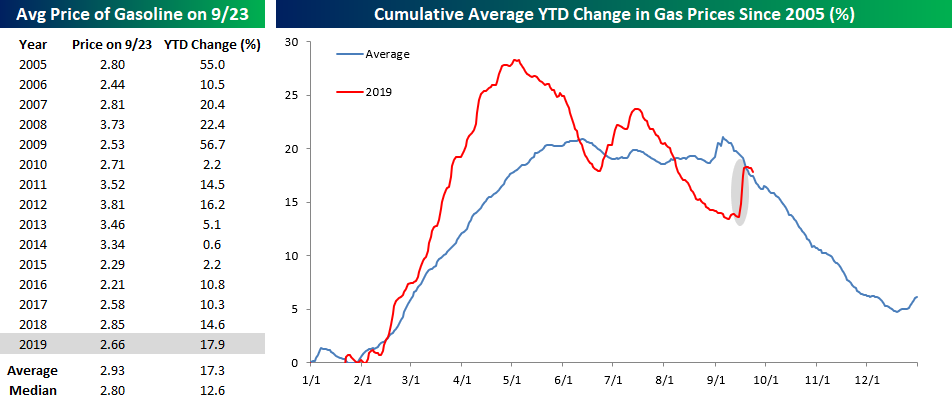
While last week’s surge in oil prices after the attacks on Saudi Arabian oil facilities stoked concerns of a spike higher in gas prices, the rally has already started to fizzle out. As of yesterday, the national average price of a gallon of gas was $2.66, and while that’s ten cents higher than where prices were before the attacks, we’ve already started to see prices ease for three days in a row now. With a YTD gain of 17.9%, this year’s move has now been slightly above the historical average (17.3%) dating back to 2005 and well above the median of 12.6%.
The chart to the right compares the change in gas prices so far this year to a composite of the YTD change for all years since 2005. Prior to the attacks in Saudi Arabia, prices were trending modestly below the historical average, but now prices are right in line with the historical average. If the pattern continues to hold, we should see prices resume their downward trend from now until year-end.
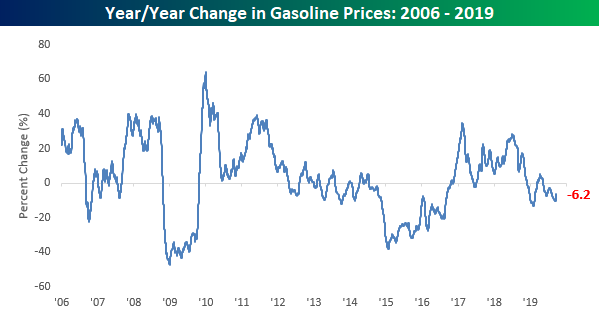
Given the seasonal nature of gas prices, where they are now versus six months ago probably isn’t as important as the year/year change. If prices are lower now than they were at this time last year, consumers will feel more flush while higher prices may crowd out spending in other areas. After about two years where gas prices were consistently higher on a y/y basis, we’ve recently seen a trend where prices have been down modestly. While the decline probably hasn’t been big enough to have a big impact, at the margin, consumers have seen a bit of a tailwind from lower prices. Start a two-week free trial to receive our market research and access our interactive tools.
Bespoke’s Morning Lineup – 9/24/19
See what’s driving market performance around the world in today’s Morning Lineup. Bespoke’s Morning Lineup is the best way to start your trading day. Read it now by starting a two-week free trial to Bespoke Premium. CLICK HERE to learn more and start your free trial.

Futures are indicated higher this morning, but equities have been in a bit of a holding pattern for the last week as all of the major index ETFs are down over the last five trading days and for the most part, hovering just below overbought levels.

The Closer – Golden Yields, Distressed Details, PMIs, Employment Breadth – 9/23/19
Log-in here if you’re a member with access to the Closer.
Looking for deeper insight on markets? In tonight’s Closer sent to Bespoke Institutional clients, we discuss the relationship between gold and yields, before reviewing the performance of the ten worst-performing stocks in the S&P 500. We also take a look at the rising number of distressed high yield issuers. In economic data, we discuss flash PMIs from Markit and the breadth of labor market strength in the US.
See today’s post-market Closer and everything else Bespoke publishes by starting a 14-day free trial to Bespoke Institutional today!
Netflix (NFLX) Round Trip
It has been quite a drama for Netflix (NFLX) in 2019. After being up nearly 50% YTD and one of the best performers in the S&P 500 back in early May, NFLX has given up all of its YTD gains, falling by nearly a third from its highs and putting the stock in the red for the year.

While the last five months have been pretty disastrous for Netflix (NFLX), it isn’t even the worst-performing stock in the S&P 500 since its closing high on 5/3. The table below lists the 19 S&P 500 components that have declined more than 25% since 5/3. Topping the list is DXC Technology (DXC), which has lost just under half of its value. Behind DXC, Align Technology (ALGN) is the only other S&P 500 stock that is down over 40% since 5/3. Outside of these two names, other notable names on the list of losers include retailers and retail-related names like Macy’s (M), Gap (GPS), PVH, Ulta Beauty (ULTA), Ralph Lauren (RL), Kohl’s (KSS), L Brands (LB), and Capri Holdings (CPRI).

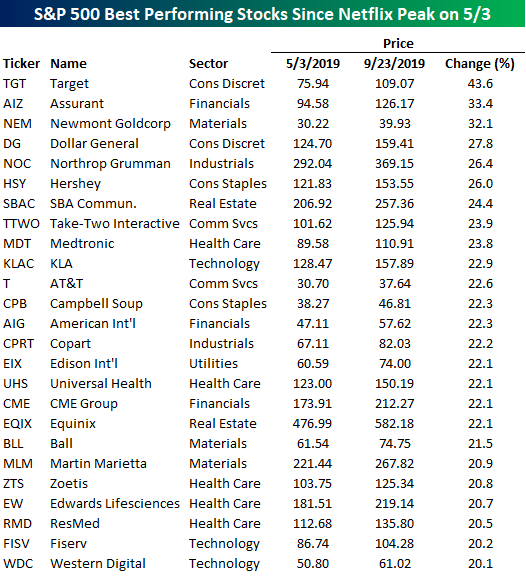
During the same span that Netflix (NFLX) has been giving up its YTD gains, a number of stocks have done quite well. The table below shows the 25 stocks in the S&P 500 that are up over 20% since NFLX’s closing high for the year. While the list of biggest losers is littered with retail-related names, Target (TGT) actually tops the list of winners with a gain of over 40%. As far as themes are concerned, though, the names are spread out across practically every different sector. Of the 25 names listed in the table, the only sector not represented is Energy, and besides Health Care which has five stocks on the list, no other sector accounts for more than three of the S&P 500’s top performers. Start a two-week free trial to receive our market research and access our interactive tools.
Dogs of the Dow 2019 Update
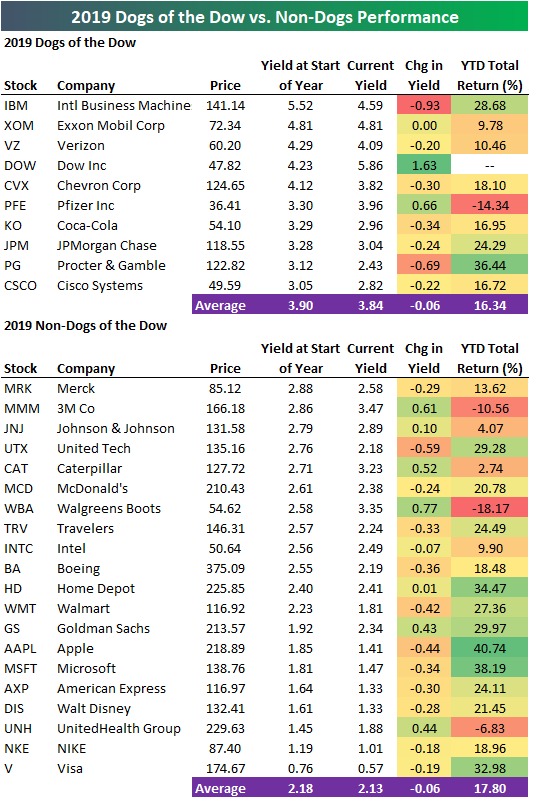
Below is an updated look at the total return performance of the 10 Dogs of the Dow for 2019 versus the 20 non-Dogs. As shown, the 10 Dogs are up 16.34% so far this year, which is 150 basis points less than the gain of 17.8% for the non-Dogs. Procter & Gamble (PG), IBM, and JP Morgan (JPM) have been the best performing Dogs, while Pfizer (PFE) has been the only loser with a YTD decline of 14.34%. Of the non-Dogs, Apple (AAPL) is up the most at +40.74%, followed by Microsoft (MSFT), Home Depot (HD), Visa (V), and Goldman Sachs (GS). Walgreens (WBA) is down the most of any Dow stocks with a YTD decline of 18.17%, while 3M (MMM) and UnitedHealth (UNH) are the only other names in the red.
Below is a look at total return performance for Dow members so far in 2019 as well as over the last 12 months. Year-to-date, these stocks are up 17.35%, but they’re up just 5.91% over the last 12 months. Apple (AAPL) is the top performing Dow stock in 2019 with a total return of 40.74%, but its total return over the last 12 months is just +2.24% because of its horrific performance in Q4 2018. Other stocks with big YTD gains but low or negative 12-month returns include Goldman Sachs (GS), United Tech (UTX), IBM, and JP Morgan (JPM).
There are three Dow stocks down 10%+ YTD (MMM, PFE, WBA) while there are six stocks that are down 10%+ over the last 12 months (XOM, CAT, UNH, MMM, PFE, WBA). Start a two-week free trial to receive our market research and access our interactive tools.

Bespoke’s Morning Lineup — 9/23/19
See what’s driving market performance around the world in today’s Morning Lineup. Bespoke’s Morning Lineup is the best way to start your trading day. Read it now by starting a two-week free trial to Bespoke Premium. CLICK HERE to learn more and start your free trial.
Bespoke Brunch Reads: 9/22/19
Welcome to Bespoke Brunch Reads — a linkfest of the favorite things we read over the past week. The links are mostly market related, but there are some other interesting subjects covered as well. We hope you enjoy the food for thought as a supplement to the research we provide you during the week.
While you’re here, join Bespoke Premium for 3 months for just $95 with our 2019 Annual Outlook special offer.
Green Energy
Longi brings forward manufacturing capacity plans by a year by Max Hall (PV Magazine)
Chinese solar wafer giant Longi now expects to produce 65 gigawatts worth of wafers by the end of 2020, 12 months faster than had previously been estimated and a sign of how rapidly solar technology is scaling. [Link]
Is this Australia’s first utility to acknowledge death by solar? by Michael Mazengarb (Renew Economy)
The utility owned by Australia’s Northern Territory government reports it faces an “existential risk” thanks to consumer solar energy deployment. The company says the cost of producing solar power is below the marginal cost of producing power from natural gas at the company’s plants. [Link]
This Week In Tech
Google’s quantum bet on the future of AI—and what it means for humanity by Katrina Brooker (Fast Company)
The story of how one of the largest tech companies in the world is deploying billions in pursuit of artificial intelligence which may challenge the human brain’s capacity. [Link]
Amazon Changed Search Algorithm in Ways That Boost Its Own Products by Dana Mattioli (WSJ)
Searches for specific products on Amazon have been tweaked to more prominently feature the company’s own-brand products, a practice unlikely to be welcomed by US anti-trust regulators. [Link; paywall]
Politics
American Migration Patterns Should Terrify the GOP by Derek Thompson (The Atlantic)
Hundreds of Americans are flowing out of large, blue states and into the metropolitan areas which dominate traditional red states, potentially accelerating a shift in demographics which is already tilting the tables against a GOP in national contests. [Link]
This drawing explains a surprising amount about your political views by Matt Yglesias (Vox)
An abstract piece of modern art is a better predictive variable for how voters think about the President than other metrics, including the impact of whether or not a voter holds a college degree. [Link]
Labor Markets
The Labor Market Effects of Legal Restrictions on Worker Mobility by Matthew S. Johnson, Kurt Lavetti, Michael Lipsitz (SSRN)
An increase in enforceability of noncompete agreements from the 10th to the 90th percentile lowered annual earnings by 3-4% and resulted in a 9% decline in the likelihood a worker would change jobs. [Link]
Army meets recruiting goal for 2019 after revamping how it attracts prospective soldiers by Corey Dickstein (Stars & Stripes)
After lower its recruiting target, the Army was able to hit its number this year, adding over 68,000 enlistees to active duty this year. [Link]
Food
Pizza Hut debuts a gigantic Cheez-It stuffed with even more cheese by Megan Lavey-Heaton (The Oregonian)
Do you like Cheez-Its? Head over to pizza hut for a bite of a jumbo homage to the snack food stuffed with delicious cheese and even pepperoni. [Link]
Makeup
Wroxeter ‘pendants’ turn out to be Roman make-up tools (BBC)
Roman artefacts uncovered recently in the UK suggest that ancient Roman Britons were fond of makeup, using specialized tools to prepare and apply the cosmetics. [Link]
Scandal
The fake French minister in a silicone mask who stole millions by Hugh Schofield (BBC)
Using a silicon mask and a Skype account, a fraudster was able to convince marks to wire millions of dollars to his accounts, putatively to support anti-terrorism activities. [Link]
Carcinogens Have Infiltrated the Generic Drug Supply in the U.S. by Anna Edney, Susan Berfield, and Evelyn Yu (Bloomberg)
Obscure chemicals that can cause cancer have made their way into the US drug supply, a byproduct of the processes used to make drugs and lax quality assurance. [Link; soft paywall]
Beer Money
‘Beer money’ sign still chugging along for charity by Tom Vanhaaren (ESPN)
A gag sign asking viewers to send a college football fan beer money ended up with tens of thousands in donations via Venmo; the proceeds are being passed on to charity. [Link]
Long Reads
Complication and Complexity: Need They Be Feared? by Dr Ewan Kirk (Cantab Capital)
Fear of the unknown can be paralyzing, but the author argues that complicated and complex are not the same thing; the risks of complexity are emergent, unlike those of complicated systems. [Link]
How Adam Neumann’s Over-the-Top Style Built WeWork. ‘This Is Not the Way Everybody Behaves.’ by Eliot Brown (WSJ)
A large read on the zany founder of WeWork, which pushed off its IPO to October or possibly later this week. [Link; paywall]
Tide’s Going Out
One in Four of New York’s New Luxury Apartments Is Unsold by Stefanos Chen (NYT)
The high end of the New York real estate market is in deep trouble, with more than 4000 apartments among the 16,000 built in new buildings since 2013 unsold. [Link; soft paywall]
Boston Fed’s Rosengren: Lower rates could expose co-working companies like WeWork by Brian Cheung (Yahoo!)
One of the hawkish dissenters from the most recent FOMC meeting thinks that highly speculative business models like WeWork could proliferate further in a world with lower rates. [Link]
Lim Chow Kiat, one of the world’s top investors, rings the alarm, again by David Ramli (Business Standard)
The head of Singapore’s massive sovereign wealth funds is worried about the stability of financial markets, economic growth, and the global political framework that is showing signs of stress. [Link]
Read Bespoke’s most actionable market research by joining Bespoke Premium today! Get started here.
Have a great weekend!