
Sentiment Remains Bearish
Even though equities are rallying considerably this week, sentiment has been little changed. That’s likely a function of the timing of this week’s survey and the massive volatility. 32.9% of respondents in AAII’s weekly sentiment survey reported as bullish this week. That’s little changed from 34.4% last week. Meanwhile, the percentage of equity newsletter writers reporting as bullish in the Investors Intelligence survey has continued to fall with just over 30% reporting as bulls this week. That is the lowest level since the first week of 2019. Prior to that, there have only been 29 other weeks since 1997 with lower readings.


The results are similar for bearish sentiment. AAII’s survey saw bearish sentiment rise slightly from 51.1% last week to 52.07% this week. Bearish sentiment has now been above 50% for three consecutive weeks. That is the first time this has happened since March of 2009. Back then readings above 50% persisted for four weeks straight. Outside of that 2009 occurrence, the only other times that bearish sentiment remained above 50% for three weeks or more was in January, March, and July of 2008 and the late summer and fall of 1990. As for the Investors Intelligence survey, 41.7% are reporting as bearish which is the highest level since October of 2011. This week’s reading is in the 96th percentile of all readings in the history of the survey.
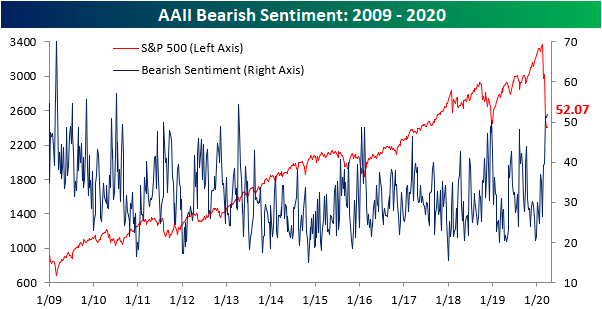

Neutral sentiment picked up about half of a percentage point this week to 15.03%. With the majority of investors reporting as bearish, this very low reading is in just the second percentile of all readings in the history of the survey. Start a two-week free trial to Bespoke Institutional to access our interactive economic indicators monitor and much more.

Records All Around Claims
No one was expecting a strong number for jobless claims this week as forecasts were predicting claims to come in at a record high. The median forecast was calling for claims to total 1.7 million compared to 282K last week which had been the highest reading since September of 2017. Instead, they practically doubled those forecasts coming in at a record 3.283 million. Fortunately, that was less than some of the most aggressive estimates like Citigroup which forecasted claims to be 4 million. This week’s data is an unprecedented albeit anticipated jump in jobless claims. To put the size of the number into perspective, that is roughly 1% of not the US working population, but the entire US population! In the history of the data going back to 1967, there has never been a higher number in the level of claims (first chart below) or week-over-week change (second chart below). The previous high for jobless claims was 695K from October of 1982, almost one-fifth of this week’s print. As for the week to week changes, the over 3 million increase in claims blew the size of the previous largest movements out of the water.

The four week moving average typically helps to smooth out the week to week fluctuations of the high-frequency data, but considering the size of the move, the utility of the moving average is fleeting this week. The moving average has also reached a record high and experienced the largest one week increase on record.

While it may not be much consolation given how horrific this week’s numbers are, one silver lining is in the non-seasonally adjusted number. Before seasonal adjustment, jobless claims were slightly less staggering at 2.898 million. In other words, seasonal factoring does make the number of claims look higher than the actual amount reported. But that is still the largest weekly increase and highest number on record regardless of any seasonal patterns that may be affecting the number. Given more workers are continuing to stay home than return to work these numbers are likely to keep rising over the coming weeks. Start a two-week free trial to Bespoke Institutional to access our interactive economic indicators monitor and much more.

Bespoke’s Morning Lineup – 3/26/20 – Yowza
See what’s driving market performance around the world in today’s Morning Lineup. Bespoke’s Morning Lineup is the best way to start your trading day. Read it now by starting a two-week free trial to Bespoke Premium. CLICK HERE to learn more and start your free trial.
We’re looking at a 1% decline in the US equity market, which wouldn’t actually be that bad given all the volatility we have had lately. Any moves in the market that would represent a more normal trading pattern would be welcome in our view. The big events so far today came from DC where the Senate unanimously passed the $2 trillion relief package. From a market perspective, the big news wasn’t from CNBC or Bloomberg but instead the ‘Today’ show where Fed Chair Powell conveyed the message that the Fed is “not going to run out of ammunition” and that the Fed “still has policy room.”
Read today’s Bespoke Morning Lineup for a discussion of the latest trends and statistics of the outbreak and overnight moves in the market.

They say a picture is worth a thousand words, and this one doesn’t really need much in the way of explanation. Everyone was expecting a surge in claims this week, but the actual increase was more than double expectations as claims came in at 3.283 million versus estimates for 1.7 million That was basically double economist expectations and more than 10x more than the prior week. Just to put this reading in perspective, it works out to 1% of the US population. Not the working population, but the entire population!

The Closer – Bounced But Not Forgetting – 3/25/20
Log-in here if you’re a member with access to the Closer.
Looking for deeper insight on markets? In tonight’s Closer sent to Bespoke Institutional clients, we recap the second day of “dash for trash” including the bounce in homebuilders and mortgage REITs. We then delve into the MBS market before turning over to weekly ICI fund flows. Afterward, we look at the EIA’s weekly petroleum data and the results of today’s 5 year note auction.

See today’s post-market Closer and everything else Bespoke publishes by starting a 14-day free trial to Bespoke Institutional today!
Boeing (BA) Sends the Dow Flying
Turnaround Tuesday has carried into hump day with the Dow up well over 5% again today as of this writing. As we mentioned in an earlier post, that means the Dow is on track for its first back-to-back up days for the first time since early February. Remarkably, even with only two consecutive up days, the index is closing in on exiting a bear market. For that to happen, the Dow would need to close above the 22,310.32 level which is 20% off of the bear market closing low (Monday’s close at 18,591.93). At today’s high, the Dow was less than 300 points or 1.32% from that level.
As for the individual stocks contributing to the rally, Boeing (BA) deserves a lot of thanks. The stock has been hit very hard during the sell-off. Whereas the stock has traded in the mid-$300 for much of the past two years and up to mid-February, as of late last week BA had fallen below $100. That massive drop in price means that day to day movements in the stock would have a lesser impact on the level of the price-weighted Dow. In spite of this, BA has contributed over 400 points to the Dow’s rally in the past two days alone! That is much more than any other stock in the index with the next biggest contributor being UnitedHealth (UNH) who’s 335.44 point contribution comes as its share price is currently around $100 more than BA. BA’s contribution is also almost 200 points more than those of McDonald’s (MCD), Visa (V), and Apple (AAPL). Of all 30 Dow stocks, there is only one that is down over the past couple of days, subtracting from the index’s rally: Walmart (WMT). Given WMT has held up fairly well recently, its performance is yet another example of investors’ focus on the more beaten down names that we have noted earlier today and in last night’s Closer. Start a two-week free trial to Bespoke Institutional to access Closer and full range of research and interactive tools.

Fixed Income Weekly – 3/25/20
Searching for ways to better understand the fixed income space or looking for actionable ideas in this asset class? Bespoke’s Fixed Income Weekly provides an update on rates and credit every Wednesday. We start off with a fresh piece of analysis driven by what’s in the headlines or driving the market in a given week. We then provide charts of how US Treasury futures and rates are trading, before moving on to a summary of recent fixed income ETF performance, short-term interest rates including money market funds, and a trade idea. We summarize changes and recent developments for a variety of yield curves (UST, bund, Eurodollar, US breakeven inflation and Bespoke’s Global Yield Curve) before finishing with a review of recent UST yield curve changes, spread changes for major credit products and international bonds, and 1 year return profiles for a cross section of the fixed income world.
In this week’s report we review corporate issuance.

Our Fixed Income Weekly helps investors stay on top of fixed income markets and gain new perspective on the developments in interest rates. You can sign up for a Bespoke research trial below to see this week’s report and everything else Bespoke publishes free for the next two weeks!
Click here and start a 14-day free trial to Bespoke Institutional to see our newest Fixed Income Weekly now!
Come on Dow, You Can Do It!
The way things have been moving on a minute to minute basis, nothing is guaranteed in this market, but the way things stand now, the Dow is on pace to break its streak of days without back to back daily gains at 32 trading days. That’s right, not since February 6th have we seen the Dow finish the day in positive territory for more than a day at a time. Looking back throughout history, there have only been a handful of other periods where the DJIA went this long or longer without two up days in a row. The last occurrence was all the way back in 1984, and before that, you have to go back to 1969. Other than those two streaks, there were also two other periods in 1931 where the DJIA went more than 30 trading days without back to back gains. While the current streak ranks as tied for the fourth-longest on record, if the DJIA isn’t able to hold onto its intraday gains today, the current streak will extend out to a minimum of at least two trading days and that would move the current streak into second place overall. Start a two-week free trial to Bespoke Institutional to access our Custom Portfolios, interactive tools, and full library of research.

Dash For Trash
Yesterday, the S&P 500 had one of its best days on record and the best day since 2008 as the index soared nearly 10%. As we noted in last night’s Closer, for stocks that have been hit the hardest during the past month’s equity rout, yesterday’s buying spree was a very welcome sign. Yesterday saw a massive “dash for trash” as the current bear market’s worst performers were the best performers in yesterday’s session. The average stock in the bottom 10% of performers over the course of the current bear market dating to February 19th was up an astonishing 18.1%. All five of the bottom deciles in the distribution of returns since the bear market began were up at least double-digit percentage points. On the other end of the spectrum, while the best performing stocks were still positive on the day, their rallies were much more muted as the average stock in the best-performing decile only rose 3.38%. Start a two-week free trial to Bespoke Institutional to access nightly Closer and full range of other research and interactive tools

Bespoke’s Global Macro Dashboard — 3/25/20
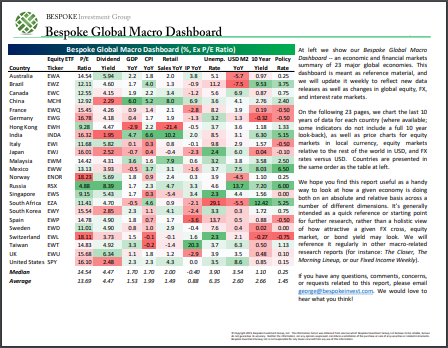
Bespoke’s Global Macro Dashboard is a high-level summary of 22 major economies from around the world. For each country, we provide charts of local equity market prices, relative performance versus global equities, price to earnings ratios, dividend yields, economic growth, unemployment, retail sales and industrial production growth, inflation, money supply, spot FX performance versus the dollar, policy rate, and ten year local government bond yield interest rates. The report is intended as a tool for both reference and idea generation. It’s clients’ first stop for basic background info on how a given economy is performing, and what issues are driving the narrative for that economy. The dashboard helps you get up to speed on and keep track of the basics for the most important economies around the world, informing starting points for further research and risk management. It’s published weekly every Wednesday at the Bespoke Institutional membership level.
You can access our Global Macro Dashboard by starting a 14-day free trial to Bespoke Institutional now!
Bespoke’s Morning Lineup – 3/25/20 – Volatility Still Reigns Supreme
See what’s driving market performance around the world in today’s Morning Lineup. Bespoke’s Morning Lineup is the best way to start your trading day. Read it now by starting a two-week free trial to Bespoke Premium. CLICK HERE to learn more and start your free trial.
Equity futures are indicating a modestly higher (or lower depending on when you look at the futures) open, but don’t let the numbers fool you. From midnight to around 4:30 eastern, S&P 500 futures rallied more than 4.5% in reaction to news of a deal being struck in DC over the $2 trillion coronavirus relief bill. From 4:30 through now, though, all of those gains have been erased.
Markets are still searching for equilibrium and trying to figure out when the economy will be able to re-open, and right now there is just about zero clarity on that front. Then, when the time comes where certain areas of the country look to be in the clear and can open for business a whole new set of questions will arise. First, how do you cordon off these areas that are no longer hotspots from the areas that are still hot?
Read today’s Bespoke Morning Lineup for a discussion of the details of the relief bill in DC, Asian and European markets, and the latest trends and statistics of the outbreak.
It’s been an exceptionally strong two days for gold as the yellow metal has rallied over 5% on back to back days. With all the liquidity being thrown into the system, some investors are clearly worried about the dollar’s purchasing power down the road. Going back to 1980, there have only been four prior periods where gold has seen similar moves on back to back days, with the last occurrence coming in September 2008. In other words, it has been extremely rare to see these kinds of moves.
