
The Bespoke Report — 3/27/20
This week’s Bespoke Report newsletter is now available for members.
After falling more than 30% over the last four weeks, the S&P 500 had its 5th one-week gain of 10%+ since 1940 this week. We cover equity markets, the economic shutdown, and the government’s emergency support plan in this week’s newsletter. To read the report and access everything else Bespoke’s research platform has to offer, start a two-week free trial to one of our three membership levels. You won’t be disappointed!

The Closer: End of Week Charts — 3/27/20
Looking for deeper insight on global markets and economics? In tonight’s Closer sent to Bespoke clients, we recap weekly price action in major asset classes, update economic surprise index data for major economies, chart the weekly Commitment of Traders report from the CFTC, and provide our normal nightly update on ETF performance, volume and price movers, and the Bespoke Market Timing Model. We also take a look at the trend in various developed market FX markets.

The Closer is one of our most popular reports, and you can sign up for a free trial below to see it!
See tonight’s Closer by starting a two-week free trial to Bespoke Institutional now!
How Much Cash For Households?
This morning the US House of Representatives is planning to pass the $2 trillion dollar economic stimulus package voted out of the Senate 96-0 earlier this week after intensive negotiations between the White House, Senate (including both Majority Leader McConnell and Minority Leader Schumer), and the House (Speaker Pelosi). The bill is enormous, with dozens of provisions ranging from modest grants to specific hospitals or other institutions to huge sweeping programs like cash rebates or corporate lending. We wanted to focus on two key aspects and see how much cash households can expect from the bill. To make things easier, we’re using New York State unemployment benefit amounts, assuming joint filers both work and earn the same amount of income, and ignoring head-of-household filers. We also use big, round numbers, so it’s important to stress this is an illustrative example. Actual benefits may vary substantially, but this is a rough set of guideposts.
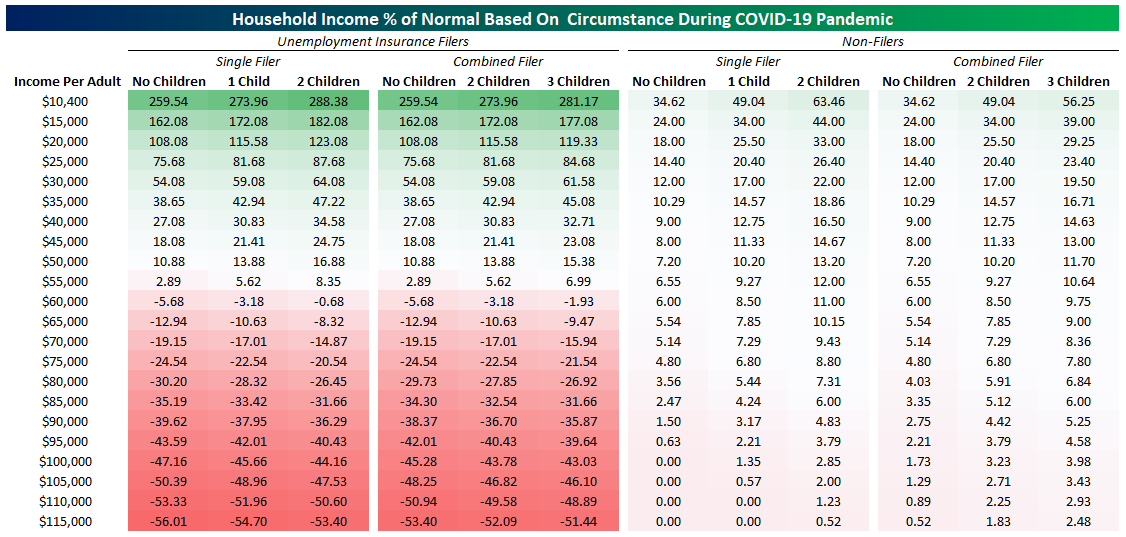
The first key benefit is a cash rebate of $1200 per adult (plus $500 per child). This amount is phased out above an annual income of $75,000 per person ($75,000 per single filer, or $150,000 for joint-filers). The second benefit adds $600 to state unemployment payouts per beneficiary per week and extends those benefits for four months. We should also note that in addition to the $600, the new bill expands the scope of who can apply for unemployment insurance, though that fact is not relevant to our calculations. In the table below, we show the dollar amount of payments in unemployment insurance as would typically be the case plus the cash payment and expanded unemployment benefits passed by the Senate bill, varying by household circumstance. As shown, while workers who do not end up on unemployment insurance roles don’t get a huge cash payout, amounts can still be large. Phase-outs over $75,000 in annual earnings mean childless filers making six figures get nothing, and having children makes a big impact for the total cash taken home by households who get these checks. For workers who receive unemployment benefits, the amount of cash put up by the government to keep people afloat is genuinely impressive: for a single filer that was earning minimum wage and working 40 hours per week (~$15,000 per year), the next four months offer about $13,000 in cash payments. There are similar amounts of cash handed out to anybody that loses their job, although number of children and size of income varies substantially.

With similar cash support for fired workers by income, on a relative basis this bill is extremely progressive. For adults earning roughly $20,000 per year or less, the bill more than replaces income lost from the pandemic. For example: adults making $15,000 will have income 162% higher than they otherwise would if they file for unemployment inusrance. Any household with average adult income below $55,000 will receive higher income than they otherwise would. Of course, that’s why this bill is “stimulus”; it’s trying to encourage consumer spending. It’s also notable that those who don’t file for unemployment insurance universally come away better off because our analysis assumes they do not lose income.
Bespoke Morning Lineup – 3/27/20 – Another Corona Friday
See what’s driving market performance around the world in today’s Morning Lineup. Bespoke’s Morning Lineup is the best way to start your trading day. Read it now by starting a two-week free trial to Bespoke Premium. CLICK HERE to learn more and start your free trial.
It’s looking like another one of those Corona Fridays for US equities as futures are trading down around 3% piggy-backing off the declines we’re seeing in Europe. News that UK Prime Minister Boris Johnson has tested positive for the virus isn’t boosting sentiment either. Here in the US, there are also concerns that the House vote on the relief bill will be forced to an in-person vote instead of unanimous consent and that would force members to return to DC from their districts and delay the ultimate passage. On the House bill, we should know by noon whether the bill will be able to be passed today, but given it’s a Friday and the market is closed for the next two trading days, it’s hard to convince investors to hold equities into a weekend where the headlines are more likely to be bad than good.
Read today’s Bespoke Morning Lineup for a discussion of the latest trends and statistics of the outbreak, overnight moves in the market, and the plunging levels of confidence just released in Italy.

The S&P 500’s 17%+ rally in the last three trading days is the strongest rally for the index since the 1930s, and one of only a handful where the S&P 500 even rallied 10% during a three-day period. The last such occurrences of a 10%+ move were in March 2009, November 2008, October 2008, and then October 1987.

The Closer – Rebalancing Boosts Bulls – 3/26/20
Log-in here if you’re a member with access to the Closer.
Looking for deeper insight on markets? In tonight’s Closer sent to Bespoke Institutional clients, we begin with a few reasons not to trust the current rally before turning to today’s strong 7 year auction. We then show what today’s initial jobless claims number means for the macroeconomic picture in Q2. We finish tonight with a theory as to why stocks have ripped higher this week.

See today’s post-market Closer and everything else Bespoke publishes by starting a 14-day free trial to Bespoke Institutional today!
Country ETFs’ Drawdowns and Rebounds
The COVID-19 pandemic has impacted equity markets around the globe. As shown in the table below, the equity markets of all the major global economies tracked in our Global Macro Dashboard (using each country’s ETF as a proxy) are all well off their 52-week highs with only four—Taiwan (EWT), Switzerland (EWL), Japan (EWJ), and China (MCHI)—less than 20% away from the past year’s high. While not as close as those four, the US is actually one of the countries that is closest to its recent high; down ‘just’ 23.2% after this week’s rally. Brazil (EWZ), on the other hand, is currently the furthest below its 52-week high at 45.8%.
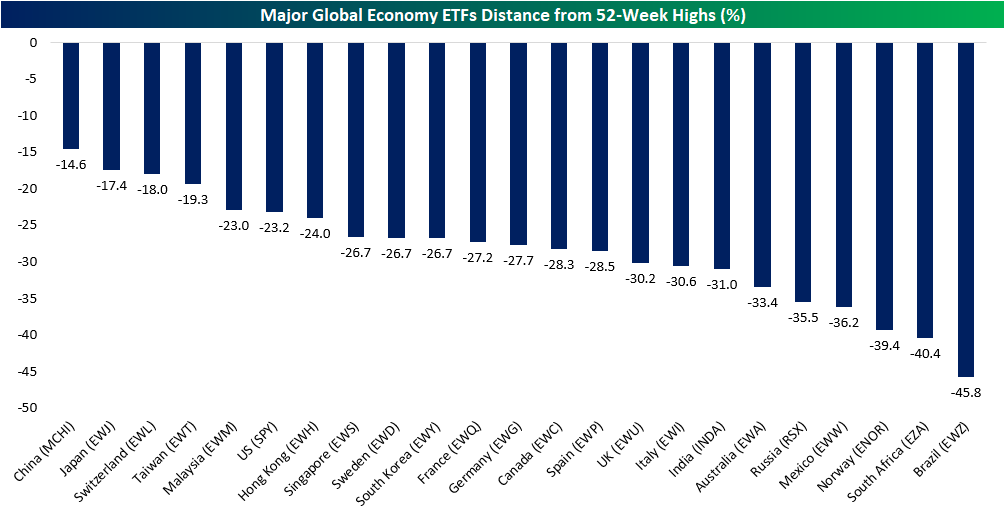
The S&P 500 (SPY) peaked on February 19th and was down 34.1% from there at Monday’s close. Including SPY, that Monday close has marked at least a temporary bottom for a number, though not all, of these country ETFs. Since then, SPY has risen over 15% and that is actually on the lower end of these countries’ performance. The chart below shows how much each country’s ETF has rallied off of their respective lows since the global sell-off began on 2/19. Russia has seen the biggest rebound having risen 28.18%. Granted, it also bottomed ahead of other countries putting in its low on March 18th. Even though it is down the most off of its 52-week high, Brazil is also one of the best performers since its low on Monday. South Africa and Canada have also risen more than 25% since their lows on Monday. Start a two-week free trial to Bespoke Institutional to access our Global Macro Dashboard and our full range of research and interactive tools.

Sentiment Remains Bearish
Even though equities are rallying considerably this week, sentiment has been little changed. That’s likely a function of the timing of this week’s survey and the massive volatility. 32.9% of respondents in AAII’s weekly sentiment survey reported as bullish this week. That’s little changed from 34.4% last week. Meanwhile, the percentage of equity newsletter writers reporting as bullish in the Investors Intelligence survey has continued to fall with just over 30% reporting as bulls this week. That is the lowest level since the first week of 2019. Prior to that, there have only been 29 other weeks since 1997 with lower readings.


The results are similar for bearish sentiment. AAII’s survey saw bearish sentiment rise slightly from 51.1% last week to 52.07% this week. Bearish sentiment has now been above 50% for three consecutive weeks. That is the first time this has happened since March of 2009. Back then readings above 50% persisted for four weeks straight. Outside of that 2009 occurrence, the only other times that bearish sentiment remained above 50% for three weeks or more was in January, March, and July of 2008 and the late summer and fall of 1990. As for the Investors Intelligence survey, 41.7% are reporting as bearish which is the highest level since October of 2011. This week’s reading is in the 96th percentile of all readings in the history of the survey.
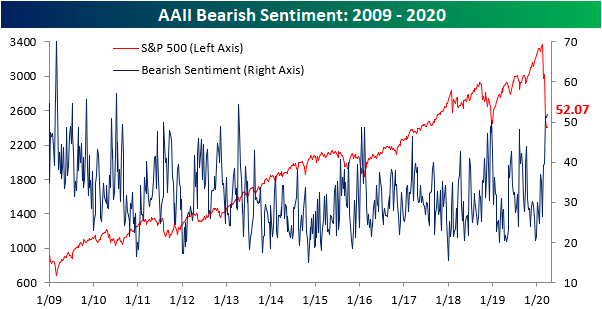

Neutral sentiment picked up about half of a percentage point this week to 15.03%. With the majority of investors reporting as bearish, this very low reading is in just the second percentile of all readings in the history of the survey. Start a two-week free trial to Bespoke Institutional to access our interactive economic indicators monitor and much more.

Records All Around Claims
No one was expecting a strong number for jobless claims this week as forecasts were predicting claims to come in at a record high. The median forecast was calling for claims to total 1.7 million compared to 282K last week which had been the highest reading since September of 2017. Instead, they practically doubled those forecasts coming in at a record 3.283 million. Fortunately, that was less than some of the most aggressive estimates like Citigroup which forecasted claims to be 4 million. This week’s data is an unprecedented albeit anticipated jump in jobless claims. To put the size of the number into perspective, that is roughly 1% of not the US working population, but the entire US population! In the history of the data going back to 1967, there has never been a higher number in the level of claims (first chart below) or week-over-week change (second chart below). The previous high for jobless claims was 695K from October of 1982, almost one-fifth of this week’s print. As for the week to week changes, the over 3 million increase in claims blew the size of the previous largest movements out of the water.

The four week moving average typically helps to smooth out the week to week fluctuations of the high-frequency data, but considering the size of the move, the utility of the moving average is fleeting this week. The moving average has also reached a record high and experienced the largest one week increase on record.

While it may not be much consolation given how horrific this week’s numbers are, one silver lining is in the non-seasonally adjusted number. Before seasonal adjustment, jobless claims were slightly less staggering at 2.898 million. In other words, seasonal factoring does make the number of claims look higher than the actual amount reported. But that is still the largest weekly increase and highest number on record regardless of any seasonal patterns that may be affecting the number. Given more workers are continuing to stay home than return to work these numbers are likely to keep rising over the coming weeks. Start a two-week free trial to Bespoke Institutional to access our interactive economic indicators monitor and much more.

Bespoke’s Morning Lineup – 3/26/20 – Yowza
See what’s driving market performance around the world in today’s Morning Lineup. Bespoke’s Morning Lineup is the best way to start your trading day. Read it now by starting a two-week free trial to Bespoke Premium. CLICK HERE to learn more and start your free trial.
We’re looking at a 1% decline in the US equity market, which wouldn’t actually be that bad given all the volatility we have had lately. Any moves in the market that would represent a more normal trading pattern would be welcome in our view. The big events so far today came from DC where the Senate unanimously passed the $2 trillion relief package. From a market perspective, the big news wasn’t from CNBC or Bloomberg but instead the ‘Today’ show where Fed Chair Powell conveyed the message that the Fed is “not going to run out of ammunition” and that the Fed “still has policy room.”
Read today’s Bespoke Morning Lineup for a discussion of the latest trends and statistics of the outbreak and overnight moves in the market.
They say a picture is worth a thousand words, and this one doesn’t really need much in the way of explanation. Everyone was expecting a surge in claims this week, but the actual increase was more than double expectations as claims came in at 3.283 million versus estimates for 1.7 million That was basically double economist expectations and more than 10x more than the prior week. Just to put this reading in perspective, it works out to 1% of the US population. Not the working population, but the entire population!

The Closer – Bounced But Not Forgetting – 3/25/20
Log-in here if you’re a member with access to the Closer.
Looking for deeper insight on markets? In tonight’s Closer sent to Bespoke Institutional clients, we recap the second day of “dash for trash” including the bounce in homebuilders and mortgage REITs. We then delve into the MBS market before turning over to weekly ICI fund flows. Afterward, we look at the EIA’s weekly petroleum data and the results of today’s 5 year note auction.

See today’s post-market Closer and everything else Bespoke publishes by starting a 14-day free trial to Bespoke Institutional today!