
Bespoke’s Morning Lineup – 4/2/20 – 2% of the Population Files For Unemployment
See what’s driving market performance around the world in today’s Morning Lineup. Bespoke’s Morning Lineup is the best way to start your trading day. Read it now by starting a two-week free trial to Bespoke Premium. CLICK HERE to learn more and start your free trial.
All eyes were on jobless claims this morning, which were expected to rise by 3.7mm, though estimates were wide-ranging from 800,000 to 6.5mm. So, where did they come in? How about 6.648 million. That was above all economists forecasts!
Equity markets were pricing a gain of more than 1% but have given up half of those gains in the immediate aftermath of the report.
Read today’s Bespoke Morning Lineup for a discussion of the latest trends and statistics of the outbreak, overnight moves in the market, and some really weak employment-related data out of Spain.

Last week’s jobless claims reading reflected the fact that 1% of the US population filed for unemployment. With claims doubling this week, that means 2% of the US population filed for claims this week Not the labor force but the entire population. Given the moves in claims over the last two weeks, the historical chart of claims is essentially useless. That surge in claims we saw during the financial crisis? It looks like nothing more than a speed bump in relation to what we’re going through now.

The Closer – The Markets’ New Me, Same As The Old Me – 4/1/20
Log-in here if you’re a member with access to the Closer.
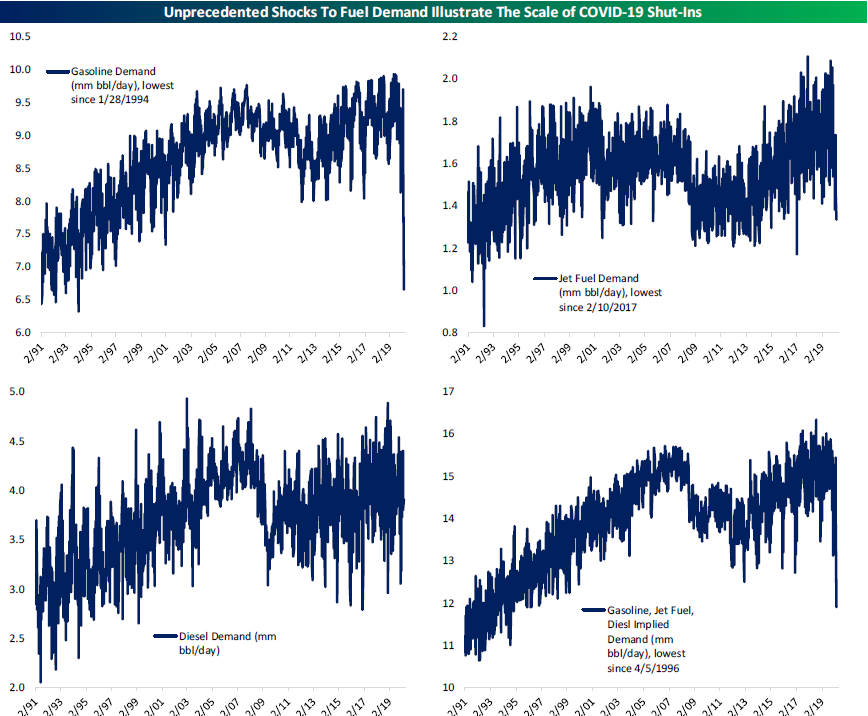
Looking for deeper insight on markets? In tonight’s Closer sent to Bespoke Institutional clients, we show how the past couple of day’s price action is similar to the start of the bear market. We then delve into the Fed’s repo operations before turning to over to today’s ISM release. We close out tonight’s report with a look at the shock to petroleum stockpiles and demand as well as weekly fund flows.
See today’s post-market Closer and everything else Bespoke publishes by starting a 14-day free trial to Bespoke Institutional today!
Fixed Income Weekly – 4/1/20
Searching for ways to better understand the fixed income space or looking for actionable ideas in this asset class? Bespoke’s Fixed Income Weekly provides an update on rates and credit every Wednesday. We start off with a fresh piece of analysis driven by what’s in the headlines or driving the market in a given week. We then provide charts of how US Treasury futures and rates are trading, before moving on to a summary of recent fixed income ETF performance, short-term interest rates including money market funds, and a trade idea. We summarize changes and recent developments for a variety of yield curves (UST, bund, Eurodollar, US breakeven inflation and Bespoke’s Global Yield Curve) before finishing with a review of recent UST yield curve changes, spread changes for major credit products and international bonds, and 1 year return profiles for a cross section of the fixed income world.
In this week’s report we discuss the income opportunities in S&P 500 dividends.

Our Fixed Income Weekly helps investors stay on top of fixed income markets and gain new perspective on the developments in interest rates. You can sign up for a Bespoke research trial below to see this week’s report and everything else Bespoke publishes free for the next two weeks!
Click here and start a 14-day free trial to Bespoke Institutional to see our newest Fixed Income Weekly now!
The Good, The Bad, and the Ugly Commodities in Q1
Very few assets have been winners recently, especially in the commodities space. As shown in the table below, no major energy or metal commodities (front-month futures) rose in March and gold was the only one to rise in the first quarter. The degree of those declines varied greatly. While gasoline and WTI futures (crude oil) were more than cut in half, gold and iron ore fell less than one percent in March. Considering iron ore’s cyclical nature, that small decline is somewhat surprising but as for Q1, iron ore’s performance was much weaker with a decline of over 10.5%. Granted, that is still a far better performance than copper which was down by more than twice that. Given the size of these declines, every one of the commodities highlighted below sits well off of its 52-week high. Gasoline and crude oil are the worst of these at 74.14% and 69.63%, respectively. As for where they finished the quarter relative to their 52-week lows, things are mixed. Gasoline, gold, and silver are off those lows by double-digit percentages while the rest are less than 10% away.

As with many charts across assets, the technical picture of these commodities looks ugly. Almost every one has broken below significant support levels and safe-haven gold is the only one currently in anything other than a downtrend. Although it finished the month just off of the lows, crude oil fell all the way to its lowest levels since 2002 after crashing through support in February. The same can be said for gasoline. Natural gas remains a pain trade with the downtrend of the past several months still firmly in place.
Given its safe-haven status, gold has again been an outperformer approaching some of its highest levels of the past decade during the risk asset rout of the past couple of months. But it has recently been a more volatile trade. The yellow metal has yet to break above resistance around 1,700/oz and has even fallen to support around the 50-DMA. Despite also having the precious metal status, silver has been a serial underperformer to gold. Silver never shared gold’s rally over the past couple of months as it fell to its lowest levels since 2009.
As for industrial metals, copper has been hovering around its lowest levels since the final quarter of 2016 after falling through the past year’s support around $2.50. On the bright side, the technicals of iron ore have been slightly more constructive as it has still held up at support around $75. Start a two-week free trial to Bespoke Institutional to access our interactive economic indicators monitor and much more.

Q1 2020 Asset Class Performance Matrix
Below is a look at total returns in Q1 2020 across asset classes using key ETFs that we track closely on a daily basis. For each ETF, we show its return in March, since the 2/19 all-time closing high for the S&P 500, and for the full first quarter of the year.
Looking at US equity index ETFs at the end of March, the S&P 500 (SPY) was down 12.46% on the month, 23.35% since the 2/19 all-time high, and 19.43% year-to-date. The Dow 30 (DIA) was down slightly more than SPY over all three time frames, while the Tech-heavy Nasdaq 100 (QQQ) was down much less in both March (-7.3%) and in the first quarter (-10.3%).
Small-caps and mid-caps have both been hit harder than large-caps, while growth outperformed value by a wide margin.
Looking at US sectors, Technology (XLK) was down the least in Q1 at -11.9%, while Energy (XLE) was down the most at -50%. The Financials sector (XLF) was down the 2nd most in Q1 with a drop of 31.8%.
Outside of the US, the hardest hit country ETFs in both March and the first quarter were Brazil (EWZ) and Mexico (EWW). Brazil was down 38.6% in March and 50% in the first quarter. Mexico was down 31.9% in March and 37% in Q1. The commodities ETF (DBC) was down 29.5% in Q1, but the oil ETF (USO) was down 67% while the gold ETF (GLD) was up 3.6%.
Treasury ETFs were up in March, with longer duration up the most. The 20+ Year Treasury ETF (TLT) was up 6.38% in March and up 22% in Q1. Start a two-week free trial to Bespoke Premium to see our list of “Stocks for the COVID Economy.”

Under the Hood Weakness From ISM
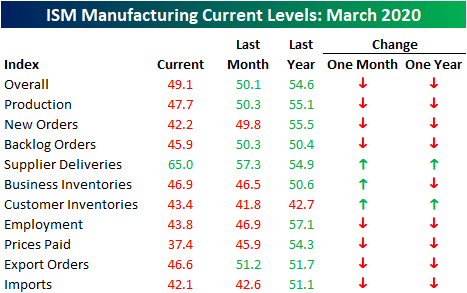
As we have been highlighting over the past couple of weeks, soft manufacturing data for the month of March from regional Federal Reserve districts was horrendous with several record lows and record month over month declines. The ISM Manufacturing index for March was not nearly as bad. Forecasts were calling for the headline number to fall to 45 from 50.1 in February. That would have been the lowest level for the index since May of 2009. Instead, it only fell to 49.1 which is still a contractionary reading but much better than expected and actually 1.3 points above the December low of 47.8.

While the headline number has held up fairly well, under the hood this month’s report was not as strong. All but three categories fell in March, and the ones that rose are not positive signs. Supplier Deliveries, Business Inventories, and Customer Inventories all rose meaning products from suppliers are taking longer to reach manufacturers and existing inventories are not being drawn down on as they were previously. Additionally, whereas most readings were expansionary one year ago, now only Supplier Deliveries is, which again is not a positive sign.
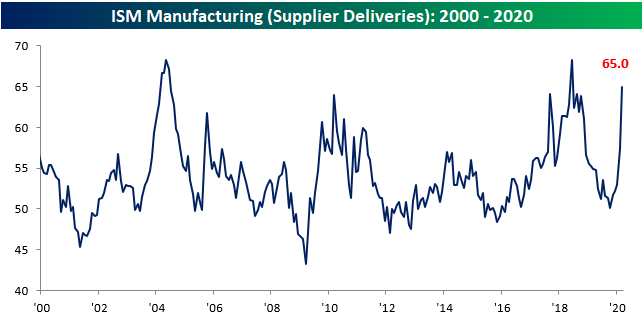
When the index for Supplier Deliveries is rising, this indicates that it is taking longer for manufacturers to receive products from their suppliers. This month, the index rose 7.7 points to 65 which is the highest level since June of 2018 when it reached 68.2. Of all readings since 1948, that is in the 89th percentile. That last time that the index rose by this much was nearly 15 years ago in September of 2005. Prior to that, you would need to go all the way back to 1988 to find a time that Supplier Deliveries rose by a larger amount. In other words, the shutdowns and slowdowns from COVID-19 are certainly beginning to disrupt supply chains.

Not only are supply chains taking a hit but so is demand. As we mentioned in Monday’s Closer, readings on new orders across other surveys have plummeted and the March ISM report is no exception. The index for New Orders fell 7.6 points to 42.2 in March. While that is not necessarily the sharpest decline in recent history (December of 2018 saw a larger decline of 8.7 points), New Orders is now at its lowest level since March of 2009.

Additionally, this month’s report has begun to show some of the adverse effects of COVID-19 on the labor market. The Employment component fell 3.1 points to 43.8 which is also the lowest level since the Spring of 2009.

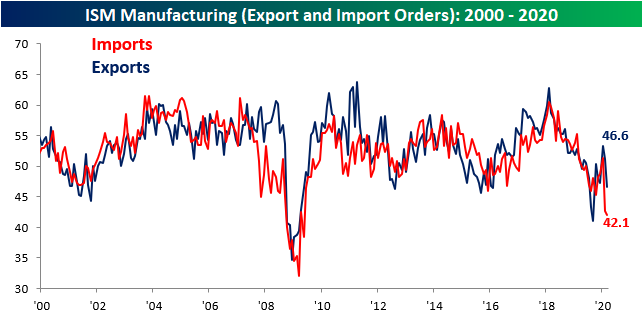
In last month’s report, we noted the record decline in imports. As could be expected, that decline continued in March, albeit at not nearly as dramatic a pace with the index for Imports falling slightly more to 42.1. That still leaves it at its lowest level since the financial crisis. Export orders, on the other hand, caught up with a sizable decline of their own. Exports fell 4.6 points to 46.6. That is the largest decline since last August and it also leaves it around similar levels to then. Either way, these two indices are pointing to an all-around slowdown of trade activity as a result of the coronavirus. Start a two-week free trial to Bespoke Institutional to access our interactive economic indicators monitor and much more.
Testing Testing Testing
We have recently begun publishing a daily look at state by state metrics for the COVID-19 outbreak that includes both the total number and day over day increases in the number of confirmed cases, deaths, and tests performed. In addition to the actual numbers, each day we also include a look at these metrics on a per capita basis to better highlight which states are doing the best and worst. This daily snapshot provides a very useful tool to stay on top of the latest trends in the pandemic.
Through the end of March, there have been a total of 183,935 confirmed cases of the COVID-19 virus, and of those, there have been 3,727 deaths. Looking just at those numbers, a 2% fatality rate is a very scary number. Almost everyone agrees, however, that the actual number of COVID-19 cases in the United States is probably much higher. The only question is how many more cases are out there? Right now, unless you are a celebrity or an athlete, it seems that you can only get tested if you are showing symptoms or you have been in close contact with someone who has been confirmed to have it. Therefore in order to get a better idea on the scope of the outbreak, testing has to become much more widespread and focus not just on suspected cases, but also on randomized samples.
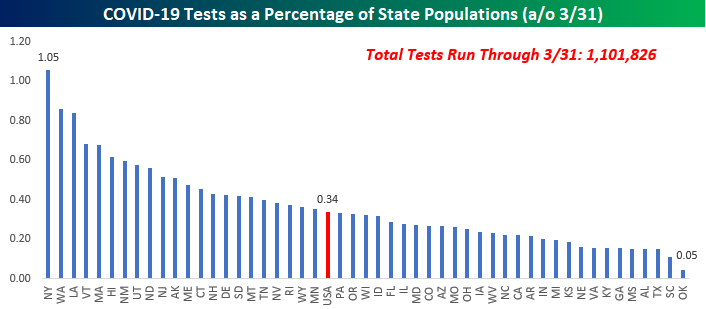
While there has been a significant improvement compared to a few weeks ago, the pace of testing in the US still has a lot of room for improvement. In the entire United States, we have only just surpassed a total of one million tests which represents just 0.34% of the population. The chart below shows a rundown of testing as a percentage of each state’s population. New York currently leads the way with over 205K tests, representing just over 1% of its population. Other states with per capita testing at the high end of the range include Washington, Louisiana, Vermont, and Massachusetts. On the downside, Oklahoma is right on the bottom of the list with just 0.05% of its population having been tested. One notable state where testing has been low is in California. While it was one of the first states to feel the outbreak, only 0.22% of its population has been tested. One of the major factors that will drive when Americans can get back to some sense of normalcy in their lives is to find out how widespread the COVID-19 outbreak has been in terms of who has or has already had it, but until there are some major improvements in the pace of testing, that’s going to be a hard trend to get a grasp of. Start a two-week free trial to Bespoke Premium to see our list of “Stocks for the COVID Economy.”
Q1 2020 Country Stock Market Performance (Local Currency)
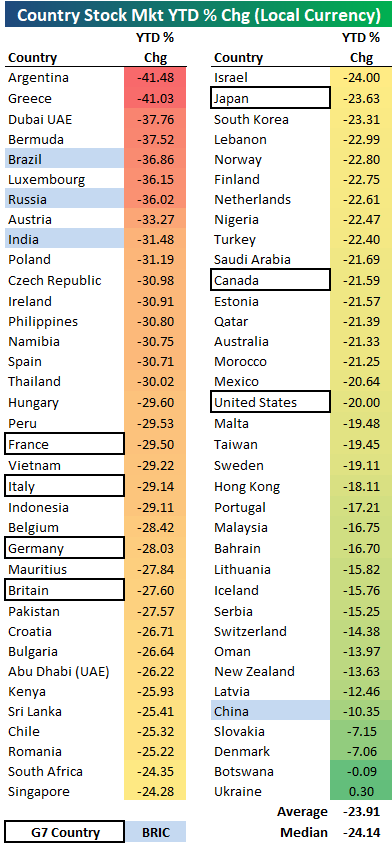
Below is a snapshot of year-to-date country stock market returns through the first quarter of 2020, all in local currency. Of the 72 countries shown, the average year-to-date change is -23.91%, with only one of 72 in the green. A total of 68 out of 72 countries are down more than 10%, while 53 of 72 are down more than 20%.
Investors in the Ukraine are the only ones in the world that can say their stock market is in the black year-to-date. It’s up 0.30%.
On the downside, Argentina and Greece have fallen the most at -40%+, while another 14 are down 30%+. Three of the four BRIC countries are down at least 30% — Brazil, Russia, and India. China is the only BRIC country not down 30%, and in fact, it is one of the best-performing countries year-to-date with a decline of only 10%.
Looking at the major G7 countries, Europe has been hit the hardest with France, Italy, Germany, and the UK all down more than 27.5%. The US is the top-performing G7 with a decline of 20%, while Japan is down 23.6% and Canada is down 21.6%. Start a two-week free trial to Bespoke Premium to see our list of “Stocks for the COVID Economy.”
US Equity Index ETFs at the Start of Q2 2020
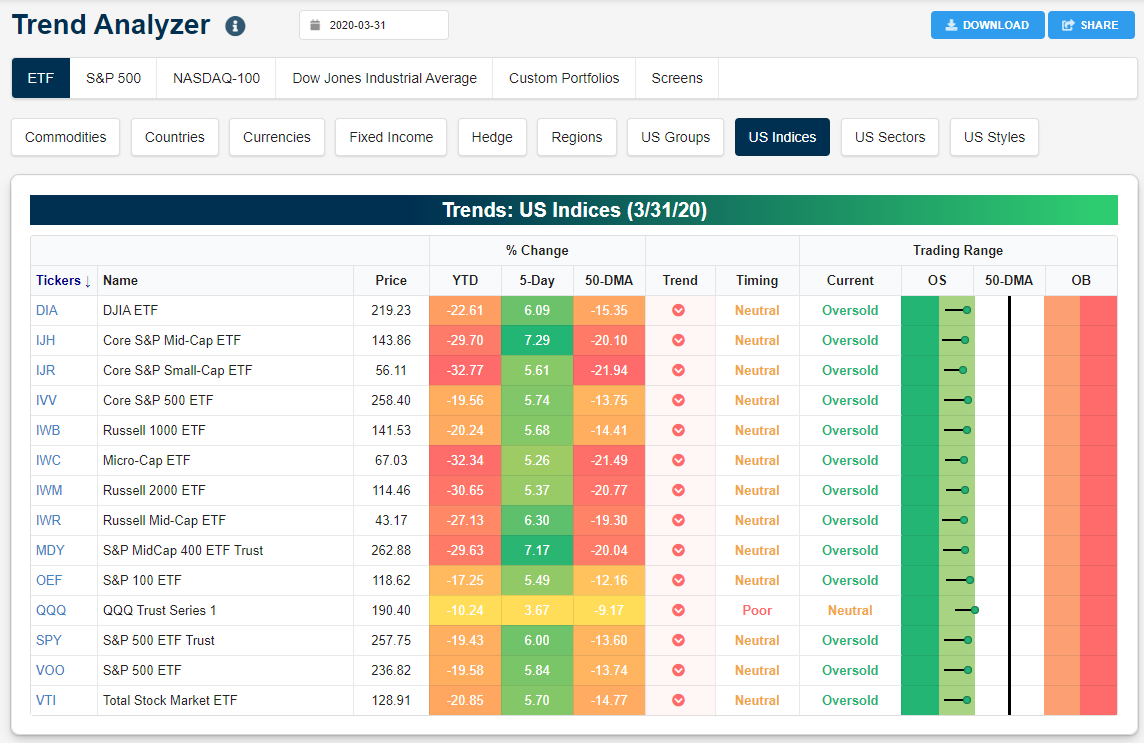
Below is a snapshot of major US equity index ETFs from our Trend Analyzer tool available to Bespoke members. Every ETF in this group was down 10% or more in the first quarter, with the Nasdaq 100 (QQQ) down the least at -10.24%. Small-caps (IJR, IWM) and micro-caps (IWC) were the worst performers in Q1 with declines of more than 30%. The S&P 500 (SPY) was down 19.4% in Q1 while the Dow 30 (DIA) was down 22.6%.
Notably, every single major index ETF is now in a long-term downtrend based on our “Trend” scoring system. All but one are trading in oversold territory, which means they’re more than one standard deviation below their 50-day moving averages. QQQ is the only ETF in the group that didn’t end the first quarter of 2020 at oversold levels.
Over the last five days, these ETFs are up 5%+ pretty much across the board. The only exception is the Nasdaq 100 (QQQ), which is up just 3.7% over the last week. As bad as things look now, they were actually a lot worse a week ago. Start a two-week free trial to Bespoke Premium to see our list of “Stocks for the COVID Economy.”
Bespoke’s Morning Lineup – 4/1/20 – In Like a Bear…
See what’s driving market performance around the world in today’s Morning Lineup. Bespoke’s Morning Lineup is the best way to start your trading day. Read it now by starting a two-week free trial to Bespoke Premium. CLICK HERE to learn more and start your free trial.
Happy April Fool’s Day. If only the picture of the futures market right now were a prank, but those numbers are real (at least for now). After a month-end rally tied to rebalancing, US futures are kicking off the new quarter on a down note as comments from the President last night that his administration now expects 100K – 240K deaths from the COVID-19 outbreak under a best-case scenario has really spooked investors. While those estimates are no doubt concerning, we would reiterate the point we have been making for some time now that the headlines are going to get a lot worse in the days and weeks ahead, so this shouldn’t be a major surprise.
Read today’s Bespoke Morning Lineup for a discussion of the latest trends and statistics of the outbreak, overnight moves in the market, and our updated state by state summary of the latest COVID-19 trends in the United States. One notable trend of the summary is that in the state of New York, 1% of the entire population has now been tested.
The S&P 500 is poised to open down over 3.5% this morning and if those numbers hold through the close it would be the 2nd worst start to a quarter in the history of the S&P 500. The only one that was worse was the first trading day of 1932 when the S&P 500 kicked off the quarter with a decline of 6.9%. The only other quarter besides that where the S&P 500 declined more than 3% was in October 1998 during the Russian debt crisis and the collapse of the hedge fund Long-Term Capital Management.
Hopefully, this quarter’s weak start isn’t a sign that we’re in for more of the same in Q2 as we saw in Q1 and March. For starters, the S&P 500’s average daily change during the month of March was 4.8% which ranks as the most volatile month in the history of the S&P 500 (first chart)! Second, with a decline of 20% during the quarter, the S&P 500 had its worst quarter since Q4 2008 and just the 9th 20%+ decline on record (second chart).

