
Optimism From the Little Guys
Early this morning the NFIB released the results of small business optimism for the month of August. The headline index rose 1.4 points to 100.2. That was better than expectations of 99.0 which would have been only slightly higher than July’s reading of 98.8. That indicates overall improved sentiment for small businesses in August though it remains far lower than levels from prior to the pandemic.
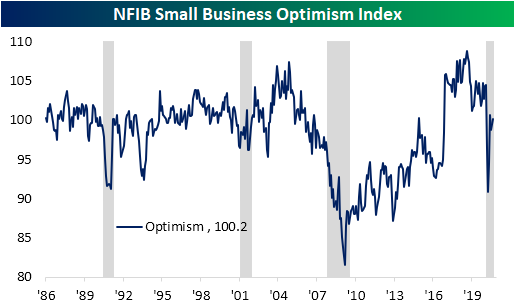
Of the ten individual components of the optimism index, most rose in August. Only two, Expectations for the Economy to Improve and Expectations for Real Sales to be Higher, fell while Plans to Make Capital Outlays was unchanged. The index that saw the biggest jump was for Actual Earnings Changes which rose 7 points to -25. That was the most that the index has risen in a single month since November of last year, but it still leaves it at the low end of the past decade’s range.
There is still a historically low level for expectations of future sales to be higher. That index was one of the two to fall in August as it is at its lowest level since October of 2016. Despite what appears like weak demand expectations, the net percent of owners viewing current inventories as too low stands at 3% which is in the 99th percentile of all readings. The current reading of 3 is the highest since February of 1997. As such, a higher share of businesses plan to increase inventories.
The indices covering employment were another strong point of this month’s survey. On a net basis, 21% of owners plan to increase employment which is up from 18 last month and stands in the top 5% of all readings. That index is currently right back to where it was before the pandemic began. Similarly, businesses are increasingly reporting job openings are hard to fill. That index rose another 3 points to 33 and is in the upper decile of historical readings. While improved and strong versus history, that index is much more muted relative to pre-pandemic levels than the index for Plans to Increase Employment.


Although they are not necessarily inputs into the headline number for the optimism index, some of the indices for actual changes shed some additional light on the picture for small businesses. For example, the index for Actual Sales Changes rose this month to -15 from -28 in July. That is tied with December of 1986 for the third-largest one month increase on record and the first back to back months with sequentially higher readings since November. While this still means that more businesses are reporting lower than higher sales, it also indicates that sales are continuing to turn around a bit. Meanwhile, fewer and fewer businesses are making capital expenditures. That index fell to 47 which means only 47% of businesses reported capital outlays in the last six months. That’s the lowest level since December of 2010. On the other side of the production function, labor also fell in August. The index for Actual Employment Changes fell 1 point to -12. Unlike for Capital Expenditures, though, that is not a fresh low.

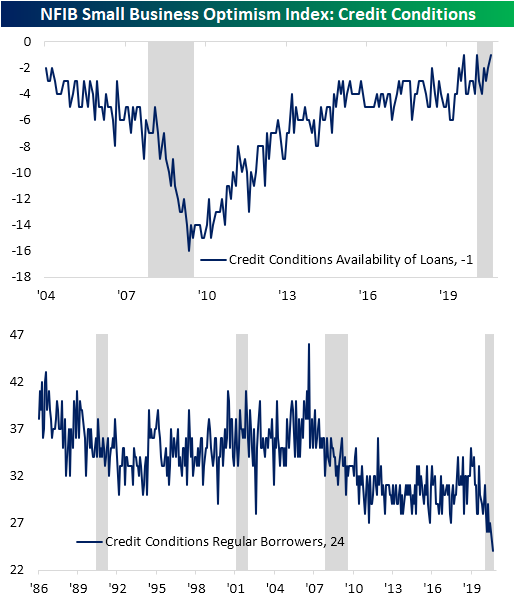
There is also an interesting divergence in readings on credit conditions. As conditions remain accommodative, the index for Availability of Loans is at its joint highest reading on record (this index only goes back to 2004). Despite this, only 24% of owners reported borrowing on a regular basis. That is a record low reading.Click here to view Bespoke’s premium membership options for our best research available.
Bespoke Brunch Reads: 9/6/20
Welcome to Bespoke Brunch Reads — a linkfest of the favorite things we read over the past week. The links are mostly market related, but there are some other interesting subjects covered as well. We hope you enjoy the food for thought as a supplement to the research we provide you during the week.
While you’re here, join Bespoke Premium with a 30-day free trial!
Elections
What if Facebook Is the Real ‘Silent Majority’? by Kevin Roose (NYT)
Political polling and betting markets show a pretty clear advantage for former Vice President Joe Biden in November, but Facebook is the heartland for conservative enthusiasm around Donald Trump. [Link; soft paywall]
U.S. Election Priced as Worst Event Risk in VIX Futures History by Michael P. Regan (Bloomberg)
The VIX futures curve is badly kinked around October’s contract, which is tied to options covering the period of the US election. [Link; soft paywall]
Exclusive: Dem group warns of apparent Trump Election Day landslide by Margaret Talev (Axios)
Leaving the slightly hyperbolic headline aside, there is a very real possibility that mail-in/absentee voting creates big differences between in-person results and the actual vote totals come election day. [Link]
Trump’s popularity slips in latest Military Times poll — and more troops say they’ll vote for Biden by Leo Shane III (Military Times)
In 2016, Military Times polling showed a 46-37 positive favorability for the President, but today that has more than flipped with a 50-38 unfavorable tilt among uniformed service members; respondents report they plan to vote 41-37 for Biden versus 41-21 advantage for President Trump in October 2016. [Link]
Generation Generalities
When It Comes to Gen Z’s Brand Preferences, the Most Important Influencers Are Their Parents by Alyssa Meyers (Morning Consult)
A recent poll shows that the youngest group of Americans are the most likely to take cues on preferred brands across a range of products from their parents. [Link]
It’s time to dispel the biggest myth about millennials by Myles Udland (Business Insider)
An oldie but a goodie from Myles Udland (now at Yahoo! Finance) arguing that Millennials’ preferences were not some sort of landmark departure from the prior American way of life but in fact just the same old story. [Link]
Dystopia
Targeted by Kathleen McGrory and Neil Bedi (Tampa Bay Times)
A detailed investigation of the Pasco County, Florida approach to crime prevention which involved invasive intelligence gathering, aggressive harassment of citizens picked out on an ad hoc basis, and general disregard for civil rights that created more crime than it prevented. [Link]
Amazon Drivers Are Hanging Smartphones in Trees to Get More Work by Spencer Soper (Bloomberg)
Drivers are competing to get orders from Whole Foods’ delivery service by hanging phones in trees near the distribution center which then pass on requests to their devices. [Link; soft paywall]
Learning At Home
Mom’s Hilarious Video Sums Up How Confusing This School Year Is For Everyone by Carolina Bologna (Huffpost)
Faced with massive frustration over the patchwork backdrop of remote and in-person learning, a mom parodied the painful experience of learning online. [Link]
Parents on TikTok mock people with disabilities for the ‘New Teacher Challenge.’ These women are reclaiming their images by Scottie Andrew and Kat Jennings (CNN)
A social media trend that sets up disabled people as the boogeyman and teaches their children to fear those same disabled people is a painful example of how what may seem innocuous fun can be deeply hurtful. [Link]
Hot Back-to-School Items During Coronavirus Are Tents, Webcams by Austen Hufford (WSJ)
Protective products, keyboards, webcams, and tents are all in huge demand as schools struggle to prevent the return of students from creating COVID hotspots. [Link; paywall]
Whales
SoftBank unmasked as ‘Nasdaq whale’ that stoked tech rally by Kana Inagaki, Katie Martin, Robert Smith and Robin Wigglesworth (FT)
In addition to buying the underlying stocks, SoftBank has reportedly bid up the call options of many of its US tech investments in an effort to push up investments even faster; that behavior may explain some of the massive tech rally we’ve seen in recent months. [Link; paywall]
Buffett’s 1977 Letter Hints at Why He Likes Japan Trading Houses by Stephen Stapczynski (Bloomberg)
Recent Berkshire Hathaway purchases in five Japanese conglomerates are in large part explained by his long-term focus on understandable, long-term, and competently run operations which are not extremely expensive. [Link; soft paywall]
Moving
New Yorkers Flee for Florida and Texas as Mobility Surges by Steve Matthews and Alexandre Tanzi (Bloomberg)
While mobility across state lines has sagged in recent years, 2020 is seeing a surge in movement from New York and New Jersey to warmer climates like Florida, Texas, and the rest of the Sunbelt. [Link; soft paywall]
Pandemic Purchases
In a Pandemic, Boats Are No Longer a Bad Investment by Alex Lauer (Inside Hook)
Loaded with operating costs and depreciation, boats have long been viewed as a great way to do away with large quantities of cash. But new and used boat sales have exploded during the pandemic as people look for ways to be outdoors and have some fun without getting on a plane or staying in a hotel. [Link]
Who Profits From Amateurism? Rent-Sharing in Modern College Sports by Craig Garthwaite, Jordan Keener, Matthew J. Notowidigdo, and Nicole F. Ozminkowski (NBER)
New research suggests that college sports effectively transfers resources away from black and lower income students and towards students who are white and higher income. This will not surprise many who have spent time close to college athletics departments. [Link]
Amazon Air
Amazon wins FAA approval for Prime Air drone delivery fleet by Annie Palmer (CNBC)
Drone delivery is now permitted to move forward for Amazon, who joins UPS and Google gaining approval for its automated airborne delivery fleet. [Link]
Read Bespoke’s most actionable market research by joining Bespoke Premium today! Get started here.
Have a great weekend!
Airports Getting a Little More Crowded
Recent economic data has been making a habit of surprising to the upside as the pace of recovery from the pandemic lows has consistently surprised most economists. While improved, the picture isn’t perfect. This morning’s non-farm payrolls report, which was better than expected at the headline level, showed a concerning increase in the number of permanent job losses (people looking for work that left their prior job on an involuntary basis). Also, looking at more real-time indicators of activity like TSA passenger throughput at the country’s airports appears to have leveled off after rising off the lows in May and June. This begs the question, has the low hanging fruit been fully harvested?
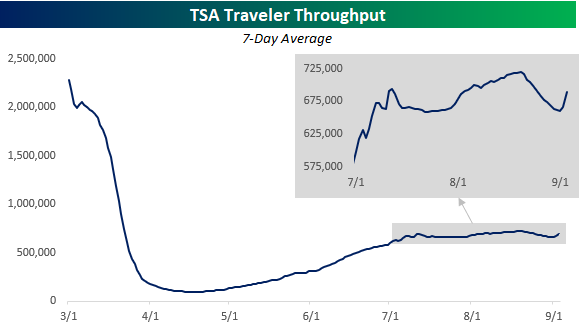
In some ways, the answer to this question is yes. In March and April, pretty much everything shut down. As awareness of the virus and how to deal with it grew, though, businesses that were little impacted have resumed operations. While those businesses have resumed activity, there are still a number of businesses such as ones in the travel, leisure, beauty, and hospitality sectors that remain weak in part because the demand hasn’t returned but also because government orders prohibit them from re-opening in full or even at all. As concerns from the public start to ease and restrictions are lifted, these sectors should also start to improve.
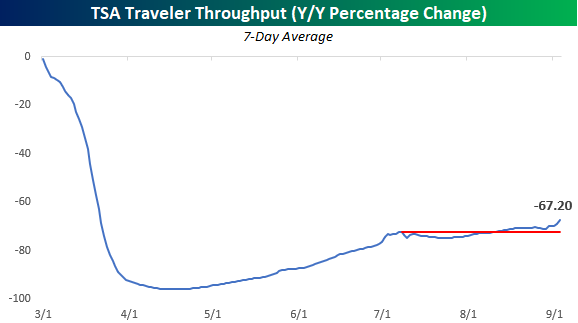
While the pace of the recovery has slowed, it doesn’t yet appear to be rolling over. Take the passenger data in the chart above. While it appears to have stalled out in the last two months, part of the decline is the result of seasonal factors. The chart below takes the same data as the chart above but compares the throughput levels to where they were a year ago and shows the y/y percentage change. On this basis, passenger traffic is still down an eye-popping 67% compared to a year ago, but yesterday’s level was actually the highest reading since late March and has actually been accelerating to the upside. It’s possible that where Labor Day falls on the calendar this year could be impacting the y/y change, so we’ll have to see where things shake out in the next week, but even with that caveat, the pace of air traffic looks better on a y/y basis than on an absolute basis. Like what you see? Try out a Bespoke subscription to receive our weekly Bespoke Report in your inbox this evening. Click here to start a two-week free trial now!
Under The Surface, The Labor Market Weakened In August
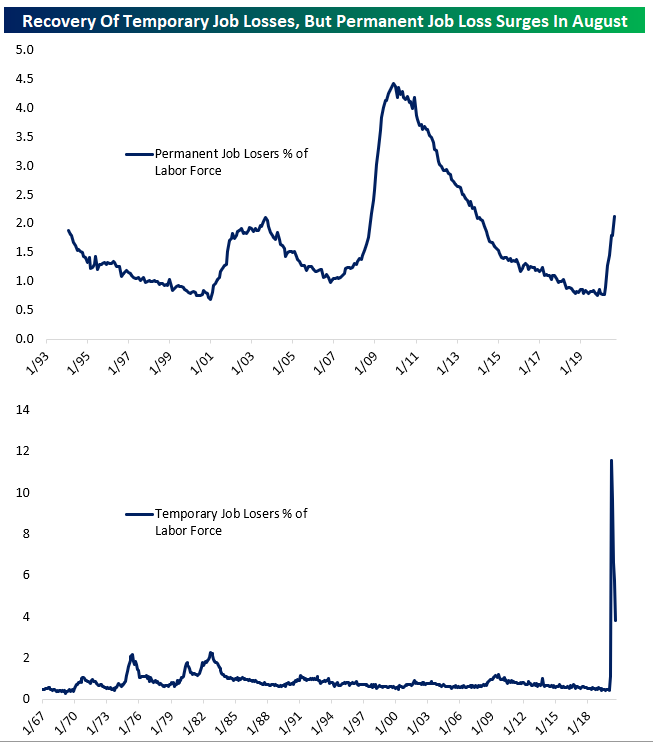
Headline statistics from the Bureau of Labor Statistics Employment Situation Report on Friday morning showed further labor market recovery from COVID. But under the surface, August had significant labor market deterioration. While payrolls beat, the unemployment rate fell faster than expected, wages were stronger than expected, and hours worked rose against expectations, the number of Americans who are on permanent layoff (involuntarily unemployed and looking for work) rose by more than 500,000, and their share of the overall labor force is now the same as during the peak of the early-2000s recession.
While the huge drop in temporarily laid-off workers that has been ongoing for several months continued, widening of permanent job loss suggests that the labor market is still deteriorating as businesses close, reduce output, or are forced from re-opening thanks to the ongoing economic impact of COVID. While the headline numbers were welcome, it’s important to understand that they don’t tell the full story. Please note both charts below show data for all periods it is available. For more on the jobs report, try out a Bespoke subscription to receive our weekly Bespoke Report in your inbox this evening. Click here to start a two-week free trial.
All or Nothing Days Make a Comeback
For those unfamiliar with the term, we consider an “all or nothing day” to be one where the S&P 500’s net daily A/D (advance/decline) reading is greater than +/-400. Earlier this year when the market was going haywire due to the COVID outbreak and subsequent lockdowns, all or nothing days were occurring nearly every other day. In the 50 trading days from 2/21 through 5/1, there were a total of 22 all or nothing days, which works out to 44% of trading days. Going back to 1990, there were only two other periods where the percentage of all or nothing days was higher. The first was in the 50 days ending 12/5/08 while the highest frequency of all or nothing days over a 50-day period was in the second half of 2011. After a 45-trading day lull with no occurrences, all or nothing days are attempting a comeback as the S&P 500 has now seen back to back all or nothing days for the first time since March

As far as for where the frequency of all or nothing days this year ranks compared to other years, 2020 already ranks in the top six of all years since 1990, and there are still nearly four months left to go! If the current pace of all or nothing days this year keeps up through year-end (a big if given that these types of days tend to occur in bunches), 2020 would see a total of 49 all or nothing days, and that would rank as the third-highest for all years since 1990 (2011 – 70 and 2008 – 52). With fall and the most volatile time of the year now upon us, we may just get there. Click here to view Bespoke’s premium membership options for our best research available.

Late Summer Service Slip
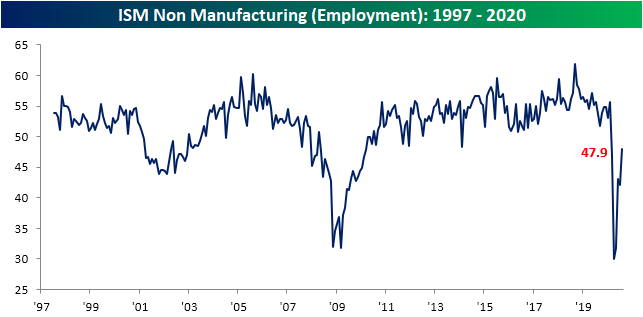
On Tuesday, ISM’s reading on the manufacturing sector rose by more than expected, but the service counterpart released today saw the opposite results. The headline index was expected to fall to 57 but instead fell by slightly more with the headline number coming in at 56.9. Although lower than the past two months, that is still indicative of expansionary activity in the service sector as the index remains at some of the highest levels of the past two years. The same can be said for the composite index which outside of last month, is at its highest level since February of last year.


Breadth in this month’s report was fairly mixed. The majority of indices rose month over month with the biggest increases in prices, exports, and employment. On the other hand, three indices fell and two are in contraction. Of the indices that did fall, the declines were historically large.

The index that experienced the most dramatic decline was that for New Orders. Last month, this index was at a record high of 67.7, but in a complete 180, the index had its second-largest decline on record in August (behind April’s 20 point decline) and is now in the middle of its historical range. That does not mean that there was an overall decline in new orders though. The level of 56.8 still indicates demand grew in August, just at a slower rate than in July.

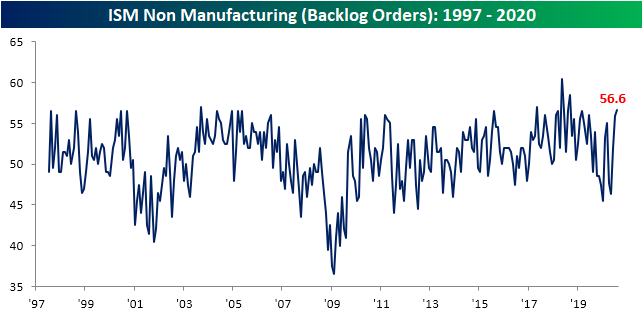
Even though new demand was not as strong, businesses still have plenty on their plates as is evident through the index of Backlog Orders. The index for Backlog Orders rose to 56.6 from 55.9. That is in the 98th percentile of all readings as the index is currently at its highest level since May of 2018.
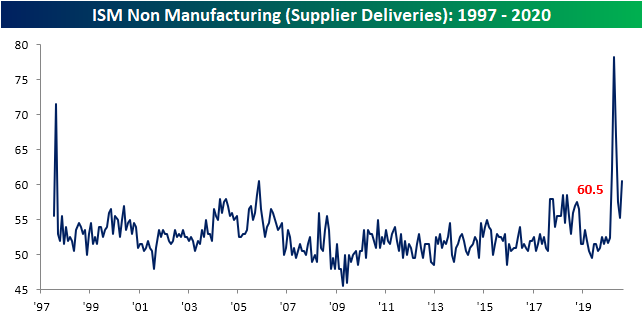
The attempt to fill the growing number of orders has led to inventory drawdowns. The index for Inventories showed a contractionary reading of 45.8. That compares to an expansionary reading of 52 last month. Outside of March’s even lower reading of 41.5, you would have to go back to February of 2010 to find the next lowest reading of this index. Additionally, as inventories have fallen, other supply chain issues seem to have appeared. The index for Supplier Delivers in which higher readings point to longer lead times, experienced its sixth-largest monthly increase on record. That increase brings the index to 60.5 which is tied with November of 2005 for the fifth-highest reading on record.

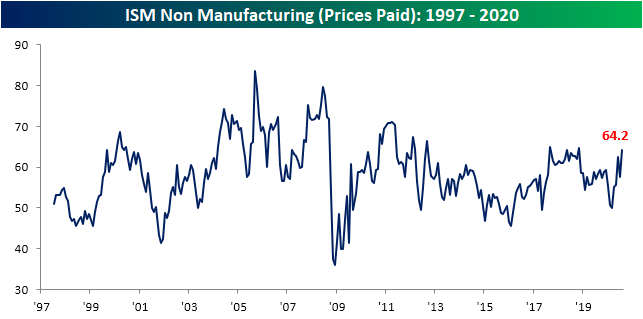
With stronger demand, falling inventories, and greater difficulty getting products from suppliers in a timely manner, it makes intuitive sense that prices are rising fairly rapidly. The index for prices paid rose to 64.2 which is the highest level since November of 2018.
Perhaps the measure that has remained the weakest has been employment. Since the low in April, the index for Employment has risen every month except for last month. Even though it was higher again in August, it has shown a sixth straight contractionary reading. Although more businesses are reporting lower than higher levels of employment, the commentary section of the report did offer some hope. One comment noted that “The need for employees is greater, but we are having a difficult time filling open positions” while another stated that “hiring is authorized, but slow to materialize”.Click here to view Bespoke’s premium membership options for our best research available.
DocuSign (DOCU) Has Been an Earnings Beast
After the close today, DocuSign (DOCU) is scheduled to report third-quarter earnings. Below is a snapshot of DOCU from our popular Earnings Explorer tool, which allows users to pull up historical earnings results for nearly all publicly traded US companies. Over the past couple of years, this stock has been stellar on earnings. DOCU has yet to miss estimates on top-line sales and has only missed EPS once (its Q3 report last year). As for forward projections, the company has actually raised guidance on every single one of its eight quarterly reports as a public company. That means that DOCU has reported a triple play (beat EPS, beat revenues, raised guidance) in seven of the eight reports on record.
Despite consistently making the list of earnings triple plays, stock price reactions for DOCU have been a coin-flip. On its eight historical earnings reports, the stock has only risen on its earnings reaction day 50% of the time.


Based on its earnings history, it is a 50/50 chance that the stock will react positively to results tonight, but headed into earnings, the chart of DOCU is much less extended than it was just a few days ago. In the past week, DOCU surged to new highs that briefly brought it out of the past several months’ uptrend channel. In the past two sessions, though, it has pulled back to the middle/lower end of this channel. This pullback at least gives the stock some breathing room when it reports after the close. You can gain access to Bespoke’s Earnings Explorer with a Bespoke Institutional membership. Click here to start a two-week free trial today!

Sentiment Out of Sync
Recently we have noted how different sentiment indicators have been showing mixed results. While some like AAII’s weekly survey continue to show overall bearish readings, others like the survey from Investors Intelligence are more optimistic. Typically, when the S&P 500 is at an all-time high, AAII’s reading on bullish sentiment has averaged a reading around 40%. But in recent weeks not even a third of respondents have been bullish. After rising for the past four consecutive weeks and despite more all-time highs in that time, bullish sentiment pulled back this week to 30.8% from 32.08% last week. While that remains at the upper end of the past several month’s range, it is very muted compared to where equities are trading.
Meanwhile, the Investors Intelligence survey of equity newsletter writers has much more bullish tones. This week, that survey saw 61.5% of respondents report as bullish. That is the highest reading of bullishness since October of 2018 and the fourth week over week increase in a row.


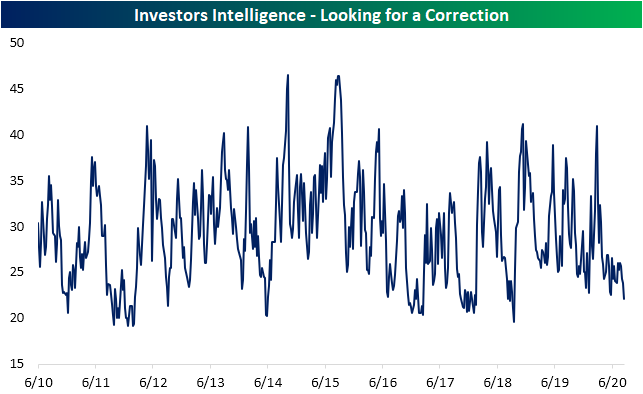
Additionally, Investors Intelligence collects the percentage of respondents that are looking for a correction. This week that reading fell for a fourth straight week to 22.1%. Similar to bullish sentiment from this survey, that is the most optimistic reading since October of 2018.
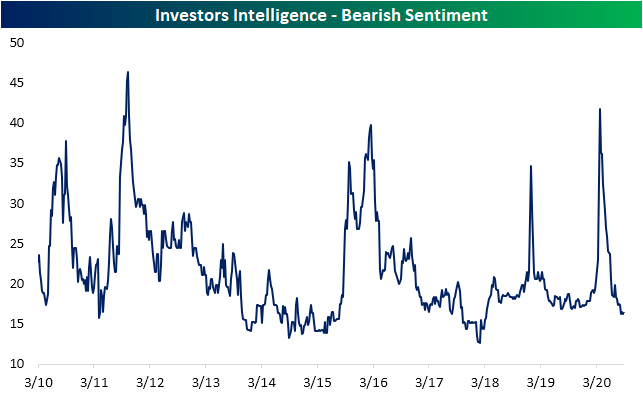
Meanwhile, AAII saw bearish sentiment rise back above 40%. Bearish sentiment remains the predominant sentiment in this survey even though this week’s reading of 41.77% is actually lower than most readings of the past several months. Again, the Investors Intelligence survey is showing the opposite from AAII as bearish sentiment is at 16.4%. That is up slightly from 16.2% last week, but that is still around some of the lowest levels since March of 2018.

Finally, investors also are slightly more decisive in the bear or bull decision as neutral sentiment fell this week from 28.3% to 27.43%, While there have been plenty of lower readings in the late spring and summer, that is still around four percentage points lower than the historical average. Click here to view Bespoke’s premium membership options for our best research available.

Bespoke’s Consumer Pulse Report — September 2020
Bespoke’s Consumer Pulse Report is an analysis of a huge consumer survey that we run each month. Our goal with this survey is to track trends across the economic and financial landscape in the US. Using the results from our proprietary monthly survey, we dissect and analyze all of the data and publish the Consumer Pulse Report, which we sell access to on a subscription basis. Sign up for a 30-day free trial to our Bespoke Consumer Pulse subscription service. With a trial, you’ll get coverage of consumer electronics, social media, streaming media, retail, autos, and much more. The report also has numerous proprietary US economic data points that are extremely timely and useful for investors.
We’ve just released our most recent monthly report to Pulse subscribers, and it’s definitely worth the read if you’re curious about the health of the consumer in the current market environment. Start a 30-day free trial for a full breakdown of all of our proprietary Pulse economic indicators.

No Inflation?
Today’s ISM Services report for the month of August came in slightly lower than forecasts, but one of the bigger stories in the report was the trend of rising prices. The Prices Paid component of August’s report rose to 64.2 which is not far from the five-year high of 64.9. Within the monthly commodities survey, there were price increases all over the place. Respondents in this month’s report noted prices increases in 26 commodities and declines in just four. The 26 commodities rising in price is the highest since October 2017. Not only that, but respondents also noted that 22 commodities were in short supply. Anyone with a basic understanding of economics can tell you that when commodities become scarce, they usually rise in price. Therefore, there’s likely a healthy pipeline of commodities that have the potential to show up in the “Up in Price” section.

Combining the results from today’s ISM Services report with the commodity survey from Tuesday’s ISM Manufacturing report, a total of 41 commodities were up in price during the month of August while just six were down. That net reading of 35 ranks as the highest in just over two years (July 2018). The chart below compares the six-month average of the net number of commodities rising in price and y/y CPI going back to 1999. As the chart illustrates, trends in the commodities survey typically track and often lead changes in y/y CPI, and while the six-month average has now been trending higher for a few months now, CPI is only just starting to tick higher. Not only that but in the next three months, the moving average of the commodities survey is only going to keep rising. Start a two-week free trial to Bespoke Institutional for full access to our research and interactive tools.
