
Rotating in August
Following the best July of the post-WWII era, equities have been getting off to a slower start in August with the Russell 3,000 experiencing a modest decline yesterday and the index fighting to move into the green as of midday today. Most of the move to start August appears to a degree to be rotational in nature. In the chart below, we show the average performance of deciles of Russell 3,000 stocks grouped by their performance in the month of July. As shown, both the best and worst performers last month have rallied in early August with the deciles of the worst performers seeing slightly larger gains. The losers this month have been in the middle of the performance spectrum as deciles 4 through 7 are each flat to lower over the past couple of sessions.

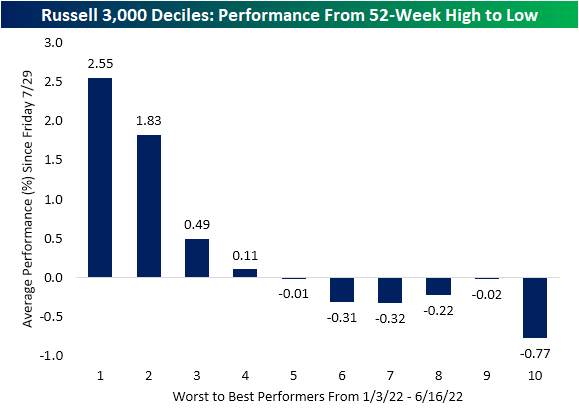
Equities bottomed in mid-June and have been in rally mode ever since. As for how performance the past couple of days relates to the first half of the year’s declines, again the worst performers have generally been outperforming. However, by this measure, the top performers from the 52-week high just after the New Year through the low in June have continued to fall this week. Click here to learn more about Bespoke’s premium stock market research service.
Bespoke’s Morning Lineup – 8/2/22 – Oil’s Not Well
See what’s driving market performance around the world in today’s Morning Lineup. Bespoke’s Morning Lineup is the best way to start your trading day. Read it now by starting a two-week trial to Bespoke Premium. CLICK HERE to learn more and start your trial.
“The more you sweat in peace, the less you bleed in war.” – Norman Schwarzkopf

Below is a snippet of content from today’s Morning Lineup for Bespoke Premium members. Start a two-week trial to Bespoke Premium now to access the full report.
With Speaker Pelosi reportedly en route to Taiwan as we type this, markets are on edge this morning as China has threatened military action if the planned trip takes place. Only Chinese authorities know exactly what the response will be, but we would expect more bluster than bite. After a relatively slow day of earnings news yesterday, today will be a busy day, and there have already been a number of important reports this morning from the likes of Caterpillar (CAT), Uber (UBER), and Marriot (MAR) among others. After the close, among others, we’ll hear from AMD, Gilead (GILD), Occidental (OXY), PayPal (PYPL), and Starbucks (SBUX).
Today’s Morning Lineup discusses earnings news out of Europe and the Americas, the rate hike in Australia, a detailed look at other economic data from around the world, and much more.
32 years ago today, Iraq invaded Kuwait, spurring a monumental surge in oil prices. In the first five trading days of August alone, WTI surged more than 35% and nearly doubled in price through the fall as tensions in the region boiled over. There are still more than enough geopolitical issues around the globe today to worry about, but unlike in August 1990, crude oil prices have been moving in the opposite direction.
After briefly trading above $130 per barrel earlier this year, crude oil has declined nearly 30% from its peak to under $95 per barrel, and just yesterday, closed below its 200-DMA for the first time in over six months.

As shown in the chart below, yesterday’s close below the 200-DMA ended what was the 12th longest streak of consecutive closes above the 200-DMA for WTI since the early 1980s. The streak that just ended was the longest since the 269 trading day streak that ended last November. That streak was the third longest on record trailing only the 276 trading day streak that ended in April 2000 and the 330 trading day streak that ended in August 2008.

Start a two-week trial to Bespoke Premium to read today’s full Morning Lineup.
Bespoke Market Calendar — August 2022
Please click the image below to view our August 2022 market calendar. This calendar includes the S&P 500’s average percentage change and average intraday chart pattern for each trading day during the upcoming month. It also includes market holidays and options expiration dates plus the dates of key economic indicator releases. Click here to view Bespoke’s premium membership options.

Gas Prices Continue to Decline
In 2022, extremely elevated gas prices have been impacting the economy, as every product-producing company has seen energy and transportation costs increase, forcing price hikes on the part of businesses simply to keep margins flat. Although there are a variety of factors affecting CPI readings, high gas prices certainly apply upward pressure. Today, gas prices are still extremely elevated compared to historical levels. At the AAA current national average of $4.22, just 1.8% of all days since the start of 2005 have seen a higher national average high, and all of them occurred this year. Click here to learn more about Bespoke’s premium stock market research service.

The national average price per barrel is still up 32.75% y/y, but this is actually the smallest y/y increase so far in 2022 and comes as the national average price has declined for 48 consecutive days. That’s the fourth longest streak on record. This streak is certainly notable, but gas prices are still at a level that is wearing on consumers.

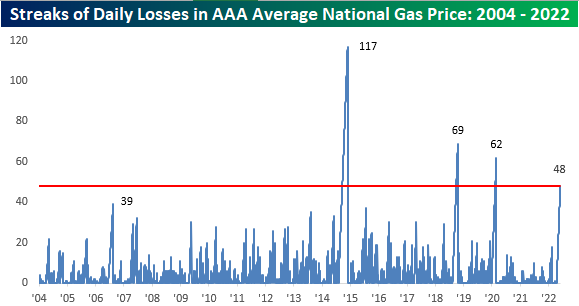
The 40-day rate of change in average gas prices (-15%) has been notable as well, with only six other periods seeing a larger decline on a percentage basis. The most recent occurred during the COVID crash when it became clear that demand was going to deteriorate due to government-imposed mandates across the globe. Consumers will hope for further declines as we begin to near the $4.00 per gallon level. Not only have prices been falling lately, but they have also been more volatile than usual, as the current 50-day standard deviation (26 cents) is 3.2 times higher than the average since 2005. Click here to learn more about Bespoke’s premium stock market research service.

Strongest July in Post-WWII Era
On Friday, the S&P 500 closed over 140 basis points higher on the back of favorable earnings from Apple (AAPL), Amazon (AMZN), Chevron (CVX) and Exxon (XOM). This was the third straight day in which the S&P 500 gained at least one percent, allowing bulls to breathe a sigh of relief after a tough start to the year. These moves came even as a second consecutive quarter of negative real GDP growth was reported and the Fed hikes rates by 75 basis points.
Friday’s move helped the S&P 500 post its best July in the post-WWII era, finishing with a gain of 9.2%. Although the index is still close to 14% off of its early January highs, the market looks more inviting than it did at the beginning of the month, when the YTD declines were above 20%. As investors, we could just give ourselves high fives for the month, but it’s vital to remain forward-looking. Following July gains of 5%+, the S&P 500 has averaged a gain of 0.6% in August (median: +1.4%), performing positively 60 percent of the time. Between the start of August and the end of the calendar year, the index has averaged a gain of 8.0% (median: +10.0%), gaining 80% of the time. Over the following twelve months (starting in August), the index has averaged an impressive gain of 15.6% (median: +15.4%), rallying 87% of the time. Based on past history, bull runs in July tend to bode well for the market for both the rest of the year and over the following twelve months. Click here to learn more about Bespoke’s premium stock market research service.

Bespoke’s Morning Lineup – 8/1/22 – The Real World
See what’s driving market performance around the world in today’s Morning Lineup. Bespoke’s Morning Lineup is the best way to start your trading day. Read it now by starting a two-week trial to Bespoke Premium. CLICK HERE to learn more and start your trial.
“Ladies and gentlemen, rock and roll.” – John Lack
Below is a snippet of content from today’s Morning Lineup for Bespoke Premium members. Start a two-week trial to Bespoke Premium now to access the full report.
41 years ago today, teens, pre-teens, and other people resembling the cast of “Stranger Things” watched “Video Killed the Radio Star” as MTV revolutionized the entertainment industry by making music both a listening and viewing experience. Eleven years later, in 1992, MTV mixed things up again with the launch of “The Real World” in what ultimately became the start of the reality TV revolution. The life cycle of MTV has been interesting to watch. What started as a network intended solely for ‘watching’ music, has become a network that now shows little or no music at all. MTV’s experience also shows the importance of adapting and changing with the times. Peter Drucker may not have had MTV in mind, but the phrase most famously applied to him still applies. Innovate or die.
Futures started off the month of August with losses last night but have erased much of the weakness so far this morning. Treasury yields are only marginally higher, crude oil is lower, while gold is higher. The big economic indicator of the day is the ISM Manufacturing report at 10:00 AM Eastern. Economists expect the headline reading to come in at 52.2 versus June’s reading of 53.0. Any reading under 53.0 would be the weakest reading in two years (June 2020).
Today’s Morning Lineup discusses earnings news out of Europe and the Americas, global PMI data for July, a detailed look at other economic data from around the world, and much more.
There may not be an official start date, but August represents what many consider the dog days of summer when, for a lot of people, the market is the last thing on their minds. Historically, there have been a number of calamitous events that began or transpired in August, but overall stock market returns during this time of year have been middling. The snapshot below from our Seasonality tool shows that over the last ten years, the S&P 500’s median performance from the close on 8/1 over the next week, month, and three months has ranked between the 50th and 60th percentile. For the next week, the S&P 500’s median gain has been 0.40%. The next month has had a median gain of 1.15% while the next three months have seen a median gain of 2.75%. Nothing especially notable, but the way this year has gone, a gain is a gain!

Start a two-week trial to Bespoke Premium to read today’s full Morning Lineup.
Bespoke Brunch Reads: 7/31/22
Welcome to Bespoke Brunch Reads — a linkfest of the favorite things we read over the past week. The links are mostly market related, but there are some other interesting subjects covered as well. We hope you enjoy the food for thought as a supplement to the research we provide you during the week.
While you’re here, join Bespoke Premium with a 30-day free trial!
Energy Policy
Department of Energy Releases New Notice of Sale as Gasoline Prices Continue to Fall (The White House)
A new Biden administration initiative will start using futures markets in conjunction with the SPR, in an effort to balance the crude market’s term structure as well as the physical market, which can allow for easier market conditions without outright selling crude from the SPR. [Link]
Resource Nationalism and Decarbonization by Miguel Ángel Marmolejo Cervantes , Martín Obaya, Thea Riofrancos, and Alex Yablon (Phenomenal World)
A conversation discussing the prospects of nationalization and national management of decarbonized energy resources in Latin America. [Link]
How London Paid a Record Price to Dodge a Blackout by Javier Blas (Blooomberg)
The UK’s metropole only barely avoided a blackout in mid-July, but to do so it needed to pay 5000% more per hour than is typical. These sorts of shocks to the grid are becoming more and more common as resilience falls. [Link; soft paywall]
Growth Tech
Zuck Turns Up The Heat by Alex Heath & David Pierce (The Verge)
The trials and tribulations of the Meta CEO, struggling to manage a sprawling social media behemoth that is being nibbled at from all sides. [Link]
Changes to Shopify’s team by Tobi Lutke (Shopify)
A frank admission that the explosion in e-commerce activity during the pandemic didn’t continue, and investments made during that period are souring amidst a huge swing back towards normal spending from consumers. [Link]
Politics
Republicans Confront Unexpected Online Money Slowdown by
While political partisans on both sides of the aisle appear motivated, recent GOP grassroots fundraising efforts have dried up at a critical period for advertising spending headed into the midterm elections, in a potential warning sign for the party that has analysts puzzled. [Link; soft paywall]
Investing
The Secret Diary of a ‘Sustainable Investor’ — Part 1 by Tariq Fancy (Medium)
A rejection of the “sustainable” or “ESG” investing movement by one of its founding members, in favor of much bigger and more dramatic interventions in how our society consumes resources. [Link]
Demographics
Study: Millennials didn’t stray far from where they grew up by Mike Schneider (AP)
A new analysis of Census data suggests that narrow economic opportunity sets mean they tend to lead their adult lives close to where they grew up. [Link]
Remembering When Bob Dylan Shocked The World By Going Electric, On This Day In 1965 [Videos] by Rex Thomson (Live For Live Music)
An oral history of the night that folk music legend Bob Dylan decided to take a different tack, switching from his acoustic guitar to an electric one and forever changing how he was viewed as an artist. [Link]
Inflation
Cheaper Beer, Cigarettes Gain Favor as Inflation Pinches Shoppers by Jennifer Maloney and Alex Harring (WSJ)
Lower-priced value brands are seeing strong sales while premium offerings suffer, a response to pinched budgets and incomes that can’t keep up with broad prices. [Link; paywall]
Read Bespoke’s most actionable market research by joining Bespoke Premium today! Get started here.
Have a great weekend!
The Bespoke Report — Equity Market Pros and Cons — Q3 2022
This week’s Bespoke Report is an updated version of our “Pros and Cons” edition for Q3 2022.
With this report, you’re able to get a complete picture of the bull and bear case for US stocks right now. It’s heavy on graphics and light on text, but we let the charts and tables do the talking!
On page two of the report, you’ll see a full list of the pros and cons that we lay out. Slides for each topic are then provided on page three and beyond.
To read this report and access everything else Bespoke’s research platform has to offer, start a two-week trial to Bespoke Premium.

Fed Chair Powell: The Comeback Kid
The S&P 500 has gained more than 1% on each of the last four Fed Days going back to March. The March meeting was the first rate hike of the Fed’s current tightening cycle, and every meeting since then has seen a hike of at least 50 basis points. Each time, the S&P surged on the day of the hike.
The recent equity market strength on Fed Days is a new trend. Market performance on Fed Days during Powell’s first few years at the helm was notoriously weak. Below we show the S&P 500’s average intraday performance on Fed Days by Fed chair since 1994 when policy changes first started being announced on the same day as the meeting. For Chair Powell, we show the S&P’s average performance on Fed Days during his tenure only through July 2021. At the time a year ago, Powell Fed Days were by far the worst of any Fed chair, and the market typically plunged into the close after the 2 PM ET announcement.
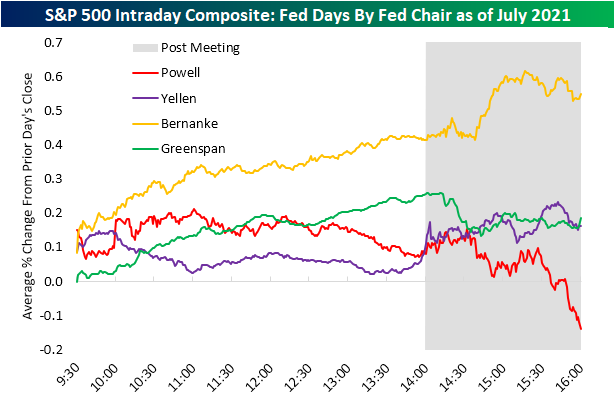
What a difference a year makes. Below we show the S&P’s average intraday performance on Fed Days by Fed chair updated through the most recent FOMC meeting this week. Whereas Powell Fed Days were by far the worst for the market at this time last year, they’re now the second best behind only Bernanke Fed Days.

To highlight the improvement in the market response to Fed Chair Powell another way, below we show the full-day percentage change of the S&P 500 on Fed Days during Powell’s tenure as well as how the cumulative averages have evolved for both the full-day change and performance from 2:30 PM ET through the close (encapsulating the market response to the presser, or the chair more directly).
As you can see, the S&P was extremely weak on Powell Fed Days early on during his tenure, but over the last year, the market has reacted extremely positively. Seven of the last eight Powell Fed Days have seen positive moves for the S&P, with the last four all seeing gains of more than 1%. Click here to learn more about Bespoke’s premium stock market research service.

Bespoke’s Morning Lineup – 7/29/22 – We Made It!
See what’s driving market performance around the world in today’s Morning Lineup. Bespoke’s Morning Lineup is the best way to start your trading day. Read it now by starting a two-week trial to Bespoke Premium. CLICK HERE to learn more and start your trial.
“The time to hesitate is through. No time to wallow in the mire.” – The Doors
Below is a snippet of content from today’s Morning Lineup for Bespoke Premium members. Start a two-week trial to Bespoke Premium now to access the full report.
Stocks are looking to close out a strong week on a positive note this morning as S&P 500 and Nasdaq futures are indicated higher. Earnings have been the driver of the strength, and this morning we’re seeing positive reactions to reports from the likes of Apple and Amazon on the tech/growth side to Chevron and Exxon on the energy side.
We’re pretty much done with earnings for the week, but a number of economic reports are on the calendar. Employment Cost Index, Personal Income, and Personal Spending were all just released, and every one of them exceeded forecasts by 0.1 percentage points. PCE Deflator numbers were also just released and were exceptionally high relative to history but generally in line with or slightly higher than expectations. The initial reaction from the markets has been weakness in equity prices and higher yields in the Treasury market. Outside of these reports, the only others on the calendar are Chicago PMI and Michigan Confidence which will both be released after the opening bell.
Today’s Morning Lineup discusses earnings news out of Europe and the Americas, a detailed look at economic data from around the world, and much more.
With all that’s gone on this week and how lousy a year it has been for the equity market, it’s surprising that the S&P 500 heads into the final trading day of the week with a gain of nearly 3%. The performance of the four mega-cap stocks (Alphabet, Amazon.com, Apple, and Microsoft) this week has been equally as impressive. The table below lists every earnings season since 2015 that all four stocks reported earnings in the same week. Before this week, in each of the eight prior earnings seasons where all four stocks reported in the same week, there was never an earnings season when they all reacted positively the day after their reports, and the S&P 500 was only higher in that week two times.
That trend changed this week. GOOG and MSFT already reported and both rallied more than 5%. AAPL and AMZN, meanwhile, reported after the close Thursday, and both stocks traded higher after hours. Along with the gains in all four stocks, the S&P 500 is already up 2.8% on the week through Thursday’s close and indicated higher in the pre-market. As nervous as bulls were heading into the week with all the major events (earnings, FOMC meeting, Q2 GDP report) on the calendar, as often ends up being in the case with these types of situations, the bark turned out to be a lot worse than the bite.

Start a two-week trial to Bespoke Premium to read today’s full Morning Lineup.