Apr 10, 2026
See what’s driving market performance around the world in today’s Morning Lineup. Bespoke’s Morning Lineup is the best way to start your trading day. Read it now by starting a two-week trial to Bespoke Premium. CLICK HERE to learn more and start your trial.
“The market is a pendulum that forever swings between unsustainable optimism and unjustified pessimism.” – Jason Zweig

Below is a snippet of commentary from today’s Morning Lineup. Start a two-week trial to Bespoke Premium to view the full report.
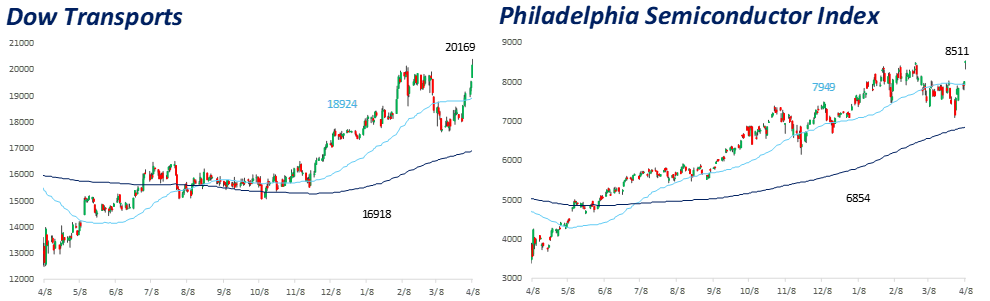
While the S&P 500 still sits 2.8% below all-time highs, both the Dow Transports and Philadelphia Semiconductor index — two groups seen as “leading” indicators — hit new all-time highs yesterday. The charts below show the breakouts to new highs for these two closely-followed areas of the market.
US equity futures are trading slightly higher this morning as we look to close out the week with five days of gains (and extend the daily win streak to eight dating back to last Tuesday).
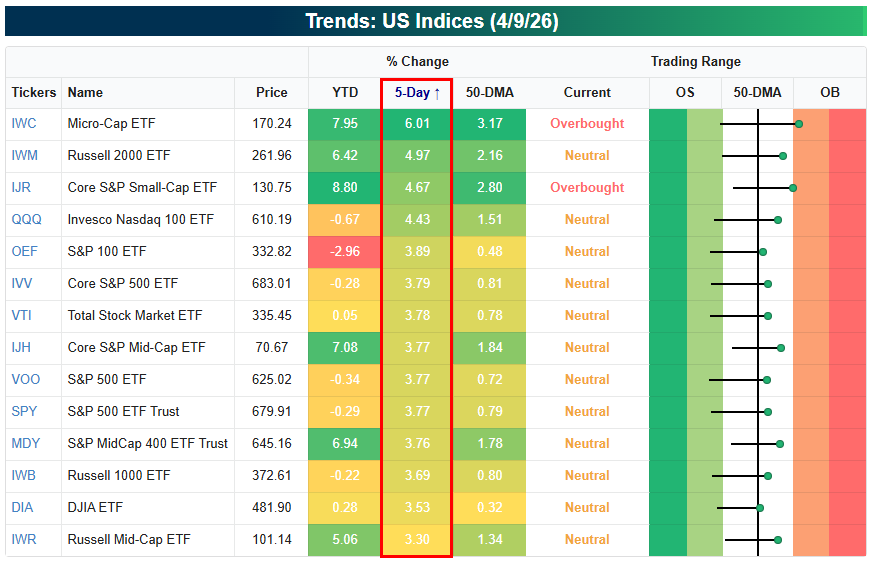
Below is a look at the swing we’ve seen from oversold levels last week to back above the 50-DMA for most key US index ETFs:
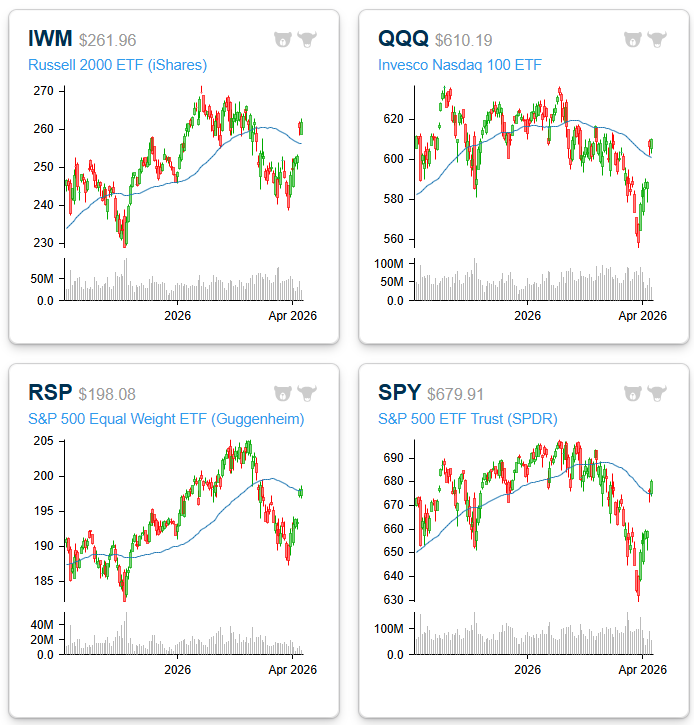
While we’ve seen a nice bounce, price charts for ETFs like SPY, QQQ, and IWM still have work to do to break out of the choppy action seen for many months now.
Yesterday was another painful day for the software group, which fell another 3.9% as algos look to exit or short anything at risk of AI obsolescence.
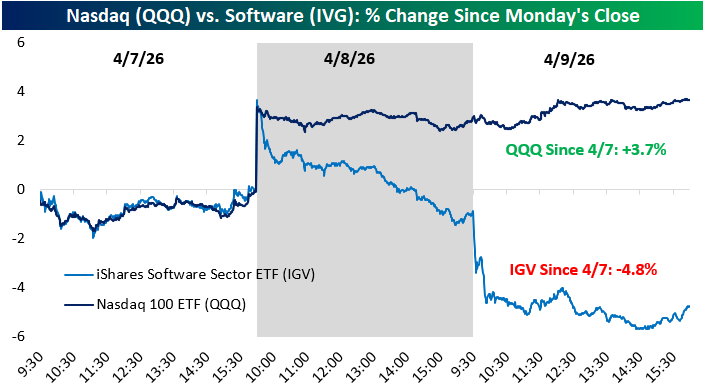
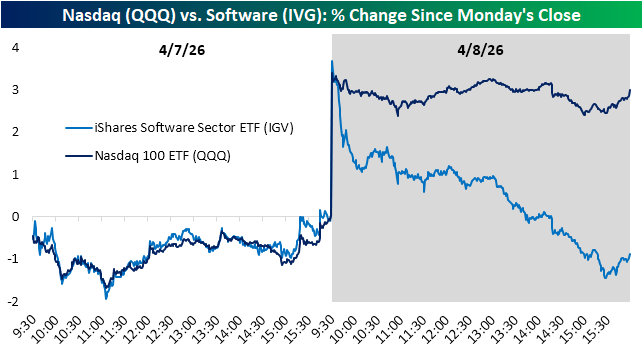
As shown below, IGV is now down 4.8% since Tuesday’s close when the US/Iran ceasefire was announced versus a gain of 3.7% for the broader Nasdaq 100 (QQQ).
Start a two-week trial to Bespoke Premium to continue reading today’s full Morning Lineup.
Apr 9, 2026
See what’s driving market performance around the world in today’s Morning Lineup. Bespoke’s Morning Lineup is the best way to start your trading day. Read it now by starting a two-week trial to Bespoke Premium. CLICK HERE to learn more and start your trial.
“Success is like Halley’s Comet, you know. Every now and then it just comes around.” – Ross Perot
Below is a snippet of commentary from today’s Morning Lineup. Start a two-week trial to Bespoke Premium to view the full report.
While the S&P 500 still sits 2.8% below all-time highs, both the Dow Transports and Philadelphia Semiconductor index — two groups seen as “leading” indicators — hit new all-time highs yesterday. The charts below show the breakouts to new highs for these two closely-followed areas of the market.
While the Semis and Transports surged and held onto gains yesterday, the same can’t be said for Software. Below is an incredible two-day intraday chart of the Nasdaq 100 ETF (QQQ) versus the iShares Software ETF (IGV). While IGV and QQQ tracked each other closely through yesterday’s sharp upside open, software (IGV) collapsed from there and ended up closing down 1% on the day, while QQQ held steady and went out with a gain of nearly 3%.
Apr 8, 2026
See what’s driving market performance around the world in today’s Morning Lineup. Bespoke’s Morning Lineup is the best way to start your trading day. Read it now by starting a two-week trial to Bespoke Premium. CLICK HERE to learn more and start your trial.
“I looked for the same pitch my whole career, a breaking ball. I never worried about the fastball. They couldn’t throw it past me.” – Hank Aaron
Below is a snippet of commentary from today’s Morning Lineup. Start a two-week trial to Bespoke Premium to view the full report.
US equity futures are sharply higher this morning, set to open up nearly 3%, after a two-week ceasefire was reached between the US and Iran to open up the Strait of Hormuz and work towards a longer-term resolution. Of course, the anti-Trump commentary suggests that it’s a disastrous outcome for the US, while the pro-Trump commentary is saying this is all part of the President’s expert negotiating skills.
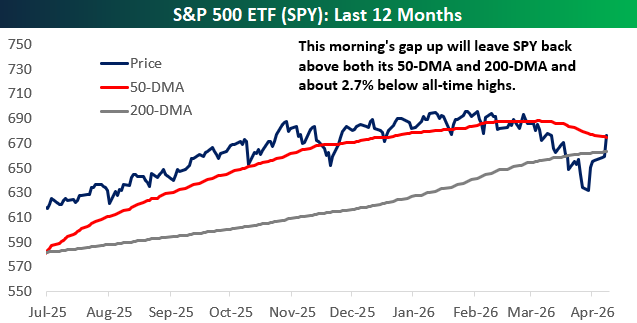
Our goal is to avoid the politics and focus on market action. Based on where futures are trading, the S&P 500 is set to move back above both its 50-DMA and 200-DMA at the open, leaving the index roughly 2.7% below its all-time closing high.
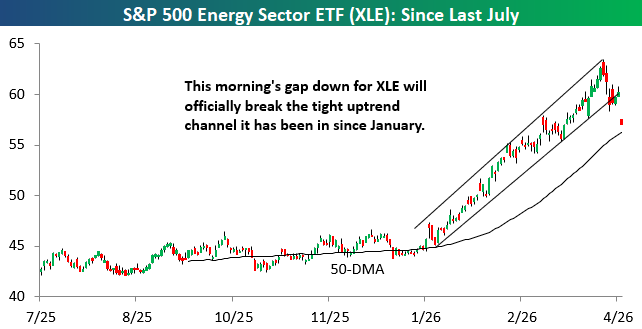
While stocks are up, front-month oil prices have crashed $20 down to the low $90s. After trading in overbought territory for 60 straight trading days, the S&P 500 Energy sector is down nearly 5% in pre-market trading. As shown below, the Energy sector ETF (XLE) will decidedly break its short-term uptrend when it opens this morning, but it’s still holding above its 50-DMA for now.
Apr 7, 2026
See what’s driving market performance around the world in today’s Morning Lineup. Bespoke’s Morning Lineup is the best way to start your trading day. Read it now by starting a two-week trial to Bespoke Premium. CLICK HERE to learn more and start your trial.
“The secret of life is to say yes all the time, because when you’re old, you don’t want to say, ‘I wish I’d done this, I wish I had done that.” – Francis Ford Coppola
Below is a snippet of commentary from today’s Morning Lineup. Start a two-week trial to Bespoke Premium to view the full report.
It’s been an up-and-down night and morning for equities. moving from negative to positive and back to negative levels. Barring any movement on the diplomatic front, it’s going to be hard for investors to take on much risk ahead of the President’s 8 PM deadline for Iran to reopen the Strait or face the wrath of the US military. At no time would a Taco Tuesday be more welcome than today, but the President has shown no signs of backing down. His latest Truth Social post comments from just a few minutes ago threaten that a “whole civilization will die tonight, never to be brought back again.” That is, unless “something revolutionary wonderful can happen”.
Besides the weakness in equity futures, Treasury yields are little changed, crude oil is up over 3%, gold is remarkably unchanged, and Bitcoin is down 2%.
Japanese stocks reopened from the long holiday weekend and finished the day effectively unchanged, while Hong Kong remained closed. Chinese stocks had marginal gains while South Korea and Australia were up close to 1% or more. With the Strait of Hormuz remaining closed, concerns have grown over the availability of not just energy, but also helium supplies for South Korea’s chip industry. Officials announced last night, though, that the country’s chip assemblers have secured supplies of at least four months.
In Europe, we’re seeing a modestly positive start to the week after the four-day weekend. Service sector PMIs for the continent declined slightly less than expected, while it was a mixed bag at the individual country level. France and Italy are leading in early trading with gains of about 0.5%, while Germany is unchanged.
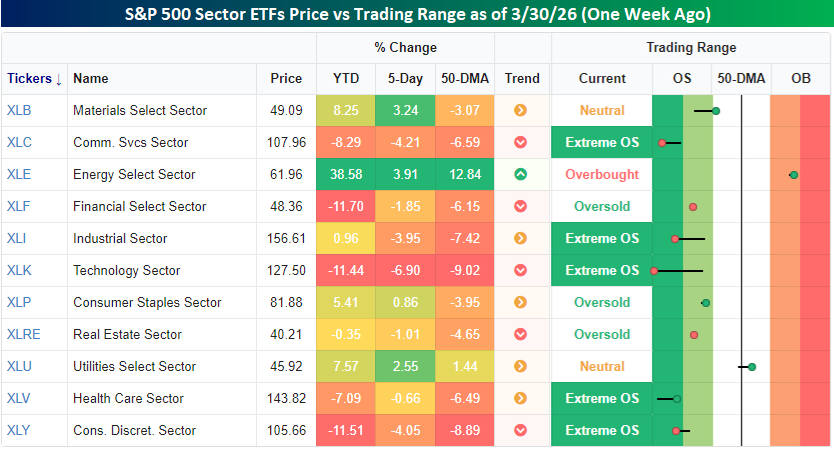
US stocks have made a nice comeback over the last year, moving from an environment where most sectors were either oversold or extremely oversold to one where most sectors are back to neutral. Starting with where things stood last week at this time, most sectors had declined over the prior week with several, like Technology, Communication Services, and Consumer Discretionary, experiencing declines of more than 4%. Those declines also put all three sectors into extreme oversold territory along with Industrials and Health Care. The only sectors above their 50-DMAs were Energy (which was overbought) and Utilities.
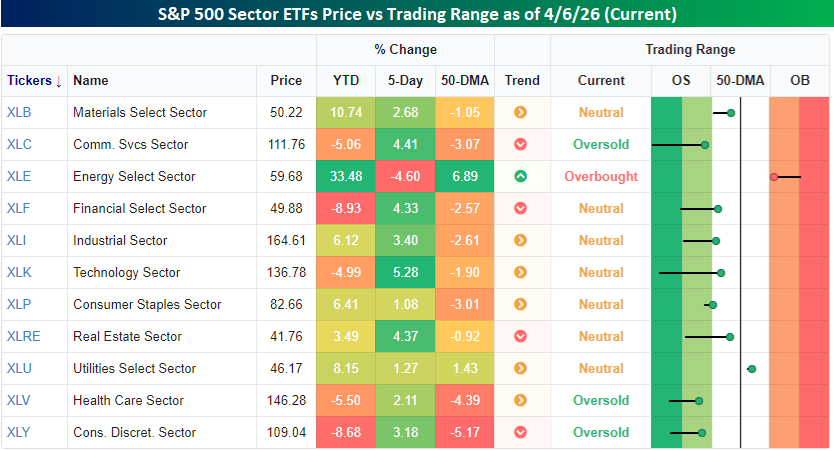
With the S&P 500 up four days in a row since the snapshot above was taken, we’ve seen a mass exodus out of oversold territory. The only sector down over the last week is Energy, while every other sector is up at least 1%, including four with gains of more than 4%. While three sectors – Communication Services, Health Care, and Consumer Discretionary – remain in oversold territory, they’re all close to moving out. That said, Energy and Utilities are still the only two sectors above their 50-DMAs, so there’s still plenty of room for improvement.
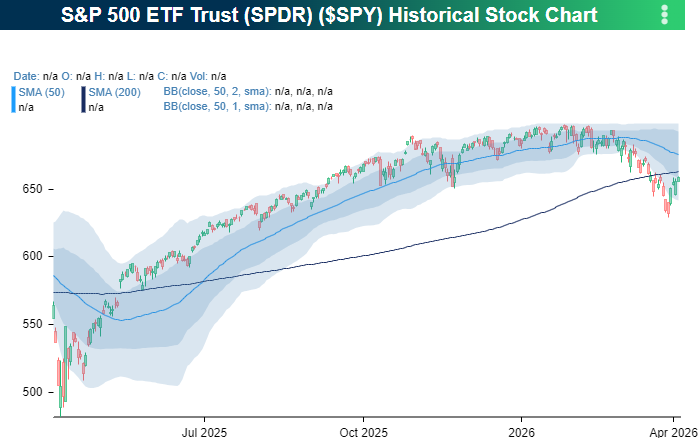
Like most sectors, the S&P 500 also managed to move out of oversold territory yesterday (light blue shaded region), an area it has been in since early March.
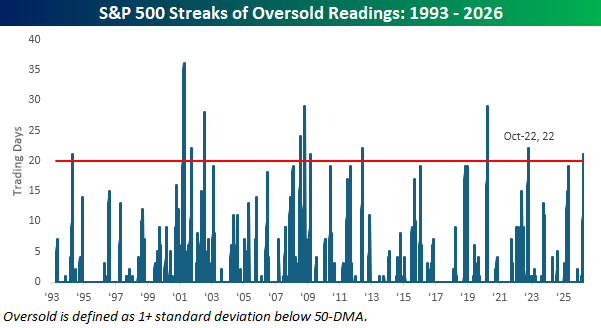
In fact, yesterday’s rally ended a streak of 21 trading days where SPY closed in oversold territory. That was the longest streak since the one that ended the bear market in October 2022, and it was only one of eleven streaks in SPY’s history since 1993 that lasted four weeks or more. The longest of these streaks was 36 trading days ending in April 2001, and eight lasted longer than 21 days.
Apr 6, 2026
See what’s driving market performance around the world in today’s Morning Lineup. Bespoke’s Morning Lineup is the best way to start your trading day. Read it now by starting a two-week trial to Bespoke Premium. CLICK HERE to learn more and start your trial.
“It is the obvious which is so difficult to see most of the time.” ― Isaac Asimov
Below is a snippet of commentary from today’s Morning Lineup. Start a two-week trial to Bespoke Premium to view the full report.
After opening firmly lower last night, equity futures gained steam overnight on hopes of a ceasefire in the Iran war. After Iranian officials refuted those reports, though, we’re basically back to the unchanged line. It could be worse!
Following last Friday’s better-than-expected jobs report, treasury yields are modestly higher, with the 10-year yield at 4.36%. In commodity markets, crude oil is surprisingly contained at a decline of less than 1%, although that could change as reports surface that Israel launched strikes on Iran’s largest petrochemical facility. Gold prices are fractionally higher at just under $4,700 per ounce, and Bitcoin is up a healthy 3% and making a run back towards $70K.
It was a positive start to the week in Asia, even as China and Australia were closed. Japanese markets rallied 0.6%, while South Korea gained 1.4%. In Europe, markets are all closed, so there’s little economic or market data for investors to react to, leaving plenty of room for investors to focus their attention on Iran and the energy markets.
In the US today, the only report on the calendar is ISM Manufacturing at 10 AM. Economists expect the headline reading to pull back from 56.1 to 54.9.
Even though it was a short one, last week’s gains were enough to make it the best weekly performance of the year. Bulls will take gains whenever and wherever they can, but the rally, at this point, has done little to break the overall trend that has been in place for the last several weeks. The S&P 500 remains below the 200-DMA, and the downtrend remains intact. Whether the rally is a dead cat bounce or the real thing, it has to start somewhere, and only time will tell. At this point, though, bulls will need to see more improvement before starting to feel more confident.
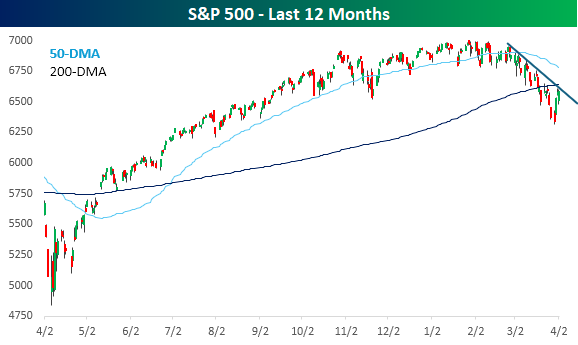
As mentioned above, many international markets are still closed for the Easter holiday, so we wanted to see what seasonal headwinds or tailwinds the Easter holiday has historically had on the market. The chart below shows the S&P 500’s performance in the week after Easter for every year since 1945. Overall, the S&P 500 has averaged a 0.2% gain during Easter week with positive returns 59% of the time, but most years have been anything but average. Look no further than last year when the S&P 500 rallied 4.6% for its second-best Easter week performance, trailing only the 5.0% gain in 2001.
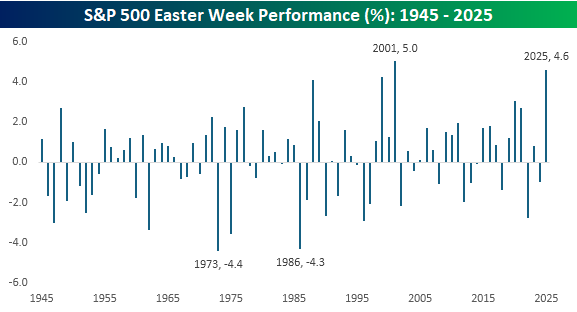
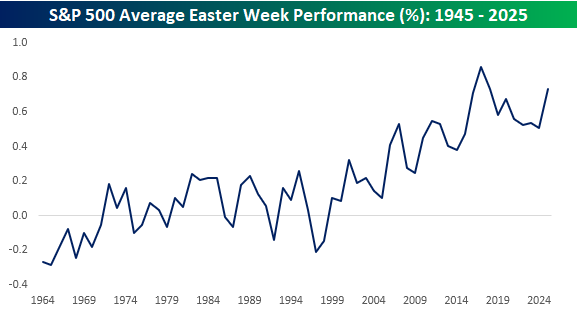
Looking at the chart above, you can see that performance around Easter week has been better more recently than in the years immediately after WWII, with fewer large declines during the Easter week. The chart below shows the 20-year average of the S&P 500’s Easter week performance since 1964, and clearly shows the improving trend. In 1964, the 20-year average performance was negative, but it has steadily increased over time, especially over the last 25 years. The 20-year average peaked in 2017 at 0.9%, but at 0.7% now, it’s the third-best reading of any since 1964, trailing only the readings in 2017 and 2018.
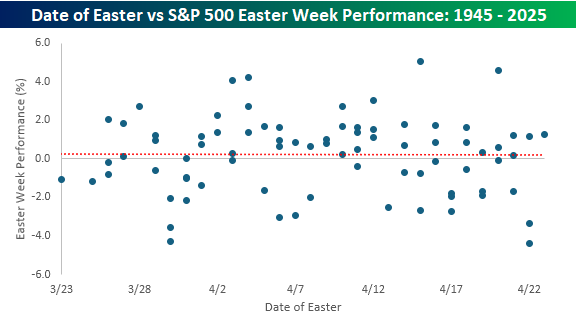
Unlike most other holidays, which fall on a specific date or particular point on the calendar, Easter can fall anywhere from late March to late April. Given Easter’s floating nature, we were curious to see if there was any correlation between the market’s performance during Easter week and when it falls on the calendar. The scatterplot below shows the date of every Easter since 1945 and the S&P 500’s performance during Easter. As shown, while Easter week performance has improved over time, there is zero correlation between performance and when Easter falls on the calendar. Nothing to see here.
Apr 2, 2026
See what’s driving market performance around the world in today’s Morning Lineup. Bespoke’s Morning Lineup is the best way to start your trading day. Read it now by starting a two-week trial to Bespoke Premium. CLICK HERE to learn more and start your trial.
“The more wonderful the means of communication, the more trivial, tawdry, or depressing its contents seemed to be.” – Arthur C Clarke, 2001: A Space Odyssey
Below is a snippet of commentary from today’s Morning Lineup. Start a two-week trial to Bespoke Premium to view the full report.
Leading up to last night’s national address from the President, there was some optimism that he would lay out a path of ending the hostilities and/or reopening the Strait of Hormuz. We got neither. Instead, the speech was more just a reheating of leftover talking points from the last few weeks.
The market response was as you would expect. Equity futures are sharply lower. The S&P 500 and Nasdaq are both indicated to open down by at least 1.5%. Treasury yields are higher, with the 10-year yield up 3 bps to 4.352%. The big move is in oil markets, though, as WTI is trading up more than 9.5%, which would be one of the largest one-day gains since the war started! Gold prices are sharply lower with a decline of close to 4%, while Bitcoin is also 3% lower. With a three-day weekend looming and an incredibly large (and increasing) presence of US military assets in the Middle East, you can’t blame someone for not wanting to take too much risk ahead of the weekend.
In international markets, Asia was sharply lower, with the Nikkei down over 2% while South Korea tanked over 4%. European markets are all down at least 1%, continuing the trend of weakness we have seen since the President’s speech started at 9:02 Eastern last night.
The last two days of trading were a relief for bulls after the weakness of the last few weeks. As the chart of the Nasdaq below illustrates, though, the gains have done little at this point to break the downtrend that has been in place for the last several weeks. Mornings like today serve as a reminder of that. It’s also hard not to blame investors for being more cautious ahead of a three-day weekend, just as the President threatens in a national address to bomb Iran back to the Stone Age.
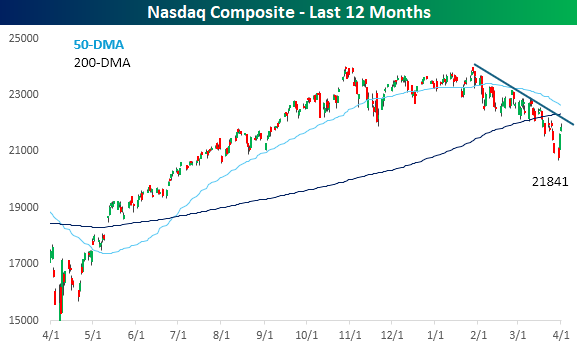
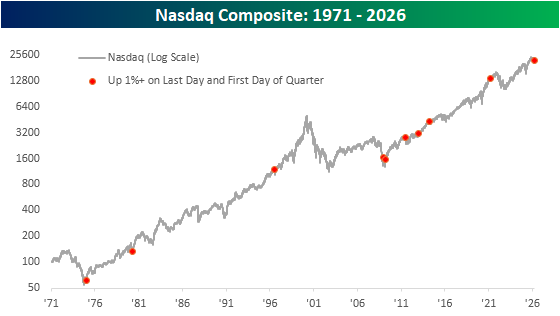
What was notable about the last two trading days was that the Nasdaq ended Q1 and started Q2 with gains of at least 1% on each trading day. The quarter-end gains were easily attributable to relancing, but gains to start a quarter tend to indicate actual inflows, which is a positive. Since the Nasdaq’s inception in 1971, the last two days were only the 10th time that the index gained at least 1% on the last day of a quarter and subsequently the first trading day of the next quarter.
The long-term chart of the Nasdaq below shows each occurrence, and they didn’t occur during the early stages of market downturns.