Nov 2, 2022
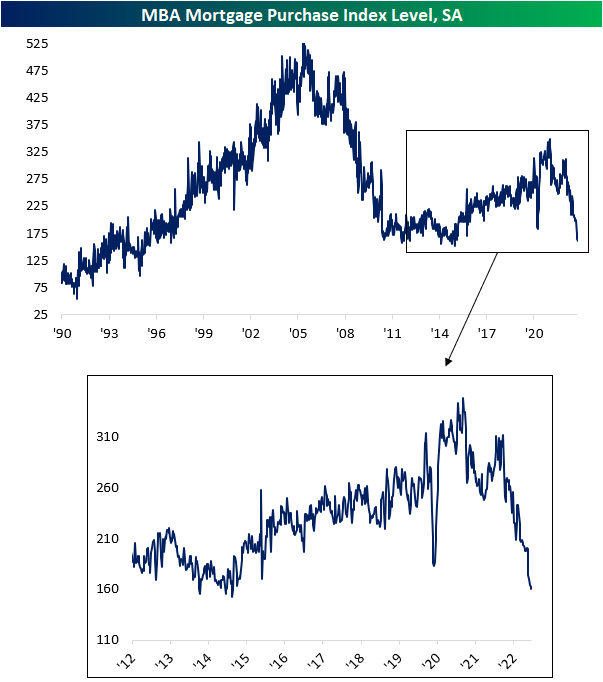
As mortgage rates continue to press higher with Bankrate.com’s 30 year national average for a fixed rate loan hovering well above 7%, high frequency housing data continues to show no signs of relief. The latest mortgage purchase reading from the Mortgage Bankers Association released this morning showed the lowest level of applications since the start of 2015. As we mentioned in today’s Morning Lineup, that would imply further significant declines in new and existing home sales data to come.
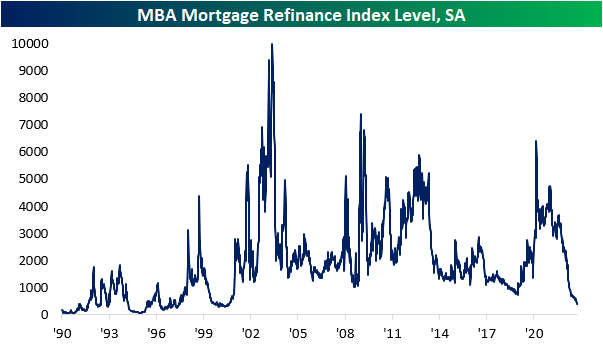
Refinance applications are even worse. Given homeowners would be refinancing at some of the highest rates of the past few decades, refinance applications were up modestly week over week, although that is far from enough to lift it off of the lowest levels since August 2000.
On a non-seasonally adjusted basis, purchases tend to peak in the late spring followed by a gradual decline through the end of the year. While mortgage activity has fallen off of a cliff this year, the drop has followed the usual seasonal pattern. What is amazing about this year is just how large of a drop that has been. Whereas 2022 started with purchase apps coming in at some of the strongest levels of the past decade for the comparable weeks of the year, the opposite is true today.

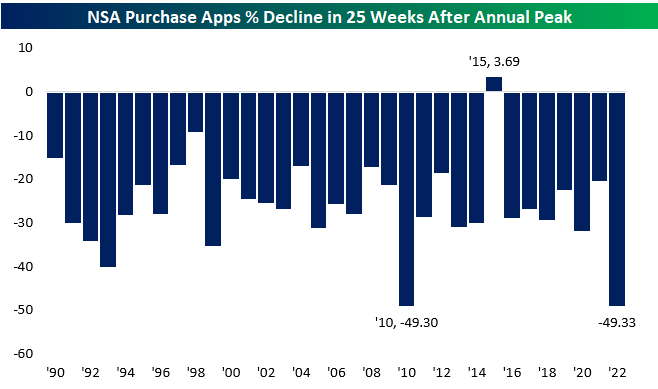
Although purchases have followed their seasonal pattern, the chart above does not do justice in showing how large of a decline it has been off of the annual peak. It has been nearly half a year (25 weeks) since applications hit their seasonal high, and in that time, purchases have been essentially cut in half. Relative to the 25 weeks after each other annual high since 1990, 2010 was the only other year in which there was a similar decline. However, that year comes with a caveat that the expiration of special homebuyer tax credits lent to a particularly strong home-buying season. Similarly, a change in mortgage disclosure rules in the fall of 2015 resulted in a seasonal peak occurring unusually late in the fall of that year, so 25 weeks later extended out to the following year. Given that, purchases were actually higher in the 25 weeks later; the only year in which that is the case. In other words, caveats aside, no other year in the history of this data has seen as sharp of a decline in homebuying/mortgage origination activity as this year. Click here to learn more about Bespoke’s premium stock market research service.
Nov 2, 2022
The past year has been a rough road for equities, but growth in particular has certainly seen its fair share of underperformance. The past month especially has been a notable microcosm of that underperformance. As we approach the one-year mark of the last all-time high in growth-oriented indices like the Nasdaq (discussed in today’s Chart of the Day) or S&P 500 Growth index, large-cap growth’s relative strength has broken down versus equities broadly, as well as growth and value across various market cap ranges.
As shown below, S&P 500 Growth relative to the S&P 500 steadily moved higher (upwards trending lines indicate S&P 500 growth outperformance) throughout the post-Global Financial Crisis era and absolutely took off in the early stages of the pandemic. After peaking in November of last year, the relative performance of growth has been on the downswing and erasing most of its earlier pandemic outperformance. In fact, following the historic weakness of mega caps on earnings (which we discussed in last week’s Bespoke report) that has continued into this week, and the relative strength is now at the lowest level since the end of February 2020.

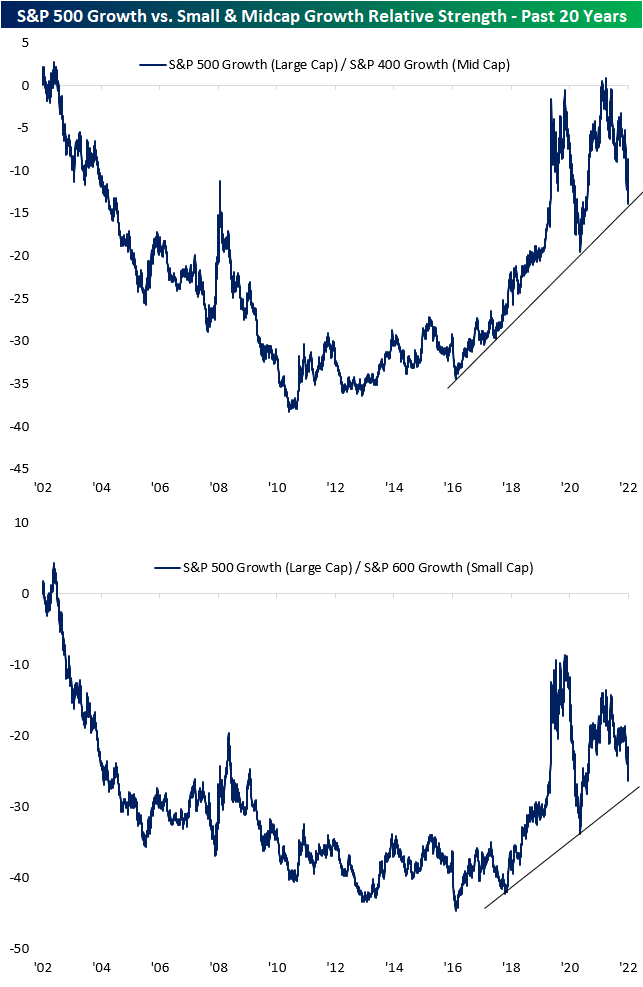
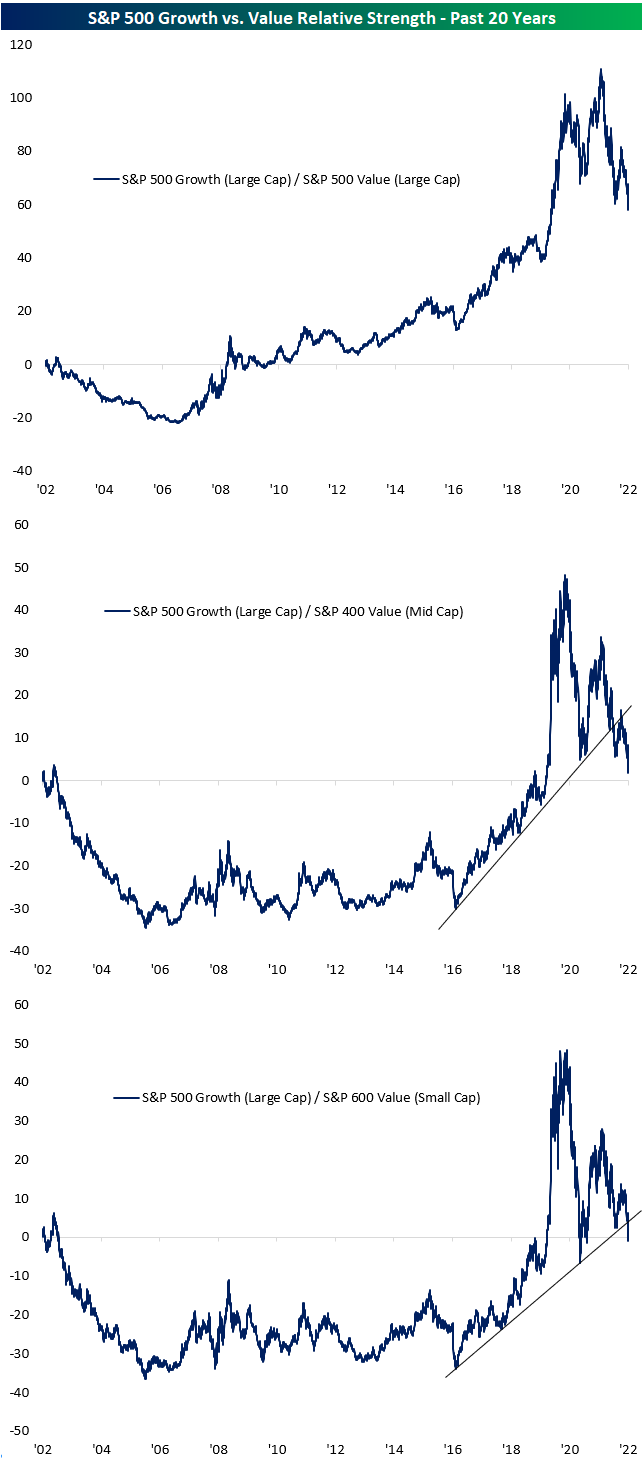
Large-cap growth has not only underperformed other large caps, but it has also dramatically underperformed its mid and small-cap peers. From the post-Dot Com Bubble years through the Global Financial Crisis period, large-cap growth serially underperformed growth stocks of both the mid and small-cap varieties. The past decade, however, erased much of that underperformance. In fact, the 20-year relative strength line of S&P 500 growth versus S&P 400 growth actually turned positive briefly earlier this year in February. In other words, after almost two decades the performance of large-cap (S&P 500) and mid-cap (S&P 400) growth was finally near equal. Since then, the relative strength line has pivoted sharply lower and is now testing the uptrend line that has been in place since 2016.
Relative to small-cap growth, large-cap growth was much weaker in the first half of the 2010s and didn’t really begin to turn higher until the past five years. With that said, it also peaked far earlier (September 2020) than the relative strength versus mid-cap growth and is not quite testing its multiyear uptrend line yet.
Where the more dramatic underperformance of large-cap growth has been is relative to value stocks. As shown in the first chart below, relative to large-cap value, large-cap growth generally remains in its longer-term uptrend although most post-pandemic outperformance has been erased. Moving down the market cap chain increasingly worsens that picture through. The relative strength line of S&P 500 growth versus S&P 400 value recently hit a new low for the post-pandemic period, nearing the flatline in the process. In other words, large-cap growth has almost erased all of its outperformance versus mid-cap value, not only since the start of the pandemic but over the past 20 years. As for small caps, that outperformance is now gone entirely gone as the relative strength line now registers negative readings. Both versus mid and small-cap value, large-cap growth has definitively broken its multi-year uptrends that had been in place since late 2016. Click here to learn more about Bespoke’s premium stock market research service.
Nov 1, 2022
Log-in here if you’re a member with access to the Closer.
Looking for deeper insight into markets? In tonight’s Closer sent to Bespoke Institutional clients, we begin tonight with a rundown of the latest earnings reports including EA (EA), AirBNB (ABNB), Credit Acceptance Corp (CACC), and AMD (AMD) (page 1). We follow up with a review of the latest JOLTS data (pages 2 and 3). Turning to construction spending, we highlight the massive surge in home improvement spending (page 4) followed by a look at the latest ISM data (page 5). We finish with a look at the October Logistics Managers Index (page 6 – 8).

See today’s full post-market Closer and everything else Bespoke publishes by starting a 14-day trial to Bespoke Institutional today!
Nov 1, 2022
Please click the image below to view our November 2022 market calendar. This calendar includes the S&P 500’s average percentage change and average intraday chart pattern for each trading day during the upcoming month. It also includes market holidays and options expiration dates plus the dates of key economic indicator releases. Click here to view Bespoke’s premium membership options.

