
Bespoke CNBC Appearance (1/28/20)
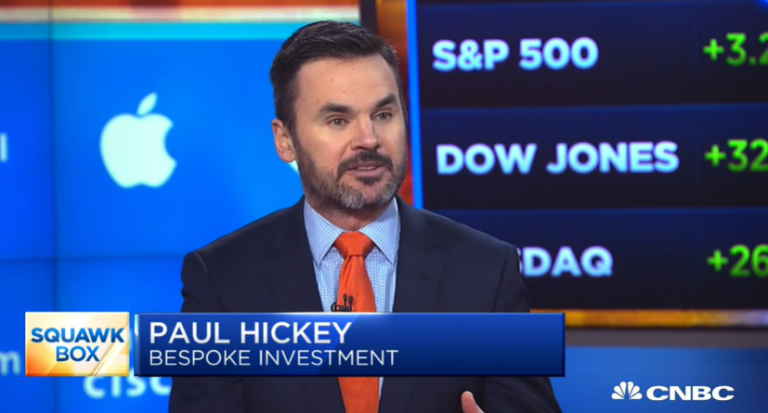
Bespoke co-founder Paul Hickey appeared on CNBC’s Squawk Box today to discuss the upcoming earnings season and trends for stocks reporting. To view the segment, click on the image below.
Start a two-week free trial to Bespoke Institutional for full access to our research and interactive tools.
Bespoke’s Morning Lineup – 1/28/20 – Turnaround Tuesday?
See what’s driving market performance around the world in today’s Morning Lineup. Bespoke’s Morning Lineup is the best way to start your trading day. Read it now by starting a two-week free trial to Bespoke Premium. CLICK HERE to learn more and start your free trial.

In yesterday’s Chart of the Day we noted that Monday gaps down of 1%+ typically see the biggest bounce backs on the following day — the “turnaround Tuesday” effect. While it’s still early, futures are attempting a bounce this morning as news regarding the coronavirus hasn’t gotten materially worse. While the number of cases has ballooned, that trend is to be expected. What we haven’t seen overnight is an increase in the mortality rate. Relative to yesterday, in fact, it appears to have actually declined slightly. We caution, though, that it’s still very very early in the outbreak, and no one really knows how this is going to shake out. We can all make estimates and look at various models but in the end, they are only that. One thing we do know is that China is one of the world’s largest economies, and growth there is definitely going to take a hit.
The Closer – Commodities & Rates Plunge, Home Sales Soften, Five Fed Firms – 1/27/20
Log-in here if you’re a member with access to the Closer.
Looking for deeper insight on markets? In tonight’s Closer sent to Bespoke Institutional clients, we begin with a look at the drops in commodities and rates and what forward returns could look like. We also show the results of today’s’ 2-Year Treasury Note and 5-Year Treasury Note auctions. Turning to today’s macroeconomic data releases, we recap new home sales data for December. We finish tonight’s note with a review of regional Fed manufacturing data.
See today’s post-market Closer and everything else Bespoke publishes by starting a 14-day free trial to Bespoke Institutional today!
Market Cap Distinctions
In a client note earlier this morning, we noted that even after today’s declines, the S&P 500 is still well over 1% above its 50-day moving average. In other words, for large-cap stocks, there is still a decent amount of air between current levels and the S&P 500’s ‘normal’ range and for that matter, oversold levels. While the S&P 500 may not be oversold yet, it does look to have broken its steep uptrend that had been in place since the October lows.

Similar to the S&P 500, the Nasdaq remains well above both its 50 and 200-day moving averages. Additionally, even though it saw a steeper decline on Monday, the Nasdaq is still 3% above its 50-day moving average. Unlike the S&P 500, though, the Nasdaq’s uptrend off the October low still looks to be intact.

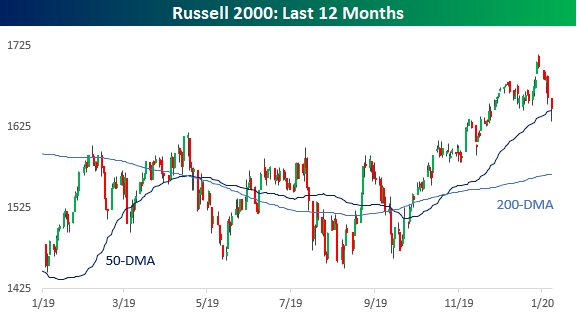
While the large-cap S&P 500 and Nasdaq indices are still trading at extended levels, when you move down the market cap ladder, mid and small-cap indices are trading at much less extended levels. The mid-cap S&P 400 actually briefly traded below its 50-DMA earlier today and is only just barely hanging out above that level heading into the close. Regarding the trend line off the October lows, that level didn’t even come into play today because that trend line broke on Friday!

Like the mid-cap S&P 400, the small-cap Russell 2000 also actually traded below its 50-DMA earlier today before rallying back above that level in the afternoon.
Finally, semis. The Philadelphia Semiconductor index was especially hard hit on Monday falling by more than 3.5%. Obviously, this index is a lot more volatile than the major indices highlighted above, but while most other indices rallied well off their early lows today, the magnitude of the move off the lows for semis was a lot more lethargic. With a large portion of the sector’s production based in China, it is understandable that the sector has been under pressure. For a sector that we consider to be a market leader, though, a bigger breakdown for the semis would be a troublesome signal for the broader market. Start a two-week free trial to Bespoke Institutional to access all of our market tools including the Earnings Explorer, Chart Scanner, Trend Analyzer, Custom Portfolios, and much more.

Stocks Yielding More Than Bonds Again
In the early summer of last year, the 10-Year Treasury Note was bid up considerably, resulting in it yielding less than the S&P 500’s dividend yield. In fact, at the point of the largest divergence between the two in late August, the dividend yield of the S&P 500 was 56.9 bps higher than the yield on the 10-Year Treasury. Although the disparity between the two has shrunk from that August peak, that trend has generally continued in the months since then, though equities’ surge into the end of the year saw bonds briefly yielding more in December. Since the start of the new year, stocks once again hold a higher yield, especially today as worries about the coronavirus have resulted in the selling of risk assets (raising the S&P 500’s yield) and subsequent buying of safe-havens (lowering the 10-Year Treasury yield). Now, the spread between the S&P 500’s dividend yield and that of the 10-Year is at its widest level in favor of the S&P 500 since October 10th. Start a two-week free trial to Bespoke Institutional to access our full library of research and interactive tools.


S&P 500 Energy Sector (XLE) Breaks Down
The S&P 500 Energy sector ETF (XLE) tried to break out of its downtrend in late 2019, but the bounce has been completely erased as of today with it plunging to new 52-week lows. Talk about an ugly chart. Start a two-week free trial to Bespoke Institutional to access our Bespoke Report, Chart Scanner, custom portfolios, and much more.

Remarkably, the Energy sector now has a weighting in the S&P 500 with a 3-handle – 3.97% to be exact. That’s less than 50 basis points larger than the Utilities sector, and less than 1.5 percentage points away from being the smallest sector in the entire index (which currently belongs to Materials at 2.52%).

Only twelve years ago, the Energy sector was less than 0.70 percentage points away from being the largest sector in the S&P 500. In mid-2008, the Energy sector’s weighting peaked at 15.96%, which was 67 basis points below Tech’s weighting of 16.63% at the time. Below is a long-term chart of the Energy sector’s weighting in the S&P 500 since 1990. The red line shows its average weighting of 9.03% over this time period. At current levels, Energy’s weighting is more than 50% below its historical average and easily at its lowest level of the last 30 years.

Below is a 10-year performance comparison of the S&P 500 Energy sector (XLE) versus the S&P 500 (SPY). As shown, XLE is now down 1.84% in price over the last ten years, while SPY is up 195.1%.

Below is a chart of XLE going back further to 1999 when the ETF began trading. From 1998 through mid-2008, the Energy sector was one of the best sectors to be in. It fell with everything else during the Financial Crisis and then managed to recover all of its losses and make new highs in 2014. It’s really only the last five years where the bottom has fallen out, especially relative to the rest of the stock market.

If we compare the price change of XLE to SPY since 1999, SPY has actually only recently overtaken the Energy sector in terms of performance. XLE is up 137% since the start of 1999 while SPY is up 169%. Just over five years ago, XLE was up more than 300% since 1999 versus SPY’s gain of 65%.

Chart of the Day: Monday 1%+ Gaps Lower
Bespoke’s Morning Lineup – 1/27/20 – A Case of the Mondays
See what’s driving market performance around the world in today’s Morning Lineup. Bespoke’s Morning Lineup is the best way to start your trading day. Read it now by starting a two-week free trial to Bespoke Premium. CLICK HERE to learn more and start your free trial.
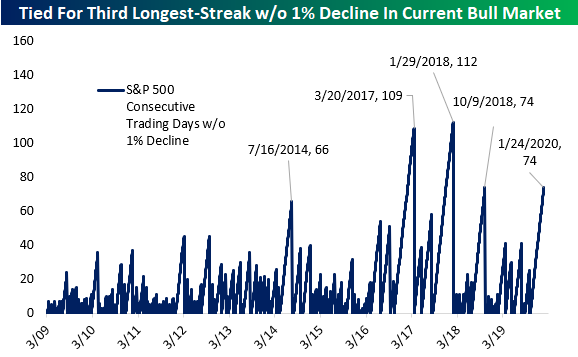
It’s going to be one of those days. US futures are down sharply this morning primarily on news of the spreading coronavirus and the Chinese government’s attempts to control it. S&P 500 futures are set to open down about 1.5% which would end the current streak of days without a 1% decline at 74.
Bespoke Brunch Reads: 1/26/20
Welcome to Bespoke Brunch Reads — a linkfest of the favorite things we read over the past week. The links are mostly market related, but there are some other interesting subjects covered as well. We hope you enjoy the food for thought as a supplement to the research we provide you during the week.
While you’re here, join Bespoke Premium for 3 months for just $95 with our 2020 Annual Outlook special offer.
Clearview
The Secretive Company That Might End Privacy as We Know It (DNYUZ)
An Australian technologist and app developer has launched a massive new surveillance tool designed to identify people in public places based on a complex algorithm. [Link]
Clearview AI Says Its Facial Recognition Software Identified A Terrorism Suspect. The Cops Say That’s Not True. by Ryan Mac, Caroline Haskins, and Logan McDonald (Buzzfeed News)
A controversial new company claims to have amassed a database of billions of photos which can be used to identify suspects using public sources. But the big claims – and the dystopian future they represent – are being called into question. [Link]
Metro Matters
Houston Is Now Less Affordable Than New York City by Peter Holley (Texas Monthly)
While land is cheap in Houston and wage levels are lower, reducing costs of living, the huge sprawl and lack of public transit actually makes it a relatively expensive city to live in. [Link]
NYC Moves to Ban Cashless Stores in Blow to Visa, Mastercard by Jennifer Surane (Bloomberg)
With some companies saying they will no longer accept cash at storefronts in New York City, the local government may enforce cash acceptance in order to protect access for customers that have a low income and lack access to electronic payments. [Link; soft paywall]
Eastern Europe
Belarus’ hi-tech export close to $15bn in 2019 (BelTA)
It’s unusual to think about Belarus when you mention high tech exports, but the tiny country is developing its focus on those types of goods and has made huge strides given their tiny size. [Link]
Health
98.6 Degrees Fahrenheit Isn’t the Average Anymore by Jo Craven McGinty (WSJ)
Changes in the human body over the last couple of centuries tied to more sedentary lifestyles have reduced the “normal” temperature of the human body. [Link; paywall]
Wuhan coronavirus may have been transmitted to people from snakes by Jessica Hamzelou (NewScientist)
The spreading coronavirus which started in Wuhan, China came from an animal, but the specific one in question may have been a snake. [Link]
Tired Nation: Americans Now Averaging Less Than 6 Hours Of Sleep Per Night by John Anderer (Study Finds)
While the amount of sleep every person needs varies, broad averages for the amount of sleep Americans get has made a new low. [Link]
Size Does Matter
Daily Fantasy Player Files Lawsuit Against MLB Over Astros Scandal by Darren Rovell (Action Network)
A New York daily fantasy player has named MLB as well as two teams in a cheating scandal that has rocked the league after unravelling this winter. [Link]
The IRS Decided to Get Tough Against Microsoft. Microsoft Got Tougher. by Paul Kiel (ProPublica)
An effort by the IRS to seal a massive tax dodge by Microsoft (via Puerto Rico) was stymied by a combination of administrative dancing, lawsuits, and Congressional lobbying that ultimately led to a change in the law in the software company’s favor. [Link]
Politics
The Black Swan Chart Of 2020 (Global Macro Monitor)
After a multi-decade high in voter turnout during 2018 midterm elections, voters are indicating rabid enthusiasm for the coming Presidential contest. That sort of turnout surge would create chaos for modelers and present a very different set of challenges for campaigns than low-turnout elections like 2016. [Link]
Unwired
Did someone put this Baltimore drug corner on Google Maps? by Dan Rodricks (Baltimore Sun)
An enterprising Google Maps user created a Google Maps listing for a drug corner in south Baltimore. This corner is known for its easy heroin availability. [Link]
Sonos Will Soon End Software Support for Its Older Speakers by Lauren Goode (Wired)
After 10+ years of use, the oldest generation of popular Sonos speakers are set to have their support cut off, in a move that may be poorly received by some of the company’s original customers. [Link]
Hyperbole
Guggenheim Says Central Bank-Driven ‘Ponzi Scheme’ Must Collapse by Ross Larsen, Sonali Basak, and Sridhar Natarajan (Bloomberg Quint)
The head of Guggenheim Investment Partners has decided to use some pretty ridiculous language to assess the current state of markets, but it speaks to still-restrained sentiment that people are regularly saying this sort of thing in public. [Link]
Read Bespoke’s most actionable market research by joining Bespoke Premium today! Get started here.
Have a great weekend!