
Disappointment Out of Dallas
Following very strong readings from the Philly Fed and preliminary Markit PMIs last week, the Dallas Fed’s Manufacturing report released this morning disappointed. The headline index came in at 7 compared to forecasts of a reading of 12 and last month’s adjusted reading of 10.5. That reading is still consistent with overall growth in the region’s manufacturing sector, but at a slower pace as the index fell to the lowest level since August.

The index for General Business Activity was far from being the only one to fall month over month. As shown below, breadth in this month’s report was terrible. Of the 17 different indices for current conditions, 13 fell month over month. That brought several of these readings from the top decile of historical readings down to the middle of their historical ranges. While the pullbacks were significant, only inventories remain in contraction. Meanwhile, breadth was a little bit better for the indices for future expectations.
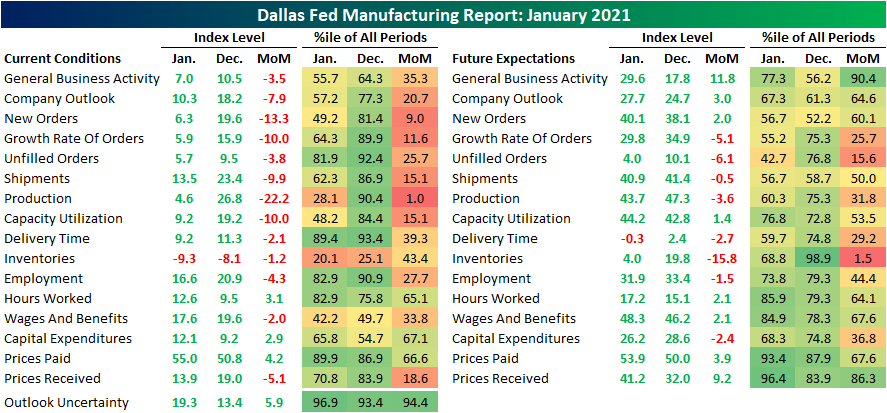
One area that saw declines across the board were the indices concerning demand. As shown below, the indices for New Orders, New Order Growth Rate, Unfilled Orders, and Shipments were all lower in January. All of these are now at the lowest levels since June, or July in the case of order growth rate. These lower readings are still indicative of growth, but at a slower rate.

Just as we have seen in other recent manufacturing reports, survey respondents are reporting price increases. The index for prices paid rose to a reading of 55 from 50.8 in December. That is nearly in the top decile of all readings as the index sits at the highest level since April of 2011. The index for future expectations similarly ticked higher reaching its highest level since March of 2012.
While prices paid were higher, the same sort of acceleration in prices was not observed for prices received. The index for prices received fell from 19 down to 13.9. Although lower month over month, that is still around some of the highest levels of the past couple of years. Additionally, expectations are calling for prices received to follow the path of prices paid. The index for future prices received rose to the highest level since 2017 which was also in the top 5% of all readings.

Similar to prices received, the current conditions index for wages and benefits fell this month, but the index for future expectations rose much more sharply and to one of the highest readings of the past couple of years. In other words, although price hikes were not observed, they are foreseen on the horizon. For wages and benefits, that expected uptick comes as hiring continues with the index of employment remaining in expansionary territory. Additionally, hours worked rose this month from 9.5 to 12.6; the highest in September of 2018. Click here to view Bespoke’s premium membership options for our best research available.

Chart of the Day: S&P 500 Stocks Falling Below Their Moving Averages
Bespoke’s Morning Lineup – 1/25/21 – More Crazy Moves Beneath the Surface
See what’s driving market performance around the world in today’s Morning Lineup. Bespoke’s Morning Lineup is the best way to start your trading day. Read it now by starting a two-week free trial to Bespoke Premium. CLICK HERE to learn more and start your free trial.
“It’s not how much money you make, but how much money you keep, how hard it works for you, and how many generations you keep it for.” – Robert Kiyosaki
It’s a mixed picture in futures markets this morning as the S&P 500 is set to open marginally higher while the Nasdaq is indicated up about 1%. At the individual stock level, the crazy moves of last week are continuing today as GameStop (GME) is up over 50% again, and a number of other high short interest and story stocks are trading up sharply in the pre-market. Economic data is on the light side this morning with just the Chicago Fed National Activity Index and the Dallas Fed Manufacturing Index.
Be sure to check out today’s Morning Lineup for updates on the latest market news and events, German sentiment data, an update on the latest national and international COVID trends, and much more.

The year is just three weeks old, but already we’ve seen some big moves in individual sectors. With its gain of 11%, the Energy sector has stolen the show, but the 5% gain in the Consumer Discretionary sector is nothing to sneeze at either. On the other end of the spectrum, Consumer Staples has already given up 3.8% this year while Industrials is down just marginally (-0.2%). The broader S&P 500 as a whole is up a respectable 2.3% on the year, and four other sectors – Materials, Financials, Technology, and Telecom Services – all have YTD gains within half of one percent of the overall market.

The gap of nearly 15 percentage points between the best and worst-performing sectors so far this year is one of the larger ones we have seen through the first 14 trading days of a year dating back to 1990. As shown in the chart below, just three years (2009, 2001, and 2000) have seen larger disparities to start the year while a number of other years have seen disparities nearly but not quite as wide as the one this year (1992, 1999, and 2006).

Bespoke Brunch Reads: 1/24/21
Welcome to Bespoke Brunch Reads — a linkfest of the favorite things we read over the past week. The links are mostly market related, but there are some other interesting subjects covered as well. We hope you enjoy the food for thought as a supplement to the research we provide you during the week.
While you’re here, join Bespoke Premium with a 30-day free trial!
Alternative Energy
Batteries Hidden Across New York Give the City a Backup Boost by Dimitra Kessenides (Bloomberg)
With disruptive natural disasters on the rise and battery prices on the fall, “microgrid” battery power facilities can be shoehorned in to cities like NYC to provide a backup to the traditional power grid. [Link; soft paywall]
Money Managers Look to Blue Seas for Green Investments by Julie Steinberg and Joe Wallace (WSJ)
As green energy capex scales up, investors are diving into all corners of production to try and make a buck, including owning and financing the ships which build and service offshore windfarms. [Link; paywall]
Chilly This Winter? Cozy Up to the Computer That’s Mining Bitcoin by Sarah E. Needlemen (WSJ)
Bitcoin mining operations are extremely power intensive and as a result of their massive processing activity send off huge amounts of heat. That byproduct is being repurposed to keep pets, vegetables, or even whole houses warm. [Link; paywall]
Housing
The Housing Market Boom Gets Another Boost From Biden by Conor Sen (Bloomberg)
Fiscal stimulus gives households who might not have the chance at owning a home a shot at cobbling together a down payment, with the possibility of reducing student loan burdens another tailwind for home buyers. [Link]
Scholarly Pursuits
The evolution of the Offshore US-Dollar System: past, present and four possible futures by Steffen Murau, Joe Rini, and Armin Haas (Journal of Institutional Economics)
A helpful review and primer of the mechanical foundations of the global financial system, focused on the role of the offshore US dollar market. [Link]
Platform Civics: Facebook in the Local Information Infrastructure by Kjerstin Thorson, Mel Medeiros, Kelley Cotter, Yingying Chen, Kourtnie Rodgers, Arram Bae, and Sevgi Baykaldi (Digital Journalism)
This paper uses quantitative and qualitative methods to identify what happens when Facebook replaces local media, with unsurprisingly toxic results. [Link]
History
What We Found in Robert Caro’s Yellowed Files by Dan Barry (NYT)
An amazing trip through the office of legendary biographer of Robert Moses and LBJ, including a fascinating anecdote about the desk that cured his bad back. [Link]
Investing
Up Is Good. Down Is Bad. by Jason Zweig (CreateSend)
Making the case that much-derided (in professional circles, anyways) traders are in fact pursuing the same sort of strategies that “fancy” quantitative investors do. [Link]
Data Security
Intel says hacker obtained financially sensitive information by Richard Waters (FT)
Hackers were able to access an infographic that was part of Intel’s earning release, forcing the company to publish the whole kit and kaboodle before the market closed. [Link; paywall]
COVID Vaccination
Israel COVID-19 ‘R’ reproduction number dips below 1 in first since vaccine drive (Reuters)
With more than one-quarter of the country vaccinated, the fastest vaccine effort in the world has helped push the previously raging COVID pandemic down in Israel. [Link]
Career Changes
Neuberger Berman’s Segal Is Retiring to Teach High School by Miles Weiss (Bloomberg)
A Neuberger fund manager that has held his seat since 1999 is retiring to pursue a masters in teaching and eventually working as a math teacher in New York. [Link]
Pay Your Lawyers
German online retailer Mytheresa valued at $3bn after US listing by David Carnevali and Sujeet Indap (FT)
Neiman Marcus acquired German online retailer Mytheresa for $200mm back in 2014, and now sits on a an impressive gain after the investment was kept remote from creditors during the company’s bankruptcy. [Link; paywall]
Read Bespoke’s most actionable market research by joining Bespoke Premium today! Get started here.
Have a great weekend!
The Bespoke Report: Equity Market Pros and Cons — Q1 2021
This week’s Bespoke Report is an updated version of our “Pros and Cons” edition as we proceed through Q1 2021.
With this report, you’re able to get a complete picture of the bull and bear case for US stocks right now. It’s heavy on graphics and light on text, but we let the charts and tables do the talking!
On page two of the report, you’ll see a full list of the pros and cons that we lay out. We then provide slides for each “pro” or “con” that we’ve highlighted.
To read this report and access everything else Bespoke’s research platform has to offer, start a two-week free trial to Bespoke Premium. Enter “THINKBIG” at checkout to receive a 10% discount once the trial ends. You won’t be disappointed!


Daily Sector Snapshot — 1/22/21
Bespoke’s Morning Lineup – 1/22/21 – Chips Fall
See what’s driving market performance around the world in today’s Morning Lineup. Bespoke’s Morning Lineup is the best way to start your trading day. Read it now by starting a two-week free trial to Bespoke Premium. CLICK HERE to learn more and start your free trial.
“Complacency often afflicts precisely those who have been the most successful.” – Andrew Grove
With a gain of over 12% already, the Philadelphia Semiconductor Index (SOX) is off to a good start in 2021. The chips are going to be giving some of those gains back this morning, though, as stocks like Intel (INTC) and Seagate (STX) are both trading lower in reaction to earnings. The weakness in those stocks is dragging down the entire sector, but it’s hard to get too upset about the weakness when the SOX will still be hanging on to double-digit YTD percentage gains at the open.
For the broader market, it’s also looking like a weaker open as S&P 500 and Nasdaq futures are both lower while Treasury yields move lower. The main driver is weak economic data out of Europe stemming from virus restrictions in the region. Elsewhere, the week can’t end soon enough for bitcoin which is down more than 13% from last Friday’s levels.
Be sure to check out today’s Morning Lineup for updates on the latest market news and events, flash Markit Manufacturing and Services data for January, an update on the latest national and international COVID trends, and much more.
While the magnitude of the gains varies, the picture for major US indices looks the same across the board. Markets are short-term overbought. From the S&P 100 and Nasdaq 100, which are both at extreme overbought levels following big rallies in the mega-cap stocks, all the way down the market cap spectrum, every index ETF heads into Friday with gains over the last week putting them all at least one standard deviation above its 50-DMA. While the big picture at the index level looks pretty uniform, underneath the surface, the gains haven’t been near as uniform. Within the S&P 500, YTD returns for individual sectors range from a gain of 11.6% for the Energy sector to a decline of 3.3% for Consumer Staples. So, depending on your level of success, stock-picking has either really helped or hurt performance so far this year.

Bespoke’s Weekly Sector Snapshot — 1/21/21
Impressive Reading From The Philly Fed
Of the several strong economic data points to have been released today, perhaps the strongest relative to expectations was the Philadelphia Fed’s monthly survey on the region’s manufacturing sector. The headline index was expected to rise from 11.1 to 11.8. Instead, it more than doubled expectations rising to 26.5. That is the highest reading since last February just before the pandemic’s full impact was felt. Overall, the report showed the region’s manufacturing sector experienced strong growth in January with accelerating growth in demand, prices, and employment.

In the table below, we break down the various sub-indices of the report. Nearly every component experienced a month over month increase that ranks in the top few percentiles of their respective histories. That also left most indices in the top decile of their historic ranges. That compares to last month in which most readings were far more moderate. Although most indices for current conditions saw impressive readings, the indices for expectations were much more mixed with a larger number falling than rising MoM. Given every one of these indices remains positive, though, the region’s manufacturers still have an overall optimistic outlook.
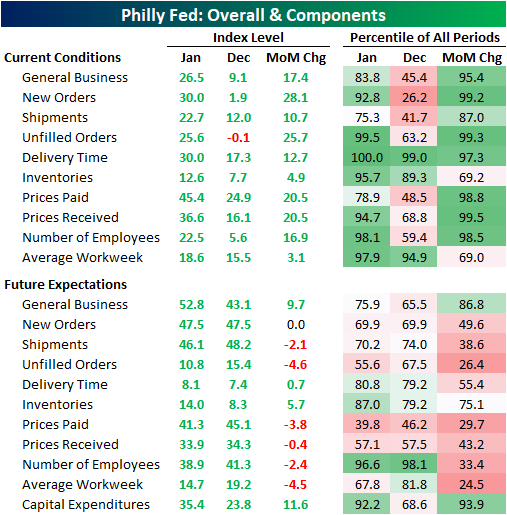
Of all the sub-indices, the New Orders index saw one of the most significant increases in January rising 28.1 percentage points from a barely expansionary reading of 1.9 to a much stronger reading of 30. Going back over the past couple of years, the only times this index was higher was in October (32.9) and February (30.7) of last year. That indicates very strong new order growth after a slowdown in December.
Similarly, the index for unfilled orders was the only index in contractionary territory (those below zero) last month, but there was a massive improvement this month as the index surged to a reading of 25.6. Both the level of the index and the monthly change stand in the top 1% of all readings going back through the history of the survey which began in 1968. The only times the index has been higher was in August of 1972 (26) and January (29.6) and March (45.1) of 1973. In other words, New Orders remain strong while Unfilled Orders are bouncing back at a historic rate,

While the unfilled orders index reached one of the highest readings on record, the index for Delivery Times actually hit a new record. The index rose 12.7 points to a record high of 30; surpassing the previous record of 21.3 from October of 2017. Higher readings in this index indicate that supplier lead times are longer and vice versa for lower readings. That means a historic number of respondents are seeing delays in their supply chains.

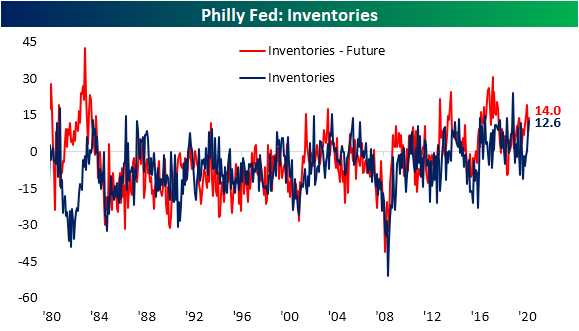
Perhaps to get ahead of the growing demand and longer lead times, businesses are also reporting higher inventories. That index rose to the highest level since September of 2019 which also stands in the top 5% of all readings in the history of the data.
Given the stronger demand and tighter supply lines, prices have also been accelerating. Both Prices Paid and Prices Received experienced some of their largest monthly increases on record after rising 20.5 points in January. At 45.4, the index for Prices Paid is at its highest level since August of 2018. Those price increases are also getting passed along to customers as the index for Prices Received is at the highest level since February of 1989. These results echo some other hints of more inflationary conditions like the New York Fed’s readings last week and the ISM services and manufacturing report earlier this month. Click here to view Bespoke’s premium membership options for our best research available.
