A Month for the Ages
Just when you think you’ve seen it all from this market, a month like November comes around. Stock returns so far this month have been extraordinary, and what makes the gains even more impressive is the fact that they came not from a starting point of a depressed bear-market environment but instead from a level that was already pretty close to record highs. Within the Russell 3000, which encompasses stocks with market caps of all sizes, the average MTD performance of stocks in the index is a gain of over 15%. Even in the large-cap S&P 500, the average stock in the index has rallied more than 13.5% so far this month! Keep in mind too that these are just averages, and plenty of individual stocks are up multiples of that.
In the Russell 3000, there are 51 stocks that are up over 50% so far in November. We don’t have enough room to list them all, but the first table below shows the twenty top performers. Topping the list is Five Prime Therapeutics (FPRX), which has rallied more than 349% this month! That’s years worth of returns in sixteen days. Behind FPRX, there are two other stocks – Cooper Standard (CPS) and Revlon (REV) – which have both more than doubled. Many of the names listed below are unknown small caps, but a handful of names like Transocean (RIG), Coty (COTY), and Lyft (LYFT) are very well known.

In the large-cap S&P 500, the gains haven’t been as gaudy but are still impressive. As shown in the table below, the twenty top-performing stocks in the index are all up over 30% MTD. One sector well represented on this list is Energy with eight of the twenty names listed coming from that sector.

While just about every stock in the S&P 500 is up this month, 18 stocks have managed to trade lower. Of these 18 stocks, only two – Hanesbrands (HBI) and NortonLifeLock (NLOK) – are down more than 5%. What’s really interesting about this list, however, is that while Energy dominates the list of S&P 500 winners, no sector dominates the list of losers as it’s a diverse set of stocks spanning ten of the eleven GICS sectors. The only sector not represented is Industrials. Click here to view Bespoke’s premium membership options for our best research available.

Chart of the Day: Seasonal Search Trends
Russell Takes a Bite of the Apple (AAPL)
After back-to-back weekly gains of more than 6%, the small-cap Russell 2000 has kept the momentum going to start the week as it is already up over 2% today. The fact that the index was up more than 5% in back to back weeks was pretty incredible enough; going back to the index’s start in the 1970s, it has only happened seven other times with the last occurrence coming all the way back in 2009. In fact, it not only happened once in 2009, but in three separate months (April, June, and July)!
The big gains in the Russell 2000 over the last two weeks has also helped the Russell 2000 to widen its lead in terms of market cap compared to Apple (AAPL). With a market cap of just over $2.5 trillion, the Russell 2000’s market cap is now close to $500 billion more than AAPL’s market cap.
Back on September 1st, AAPL’s market cap actually topped the entire market cap of the Russell 2000 for the first time in history. The honeymoon for AAPL didn’t last long, though. The next day the iPhone maker’s market cap dipped back below the Russell 2000’s and hasn’t topped it again since. Click here to view Bespoke’s premium membership options for our best research available.

Finally A New High for Small Caps
It only took over two years, but the Russell 2000 finally put in a new all-time high on Friday. As shown in the charts below, Friday marked the first all-time high on a closing basis since August 31st, 2018; a total of 553 trading days between highs. As shown in the second chart below, since the index began trading in the late 80’s, that makes for the third-longest stretch without a new high. The only two longer periods were from March 10th, 2000 through April 2nd, 2004 and from July 16, 2007 through April 26th, 2011. Both of those streaks were nearly twice as long as the past two years’ streak.

The Russell 2000 is up another 2% to more fresh highs this morning, but the recent move to new highs has left the index very overbought. As shown in the snapshot of our Trend Analyzer below, at Friday’s close small caps like the Russell 2000 (IWM) and Core S&P Small-Cap ETF (IJR) are two of the most overbought major index ETFs after having seen some of the strongest performance over the past five days. Granted, as other large-cap indices like the S&P 500 (SPY) and Nasdaq (QQQ) were quicker to return to all-time highs earlier this year making them some of the stronger performers on the year, small caps have been laggards on a year to date basis. In other words, this year’s weakest performers have been a factor in recent strength. Click here to view Bespoke’s premium membership options for our best research available.

Bespoke’s Morning Lineup – 11/16/20 – Groundhog Week
See what’s driving market performance around the world in today’s Morning Lineup. Bespoke’s Morning Lineup is the best way to start your trading day. Read it now by starting a two-week free trial to Bespoke Premium. CLICK HERE to learn more and start your free trial.
“In investing, what is comfortable is rarely profitable.” – Robert Arnott
This week has kicked off looking very similar to last week as futures are surging on news of positive date related to a COVID vaccine. Last week it was Pfizer (PFE), but this morning it was Moderna (MRNA). Even the timing of the news announcements was similar! The MRNA news is very good as the headlines suggest the vaccine is more effective and can be stored in less extreme temperature conditions. What’s also important to note, however, is that futures were already considerably higher before the news, so the animal spirits were already out before the headlines.
In economic news, this week will be a relatively busy one on the data front, but the only report today was Empire Manufacturing for November which came in weaker than expected (6.3 vs 13.5). Also, don’t forget that earnings season will wind down this week with Walmart (WMT) reporting tomorrow.
Be sure to check out today’s Morning Lineup for a rundown of the latest stock-specific news of note, trends related to the COVID-19 outbreak, and much more.

Outside of the Nasdaq 100, last week was a positive one for every other major index ETF in our Trend Analyzer screen of major US indices. While QQQ was down just over 1%, the S&P 500 (SPY) was up over 2%, and small caps (IWM) surged over 6%. Those are impressive gains no matter how you look at it, but they also leave the majority of US indices at not only short-term overbought levels but ‘extreme’ overbought levels (at least 2 standard deviations above the 50-DMA). Again, this does not mean that equities have to trade lower from here, but from a timing perspective, conditions are poor.

Bespoke Brunch Reads: 11/15/20
Welcome to Bespoke Brunch Reads — a linkfest of the favorite things we read over the past week. The links are mostly market related, but there are some other interesting subjects covered as well. We hope you enjoy the food for thought as a supplement to the research we provide you during the week.
While you’re here, join Bespoke Premium with a 30-day free trial!
Election Analysis
The Polls Weren’t Great. But That’s Pretty Normal. by Nate Silver (538)
Polls were certainly off in 2020, but the national polling miss was far smaller – and less unusual – than the headlines might have indicated. [Link; soft paywall]
Nate Cohn Explains What the Polls Got Wrong by Isaac Chotiner (The New Yorker)
The NYT’s top voting analyst and pollster discusses why polls missed, with granular discussion of the specific factors and voting patterns that led pollsters to predict much larger Biden margins than those that actually appeared. [Link; paywall]
Election Showed a Wider Red-Blue Economic Divide by Jed Kolko (NYT)
This data-heavy column looks at the attributes of red and blue counties to offer some more detailed discussion 2020 vote patterns than simple results maps may indicate. [Link; soft paywall]
Fast Food
The Future of McDonald’s Is in the Drive-Thru Lane by Brian Barrett (Wired)
Machine-learning, transponders, and an emphasis on drive-thru dining are just some of the many innovations McDonalds is working on to power further growth. [Link; soft paywall]
Fast Food’s Bet on Breakfast Goes Bust During Covid-19 Pandemic by Julie Wernau (WSJ)
With more working from home and fewer commutes, fast food companies’ bets on the first meal of the day has gone sour at a grand scale. [Link; paywall]
China
China’s President Xi Jinping Personally Scuttled Jack Ma’s Ant IPO by Jing Yang and Lingling Wei (WSJ)
On October 24th, Alibaba controlling shareholder Jack Ma argued financial regulation is standing in the way of private market innovations that can solve China’s debt problem. President Xi Jinping didn’t take so well to that line of thinking, and a few days later the company’s IPO of Ant Group was pulled. [Link; paywall]
Hong Kong regulator clears funds and banks to implement US sanctions by Primrose Riordan and Nicolle Liu (FT)
In a sign of who really calls the shots in the global financial system, Hong Kong regulators have assured banks that complying with US sanctions that punish officials for enforcing anti-democratic measures designed by Beijing will not lead to a new round of penalties from Beijing. [Link; paywall]
TikTok says the Trump administration has forgotten about trying to ban it, would like to know what’s up by Sam Byford (The Verge)
The US government has gone silent on its directive for Chinese company ByteDance to sell video service TikTok’s US operations, leading the company to ask whether it’s still supposed to be complying with the original order. [Link]
Policy Cliffs
Federal Reserve’s Emergency Loan Programs at Center of Political Fight by Jeanna Smialek and Alan Rappeport (NYT)
Programs which underwrote the bottoming out of financial markets in March and would offer a critical backstop should fiscal policy fail to underwrite a rocky winter period may end up cancelled by the Trump Administration during its lame duck period. [Link; soft paywall]
Investors
Ackman places new bet against corporate credit by Ortenca Aliaj (FT)
After making $2.6bn betting against $71bn of notional corporate credit in late February, Bill Ackman is returning to the theme as he shorts the same market again; it should be noted, however, that he explicitly views this latest trade as a hedge against his equity longs. [Link; paywall]
The Tiny Hedge Fund That’s Loved on Twitter — And Now Backed by Greenlight by Leanna Orr (Institutional Investor)
A small hedge fund run by a Twitter personality has seen a sizeable investment from fund-of-funds Greenlight, offering the large firm’s imprimatur and prestige in addition to more assets. [Link]
The Investors Gambit by Michael Antonelli (Bull & Baird)
What investors large and small can learn from Netflix’s latest smash hit Queen’s Gambit: constant obstacles, many ups and downs, signs for a path, and a face down with rivals are all part of both successful investing and the series. [Link]
New York State of Mind
Richest New Yorkers Will Devastate City If They Leave With $133 Billion by Alexandre Tanzi and Ben Steverman (Bloomberg)
Income taxes account for less than 20% of New York City’s total receipts, but they are dominated by an extremely small and extremely high-income group of 30,000 households making in excess of $1mm/year. [Link; soft paywall]
The Bronx’s Little Italy is thriving amid the COVID-19 crisis by Lisa Fickenscher (NYP)
With New Yorkers stuck near home, Arthur Avenue has seen a boom in business that has kept footfalls at or above the levels that prevailed before COVID struck. [Link]
COVID
Life after COVID-19 hospitalization: Statewide study shows major lasting effects on health, work and more (Michigan Institute for Healthcare Policy & Innovation)
A new study shows that in the two months after leaving the hospital, 7% of severe COVID cases were dead, 15% returned to the hospital, and 12% were unable to carry out basic care of themselves, illustrating the “long tail” of COVID’s impact on the human body long after the acute infection period. [Link]
How Ticketmaster Plans to Check Your Vaccine Status for Concerts: Exclusive by Dave Brooks (Billboard)
The events company plans to use third-party services as well as health care providers to make sure that attendees either had a negative COVID test or vaccination in the past couple of days before any event they attend. [Link]
Animal Products
When Pigs Fly, They Want Drinks, Leg Room by Lucy Cramer (WSJ)
Faced with crashing passenger counts, airlines are scrambling to re-orient their fleets towards cargo hauling, and some of their passengers have even more finnicky than the human kind. [Link; paywall]
Where’s the meat? UK’s first vegan butchers launches (Reuters)
Soy and seitan-based proteins will be the focus in a new UK business that hopes to cater to customers who have completely forgone animal products. [Link; auto-playing video]
The Secrets of Deviled Eggs by Emily Strasser (The Bitter Southerner)
A uniquely Southern hors d’oeuvre (or maybe hors d’oeuf) is the focus of cravings and mouth-waterings all across the country, bringing with it a unique food history that is much more intense than many other favored foodstuffs. [Link]
Read Bespoke’s most actionable market research by joining Bespoke Premium today! Get started here.
Have a great weekend!
The Bespoke Report — Event Risk Off, Event Risk On
US equity performance this week was dominated by vaccine news. Good data from Pfizer early in the week sparked all-time highs for small caps and robust equity rallies around the world. Technical backdrops have improved dramatically both in the US and Europe versus where they sat just before the US election. The relief rallies in stocks around the world are indicative of just what can happen when risk events are taken off the table. Unfortunately for investors, the risk events moving off the table have been replaced by others: government funding deadlines in mid and late December, as well as more Phase 3 trial data from vaccine companies. In the background, the US economy is starting to slow as COVID prevalence explodes across the country. We discuss all the latest US data, earnings results, and more in this week’s Bespoke Report.
This week’s Bespoke Report newsletter is now available for members.

To read the report and access everything else Bespoke’s research platform has to offer, start a two-week free trial to one of our three membership levels. You won’t be disappointed!
Daily Sector Snapshot — 11/13/20
The Bespoke 50 Top Growth Stocks — 11/13/20
Every Thursday, Bespoke publishes its “Bespoke 50” list of top growth stocks in the Russell 3,000. Our “Bespoke 50” portfolio is made up of the 50 stocks that fit a proprietary growth screen that we created a number of years ago. Since inception in early 2012, the “Bespoke 50” has beaten the S&P 500 by 174.9 percentage points. Through today, the “Bespoke 50” is at new all-time highs and up 332.9% since inception versus the S&P 500’s gain of 158.0%. Always remember, though, that past performance is no guarantee of future returns. To view our “Bespoke 50” list of top growth stocks, please start a two-week free trial to either Bespoke Premium or Bespoke Institutional.

A Very Good Ten
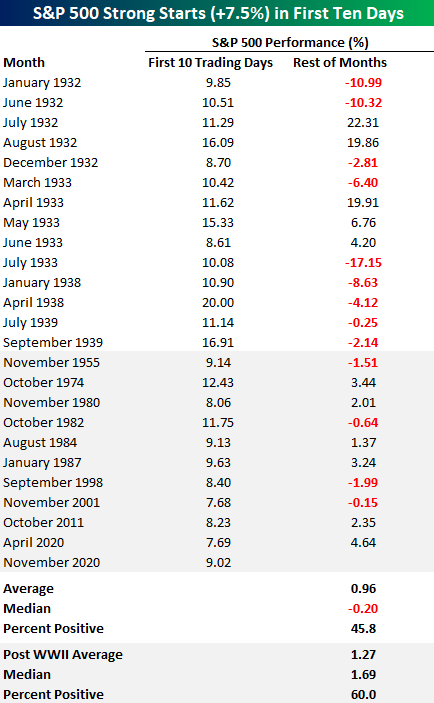
With nearly ten trading days under its belt for November, the S&P 500 is putting together quite a month. Through early morning Friday, the S&P 500 was up just over 9% which ranks as the best first ten trading days for a month since January 1987. In the entire history of the S&P, there have only been 17 other months where the S&P 500 was up over 9% in the first ten trading days of the month, and in the post-WWII period, there have only been five.

So, when a month starts off strong, does it usually finish that way? Or is there some sort of reversion to the mean? Unfortunately, prior experience isn’t particularly consistent in one direction of the other. The table below shows each month since 1928 where the S&P 500 was up at least 7.5% in the first ten trading days of a month. Overall, the S&P 500’s average rest of month performance has been a gain of 0.96%. That sounds good, but on a median basis, the rest of the month typically sees a decline of 0.2% with positive returns less than half of the time.
In looking at the chart above and the table below, you’ll notice that most of the strong starts for the S&P came during the Depression in the pre-WWII period. In 1932 and 1933, for example, there were five occurrences each year! Looking at the post-WWII period where the frequency of occurrences wasn’t nearly as common, strong starts to a month typically saw a more positive but still not a very consistent trend. In the ten prior months since the end of WWII, the S&P 500’s average rest of month performance was a gain of 1.27% (median: 1.69%) with gains 60% of the time. Click here for a free trial and full access to Bespoke’s research and interactive tools.