
US Economic Data Turning Negative
With a federal holiday yesterday and nothing on the docket today, our Economic Monitors are unusually light the first half of this week. While there is nothing that would have an impact so far this week, the Citi Economic Surprise Index for the US is reaching the lowest levels since May of last year, shortly after the index hit record lows as economic data saw drastic impacts from the onset of COVID. These surprise indices represent how economic data is coming in relative to expectations. Lower/negative readings indicate economic data is coming in worse than expected and vice versa for higher readings.
Last year saw record lows in the index which were followed by record highs that far surpassed any level with historical precedence. Since the peak in July 2020, the Surprise index has not only moderated but turned negative. The US is now at the lowest level in over a year and in the eighth percentile of its historical range. While it has yet to find a bottom, this negative of a reading won’t last forever. The economists providing estimates will eventually catch up to the downside, and they usually overshoot, which will allow for the surprise index to bottom and start heading higher again. Click here to view Bespoke’s premium membership options.

Daily Sector Snapshot — 9/7/21
Chart of the Day – Japan Jumping to Record Overbought Levels
Bespoke Stock Scores — 9/7/21
Bespoke’s Morning Lineup – 9/7/21 – Back to Work
See what’s driving market performance around the world in today’s Morning Lineup. Bespoke’s Morning Lineup is the best way to start your trading day. Read it now by starting a two-week trial to Bespoke Premium. CLICK HERE to learn more and start your trial.
“Only those who will risk going too far can possibly find out how far one can go.” – T.S. Eliot
Welcome back. While the weather outside may suggest otherwise, the unofficial end to summer has come and gone, football season is ready to kick off, pumpkin-flavored coffee, beer, and bread is everywhere you look, and before you know it, the leaves will start turning. Equity markets are heading into the fall season with more green than red, but treasuries are lower and yields are higher heading into what will be a quiet day in terms of data to kick off the holiday-shortened week.
Read today’s Morning Lineup for a recap of all the major market news and events from around the world, including the latest US and international COVID trends.
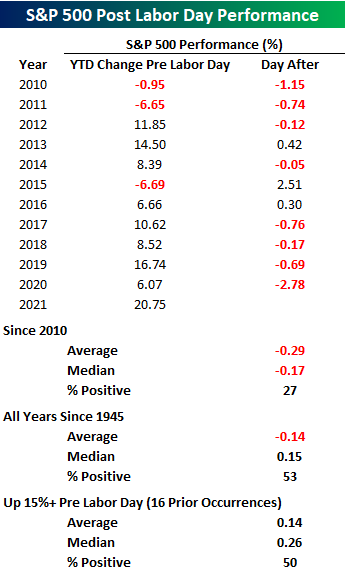
With the unofficial end to summer behind us, we wanted to provide a quick summary of how the S&P 500 has historically performed the day after Labor Day (we covered other post-Labor Day performances in today’s Morning Lineup). In the post-financial crisis period since 2010, there has clearly been a Labor Day hangover with the S&P 500 trading lower nearly three-quarters of the time for a median decline of 0.17%, including declines on this day in each of the last four years. From a longer-term vantage point since 1945, the day after Labor Day hasn’t been as negative with a median gain of 0.15% and positive returns 53% of the time. Lastly, with the S&P 500 up just over 20% already this year, we also looked at years where the S&P 500 was up at least 15% YTD heading into Labor Day weekend, and in these scenarios, returns were more positive. In the 16 prior years, the day after Labor Day had a median gain of 0.26% with positive returns half of the time.
Start a two-week trial to Bespoke Premium and read today’s full Morning Lineup.
Bespoke Brunch Reads: 9/3/21
Welcome to Bespoke Brunch Reads — a linkfest of the favorite things we read over the past week. The links are mostly market related, but there are some other interesting subjects covered as well. We hope you enjoy the food for thought as a supplement to the research we provide you during the week.
While you’re here, join Bespoke Premium with a 30-day free trial!
Technology
What the Metaverse is and why it matters to you by Andy Serwer with Max Zahn (Yahoo! Finance)
The hottest trend in Silicon Valley is an immersive series of platforms, experiences, and spaces that deepen the human experience beyond the physical world into untold layers of code. [Link]
The Silent Partner Cleaning Up Facebook for $500 Million a Year by Adam Satariano and Mike Isaac (NYT)
Accenture is widely known as a stodgy and quotidian consulting firm. It also sits at the center of a massive effort to make Facebook a tolerable place to spend time, at an equally massive human cost. [Link; paywall]
Leveraging Brands against Disinformation by Steph Hill (SSRC)
Social media and intensification of brands into value statements have created a two-way dialogue and placed non-political actors right into the middle of major efforts to shift society. [Link]
Afghanistan
Taliban Move to Ban Opium Production in Afghanistan by Sune Engel Rasmussen, Zamir Saar and James Marson (WSJ)
The lynchpin of the Afghan economy is being removed by its new rulers, which given the massive balance of payments crisis the company is going through may prove totally unsustainable. [Link; paywall]
Studies
J&J’s HIV Vaccine fails phase 2b, extending long wait for an effective jab by Nick Paul Taylor (Fierce Biotech)
Johnson & Johnson announced that its Stage 2 trial of an HIV vaccine did not demonstrate sufficient efficacy to continue trials in a setback for vaccines after a banner year. [Link]
The Impact of Mask Distribution and Promotion on Mask Uptake and COVID-19 in Bangladesh by Jason Abaluck et al (Innovations for Poverty Action)
A massive randomized control trial gives concrete and scientific evidence what had been strongly suggested by lower-level analysis: that masks, especially surgical masks, make a large difference in slowing transmission of COVID. [Link]
Regulation
McDonald’s McFlurry Machine Is Broken (Again). Now the FTC Is On It. By Heather Haddon (WSJ)
The Federal Trade Commission has reached out to McDonald’s franchisees in an inquiry related to the constant state of disrepair franchisees and the chain keep their machines in resulting in frequent breakdowns. [Link; paywall]
China Sets New Rules for Youth: No More Videogames During the School Week by Keith Zhai (WSJ)
After cracking down on for-profit education companies earlier this summer, Chinese authorities are now coming after students, setting rules for videogame time. [Link; paywall]
James Simons, Robert Mercer, Others at Renaissance to Pay Up to $7 Billion to Settle Tax Probe by Gregory Zuckerman and Richard Rubin (WSJ)
An inquiry into the treatment of investments as long-term capital gains as opposed to short-term capital gains (and therefore a massively reduced tax burden) has led to a massive $7bn settlement between investors in one of the . [Link; paywall]
Labor Markets
Need to Call and Airline? Your Hold Time Will Be Approximately One Zillion Hours by Allison Pohle and Krystal Hur (WSJ)
With massive demand and complex local regulations, airlines are struggling to accommodate high call volumes that are being further hindered by under-staffed call centers. [Link; paywall]
Amazon’s Answer to Delivery Driver Shortage: Recruit Pot Smokers by Spencer Soper (Yahoo! Finance)
With a complete lack of available labor for delivery trucks, Amazon is experimenting by featuring a lack of marijuana testing in its recruiting materials, part of an effort to reach into every crack of the workforce for potential candidates. [Link]
Ben Dugan Works for CVS. His Job Is Battling a $45 Billion Crime Spree by Rebecca Ballhaus and Shalini Ramachandran (WSJ)
Physical retail is facing a different kind of online competition: thieves are ripping off stores in order to sell goods online via platforms like Amazon or EBay. [Link; paywall]
Weird News
This company sold a copy of ‘Super Mario Bros.’ for $2 million. NFTs and a Triceratops skull could be next by Tom Huddleston Jr. (CNBC)
Video games are collectors items just like baseball cards: their rarity is the source of much of their value, and the values can get extraordinarily high when prestige buyers step up to the plate. [Link]
Coronal Ejections
A bad solar storm could cause an “Internet apocalypse” by Lily Hay Newman (ARS Technica)
A coronal mass ejection or solar storm could wreck havoc on electrical and electronic infrastructure that serves as the backbone of local and global commerce and industry, as well as badly damaging electrical grids. [Link]
Duration and extent of the great auroral storm of 1859 by James L. Green and Scott Boardsen (NCBI)
Just before the Civil War, a massive ejection of material from the sun drove an electromagnetic storm of epic proportions which knocked out massive swathes of telegraph infrastructure; a similar event today would have much further-reaching implications. [Link]
Indices
GameStop Stock’s Possible Return to S&P 500 in Hands of Anonymous Committee by Akane Otani (WSJ)
While the S&P 500 is widely used as a “passive” index, inclusion is largely dictated by human judgement rather than strict quantitative criteria that other indices tend to use. [Link; paywall]
Read Bespoke’s most actionable market research by joining Bespoke Premium today! Get started here.
Have a great weekend!
The Bespoke Report – September Starting Soggy
This week’s Bespoke Report newsletter is now available for members.
There were a lot of convulsive headlines this week, ranging from Hurricane Ida to the Supreme Court to China to the Delta variant, but markets broadly yawned at events thrown their way. Even a massive miss from payrolls on Friday morning couldn’t derail the slow and steady grind that the US equity markets have trended on for the past several months. That steady grind is also impressive given the huge wave of hawkish Fed speakers in August and the very high likelihood of a taper starting before the end of the year.

In this week’s Bespoke Report, we cover a lot of different topics. Among them:
- Q3 performance drivers.
- The state of COVID in the United States.
- Very low real rates compared to prior economic recoveries.
- The hawkish August in Fedspeak and outlook for tapering.
- Easy financial conditions.
- The US auto industry.
- Policy and political developments in China.
- EM’s breakout.
- German elections.
- Earnings Triple Plays.
- And so much more!
To read this week’s full Bespoke Report newsletter and access everything else Bespoke’s research platform has to offer, start a two-week trial to one of our three membership levels.

Daily Sector Snapshot — 9/3/21
Bespoke’s Weekly Equity/Crypto Sentiment Survey
This week we launched a new weekly crypto sentiment survey to track sentiment towards the space. There are already plenty of stock market sentiment surveys, but sentiment survey data in the crypto space — bitcoin, ethereum, NFTs, etc. — is few and far between.

The new survey will be sent weekly to our Think BIG mailing list that has thousands of potential survey participants that have an interest in financial markets simply based on the fact that they joined our mailing list by visiting our website. We will collect responses from Tuesday through Thursday each week and publish the results on Fridays.
In the survey, we ask whether the participant is “bullish or bearish” on seven things over the next 12 months — 1) the entire crypto space, 2) bitcoin, 3) ethereum, 4) NFTs, 5) the S&P 500, 6), US Tech stocks, and 7) Chinese equities. While we are mainly focused on collecting sentiment towards the crypto space, we thought including sentiment on equities was beneficial so that we could easily compare the two over time.
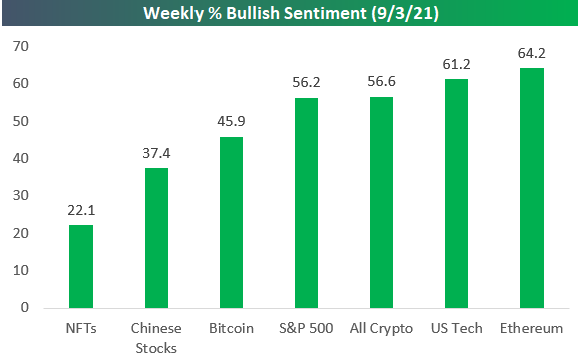
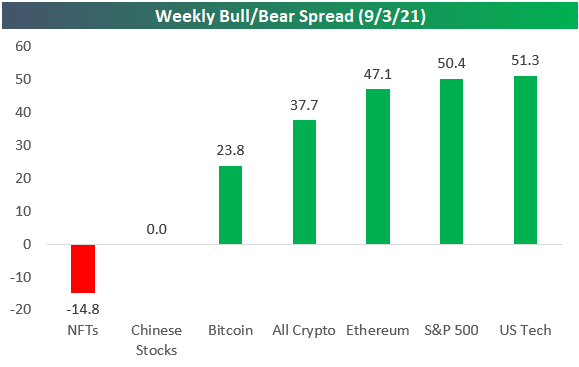
Below are the results from the first run of our new weekly survey. Participants are actually most bullish on US Tech stocks out of this group with a bull/bear spread of +51.3%. The S&P 500 also leaned heavily bullish with only 5.8% of respondents saying they were bearish over the next 12 months.
Sentiment towards the entire crypto sector leans bullish with bulls coming in at 56.6% and bears coming in at 18.9%. The bull/bear spread for bitcoin was +23.8 ppts, while the bull/bear spread for ethereum was considerably higher at +47.1 ppts. Notably, participants are much less bullish on the NFT space with just 22.1% bulls and 36.9% bears. Chinese stocks also saw bulls and bears come in exactly equal at 37.4% each. If you’d like to help us measure crypto sentiment going forward, you can join our Think BIG mailing list and take the survey starting next week. Click here to view Bespoke’s premium membership options.


Gas Prices High Following The Seasonal Pattern Into Labor Day
If you’re planning to drive anywhere this weekend, you may need a wheelbarrow to carry the cash you’re going to need to fill up. According to AAA, based on the national average, a gallon of gas will set you back $3.184. Around the country, though, prices vary widely. In California, where prices are the highest (even higher than Hawaii), the average price of a gallon of gas is $4.40 ($4.71) if you fill up with premium). Mississippi wins the title of lowest average price at just $2.79 per gallon and is one of just 15 states where you can still get a gallon of gas for less than $3. While prices may be high heading into Labor Day weekend, the fact that it still costs less than 13 cents to drive a mile isn’t all that bad (based on the average fuel efficiency of 24.9 miles per gallon), and it’s much cheaper than most other areas of the world.
That being said, prices at the pump are still high whether you look at things from an absolute or relative basis. For the current day of the year, the national average of $3.18 is higher than at this point in any other year since 2014, and forty cents above the median level for this time of year. On a YTD basis, going back to 2005, this year’s increase is the third largest of any other years besides 2009 and 2005. At 41.3%, prices are up by more than double their average YTD increase through 9/3.

On a y/y basis, average gas prices are also up over 40%. For just about any other time that rate of increase would be extreme, but given the y/y increase just hit a record high of 63.98% in May it doesn’t seem that bad.

Now that we’ve established that gas prices are high, it is worth pointing out that despite the high levels, prices have loosely followed the seasonal trend. The chart below compares gas prices this year to a composite of the average YTD increase for every day of the year going back to 2005. Through the end of May, prices were already up 35% YTD, and in the three months since then, prices have still increased, but at a much slower pace. Historically, prices tend to rise through Memorial Day and then level off through Labor Day before steadily declining to close out the year. Like the annual composite, prices dipped into the end of August this year and have spiked into Labor Day weekend. With respect to this year, increases have been exaggerated due to Hurricane Ida, but if history is any guide, drivers should start to see some relief in the final four months of the year. Click here to view Bespoke’s premium membership options.
